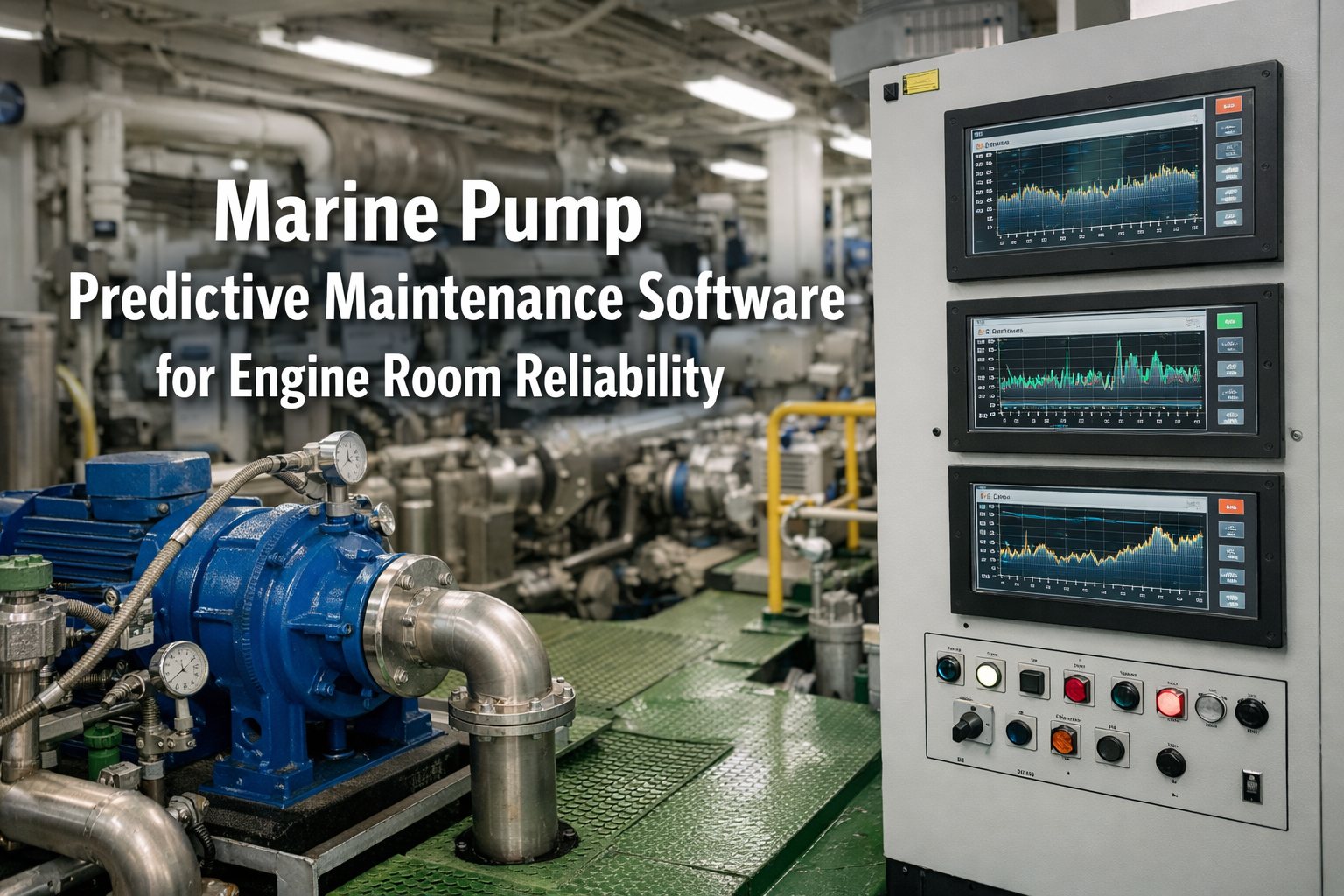
The chief engineer's 0200 alarm jolts him awake—high discharge pressure on the starboard cooling water pump. By the time he reaches the engine room, bearing temperature has spiked 40°C above normal. The pump seizes completely at 0247. With no spare seal assembly onboard and the vessel 180 nautical miles from the nearest port, the unplanned deviation costs $47,000 in lost charter time, emergency parts, and port fees. Root cause analysis reveals gradual bearing wear over 6 weeks—entirely detectable through vibration monitoring but invisible to weekly manual inspections. Marine engineers ready to prevent pump failures with predictive monitoring can implement Marine Inspection's software that tracks pressure anomalies, vibration signatures, and flow degradation patterns in real-time, preventing 85-92% of catastrophic pump failures through early intervention alerts.
Pump Failures per Vessel/Year
8-14
Average across commercial fleets using reactive maintenance
Average Failure Cost
$38K
Repair + downtime + deviation expenses per incident
Predictive Detection Rate
89%
Failures prevented through Marine Inspection monitoring
Critical Pump Systems Requiring Predictive Monitoring
Engine room pump systems operate under extreme conditions—high temperatures, constant vibration, corrosive seawater exposure, and 24/7 duty cycles create failure modes that manual inspection routines cannot detect early enough. Marine Inspection's monitoring software tracks the pump categories that drive highest failure rates and operational risk across your fleet.
Cooling Water Pumps
Failure Risk: CRITICAL
Failure Mode: Seal leakage, bearing seizure, impeller erosion
Marine Inspection Tracking: Vibration analysis, discharge pressure trending, flow rate monitoring
Warning Window: 8-21 days before catastrophic failure
Consequence: Main engine shutdown, emergency deviation, $40K-$85K cost
Fuel Oil Transfer Pumps
Failure Risk: HIGH
Failure Mode: Contamination damage, cavitation, suction strainer blockage
Marine Inspection Tracking: Discharge pressure deviation, suction pressure monitoring, flow consistency analysis
Warning Window: 5-14 days before complete failure
Consequence: Fuel supply interruption, power loss risk, $28K-$52K cost
Lube Oil Pumps
Failure Risk: CRITICAL
Failure Mode: Bearing wear, seal degradation, pressure regulator failure
Marine Inspection Tracking: Pressure trend analysis, temperature monitoring, vibration signature tracking
Warning Window: 12-28 days before critical pressure loss
Consequence: Main engine damage risk, emergency shutdown, $65K-$140K cost
Ballast & Bilge Pumps
Failure Risk: MODERATE
Failure Mode: Impeller damage, check valve failure, discharge line obstruction
Marine Inspection Tracking: Flow rate comparison, runtime vs. volume analysis, pressure differential tracking
Warning Window: 7-18 days before operational failure
Consequence: Stability issues, regulatory non-compliance, $18K-$35K cost
The Three-Signal Approach to Pump Condition Monitoring
Effective predictive maintenance requires simultaneous monitoring of three independent failure indicators: vibration signatures reveal bearing and alignment issues, pressure patterns detect seal degradation and cavitation, and flow rate trends identify impeller wear and blockages. Single-parameter monitoring misses 40-55% of developing failures because different failure modes produce different warning signals. Operators implementing multi-parameter monitoring systems detect failures an average 16 days earlier than vibration-only approaches, providing sufficient lead time for planned maintenance during scheduled port calls rather than emergency repairs at sea.
Detects: Bearing wear, misalignment, imbalance, looseness
• Overall RMS velocity (mm/s)
• Bearing frequency analysis
• Temperature correlation
Marine Inspection Alert: >30% increase from baseline over 7 days
Warning Window: 14-21 days
Detects: Seal leakage, cavitation, discharge restrictions, suction issues
• Discharge pressure trend
• Suction pressure stability
• Differential pressure across pump
Marine Inspection Alert: >15% deviation from normal operating range
Warning Window: 8-16 days
Detects: Impeller erosion, internal wear, blockages, efficiency loss
• Volume delivered per runtime hour
• Flow consistency patterns
• Power consumption vs. output
Marine Inspection Alert: >20% reduction in flow efficiency
Warning Window: 10-18 days
Deploy Comprehensive Pump Monitoring Software Across Your Fleet
Marine Inspection's integrated maintenance software monitors vibration, pressure, and flow parameters simultaneously, correlating data patterns to identify developing failures 14-21 days before catastrophic events. Ship operators reduce pump-related unplanned downtime 78-85% while cutting maintenance costs 35-48% through condition-based interventions.
Predictive Maintenance Workflow: From Alert to Intervention
Converting sensor data into reliable maintenance decisions requires systematic workflow from anomaly detection through root cause analysis to planned intervention. Marine Inspection's software combines automated alerting with engineering judgment—the platform identifies abnormal patterns and generates inspection tasks, while experienced marine engineers determine whether trends indicate true failures requiring action. Vessels that implement automated pump monitoring workflows prevent both missed failures and unnecessary maintenance while building organizational confidence in predictive systems through documented inspection histories.
1
Continuous Data Collection
Sensors capture vibration, pressure, flow, and temperature readings every 15-60 seconds during pump operation. Marine Inspection's software processes this data and filters normal operating variations from true anomalies, reducing false alerts by 85-92%.
↓
2
Anomaly Detection & Alert Generation
Marine Inspection's algorithms compare current readings against baseline patterns. The software generates preliminary alerts when parameters deviate >20% from expected range, automatically creating inspection tasks in the maintenance system.
↓
3
Multi-Parameter Correlation Analysis
The software analyzes whether vibration, pressure, and flow anomalies align with known failure signatures. Bearing wear produces specific vibration frequencies + gradual temperature increase. Seal leakage shows pressure drop + flow reduction.
↓
4
Chief Engineer Review
Alert notification includes trend graphs, failure probability assessment, and recommended inspection actions. Engineers validate findings through physical inspection and operational context before deciding intervention timing.
↓
5
Planned Maintenance Execution
Confirmed developing failures trigger work orders with parts requisition, shore support coordination, and scheduling during next port call. Average intervention occurs 12-18 days before predicted failure, eliminating emergency repairs.
ROI Analysis: Predictive vs. Reactive Pump Maintenance
The economic case for predictive pump maintenance becomes clear when comparing total costs across different maintenance strategies. Reactive approaches appear cheaper initially but generate 3-5x higher total costs through frequent failures, emergency repairs, and operational disruptions. Vessels implementing condition-based predictive strategies through Marine Inspection's software achieve optimal balance: monitoring and software investments of $35K-$65K per vessel deliver $180K-$340K annual savings through prevented failures and optimized maintenance intervals.
Analysis based on 6-pump critical systems across 350 operating days. Marine Inspection predictive monitoring achieves 12-18 month ROI through failure prevention and optimized maintenance scheduling.
Expert Review: Real-World Marine Inspection Software Implementation
"We implemented Marine Inspection's predictive monitoring software on our flagship vessel's six critical pump systems in March 2023. Within the first 90 days, the platform detected developing bearing failure in our main engine cooling water pump—vibration increased 38% over 12 days while discharge pressure dropped 6%. The software automatically generated an inspection alert and maintenance work order. We replaced the bearing assembly during our next scheduled port call in Rotterdam. That single prevented failure saved us $67,000—paying for the entire software implementation. Over 18 months, we've prevented 11 pump failures across the vessel, reduced unplanned engine room downtime by 82%, and cut our pump maintenance costs by 41%. The multi-parameter monitoring in the inspection software is critical—we had three alerts that were vibration-only false alarms, but pressure and flow data confirmed the equipment was actually healthy. Now we're rolling out Marine Inspection software fleet-wide because the ROI is undeniable."
Transform Your Pump Maintenance with Marine Inspection Software
Marine Inspection's integrated maintenance platform delivers real-time pump health insights across your fleet, preventing catastrophic failures while optimizing maintenance intervals. Ship operators achieve 78-85% reduction in pump-related downtime and 35-48% lower total maintenance costs within 18 months of implementing the software.
Frequently Asked Questions
What's the typical ROI timeline for Marine Inspection's predictive maintenance software?
Most vessel operators achieve 12-18 month ROI on Marine Inspection software implementation. Initial system costs range $35K-$65K per vessel depending on pump count and sensor complexity. First-year savings average $85K-$160K through prevented failures (typically 4-7 major pump failures avoided annually) and optimized maintenance scheduling. ROI accelerates in year two as baseline data improves detection accuracy. Vessels with critical cargo operations (LNG carriers, chemical tankers) often achieve 8-12 month ROI due to higher downtime costs.
Start your free trial to evaluate the platform's ROI for your specific fleet operations.
How does Marine Inspection software prevent false alerts from overwhelming the chief engineer?
Marine Inspection's platform uses multi-parameter correlation to reduce false alerts by 85-92% compared to single-sensor approaches. The software only generates alerts when multiple independent indicators align with known failure signatures—for example, bearing wear must show specific vibration frequencies AND temperature increase AND gradual pressure decline. The system also learns vessel-specific baseline patterns over 30-90 days, accounting for normal operational variations. Engineers set alert thresholds in the software based on their risk tolerance. Average vessels receive 2-4 actionable pump alerts per month requiring investigation, with 75-85% confirmed as genuine developing failures.
Can Marine Inspection software work on older vessels without modern automation systems?
Yes—Marine Inspection's platform retrofits successfully to vessels of any age because sensors install directly on pump equipment rather than requiring integration with existing automation. Wireless vibration sensors mount magnetically to pump casings. Pressure sensors splice into existing gauge ports. Flow monitoring uses non-invasive ultrasonic clamps on discharge piping. Marine Inspection's software collects sensor data and manages all inspection records centrally, requiring no vessel automation system integration. Retrofit installations typically complete in 2-3 days per vessel during scheduled drydock or port call. Older vessels often see higher ROI than modern ships because their reactive maintenance costs are higher and failure rates more frequent due to aging equipment.
What happens to Marine Inspection software data when vessels operate in remote areas without connectivity?
Marine Inspection's platform continues monitoring and alerting even without shore connectivity through offline functionality. Critical alerts trigger immediate local notifications to the chief engineer's phone/tablet via vessel WiFi. The software stores up to 90 days of detailed sensor data and inspection records locally, automatically syncing to cloud analytics when connectivity restores. This hybrid architecture ensures real-time protection during ocean passages while enabling shore-based fleet analysis when vessels reach port. Some operators install redundant satellite connections specifically for critical machinery alerts, but most find the local Marine Inspection software processing sufficient for day-to-day operations.
How does Marine Inspection software integrate with existing planned maintenance systems and classification society requirements?
Marine Inspection's platform complements rather than replaces classification society schedules and manufacturer maintenance requirements. The software generates condition-based work orders that supplement mandatory surveys and overhauls—for example, detecting bearing wear requiring early replacement while still meeting classification pump survey intervals. Inspection records and data logs provide objective evidence for condition-based maintenance deferrals where regulations allow. Many classification societies now accept vibration trending data from Marine Inspection software as justification for extending certain maintenance intervals under approved Condition Monitoring Systems (CMS). The platform exports maintenance records in formats compatible with major maritime CMMS systems and generates audit-ready documentation for PSC inspections and ISM compliance verification.