When a ship runs aground, the easiest explanation is almost always the wrong one. "The officer of the watch made an error" is true, satisfying, and useless — because it stops exactly where the learning begins. The officer made an error, but why was he fatigued, why was the passage plan never briefed, why did the alarm setting invite complacency, why did the company's manning make that watch pattern inevitable? Modern marine accident investigation exists to keep asking that question until it reaches something a company can actually fix. This is the shift the IMO codified in 2008 with the Casualty Investigation Code: investigations are for prevention, not blame, and they must examine the whole interplay of technical, human, organisational, and environmental factors rather than settling for the nearest human to the wheel. For a designated person ashore or a safety officer, accident investigation is not an occasional formality triggered by disaster. It is a continuous discipline that runs from near-miss reporting through structured root cause analysis to corrective action and, crucially, to lessons shared across the fleet so one ship's accident becomes every ship's prevention. This guide covers the IMO legal framework and casualty categories, the investigation process step by step, the root cause analysis methods that matter, human factors, building corrective actions that hold, and turning findings into fleet-wide learning. Because investigation lives or dies on the records — the near-miss log, the CAPA tracker, the audit trail — and those are exactly what a purpose-built system manages, book a Marine Inspection demo to see incident and corrective-action tracking in one place.
Crew & training · accident investigation
Marine Accident Investigation: Root Cause Analysis & Lessons Learned
A guide for DPAs and safety officers — the IMO Casualty Investigation Code, the investigation process, root cause analysis methods, human factors, building corrective actions that hold, and turning findings into fleet-wide prevention.
What happened
The event and its immediate cause
How it happened
The underlying conditions that allowed it
Why it happened
The root causes worth fixing
The Legal Framework: Safety Over Blame
The governing instrument is the IMO Casualty Investigation Code, adopted as Resolution MSC.255(84) in 2008 and made mandatory through amendments to SOLAS Chapter XI-1 that took effect on 1 January 2010. Its purpose reframed how the industry investigates. See safety-management records in a demo.
Legal basis
SOLAS regulation XI-1/6 makes Parts I and II of the Code mandatory; Part III is guidance. It expanded the older, discretionary duty to investigate into a firm obligation.
Mandatory trigger
A marine safety investigation must be conducted into every very serious marine casualty — one involving the total loss of the ship, a death, or severe damage to the environment.
Safety, not liability
The objective is to prevent future casualties, not to apportion blame or determine civil or criminal responsibility. Investigations are meant to be objective, fact-based, and independent of liability considerations.
Systemic lens
The Code's methodology examines the interplay of technical, human, organisational, and environmental factors, rather than narrowly identifying rule violations or individual error — addressing root causes, not symptoms.
Report and share
The investigating State submits the final report to the IMO for every very serious casualty, and for lesser casualties where the findings may prevent future incidents. Reports feed the global GISIS database.
Fair treatment
The parallel Guidelines on Fair Treatment of Seafarers in the Event of a Maritime Accident protect seafarers' rights during an investigation, reinforcing the no-blame purpose.
This flag-State safety investigation is separate from a company's own internal investigation under the ISM Code, but they share the same philosophy. The ISM Code requires companies to investigate accidents, non-conformities, and hazardous occurrences, and to implement corrective action — which is where the DPA and safety officer do most of their work, on casualties well below the "very serious" threshold.
The Three Casualty Categories
Not every event is investigated the same way. The Code and related reporting guidance distinguish severity, and a company's response should scale accordingly.
Very serious
Very serious marine casualty
Total loss of the ship, loss of life, or severe pollution. A full flag-State safety investigation is mandatory, and the report goes to the IMO.
Serious
Serious marine casualty
A casualty not meeting the "very serious" bar but involving fire, grounding, structural damage, pollution, or a breakdown requiring towage — investigated where it may yield preventive lessons.
Incident
Marine incident & near-miss
Events that endangered, or could have endangered, the ship or persons without meeting the casualty thresholds — including near-misses, the richest and most numerous source of learning.
The near-miss deserves special weight, and it is where the smartest safety programmes concentrate. Under the well-known safety triangle, a large base of near-misses and unsafe acts underlies every serious casualty; each near-miss is a free lesson, an accident that announced itself without causing harm. IMO guidance on near-miss reporting exists precisely to capture this layer, and a culture that reports near-misses honestly is worth more than any single investigation, because it lets a company act before the casualty rather than after it.
The free lessons are the ones you record
Capture Near-Misses Before They Become Casualties
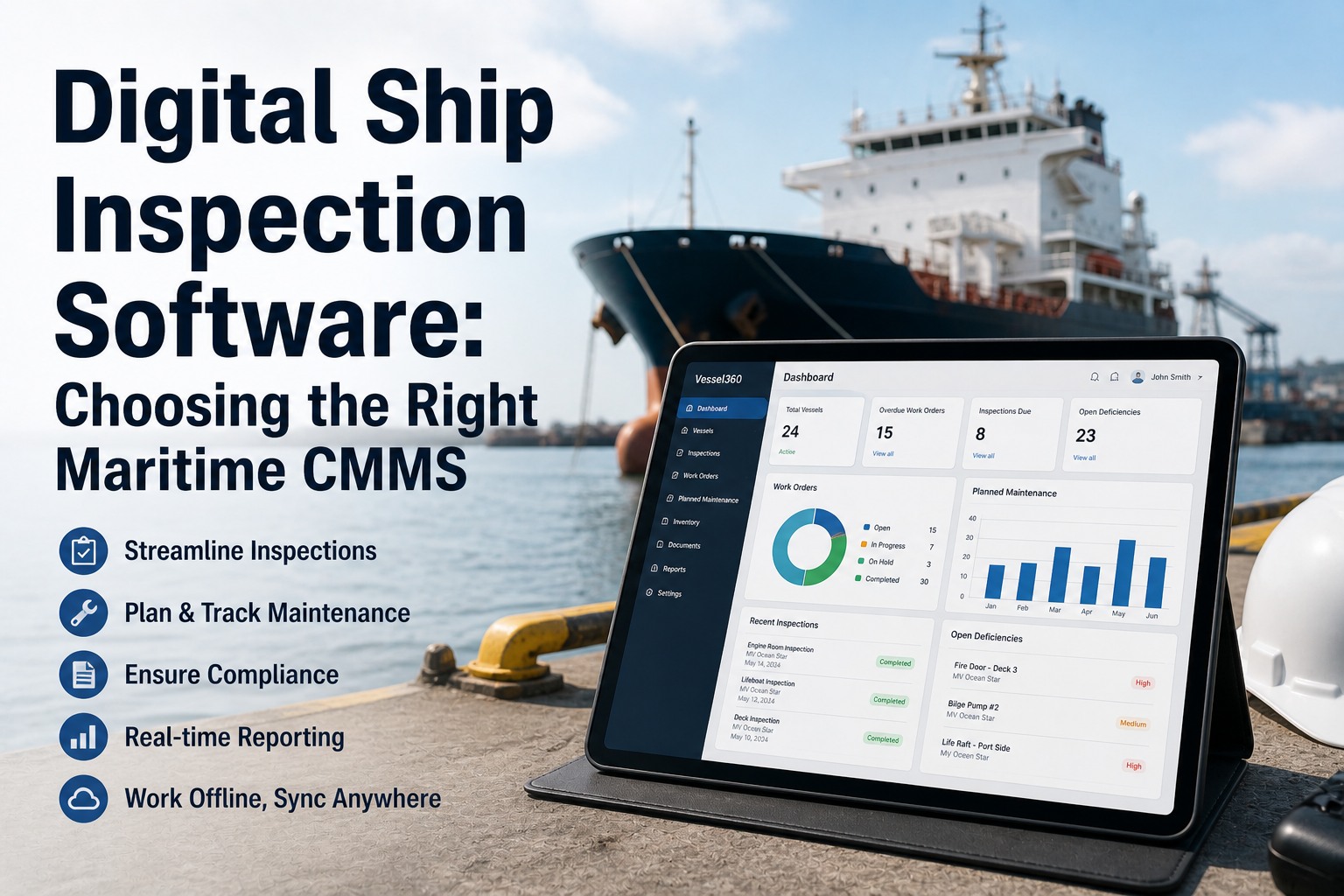
Every near-miss is an accident that gave you a warning instead of a bill. Marine Inspection captures near-miss and incident reports from the vessel, routes them for investigation, tracks the resulting corrective actions to closure, and surfaces the patterns across your fleet — so the warning gets acted on. Book a 30-minute demo to see incident and near-miss reporting in action, or start a free trial today.
The Investigation Process, Step by Step
A sound investigation follows a disciplined sequence. Skipping or rushing a stage is how investigations arrive at "human error" and stop. See investigation workflow in a demo.
1
Respond and preserve
Make the situation safe first, then preserve evidence before it degrades — VDR data, alarm logs, equipment states, positions, and the recollections of those involved while memory is fresh.
2
Gather the facts
Collect physical evidence, records, and documentation, and interview witnesses in a non-blaming way that encourages candour. What people saw and did matters more than who to fault.
3
Build the timeline
Reconstruct the sequence of events as an objective chronology. The timeline exposes the decision points where the outcome could have changed and anchors the analysis in fact.
4
Analyse the causes
Apply root cause analysis to move from the immediate cause down through underlying conditions to root causes. This is the analytical heart of the investigation.
5
Develop corrective actions
Formulate actions that address the root causes, assign owners and deadlines, and design them to be verifiable rather than aspirational.
6
Report, close out, and share
Document findings and actions, verify each action is effective before closing it, and disseminate the lessons across the fleet so other vessels benefit.
The single most common failure in this sequence is treating step four as if it were step two — jumping from facts straight to a cause without the disciplined analysis in between. The result is a report that names a symptom, a corrective action that treats the symptom, and a near-identical accident on another ship six months later.
Root Cause Analysis: the Methods That Matter
Root cause analysis is the toolkit that separates real investigation from blame. The principle beneath every method is the same: distinguish the immediate cause from the underlying conditions and the root causes, because only the roots are worth fixing.
Immediate cause
The visible event — the oil on the deck, the missed alteration of course, the valve left open. Real, but rarely the thing to fix.
Underlying causes
The conditions that allowed it — the leaking equipment, the missed inspection, the unbriefed plan, the fatigue, the ambiguous procedure.
Root causes
The organisational and management failures beneath — the ineffective maintenance planning, the manning decision, the training gap, the safety-culture weakness.
Incidents rarely have a single root cause; most result from several interconnected failures across procedures, training, supervision, maintenance, and communication. Three methods do most of the work in maritime practice.
The 5 Whys
Ask "why?" repeatedly until you reach an organisational cause. A slip becomes oil on the floor, becomes a leaking hose, becomes deteriorated equipment, becomes an overdue inspection, becomes ineffective maintenance planning. Best for incidents with a linear causal chain.
Fishbone (Ishikawa)
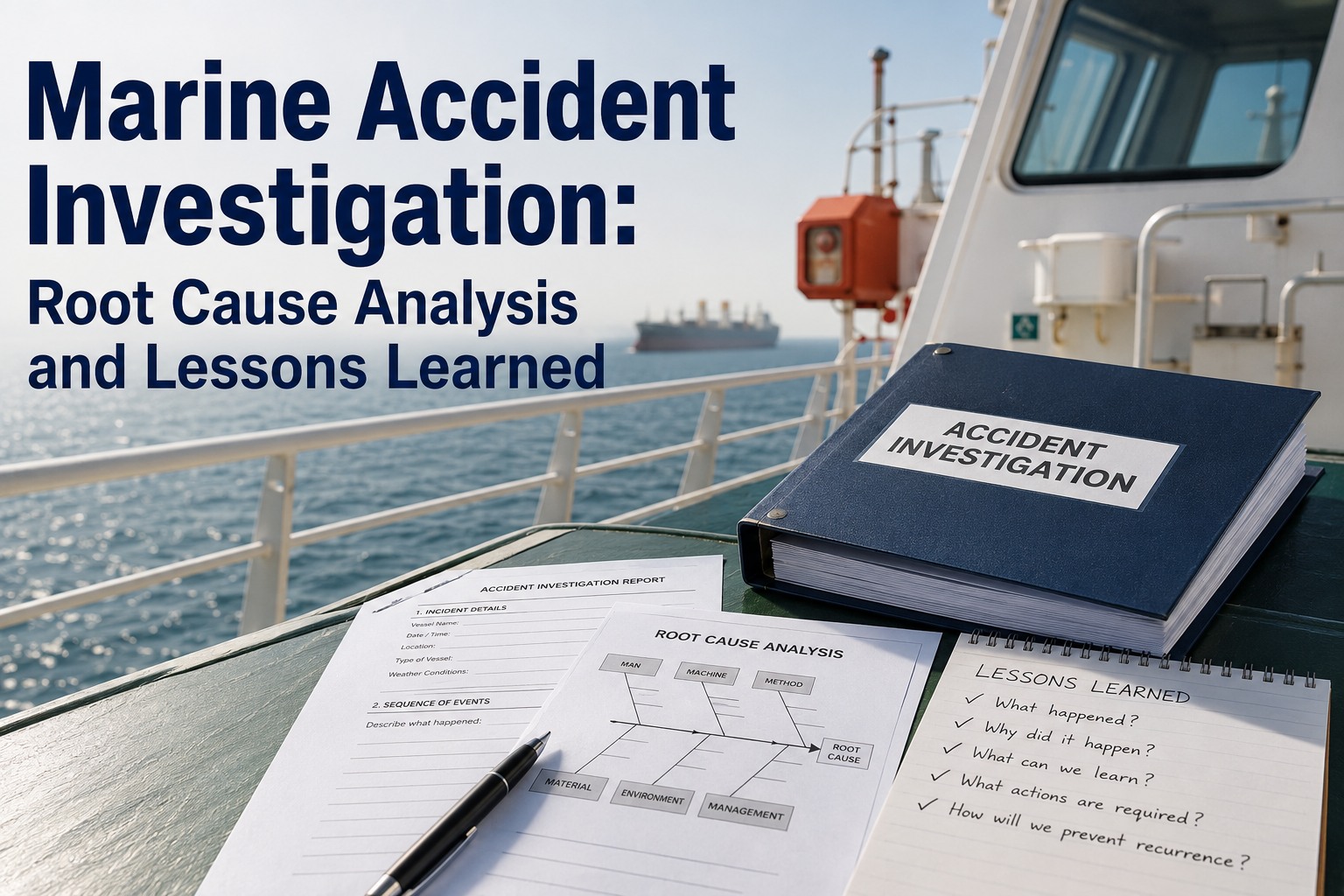
A cause-and-effect diagram mapping contributing factors across categories — often People, Machine, Method, Material, Measurement, and Environment. Best when an incident has multiple contributing factors across different domains and no single chain tells the story.
The Swiss Cheese model
Views defences as layers of cheese, each with holes; an accident occurs when the holes momentarily align. It explains why several barriers must fail together, and why fixing one hole still leaves the system safer.
The methods are complementary, not competing. A common maritime practice is to run the 5 Whys first, and when it produces several plausible "maybes" or the crew disagrees, escalate to a Fishbone diagram to map the full landscape of factors — then use the Swiss Cheese logic to check which defensive barriers failed and why. The goal in every case is to reach causes a company controls, not to stop at the seafarer nearest the event.
The Human Element
Studies consistently attribute the large majority of marine casualties to human factors — but "human error" as a finding is the beginning of analysis, not the end. The disciplined investigator asks what shaped the human's actions. See human-factor tracking in a demo.
The SHELL model
A framework placing the human (Liveware) at the centre, examining the fit between the person and the Software (procedures), Hardware (equipment), Environment, and other Liveware (people). A mismatch at any interface — a confusing alarm, an unusable procedure, a communication gap — produces the error the human is later blamed for.
Active failures vs latent conditions
The unsafe act at the sharp end is the active failure; the latent conditions — a poor design, a manning shortfall, a normalised shortcut — were built into the system long before, waiting. Fixing latent conditions prevents whole classes of future error.
Performance-shaping factors
Fatigue, stress, time pressure, distraction, inadequate training, and poor communication are the recurring conditions behind human error at sea. Each is a factor a company can measure and manage, not a character flaw to reprimand.
The practical test of a good human-factors analysis is whether its corrective actions would prevent the next competent, well-intentioned seafarer from making the same mistake. If the only proposed fix is "be more careful" or "re-train the individual," the analysis has failed, because it leaves the trap in place for the next person to fall into.
Corrective Actions That Actually Hold
An investigation is only as valuable as the change it produces. The gap between a good report and a safer fleet is the corrective and preventive action process — and this is where most safety systems quietly leak. See CAPA tracking in a demo.
Address the root, not the symptom
A corrective action aimed at the immediate cause fixes nothing durable. The action must target the organisational or management failure the analysis uncovered.
Prefer stronger controls
Engineering solutions and design changes outlast procedures and warnings. "Redesign the alarm" beats "remind the watch," which beats "tell them to be careful."
Assign owner and deadline
Every action needs a named owner and a date. An unassigned action is a wish; an unverified one is a hope. Accountability is what converts a report into change.
Verify effectiveness
Close an action only after confirming it actually worked, not merely that it was done. Effectiveness review is the step that separates real safety management from paperwork.
Watch for recurrence
Track whether the same or similar events recur after the action. Recurrence is the clearest signal that the true root cause was never reached.
Feed the management review
Patterns across incidents belong in the ISM management review, where systemic fixes to manning, procedures, and culture are decided above the level of any single ship.
The corrective-and-preventive-action loop is a core ISM Code expectation, and it is the part of investigation an auditor scrutinises most closely, because it is the part that actually prevents the next accident. Corrective action treats what happened; preventive action addresses what could happen elsewhere in the fleet on the same evidence.
Turning Findings Into Fleet-Wide Learning
The final and most under-used stage is dissemination. An accident investigated on one ship and filed there teaches nobody; the same lesson shared across the fleet prevents the next occurrence on a sister vessel.
Write a usable lesson
Distil the investigation into a short, blame-free lessons-learned bulletin: what happened, why, and what to do differently — written to be read and used by crews, not filed by managers.
Share across the fleet
Push the lesson to every vessel where the same conditions could exist, and confirm it was received and discussed, for example at a safety meeting, rather than merely circulated.
Learn from others' casualties
Published flag-State reports, the IMO GISIS database, and industry alerts are a vast library of accidents other companies have already paid for. Reading them is prevention at no cost.
Analyse trends, not just events
Individual investigations catch single failures; aggregated data catches patterns — the recurring near-miss, the equipment that keeps failing, the procedure crews keep working around.
Close the loop to procedures
A lesson that changes a checklist, a standing order, or a procedure is embedded permanently; one that lives only in a bulletin fades with the next crew change.
This is where accident investigation stops being reactive and becomes genuinely preventive. A company that reports near-misses honestly, investigates to root cause, tracks corrective actions to verified closure, shares lessons across the fleet, and watches the aggregate trends has built a learning system — and a learning system is what the ISM Code's continual-improvement philosophy actually asks for. The obstacle is almost never the will; it is the machinery. Reports scattered across emails and spreadsheets, actions that lose their owners, lessons that never leave the ship they came from, and trends invisible because no one aggregated the data. That machinery is a solvable problem. Book a demo to see investigation, CAPA, and lessons-learned managed as one system.
Frequently Asked Questions
What is the IMO Casualty Investigation Code?
Adopted as Resolution MSC.255(84) in 2008 and made mandatory through SOLAS Chapter XI-1 amendments effective 1 January 2010, the Code establishes a standardised, impartial framework for investigating marine casualties. Its purpose is to prevent future accidents by examining technical, human, organisational and environmental causes — explicitly not to apportion blame or determine civil or criminal liability.
When is a marine safety investigation mandatory?
A safety investigation must be conducted into every very serious marine casualty — one involving the total loss of the ship, loss of life, or severe damage to the environment. For serious casualties and incidents below that threshold, investigation is conducted where it may produce lessons that prevent future accidents, and the report is submitted to the IMO where relevant.
What is the difference between immediate, underlying, and root causes?
The immediate cause is the visible event, such as a valve left open. Underlying causes are the conditions that allowed it, such as an ambiguous procedure or fatigue. Root causes are the organisational and management failures beneath, such as ineffective maintenance planning or a manning decision. Only the root causes are worth fixing, because correcting the immediate cause alone leaves the accident free to recur.
What root cause analysis methods are used in shipping?
The 5 Whys asks "why" repeatedly to trace a linear chain to its organisational root. The Fishbone or Ishikawa diagram maps contributing factors across categories such as people, machine, method, material, measurement and environment. The Swiss Cheese model explains how multiple defensive barriers must fail together. They are complementary, often used in sequence.
Why are near-misses so important to investigate?
Under the safety triangle, a large base of near-misses and unsafe acts underlies every serious casualty. Each near-miss is effectively a free lesson — an accident that warned without harming. A culture that reports near-misses honestly lets a company act before a casualty occurs rather than after, which is why IMO guidance specifically addresses near-miss reporting.
What makes a corrective action effective?
It must address the root cause rather than the symptom, favour stronger controls such as engineering and design changes over reminders, carry a named owner and deadline, and be closed only after its effectiveness is verified — not merely after it is done. Tracking recurrence afterwards confirms whether the true root cause was actually reached.
How do lessons learned prevent future accidents?
By being shared. A lesson distilled into a short, blame-free bulletin and pushed to every vessel where the same conditions could exist prevents recurrence on sister ships. Reading published flag-State reports and the IMO GISIS database extends this to accidents other companies have already investigated, and embedding lessons into checklists and procedures makes them permanent.
From near-miss to fleet-wide prevention
Build a Safety Learning System, Not a Filing Cabinet
Capture near-miss and incident reports from every vessel, run investigations to root cause, track corrective and preventive actions to verified closure, share lessons across the fleet, and see the trends that single reports hide. Marine Inspection turns scattered incident paperwork into the continual-improvement loop the ISM Code expects. Book a tailored demo to see it on your fleet, or start a free trial today.