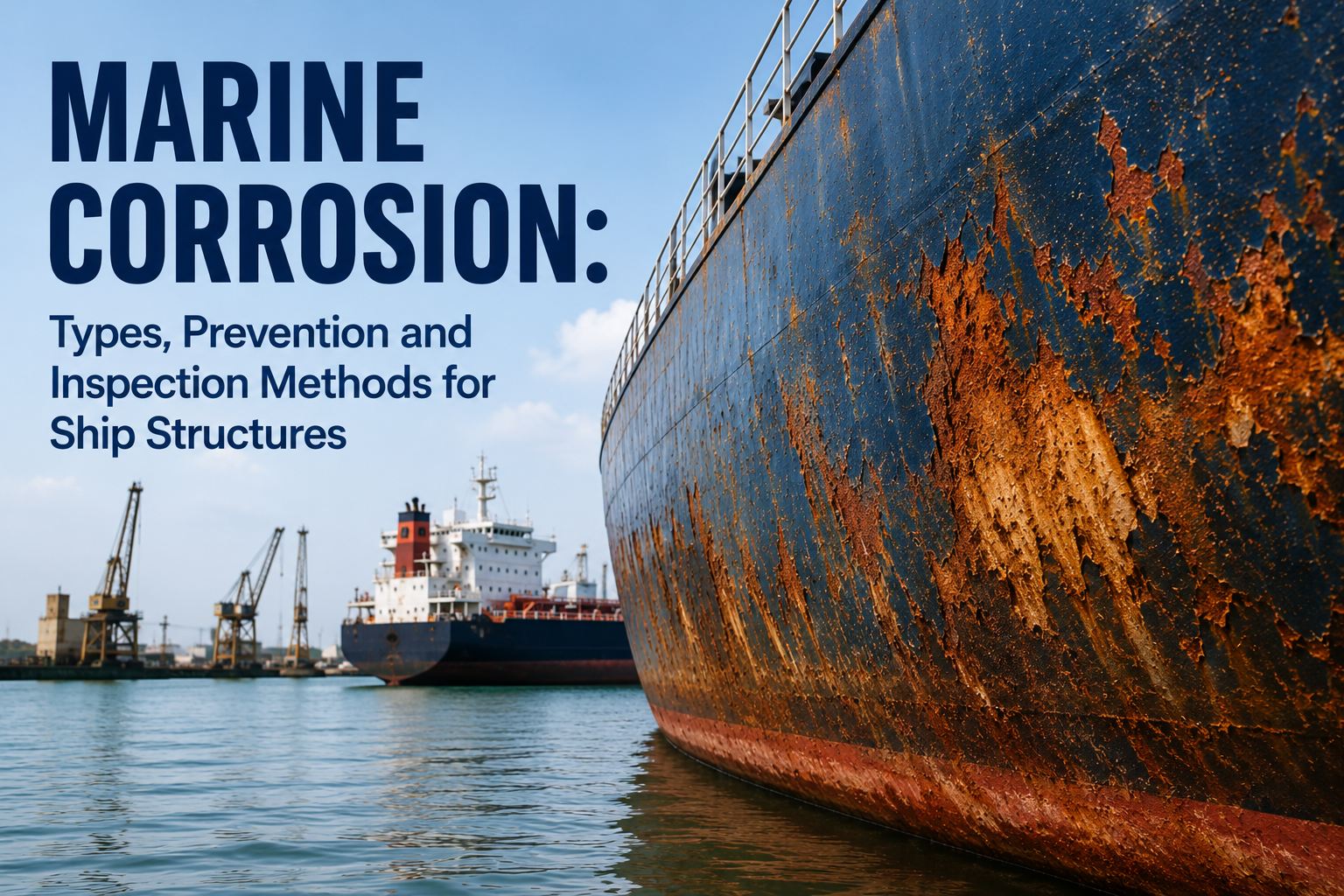
A ship is a steel structure that spends its life immersed in, or surrounded by, the most aggressive common electrolyte on earth. Seawater, oxygen, chlorides, temperature swings, mechanical stress and biological growth combine to attack the hull, the tanks and the internal structure continuously, and left unchecked that attack thins plating, pits tank bottoms, cracks welds and ultimately threatens the vessel's structural integrity and its class. Corrosion is not a maintenance nuisance to be tidied up at dry dock; it is a slow, relentless structural process that determines how long a ship can safely trade, and managing it is one of the central engineering disciplines of running a fleet. Doing that well requires three things held together: understanding the different forms corrosion takes and why each occurs, applying the right combination of prevention — coatings, cathodic protection, material and design choices — to slow it, and inspecting the structure rigorously enough to catch wastage before it crosses the line from acceptable to dangerous. This guide works through all three for the engineers, superintendents and officers responsible for the steel. It explains the electrochemical basis of marine corrosion, the main types found on ships and where each appears, the coating systems and cathodic protection that defend against them, the inspection methods from visual survey to ultrasonic thickness measurement, and how coating condition and steel diminution are assessed against class standards. To plan corrosion-control maintenance, record thickness measurements and coating condition, and keep the evidence class expects across your fleet, start a free trial or book a demo.
INDUSTRY GUIDE · HULL & STRUCTURE
Marine Corrosion: Types, Prevention and Inspection Methods for Ship Structures
A technical guide for engineers and superintendents to the corrosion that attacks a ship's steel — the forms it takes, the coatings and cathodic protection that defend against it, and the visual and ultrasonic inspection methods that catch wastage before it threatens structure or class.
Why Steel Corrodes in Seawater
Every form of marine corrosion, however different it looks, comes from the same electrochemical process, and understanding that process is what makes the prevention methods make sense rather than seeming like a grab-bag of unrelated tricks. Corrosion is an electrochemical reaction that needs four things present together: an anode, a cathode, a metallic path between them, and an electrolyte.
On a ship, the steel provides the anode and cathode, the structure itself is the metallic path, and seawater is a near-perfect electrolyte — conductive, oxygen-bearing and rich in chlorides. Where these come together, an electrochemical cell forms: at the anode, iron gives up electrons and dissolves into the water as corrosion product, losing metal; at the cathode, those electrons are consumed in a reaction that leaves the metal intact. The anode wastes away; the cathode is protected. Every corrosion-control method is, at its core, a way of manipulating this cell — either by breaking the circuit with a barrier, or by deliberately making the whole structure a cathode so it stops being the metal that dissolves.
This also explains why damage concentrates rather than spreading evenly. If a ship's protective coating is broken at one point, the small area of exposed bare steel becomes the anode while the large surrounding coated area acts as the cathode, and the electron flow drives intense, localised attack at that exposed spot — the mechanism sailors know as pitting. A large anode and small cathode corrode slowly; a small anode and large cathode corrode fast and deep. This single principle — that a small exposed area surrounded by a large protected one corrodes viciously — underlies why coating breakdown is so serious and why a pinhole matters far more than its size suggests.
i
Corrosion is not erosion
It is worth distinguishing corrosion from erosion, because the two are often confused and the remedies differ. Corrosion is the electrochemical dissolution of metal described above. Erosion is mechanical wear caused by moving fluids or gases — the physical scouring of a surface. The two frequently combine as erosion-corrosion, where turbulence strips away protective films and exposes fresh metal to renewed electrochemical attack, which is why high-flow areas like propellers and pump internals suffer disproportionately. Naming the mechanism correctly is the first step to choosing the right defence.
The Main Types of Corrosion on Ships
Corrosion takes several distinct forms, each with its own mechanism and its own characteristic locations on a vessel. Recognising which type is at work is essential, because the prevention and the inspection response differ for each.
Uniform (general) corrosion
The even, overall thinning of a surface exposed to a corrosive environment, producing general wastage across a plate rather than concentrated damage. It is the most predictable form and the one that coatings and cathodic protection are primarily designed to slow. On a ship it shows as steady loss of plate thickness over large areas, tracked through thickness measurement over the vessel's life.
Pitting corrosion
Highly localised attack that drives deep, narrow pits into the steel while the surrounding surface stays relatively intact — the small-anode, large-cathode mechanism. It is dangerous precisely because it concentrates: a pit can penetrate plating while overall thickness looks acceptable. Tank bottoms are a classic site, and pitting in tank bottoms is a leading finding in structural surveys.
Galvanic (dissimilar-metal) corrosion
Occurs when two dissimilar metals are electrically coupled in an electrolyte: one becomes the anode and corrodes while the other becomes the cathode and is protected. It needs the dissimilar metals in contact in seawater. The bow thruster tunnel, with its mix of metals, is a common site, and copper alloys such as bronze and brass are especially vulnerable as their zinc and aluminium waste away.
Crevice corrosion
Concentrated attack in tight gaps where stagnant electrolyte and oxygen depletion create an aggressive local cell — under support brackets in ballast and cargo tanks where two items touch, between a metal structure and a gasket, or even between stacked steel plates in storage before the ship is built. Anywhere a crevice traps water and excludes oxygen is a candidate.
Stress corrosion cracking
The combination of tensile stress and a corrosive environment producing cracks that neither would cause alone. Chloride-induced cracking is a marine hazard, and it is insidious because the cracks can propagate with little visible surface loss, threatening structural integrity in a way general wastage does not. Highly stressed, chloride-exposed components are the concern.
Erosion and stray-current corrosion
Erosion-corrosion occurs where turbulence and aeration strip protective films and accelerate attack, concentrating around propulsion and high-flow areas. Stray-current corrosion, caused by unintentional leakage of current from onboard or external electrical sources, can be far more rapid than natural galvanic corrosion and has caused dramatic failures in days rather than years, so it must be checked for and corrected promptly.
Coating Systems — the First Line of Defence
The primary defence against marine corrosion is the coating, which works by the simplest principle available: put a barrier between the steel and the electrolyte so the corrosion cell cannot form. The effectiveness of that barrier depends as much on how it is applied as on what it is, which is why surface preparation is as important as the paint itself.
Barrier coatings — epoxy and polyurethane
Epoxy and polyurethane-based systems form the workhorse protective barrier in tanks and on structure, sealing the steel from seawater and oxygen. Epoxy is widely used in ballast and cargo tanks for its adhesion and chemical resistance; polyurethane topcoats add weathering and colour retention. Their protection is only as good as their integrity, so any breakdown, blister or holiday becomes a corrosion initiation point.
Zinc-rich coatings — sacrificial pigment
Zinc-rich primers do more than form a barrier: the zinc pigment is sacrificial, corroding preferentially to protect the steel where the film is scratched, then building a shielding layer of zinc corrosion product. This combines active cathodic protection at the microscopic scale with physical shielding, giving these coatings a self-healing character at defects that inert barrier coatings lack.
Antifouling — the outer hull
Antifouling coatings on the underwater hull prevent marine growth that both increases drag and creates the differential conditions that promote localised corrosion. Applied over the anticorrosive scheme, they keep the hull clean, so they contribute to corrosion control indirectly by denying biological growth the foothold from which it drives attack.
Surface preparation — the hidden half
No coating outperforms the steel preparation beneath it. Removing mill scale, rust, salts and contamination and achieving the specified surface profile before application is what lets a coating adhere and last its design life. Poor preparation is the most common cause of premature coating failure, which is why tank coating application is governed by strict standards from surface preparation through to final inspection.
i
The Performance Standard for Protective Coatings
For dedicated seawater ballast tanks and certain other spaces, coating is not left to preference — the IMO Performance Standard for Protective Coatings (PSPC) sets mandatory requirements for the coating system, its application and its inspection, aiming for a target useful coating life. The standard reflects hard experience that ballast tanks are among the worst corrosion environments on a ship and that the coating applied at build largely determines how the structure ages. When a coating is specified and applied to PSPC, the expectation is a defined protective life, and its condition is then tracked through survey against that expectation.
Cathodic Protection
Where coatings form a passive barrier, cathodic protection is an active defence that attacks the corrosion cell directly. Its principle is elegant: make the entire structure you want to protect into a cathode, so that by definition it stops being the metal that dissolves. There are two ways to achieve this, and understanding both is essential because they suit different situations. Cathodic protection is used in combination with coatings, not instead of them — the coating does most of the work and the cathodic protection defends the inevitable defects.
SACRIFICIAL ANODE
Galvanic (passive) protection
Blocks of a more reactive metal — zinc, aluminium or magnesium alloy — are bolted or welded to the structure. Being more electrochemically active, they become the anode and corrode preferentially, feeding protective current to the steel, which becomes the cathode and is spared. The anodes waste away and are renewed at dry dock.
Simple, needs no power source, low capital cost
Ideal for ballast tanks and internal spaces, and smaller vessels
Anodes are consumed and must be inspected and renewed periodically
On very large hulls the number needed becomes impractical, and they add drag
IMPRESSED CURRENT
ICCP (active) protection
An impressed current cathodic protection system drives protective current from an external DC power source through durable anodes, typically mixed-metal-oxide coated titanium, mounted on the hull. Reference electrodes monitor the protection level and a controller adjusts the current to hold the structure at the right potential as conditions change.
Efficient for large hulls where sacrificial anodes are impractical
Adjusts automatically to speed, salinity and temperature
Anodes are long-lived; the system is monitored and controlled continuously
More complex, needs power and control, and demands maintenance of its own
Over-protection has its own hazard
Cathodic protection is not simply "more is better." Excessive protection potential, particularly on high-strength steel structures, can drive hydrogen into the steel and cause hydrogen embrittlement, weakening exactly the highly stressed components that matter most. This is why ICCP systems control the potential to a target range rather than maximising current, and why cathodic protection on high-strength steel is managed with care. The goal is the correct potential, not the greatest one, and a system that is maintained and monitored delivers that where an unmanaged one may not.
Track anodes, coatings and wastage as living records
Corrosion control only works if the defences are maintained and the deterioration is tracked — anode wastage recorded, coating condition graded and re-examined, thickness readings trended against renewal criteria. Marine Inspection captures thickness measurement reports, coating condition, anode and cathodic protection status and the survey file per vessel, with photo evidence and deadline alerts, so the structural picture is current and class-ready rather than reconstructed at dry dock. See how it keeps a fleet's steel under control.
Design and Material Defences
Beyond coatings and cathodic protection, corrosion is fought through the choices made in how the structure is built and what it is made of. These are the quieter defences, designed in rather than applied on, and they shape how vulnerable a vessel is for its whole life.
Material selection
Choosing corrosion-resistant materials for the duty — stainless steels or specialised alloys for aggressive cargo tanks, appropriate grades for the environment — reduces the corrosion problem at source. The trade-off is cost and, with some high-strength steels, susceptibility to cracking and embrittlement that must be managed. Material choice is a balance of corrosion resistance, strength, weight and price.
Avoiding galvanic couples
Where dissimilar metals must meet, isolating them electrically or selecting metals close in the galvanic series prevents the dissimilar-metal cell from forming. Insulating gaskets, careful material pairing and attention to fittings in high-risk areas like the bow thruster tunnel head off galvanic attack before it starts.
Designing out water traps and crevices
Structural detailing that avoids pockets where water and sediment collect, and gaps that trap stagnant electrolyte, removes the conditions crevice and pitting corrosion need. Drainage, rounded details and access for coating and inspection all reduce the number of places corrosion can take hold unseen.
Managing stray current
Proper electrical bonding and earthing, and correcting unintended current leakage promptly, prevent the rapid stray-current corrosion that can destroy underwater components in days. Because stray current is an electrical fault rather than a natural process, it is found and fixed by electrical checks, not by more anodes.
Inspection Methods
Prevention slows corrosion; inspection is how you know whether it is winning. Because corrosion is progressive and often hidden, a structured programme of inspection catches deterioration while it is still repairable and provides the objective data that class decisions rest on. Inspection runs from the eye to the instrument.
01
Overall (general) survey
A general examination of a space or structure to assess its overall condition and determine where closer inspection is needed. It identifies the areas of concern — poor coating, visible corrosion, water traps, previous repairs — that then receive detailed attention. The overall survey is the wide-angle view that directs the close-up effort.
02
Close-up survey
Detailed examination of structural components within hand's reach — plating, stiffeners, brackets, web frames and connections inspected at arm's length so fine cracks, pitting and coating breakdown are seen directly. Close-up survey of internal structure at intermediate and special surveys is where the real structural condition is established, and it is increasingly supported by drone-based remote inspection techniques now recognised for close-up work.
03
Ultrasonic thickness measurement (UTM)
The core quantitative method: an ultrasonic gauge measures the remaining thickness of plating and members, quantifying material loss against the as-built thickness. Readings are taken as representative grids and specifically where uneven corrosion or pitting is found, turning visible deterioration into hard numbers of remaining steel. UTM is what converts "this looks corroded" into a measured percentage of wastage.
04
Crack detection and NDT
For cracks, especially at welds and joints, non-destructive testing supplements the eye: magnetic particle testing for surface cracks, dye penetrant on critical joints, and techniques able to detect cracking through coatings. These target the stress-corrosion and fatigue cracks that thickness measurement alone will not reveal, at the girth, longitudinal, fillet and tee joints where they concentrate.
i
Representative spaces and suspect areas
Two terms shape how inspection is targeted. Representative spaces are selected areas chosen to reflect the condition of similar spaces throughout the vessel, so that inspecting them gives a fair picture without opening every tank. Suspect areas are locations showing substantial corrosion, or where the surveyor judges rapid wastage is likely, and they demand enhanced attention — additional thickness measurements and more frequent inspection. Directing effort by representative and suspect areas is what makes a survey both efficient and safe, concentrating measurement where the risk is rather than spreading it evenly across sound steel.
Assessing Coating Condition and Steel Wastage
Inspection produces two judgements that drive maintenance and class decisions: how good the coating is, and how much steel remains. Both are assessed against defined standards, and both have seen their requirements tightened in recent years.
Coating condition is graded on a three-level scale — GOOD, FAIR or POOR — under the IMO coating performance standard. The definitions are specific: FAIR describes local breakdown of coating at the edges of stiffeners and weld connections, or light rusting over twenty per cent or more of the area under consideration, but less than the threshold for POOR; POOR describes general breakdown of coating over twenty per cent or more of the area, or hard scale over ten per cent or more. These are not loose descriptions but measured proportions that determine what happens next.
The consequences of a downgrade have become significant. Under recent changes to the survey regime, any coating condition rated below GOOD must be recorded and re-examined at subsequent annual surveys, rather than being allowed to degrade untracked between special surveys. For water ballast tanks with FAIR coating, annual examination is required after the first special or intermediate survey unless the coating is restored to GOOD, and for older, larger vessels, double-side skin void spaces with POOR coating must be re-examined at each annual survey. A coating downgrade now carries direct commercial weight — more inspection, potential operational delay, and reduced charter appeal — so maintaining coating in GOOD condition is a competitive matter as much as a regulatory one.
GOOD
Only minor spot rusting. The target condition, requiring no additional survey attention and preserving the structure's protection and the vessel's commercial standing.
FAIR
Local breakdown at stiffener edges and weld connections, or light rusting over twenty per cent or more but less than POOR. Now recorded and re-examined at annual surveys where it applies.
POOR
General coating breakdown over twenty per cent or more, or hard scale over ten per cent or more. Triggers the heaviest survey attention and, in the worst spaces, annual re-examination.
Steel wastage is judged against allowable diminution — the amount of thickness a member may lose from its as-built dimension before it must be renewed. Thickness measurement quantifies the loss, and when it reaches a defined proportion of the allowable wastage, the response escalates. Reaching roughly seventy-five to one hundred per cent of the allowable wastage marks substantial corrosion, which triggers expansion of the survey to establish the extent of the problem, additional measurements, and ultimately renewal of steel that has crossed the limit. The principle is that structure is renewed before wastage compromises strength, and the measured numbers, trended over the vessel's life, are what show whether that line is approaching so it can be planned for rather than discovered. To capture thickness readings, grade coating condition and trend wastage against the renewal limits per vessel, start a free trial or book a demo.
Building a Corrosion-Control Strategy
The individual defences and inspections come together into a strategy only when they are managed as a continuous programme rather than a series of dry-dock events. Corrosion never pauses, so the control of it cannot either, and the vessels that age well are those where the whole cycle is planned, recorded and acted on.
1
Protect at build and preserve the coating
Get the coating right at construction to the applicable standard, and then treat preserving it as the priority — because the coating applied and maintained does most of the corrosion control, and a coating kept in GOOD condition avoids the cascade of survey and commercial consequences a downgrade brings.
2
Maintain the cathodic protection
Inspect and renew sacrificial anodes on schedule, and monitor and maintain any impressed current system so the structure stays at the right protective potential — neither under-protected and corroding nor over-protected and at risk of embrittlement.
3
Inspect on a structured cycle
Run overall and close-up surveys and thickness measurement to the survey programme, targeting representative and suspect areas, and use crack detection where cracking is the risk — so deterioration is caught and quantified while it is still repairable.
4
Trend the data and plan renewals
Record coating grades, anode condition and thickness readings over time, so wastage trends are visible and steel renewals and recoating can be planned into dry docks before substantial corrosion forces the issue — turning corrosion management from reactive to predictive.
Marine corrosion is, in the end, a race between deterioration and management that runs for the whole life of a ship. The steel will always want to return to the state seawater draws it toward; the job of corrosion control is to slow that return enough, and monitor it closely enough, that the structure stays strong and in class for its intended life and beyond. That is achieved not by any single measure but by the combination this guide has walked through — understanding which form of corrosion is at work, defending with coatings and cathodic protection and sound design, and inspecting rigorously enough to turn the invisible progress of wastage into measured numbers that drive timely action. The vessels that reach twenty and twenty-five years still trading and still in class are not the ones that were built differently; they are the ones where the coating was preserved, the anodes were renewed, the thickness was measured and trended, and the coating downgrades and wastage limits were seen coming and planned for. Corrosion cannot be stopped, but it can be managed into a predictable, budgeted, controllable process rather than a sequence of expensive surprises at dry dock. To hold coating condition, anode status, thickness measurements and the structural survey file together across your fleet, and manage corrosion control as a continuous programme, start a free trial or book a demo.
Frequently Asked Questions
What causes marine corrosion?
Marine corrosion is an electrochemical process requiring an anode, a cathode, a metallic path and an electrolyte. On a ship the steel provides the anode and cathode, the structure is the path, and seawater is a highly effective electrolyte because it is conductive, oxygen-bearing and rich in chlorides. Where these come together, iron dissolves at the anode while the cathode is protected. This is why damage concentrates where coating breaks down: a small area of exposed steel surrounded by a large protected area becomes an intense local anode, which is the mechanism behind pitting.
What are the main types of corrosion on ships?
The main forms are uniform (general) corrosion, which thins surfaces evenly; pitting, which drives deep localised pits and is common in tank bottoms; galvanic or dissimilar-metal corrosion, where two coupled metals in seawater corrode unequally; crevice corrosion in tight gaps under brackets and gaskets; stress corrosion cracking, where tensile stress and a chloride environment combine to crack steel; and erosion-corrosion and stray-current corrosion around high-flow areas and electrical faults. Each has its own mechanism and characteristic location, so recognising which is at work guides the prevention and inspection response.
What is the difference between sacrificial anodes and impressed current cathodic protection?
Both make the structure a cathode so it stops corroding, but differently. Sacrificial anodes are blocks of a more reactive metal — zinc, aluminium or magnesium — that corrode preferentially and are consumed, needing no power and suiting ballast tanks and smaller vessels, but becoming impractical on very large hulls. Impressed current cathodic protection drives protective current from an external DC power source through durable anodes, with reference electrodes and a controller adjusting the current automatically, which suits large hulls but is more complex and needs power and maintenance. Both are used together with coatings, not instead of them.
How is ship steel thickness measured?
By ultrasonic thickness measurement, in which a gauge measures the remaining thickness of plating and structural members and the material loss is calculated against the as-built thickness. Readings are taken as representative grids and specifically where uneven corrosion or pitting is found, converting visible deterioration into measured remaining steel. When wastage reaches a defined proportion of the allowable diminution — roughly seventy-five to one hundred per cent — it is classed as substantial corrosion, triggering expanded survey and, past the limit, steel renewal. Trended over time, these numbers show when renewal is approaching.
What do the coating conditions GOOD, FAIR and POOR mean?
They are the three grades used to assess protective coatings under the IMO coating standard. GOOD means only minor spot rusting. FAIR means local breakdown at the edges of stiffeners and weld connections, or light rusting over twenty per cent or more of the area but less than POOR. POOR means general coating breakdown over twenty per cent or more, or hard scale over ten per cent or more. Under recent survey changes, any condition below GOOD must be recorded and re-examined at annual surveys, and FAIR or POOR ballast tank coatings can trigger annual examination, so a downgrade carries real inspection and commercial consequences.
Why are ballast tanks so prone to corrosion?
Ballast tanks combine everything corrosion needs: repeated immersion in seawater, cyclic wetting and drying, oxygen, warmth, and structural details full of edges, brackets and crevices where water and sediment collect. The immersion degrades both coatings and sacrificial anodes over time, and poorly coated areas, water traps and previous repairs become sites of accelerated wastage. This is why dedicated seawater ballast tanks are subject to the IMO Performance Standard for Protective Coatings and to close inspection attention, and why their coating condition is tracked so carefully through the vessel's surveys.
Can cathodic protection cause damage?
Yes, if it is excessive. Over-protection — driving the structure to too negative a potential — can force hydrogen into the steel and cause hydrogen embrittlement, which weakens high-strength steel components in particular. This is why impressed current systems control the protective potential to a target range rather than simply maximising current, and why cathodic protection on high-strength steel is applied with care. The aim is the correct protective potential, not the greatest, and a properly monitored and controlled system delivers that where an unmanaged one may over- or under-protect.
How often should corrosion inspection be carried out?
Corrosion inspection follows the vessel's survey programme — overall and close-up surveys and thickness measurement at annual, intermediate and special surveys, with the scope increasing as the ship ages, alongside routine in-service checks by the crew. Recent changes require coating conditions below GOOD to be re-examined at annual surveys, and suspect areas showing substantial corrosion demand more frequent attention than sound structure. Between the formal surveys, continuous crew monitoring of coating, anodes and visible corrosion is what catches problems early, which is why corrosion control is best treated as an ongoing programme rather than a dry-dock event.
Manage Corrosion as a Programme, Not a Dry-Dock Surprise
Marine Inspection holds coating condition, anode and cathodic protection status, ultrasonic thickness measurements and the structural survey file together per vessel, with photo evidence, corrosion mapping and deadline alerts — so wastage is trended, coating downgrades are caught, and renewals are planned before substantial corrosion forces them. Keep every hull's steel measured, defended and provably in class across the fleet.