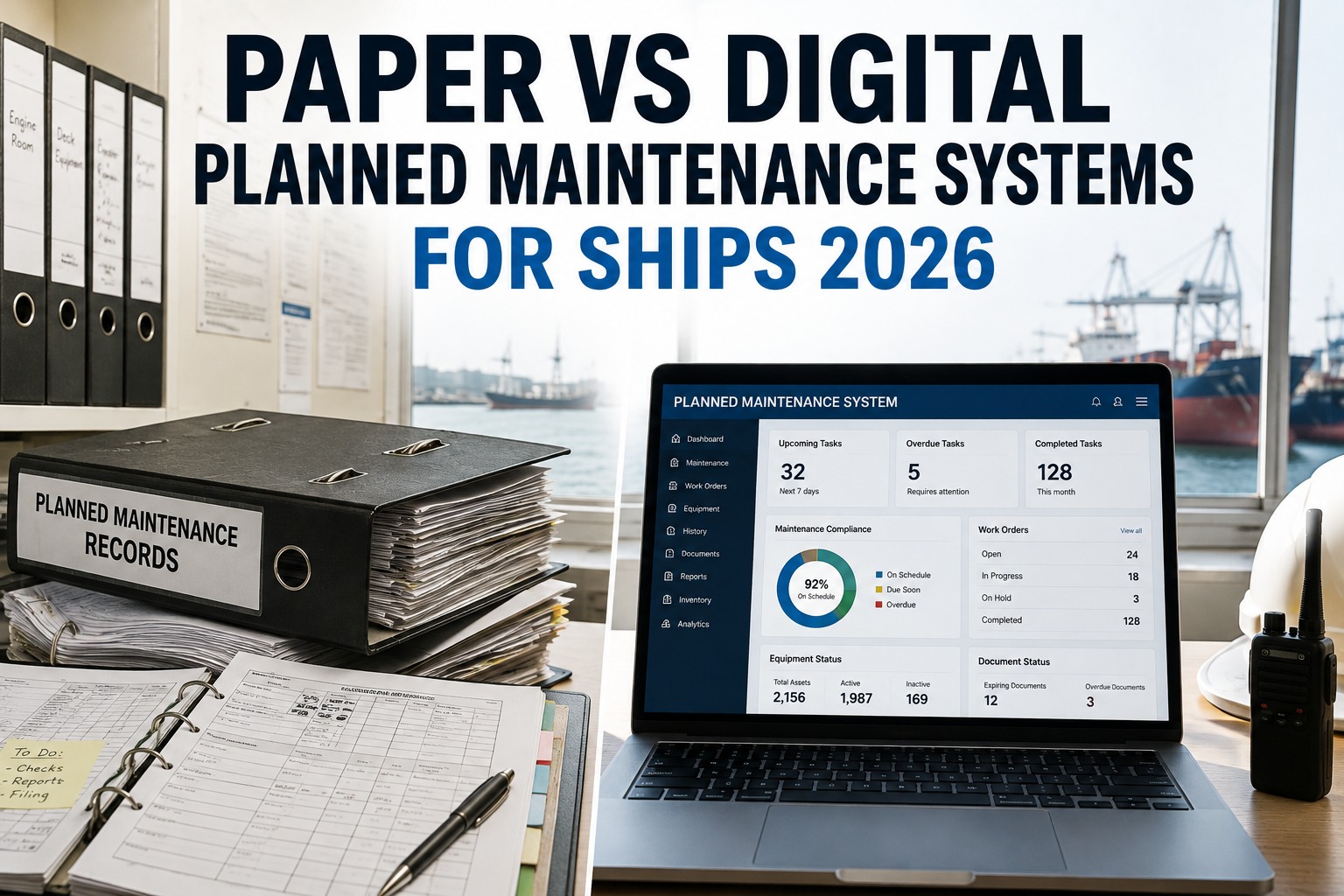
Paper planned maintenance is legal, it is approved by every classification society, and thousands of vessels run it without incident. Nobody should be told otherwise. What paper does is set a ceiling, and most operators discover where that ceiling sits only when they try to move above it. Class societies assess maintenance systems against IACS unified requirements, and the survey arrangements available to a vessel form a ladder: standard periodical machinery survey, then continuous machinery survey, then an approved planned maintenance scheme, then condition-based maintenance under UR Z27, which was introduced in July 2018 and can only be applied to vessels already operating on an approved PMS survey arrangement. Each rung reduces survey burden and gives the owner more control over when work happens. Each rung also demands more from the record. By the time you reach Z27, an annual audit reviews analyses and trends of vibration measurement data and lubrication oil analyses, verifies crew skill at operating condition monitoring equipment, and checks calibration status. A paper file holds values. It does not hold trends. That distinction is where paper stops, and it stops well below the level a modern fleet wants to operate at. Start a free trial of Marine Inspection and see the rungs above the line.
Survey Arrangement Ladder, and Where Paper Stops
Level 4
Condition-Based Maintenance under UR Z27
Survey items credited on measured condition rather than elapsed time. Requires class approval, reference values for diagnostic parameters, and an annual audit reviewing trend analyses. Applicable only to vessels already on an approved PMS arrangement.
Level 3
Approved Planned Maintenance Scheme
The owner's own maintenance programme carries survey credit for machinery items, subject to class approval of the system and an implementation survey confirming it is genuinely operating on board.
The paper ceiling
Paper records can satisfy the levels below. Above the line, survey credit depends on trend analysis, reference values and calibration evidence that a paper file structurally cannot assemble on demand.
Level 2
Continuous Machinery Survey
Machinery items surveyed on a rolling cycle rather than all at once, spreading the burden across the class period. Generally a prerequisite for moving to a PMS arrangement.
Level 1
Standard Periodical Survey
Machinery opened and examined by an attending surveyor to the class schedule. Fully workable on paper, and the most survey-intensive arrangement available.
What the Surveyor Actually Reviews
Class rules covering condition monitoring arrangements set out what an annual audit examines, and reading that list changes how you assess a record system. Each item below is what gets reviewed, followed by what happens when it is held on paper against a digital record. Book a Marine Inspection demo and produce each one live from your own data.
Reviewed at Audit
On Paper
On a Digital System
Planned maintenance and equipment maintenance documentation
Present and reviewable, provided the right binder is aboard and complete. This is the one paper handles well.
Same content, retrievable by component in seconds rather than by binder and tab.
Analyses and trends of vibration measurement data
Individual readings exist. The trend across readings has to be constructed by hand, usually the night before.
Trend is the native view. Four consecutive readings moving the wrong way are visible as a slope, not as four sheets.
Analyses and trends of lubricating oil analyses
Laboratory reports filed chronologically, with degradation across samples invisible unless someone plots it.
Results held against the component, with movement across samples surfaced automatically.
Crew competence at operating condition monitoring equipment
Demonstrated in person. Evidence of who has been trained and when sits in a separate file, if anywhere.
Completion records attributed to named individuals, so competence and activity are already linked.
Equipment calibration status
Certificates in a folder, with expiry noticed when someone checks rather than when it approaches.
Calibration dates tracked as windows with escalation before they lapse.
Reference values for diagnostic parameters
Recorded somewhere in the approved programme, and compared to current readings manually.
Held against the component, with measured values checked against them at the point of entry.
Four Things Paper Structurally Cannot Do
These are not criticisms of anyone's filing. They are properties of the medium, and no amount of discipline changes them. Sign up for Marine Inspection and check which of the four are currently costing you.
Gap 1
Turn Records Into Trends
A file of readings and a trend are different artefacts. An insulation resistance value of eight megohms is acceptable; a sequence of twelve, ten, eight and six across six months is a fault developing. Paper holds the first and cannot produce the second without someone building it by hand, which means it gets built for audits rather than for decisions.
Gap 2
Escalate Before a Date Passes
Paper is inert. A survey window, a calibration certificate or a certificate of class looks identical the day before expiry and the day after. Detection depends on a human opening the right file at the right moment, repeatedly, across an entire fleet, forever.
Gap 3
Exist in Two Places at Once
The record is aboard the vessel. The superintendent is ashore. Answering a question about a component means asking someone at sea to find a binder and describe what it says, which is why shore-side visibility on paper fleets is always a reconstruction of the vessel's position rather than the position itself.
Gap 4
Carry Evidence Alongside the Entry
A signature confirms a job was done. It does not show the condition found. Photographs of a corroded seat or a worn liner live in a phone, an email or nowhere, so the strongest evidence available is routinely the piece least likely to be in front of the surveyor.
Measured Where It Counts
Audit outcomes, administrative load, deficiency exposure and survey readiness are the four things a technical director is actually judged on. Here is how the two approaches compare across each. Schedule a walkthrough and test the survey readiness row against your own last audit.
Table 1: Paper PMS and Digital PMS Compared on Outcomes
2026 REGULATORY REALITY
Paper is not non-compliant, and nobody should suggest it is. ISM Code Element 10 requires a documented maintenance system and does not mandate a format, and class societies approve owners' systems on substance rather than medium. The ceiling is real, though. UR Z27, introduced in July 2018, governs condition monitoring and condition-based maintenance, requires class approval where an owner wishes to change the survey regime, and can be applied only to vessels already on an approved PMS survey arrangement. Its audit regime turns on trend analysis, reference values and calibration status. Regimes can now be mixed per item. Societies have revised rules that previously forced a single approach across all planned machinery survey items, so continuous survey, planned maintenance and condition monitoring can be selected for individual items — administratively straightforward in a system and difficult on paper. IACS unified requirements are minimums. Each member society is free to set more stringent rules, so confirm your own society's position rather than assuming the IACS text is the whole obligation.
Above the Line
Records That Produce Trends, Not Just Values
Measured values held against acceptance criteria and trended automatically, calibration and certificate windows tracked with escalation, completions attributed to named people, photographic evidence attached to the job that generated it, and the same record visible ashore and afloat. Deployed in weeks, priced per vessel, and usable by a crew member on the device already in their pocket.
How One Log Entry Becomes Survey Credit
Class rules contain a small, concrete example that explains the whole argument better than any general claim. Under the IACS requirements governing machinery survey, where steam cannot be raised in port, an exhaust gas heated economiser's safety valves may be set and tested by the chief engineer at sea within the annual survey window. The result is recorded in the log book, and the attending surveyor reviews that record before crediting the annual survey of machinery. Follow the chain. Start a free trial and see where each link either holds or slips.
1
The work happens at sea
A chief engineer performs a test that only the vessel can perform, at a moment when no surveyor is present and no shore office is watching.
2
The record is the only artefact
Nothing physical persists to demonstrate the test occurred correctly. The entry is not administration about the work; the entry is the work, as far as class is concerned.
3
A surveyor reviews it later
The attending surveyor examines the record before crediting the annual survey. Legibility, completeness, attribution and the measured result all sit between the vessel and its survey credit.
4
Credit is granted, or it is not
A weak record does not mean the work was poor. It means the credit is unavailable, and the item returns to the surveyor's scope with the cost and downtime attached. Multiply by every log-dependent item across a fleet.
What Changes in the First Ninety Days
Coming off paper is the least complicated transition in this market, because there is no legacy platform to decommission and no contract to exit. The work sits almost entirely in preparation rather than software. Book a walkthrough and bring one vessel's maintenance file to the call.
Table 2: Moving a Paper PMS to a Digital System
Frequently Asked Questions
Is a paper planned maintenance system still compliant in 2026?
Yes. ISM Code Element 10 requires a documented maintenance system and does not specify a format, and classification societies approve owners' maintenance systems on substance rather than medium. What class assesses is whether adequate maintenance was carried out at the right interval by competent people with the right parts, and whether the condition found was recorded. Paper can satisfy that. The limitation is not legality but reach: survey arrangements that credit machinery items on measured condition depend on trend analysis and reference values, which paper cannot assemble on demand, so the practical ceiling on your survey regime is lower.
What is UR Z27 and why does it matter to this decision?
UR Z27 is the IACS unified requirement covering condition monitoring and condition-based maintenance, introduced in July 2018. It allows survey items to be credited on measured equipment condition rather than elapsed time, which reduces survey burden and gives owners more control over when work happens. Two conditions matter here. It requires class approval where an owner wishes to change the survey regime, and it can be applied only to vessels already operating on an approved PMS survey arrangement. The audit regime around it reviews trend analyses of vibration and lubricating oil data, crew competence at operating monitoring equipment, and calibration status — all of which assume a system rather than a file.
Can we run some machinery on condition monitoring and the rest on planned maintenance?
Increasingly yes. Rules that previously required a single approach to be adopted and applied exclusively across all survey items subject to planned machinery surveys have been revised, so continuous machinery survey, planned maintenance and condition monitoring maintenance can be selected for individual survey items. This is a significant practical improvement, because critical machinery with good instrumentation can move to condition-based credit while simpler items stay on interval. It also raises the administrative bar: running three regimes across one machinery list means tracking three different credit mechanisms simultaneously, which is straightforward in a system and unpleasant on paper.
Will going digital reduce our PSC deficiencies?
Not directly, and it is worth being precise about the mechanism. Software does not fix a fire door or start an emergency generator. What it changes is visibility of accumulation. Detentions typically arise from several converging findings across unrelated areas rather than one fault, and the conclusion a Port State Control officer eventually draws is that the safety management system is not being implemented. A digital record makes the running total of open items, overdue jobs and approaching expiries continuously visible to the people who can close them, so items get resolved before they converge. The reduction comes from earlier action, not from the software itself.
How long does the transition take, and what is the hardest part?
Around six to ten weeks for five to eight vessels, and coming off paper is the simplest starting position because nothing has to be decommissioned. The hardest part is not the software and not the import. It is standardising component naming across the fleet, and converting free-text job instructions into quantified acceptance criteria with maker scope and interval attached. Both are things a paper system let you avoid, and both are what makes the resulting record worth having. Pilot on your most difficult vessel, train crews during cutover rather than after, and set a fixed date after which paper becomes reference-only.
If your survey regime is where you want it and your audits are calm, paper is doing its job. If you have been told a condition-based arrangement is not available to you yet, the reason is usually the record rather than the machinery. Marine Inspection produces the trends, reference values, attributed completions and calibration tracking that arrangement depends on — deployed in weeks, on the device your engineers already carry.