A planned maintenance system is not just good engineering practice on a ship — it is a regulatory requirement woven into the fabric of how a vessel stays in class and keeps trading. Under the ISM Code, every company holding a Document of Compliance must run a documented maintenance system that keeps the ship and its equipment in conformity with the rules, and SOLAS Chapter II-1 sets the structural and machinery maintenance obligations behind it. Classification societies go a step further: a properly implemented PMS is accepted as the basis for Continuous Machinery Survey, letting operators survey machinery progressively through the year instead of cramming everything into a single drydocking. That is the difference a class-aligned PMS makes — it turns maintenance from a scramble before each survey into a continuous, auditable system that surveyors, flag states, and Port State Control all recognise. This guide explains what makes a PMS class-aligned, how it maps every component and task into one structure, and why the implementation details decide whether your next survey is a formality or a fire drill.
Built on three regulatory pillars
Why a PMS Is Non-Negotiable at Sea
A planned maintenance system sits at the intersection of three frameworks that every trading vessel must satisfy. Miss the system, and you miss all three at once.
ISM Code
Section 10 requires a documented maintenance system with inspections at appropriate intervals, non-conformity reporting, and corrective action — verified at ISM audits for the DOC and SMC.
SOLAS
Chapter II-1 sets maintenance obligations for ship structure, machinery, and electrical installations; Chapter IX makes the ISM Code mandatory for all SOLAS-certified vessels.
Class / IACS
DNV, Lloyd's Register, Bureau Veritas, ABS, and ClassNK accept an approved PMS as the basis for Continuous Machinery Survey in place of a single drydock survey.
What "Class-Aligned" Actually Means
Any spreadsheet can list maintenance tasks. A class-aligned PMS is different: it is structured so that its records satisfy the exact evidence a classification surveyor needs, and so that the maintenance it schedules can replace prescriptive surveys. The distinction matters because class societies accept a properly implemented PMS as an alternative to the special machinery survey or Continuous Machinery Survey — but only when the system covers what those surveys would have covered.
Survey-grade records
Every completed job is timestamped, signed, and retained as the evidence a class surveyor, flag state, or PSC officer reviews — incomplete records contribute directly to detention decisions.
CMS coverage
The maintenance items map onto the test items of the survey they replace, so machinery can be surveyed continuously through the year rather than all at once in drydock.
Manufacturer-based intervals
Job intervals reflect equipment manufacturer instructions and class rules, the two authorities a surveyor checks the programme against.
Role-based accountability
Access is tailored by role, with the chief engineer overseeing survey-related tasks, so responsibility for each class item is clear and traceable.
One Structure for Every Component and Every Task
The backbone of a PMS is the equipment hierarchy — a tree that organises every component on the vessel from system down to individual part. This structure is what makes it possible to locate any job, attach its history, and prove coverage across the whole ship rather than hoping nothing was missed.
Vessel The whole ship as the top node
System Propulsion, electrical, cargo, safety, auxiliary
Sub-system e.g. main engine, fuel system, cooling
Equipment e.g. turbocharger, fuel pump, cooler
Component The individual part a job acts on
Against that hierarchy, a complete PMS covers every category of work a crew performs. Modern systems define distinct maintenance types so each job carries the right scope and evidence rather than being lumped into a single generic "service" entry.
Maintenance
Performance Test
Safety Check
Measurement
Visual Check
Calibration
Megger Test
Overhaul
See it on a live vessel
Run a PMS That Impresses Class Surveyors
Equipment hierarchy, dual calendar and running-hour scheduling, class survey due dates, spare parts, and audit-ready records — Marine Inspection is the complete maritime PMS. Book a demo to see the class-aligned workflow, or start free and load your first vessel.
The Core Modules of a Maritime PMS
Maintenance remains the heart of the system, but a modern PMS surrounds it with the modules that make the maintenance executable and the records complete. These work together so a job scheduled is a job resourced, completed, and recorded.
Job Scheduling
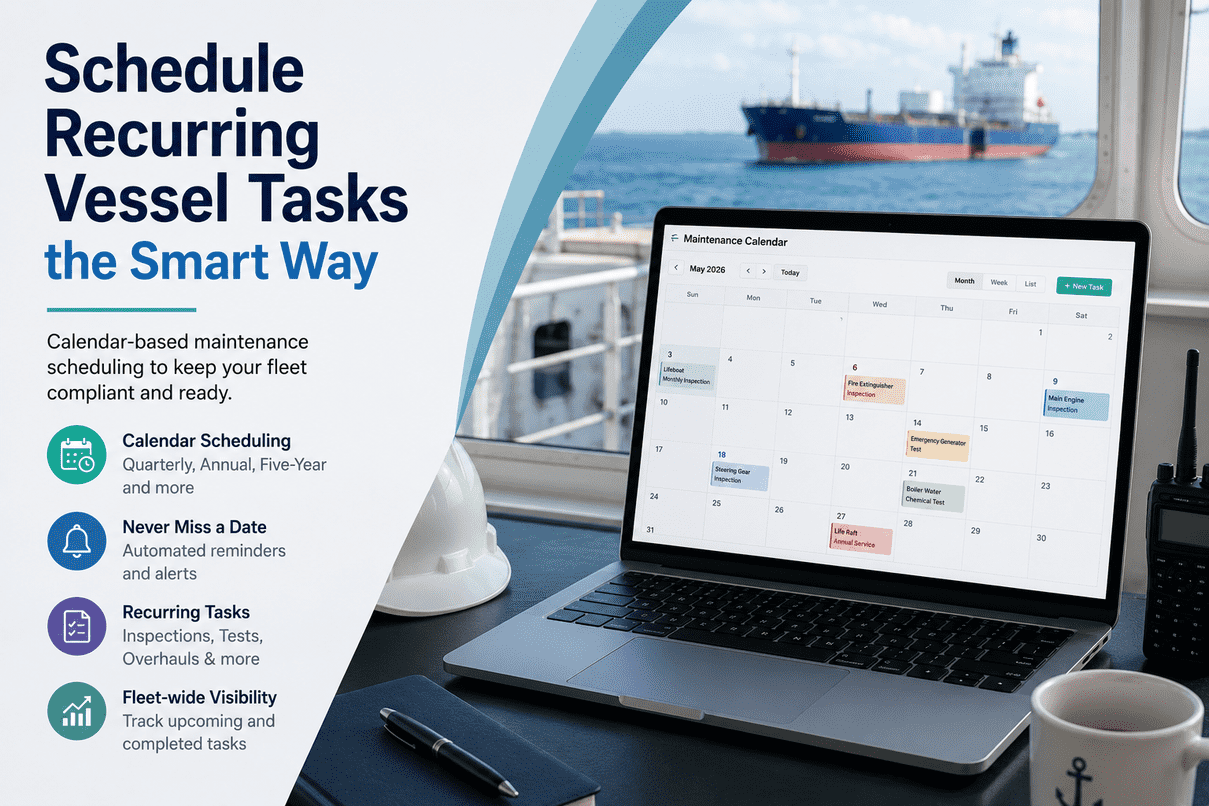
Calendar-based and running-hour triggers running simultaneously, with automatic work-order generation and overdue alerts to vessel, superintendent, and fleet manager.
Work Orders
Assigning, tracking, and signing off every task, with a configurable approval workflow and deferral chain for jobs that must wait.
Spare Parts
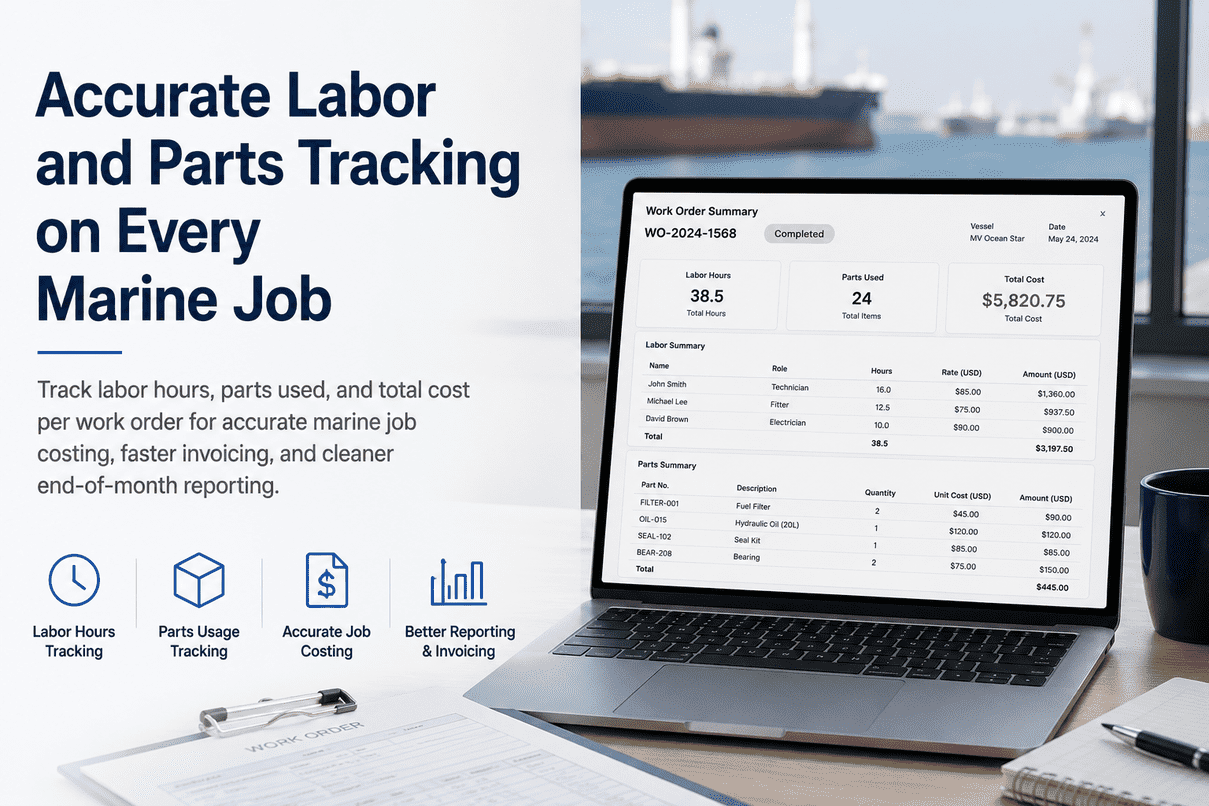
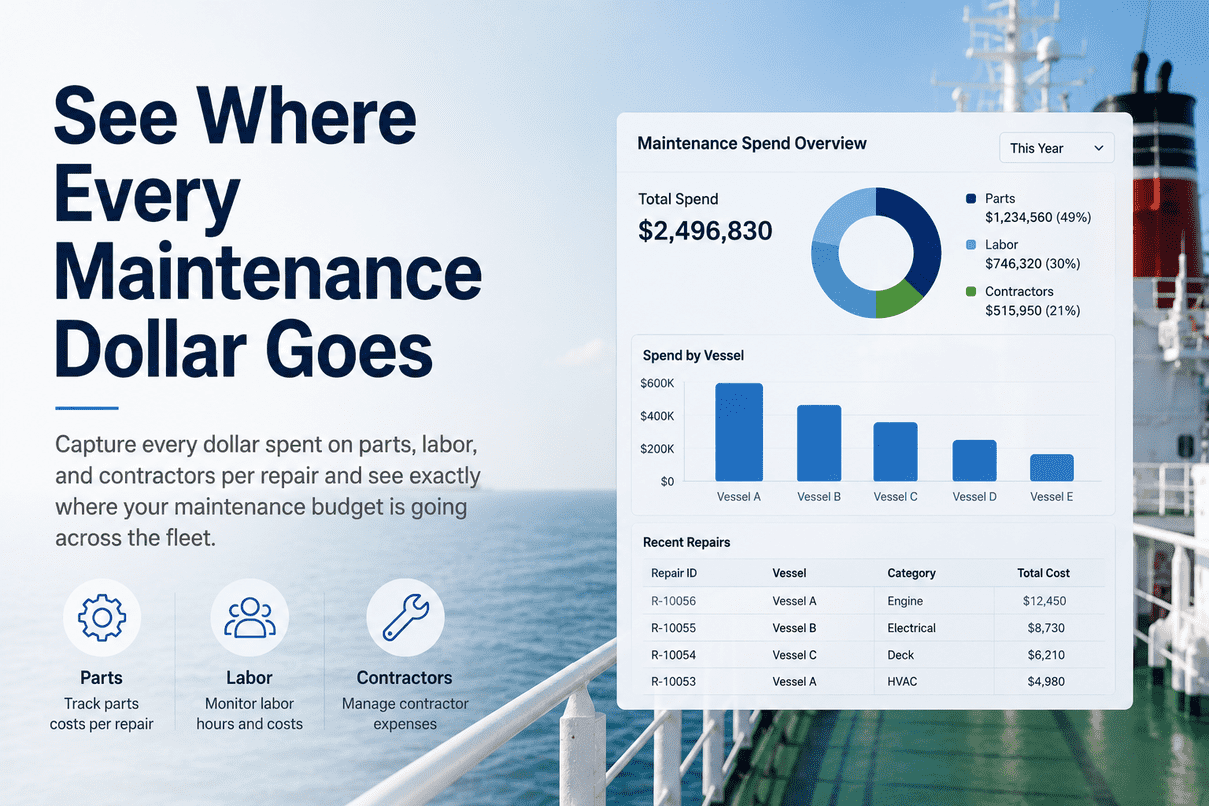
Inventory linked to each component, consumption tracked per job, and requisitions raised so the parts for a job are aboard before it falls due.
Running Hours
Accurate hour counters per machine feeding usage-based jobs, kept current by crew logging or onboard system integration.
Class Survey Tracking
Survey due dates and certificate expiries surfaced ahead of time, tied to the CMS programme so nothing critical lapses unseen.
History & Records
A complete, searchable maintenance log per asset — the audit trail that proves compliance during ISM audits and class surveys.
What Separates a Working PMS from a Failing One
Most PMS software offers the same modules; the difference is in the implementation. The same system can keep a fleet survey-ready or quietly accumulate overdue jobs, depending on how well a handful of fundamentals are handled.
Equipment hierarchy
A complete, correctly structured tree so every class item has a home and coverage gaps are visible.
Interval calibration
Job intervals set to manufacturer and class requirements, not arbitrary round numbers that over- or under-service.
Running-hour accuracy
Reliable hour data so usage-based jobs fire at the right point rather than drifting out of step with real wear.
Spare parts integration
Inventory linked to jobs so a scheduled task is never blocked by a missing spare nobody ordered.
Completion discipline
An overall completion rate above ninety percent, and one hundred percent with zero deferrals on safety-critical and class-required items.
Feedback loop
Actual equipment performance feeding back to adjust intervals and tasks, so the programme improves rather than ossifies.
Why Generic CMMS Falls Short at Sea
PMS is the maritime industry's term for what other sectors call a CMMS, but a generic land-based tool lacks the features that make a system class-aligned. The maritime context imposes constraints a factory never faces, and those gaps are where surveys and inspections find fault.
Connectivity at sea
A vessel cannot rely on constant internet, so a PMS must operate fully offline and synchronise ship-to-shore when the link returns — a cloud-only CMMS stalls mid-ocean.
Class survey integration
Generic tools have no concept of Continuous Machinery Survey or certificate windows, so they cannot serve as the survey evidence a marine PMS is built to provide.
Crew rotation
Crews change every few months, so knowledge must live in the system, not in people — a structured PMS preserves institutional memory across every handover.
Vessel equipment structure
Marine PMS is built around the system-to-component hierarchy and shipboard equipment that generic asset tools were never designed to model.
Frequently Asked Questions
What is a planned maintenance system on a ship?
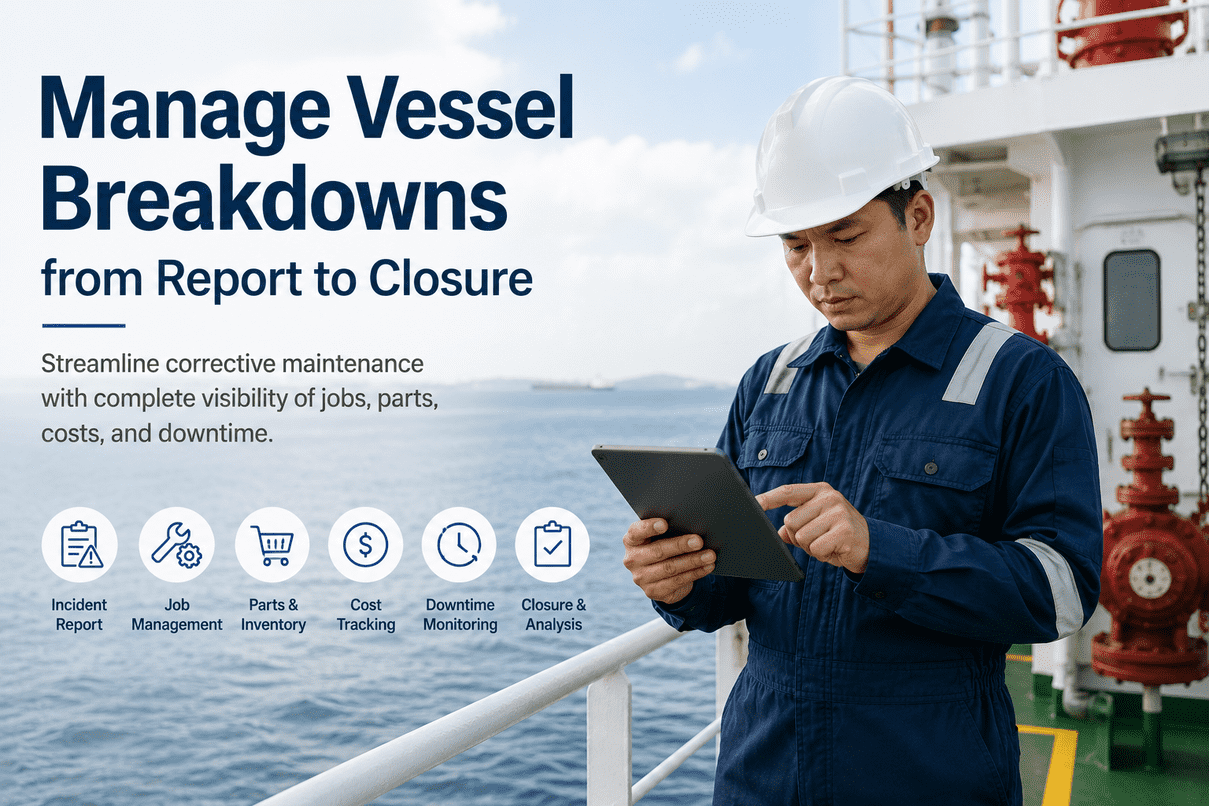
A PMS is a structured system that schedules and records maintenance on shipboard equipment at set intervals based on manufacturer recommendations and class society rules. It organises every component in an equipment hierarchy, triggers jobs by calendar and running hours, tracks spares, and keeps the maintenance history that surveyors and inspectors require as evidence of compliance.
Is a PMS legally required?
Effectively yes. ISM Code Section 10 requires companies holding a Document of Compliance to run a documented maintenance system, and SOLAS Chapter IX makes the ISM Code mandatory for SOLAS-certified ships. The Code does not name specific software, but class societies require verifiable maintenance records, and a PMS is the universally accepted way to provide them.
What does class-aligned or class-approved mean?
It means the PMS is implemented to the standard where a classification society accepts its records as the basis for Continuous Machinery Survey, allowing machinery to be surveyed progressively through the year instead of in a single drydocking. The maintenance items must cover what the replaced survey would have covered, with proper records and accountability.
How is a PMS different from a generic CMMS?
PMS is the maritime term for a CMMS, but a marine PMS adds features generic tools lack: offline operation with ship-shore synchronisation, class survey and certificate integration, running-hour tracking from onboard systems, and a vessel-specific equipment hierarchy. These are exactly the capabilities a land-based CMMS was never built to provide.
What completion rate should a PMS achieve?
The industry-standard target is an overall completion rate above ninety percent. For safety-critical and class-required items — safety systems, propulsion, steering, fire-fighting — the target is one hundred percent completion with zero deferrals, since these are the items most scrutinised at surveys and inspections.
How long does it take to implement a PMS?
For a small fleet of five to eight vessels, a realistic timeframe is roughly six to ten weeks if existing records are reasonably complete. The work typically covers data collection, system setup, pilot testing on one vessel, crew training, and final fleet-wide rollout, with modular platforms that ship with equipment templates accelerating the process considerably.
Built for maritime, not adapted to it
A PMS Your Surveyor Will Trust
From equipment hierarchy to class survey integration, running hours to spare parts and audit-ready records, Marine Inspection delivers the complete class-aligned PMS in one platform — offline-capable and built for real-world ship operations. Book a tailored walkthrough or start a free trial today.