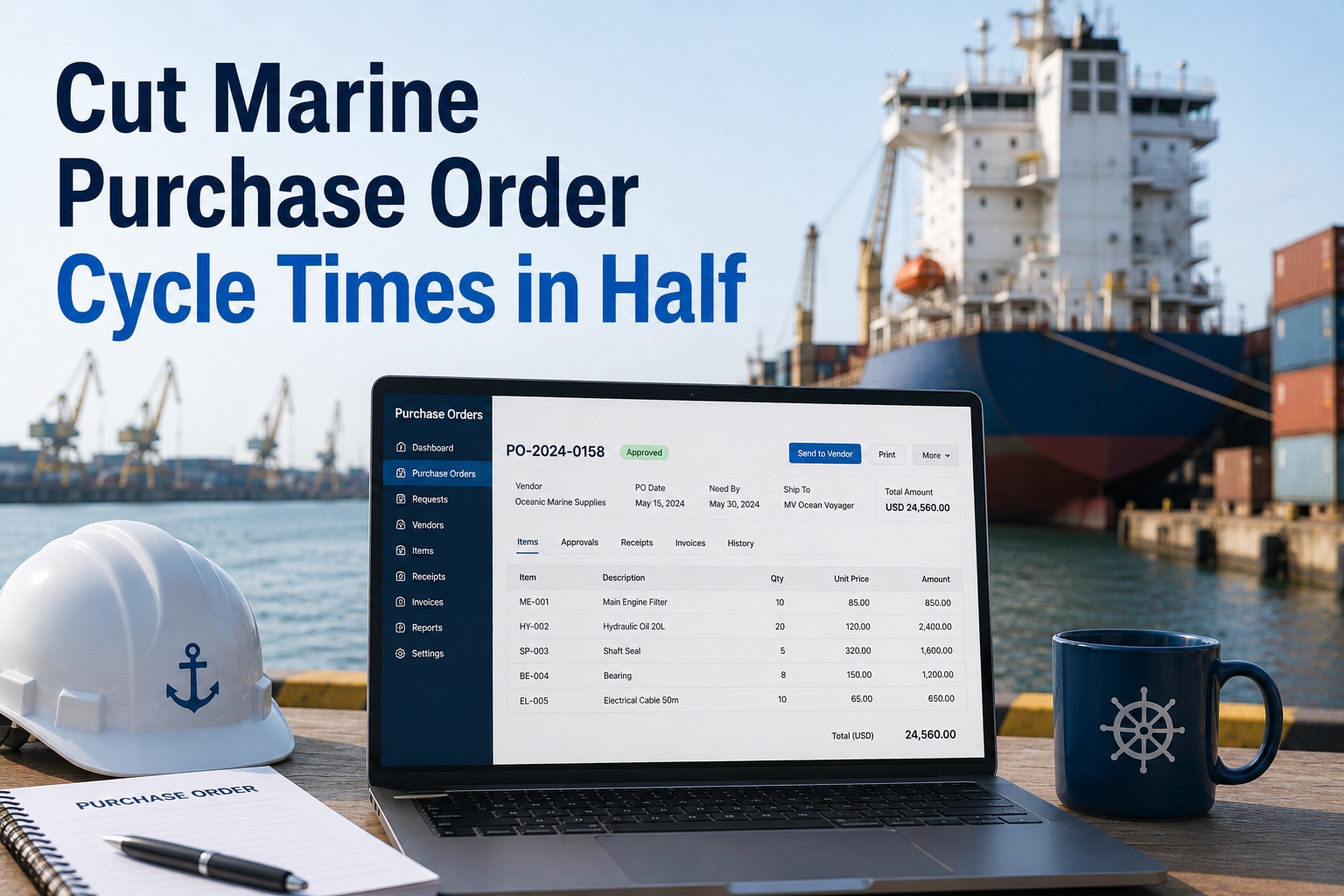
The gap between needing a part and ordering it is where marine procurement quietly bleeds time and money. A requisition raised onboard waits for an email reply, a quote sits unopened, an approval bounces between the superintendent and finance, and by the time the purchase order finally goes out the vessel's window has narrowed and the price has moved. Manual purchase order processing is slow, error-prone, and impossible to audit cleanly — yet most of that delay is pure administrative friction, not real decision time. Digitizing the purchase order workflow changes the maths entirely: teams that automate routing, approvals, and matching routinely cut processing time by fifty to seventy percent. Marine purchase order software does exactly this by turning the requisition-to-payment chain into one connected flow with budget controls, vendor catalogs, configurable approval routing, and three-way matching built in — so a PO is created, approved, and sent in minutes, tracked to delivery, and matched to invoice automatically. This guide breaks down the PO lifecycle, the controls that prevent overspending, the three-way match that protects payments, the KPIs that prove the gain, and why a connected system beats email-and-spreadsheet purchasing every time. To see a PO go from requisition to approved in minutes, book a Marine Inspection demo.

Requisition to PO in minutes
Cut Purchase Order Cycle Times in Half
Automating routing, approvals, and matching cuts PO processing time by 50 to 70 percent. Marine Inspection turns the whole requisition-to-payment chain into one connected, auditable flow.
50–70%faster PO processing when digitized
3-waymatch protects every payment
1 flowrequisition to payment, fully tracked
Book a Demo

The Purchase Order Lifecycle, Stage by Stage

Every PO moves through the same defined sequence, and each stage has a specific job: approvals protect the budget, the PO sets the terms, receiving confirms delivery, and three-way matching safeguards the payment. The friction that slows a fleet down is almost always in the handoffs between these stages — exactly what automation removes. See the flow in a demo.

1
Requisition
Raised onboard via the PMS or by crew, linked to the vessel, job, or component it is for.
2
Quote & select
Quotes collected from the vendor catalog and compared on price, lead time, and performance.
3
Approve
Routed automatically by cost, item type, or vessel through a configurable approval chain.
4
PO issued
Generated from the approved request, setting terms and sent to the supplier with acknowledgment tracked.
5
Receive
Goods delivered to port or vessel, received and scanned, quantities recorded against the PO.
6
Match & pay
PO, receipt, and invoice matched automatically; finance clears payment once verified.

Where the Time Actually Goes — and How It's Recovered

Cutting cycle time in half is not about rushing decisions; it is about deleting the dead time between them. Each manual handoff in the traditional process has a digital equivalent that takes minutes instead of days.

Table 1: Manual vs Automated PO Processing
Stage Manual Process Automated Process
Requisition Emailed or paper form, re-keyed ashore Raised in-system, linked to equipment, no re-entry
Approval Chased by email, stalls in inboxes Auto-routed by rules, escalated if idle
PO creation Typed up from the requisition by hand Generated from the approved request in one click
Order tracking Phone calls to check status Acknowledgment and delivery status tracked live
Invoice matching Manual cross-check against PO and receipt Three-way match runs automatically with tolerances

Remove the chasing, the re-keying, and the manual cross-checks, and what remains is the genuine decision time — which is a fraction of the old cycle. That is how digitized workflows reach the fifty-to-seventy-percent reduction the industry reports.

Budget Controls That Stop Maverick Spend

Speed without control is just faster overspending. The point of built-in budget controls is to make every PO check itself against the vessel and department budget before it goes out, so surprises never reach finance. See budget controls in a demo.

Spend against budget
Every dollar tracked against a specific vessel and department, so commitments are visible before approval, not after the invoice.
Approval by threshold
Higher-value POs route to higher authority automatically, enforcing policy without manual gatekeeping.
Maverick-spend prevention
Off-catalog or out-of-policy purchases are flagged or blocked, mitigating the financial risk of unauthorized buying.
Real-time visibility
Finance sees committed and actual spend per vessel live, replacing surprise invoices with an accurate running picture.
See it on your fleet
From Requisition to Approved PO in Minutes
Marine Inspection routes approvals by rule, generates POs from approved requests, tracks acknowledgments, and runs three-way matching automatically — with budget controls on every order. Book a 30-minute demo to watch a PO move from requisition to approved live, or start a free trial and set up your approval chains today.

Three-Way Matching: The Control That Protects Payments

The single most important financial control in purchasing is the three-way match — confirming that what was ordered, what was received, and what was invoiced all agree before a payment is released. Done manually it is slow and easily skipped; built into the software it runs automatically on every order, with tolerance rules for the small variances that are not worth blocking a payment over.

Purchase Order
What was ordered, at what price, on what terms
+
Goods Receipt
What was actually delivered and accepted
+
Invoice
What the supplier is billing for
=
Verified Payment
Released only when all three agree within tolerance

This is what stops a fleet paying for goods it never received, paying twice, or paying an invoice that crept above the agreed PO price. The match becomes a safeguard that runs on every transaction rather than a spot-check finance does when it has time.

The KPIs That Prove the Gain

A digitized PO process is measurable, and these are the metrics that show whether it is working. Tracking them turns procurement from a cost centre into a managed function with visible performance.

Table 2: Purchase Order Performance KPIs
KPI What It Measures Why It Matters
Procurement cycle time Time from requisition to PO issued The headline measure of process speed
Purchase price variance Actual price paid versus quoted or budgeted Exposes cost creep and weak negotiation
Emergency purchase rate Share of POs raised as urgent or unplanned A high rate signals poor planning and premium cost
Supplier on-time delivery How reliably vendors hit promised dates Drives vendor selection and avoids vessel delays
Spend under management Share of spend running through the system The more captured, the more control and savings

How Marine Software Runs It — and Why It's Needed

The reason most fleets cannot cut their cycle times is that their PO process lives across email, spreadsheets, and finance systems that do not talk to each other. Purpose-built marine software connects the chain end to end and copes with the realities of a fleet.

One connected flow
Requisition, approval, PO, receipt, and matching run in one system, so nothing is re-keyed and nothing stalls between disconnected tools.
Configurable approval routing
Chains route by cost, item type, or vessel automatically, with escalation when an approval sits idle — removing the email chasing that eats days.
Linked to PMS and inventory
A requisition can be raised straight from a maintenance job, so a PO is never the bottleneck that delays a repair or leaves a stockout unfilled.
ERP and finance integration
Two-way sync with finance systems eliminates double entry and keeps PO and invoice data matched, giving finance a real-time view of spend.
Works across ship and shore
Crew raise requisitions, shore teams approve and order, and everyone sees the same live status — even when vessels are out of range and sync later.
Tamper-proof audit trail
Every requisition, RFQ, approval, and PO is logged automatically, creating the defensible record internal and external audits require.

The deeper reason it is needed is that marine procurement is a hybrid process spanning ship, shore, and port at once, with budgets, approvals, and finance all in play. A generic ERP rarely fits that reality, and email-and-spreadsheet purchasing fragments it. A connected platform keeps one auditable flow alive from the moment a part is needed to the moment its invoice is paid. Book a demo to see it on your fleet.

Frequently Asked Questions

What is marine purchase order software?
It is software that manages the full purchase order lifecycle for a fleet — creating POs from approved requisitions, routing approvals automatically, sending orders to suppliers, tracking delivery, and matching PO, receipt, and invoice before payment. It replaces email-and-spreadsheet purchasing with one connected, auditable flow with budget controls built in.
How does it cut purchase order cycle times?
By removing the manual handoffs that cause delay: requisitions are raised in-system without re-keying, approvals route automatically and escalate if idle, POs generate from approved requests in one click, and invoice matching runs automatically. Industry data shows digitizing and automating the workflow cuts processing time by fifty to seventy percent.
What is three-way matching?
Three-way matching confirms that the purchase order, the goods receipt, and the supplier invoice all agree before a payment is released. It stops a fleet paying for goods never received, paying twice, or paying an invoice that crept above the agreed price. Built into software, it runs automatically on every order with tolerance rules for minor variances.
How do budget controls prevent overspending?
Built-in controls check every PO against the vessel and department budget before it is approved, route higher-value orders to higher authority, and flag or block off-catalog and out-of-policy purchases. Finance sees committed and actual spend in real time, so maverick spending is prevented rather than discovered after the invoice arrives.
Which KPIs should I track for purchasing?
Key measures include procurement cycle time, purchase price variance, emergency purchase rate, supplier on-time delivery rate, and spend under management. Together they reveal how fast the process runs, how well costs are controlled, how much purchasing is planned versus urgent, and how much spend is actually captured in the system.
Why not just use a general ERP for marine purchasing?
Marine procurement is a hybrid process spanning ship, shore, and port, with requisitions raised onboard, approvals and ordering done ashore, and delivery at global ports — often with intermittent connectivity. Generic ERP systems rarely fit that reality, which is why purpose-built marine software that links to the PMS, inventory, and finance while working across ship and shore is the better fit.
Built for marine procurement
Order Faster, Spend Smarter, Audit Easier
Automated approval routing, vendor catalogs, budget controls, three-way matching, live order tracking, and a tamper-proof audit trail — all linked to your PMS, inventory, and finance. Marine Inspection turns slow, scattered purchasing into one fast, controlled flow. Book a tailored walkthrough or start a free trial today.