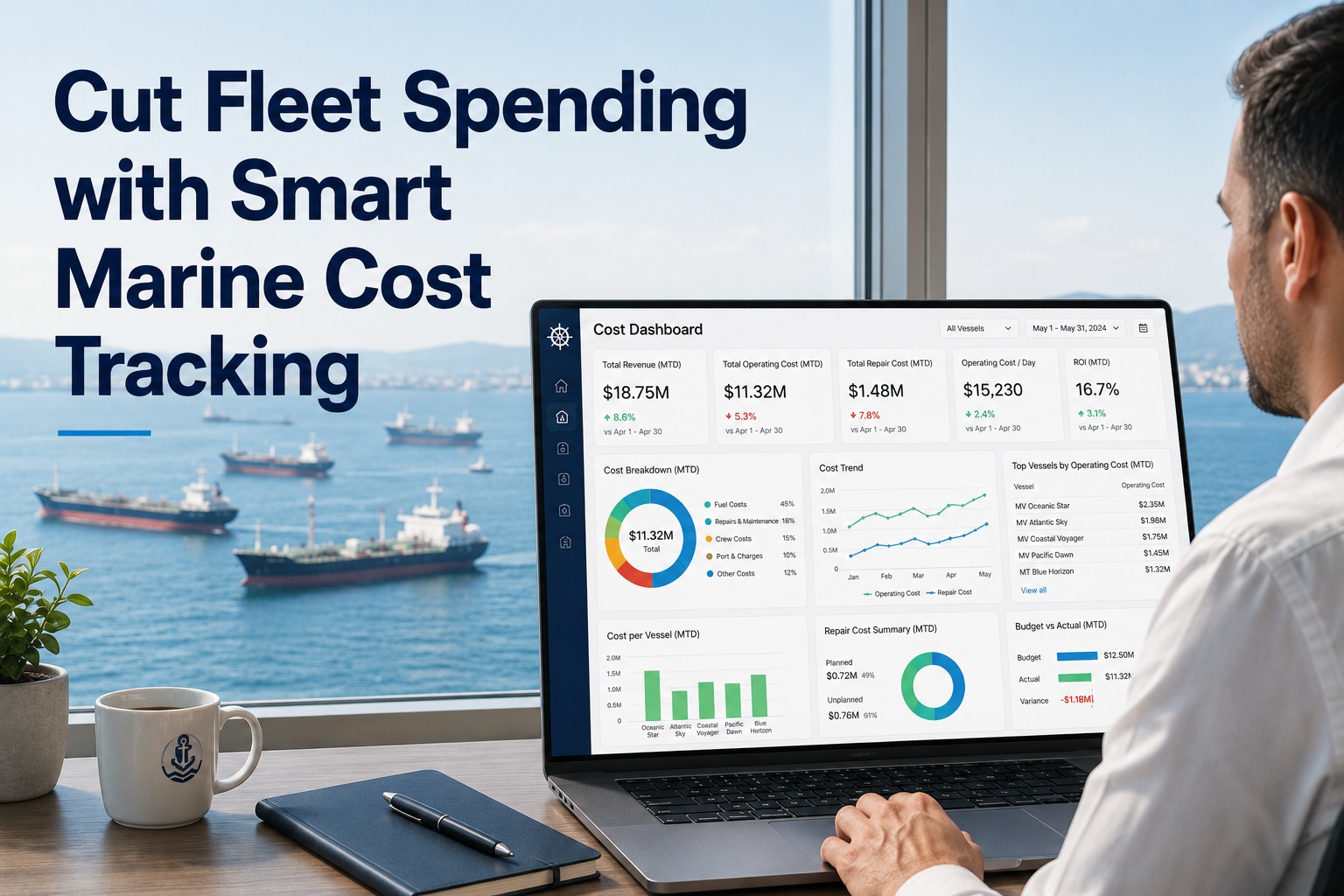
Most fleets know their total maintenance spend to the dollar — and almost nothing about where it actually went. The annual figure arrives from accounting, accurate and useless, because it answers the wrong question. Accounting reports what happened; cost tracking surfaces what to do next. When parts, labor, and contractor charges are lumped into one line per vessel, the chief engineer cannot see that one aging generator is quietly consuming a third of the budget, that emergency repairs are costing three to nine times their planned equivalents, or that a contractor is being called for work the crew could do. Repair cost tracking fixes that blind spot by capturing every dollar at the work-order level — parts from inventory, labor hours per engineer, and contractor invoices — and attributing it to the specific asset that consumed it. The result is a live picture of where the maintenance budget really goes, vessel by vessel and component by component. This guide breaks down the cost categories that matter, the analytics that turn them into decisions, and why a budget built from this data survives a finance review when last year's guess does not.
Follow One Repair Dollar
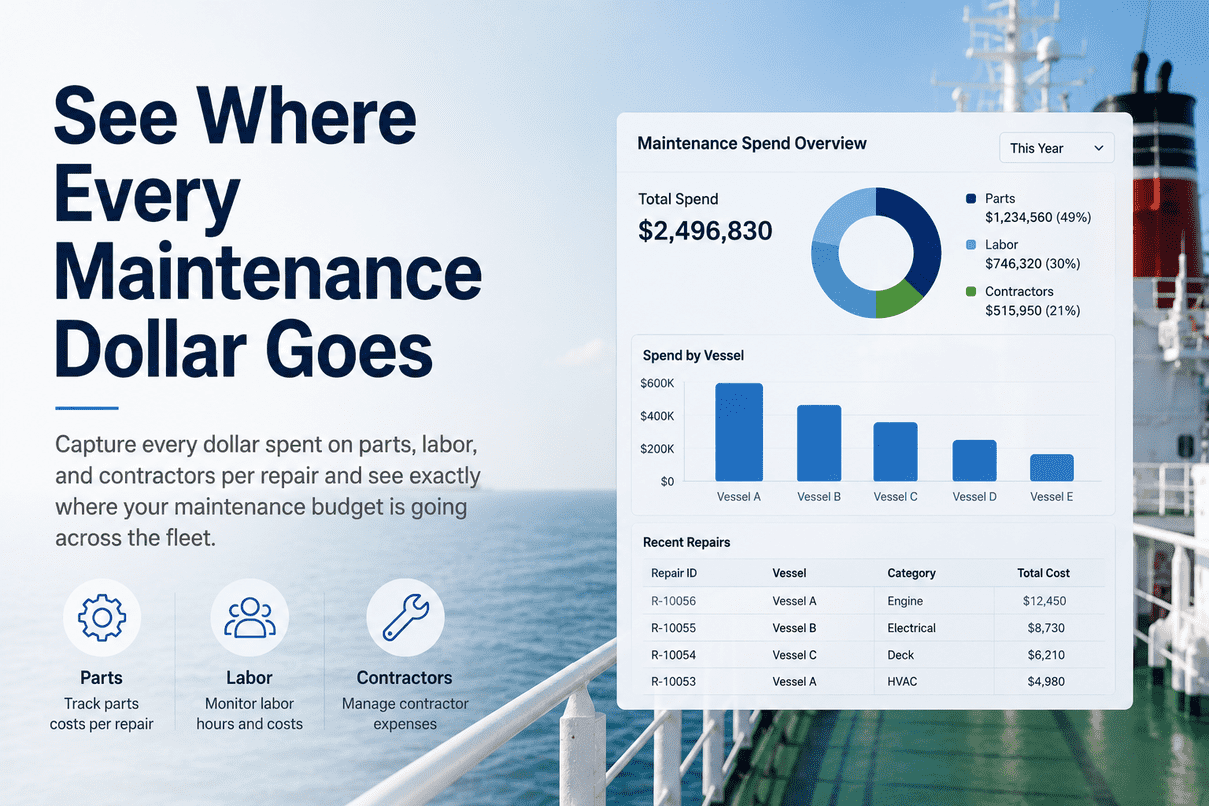
Every job splits into three cost streams. Track them separately and the budget stops being a mystery.
Parts
Spares drawn from inventory and deducted automatically, valued and attributed to the job that used them.
+
Labor
Actual engineer hours per work order, costed at real rates rather than estimated after the fact.
+
Contractor
External labor, port-based service work, and riding crews invoiced against the specific job.
=
True Job Cost
The full, accurate cost of the repair, attributed to the asset — the unit every decision is built on.
Why Total Spend Hides the Truth
A single annual maintenance number is an average, and averages conceal exactly the information you need to act. Cost tracking at the work-order and asset level exposes the patterns buried inside that total — and the patterns are where the savings live.
The budget-eating asset
Aging equipment consumes a wildly disproportionate share of spend. Without cost-per-asset data, the worst offender hides inside the fleet average until it fails expensively.
The reactive premium
Emergency repairs run three to nine times the cost of the same job planned, with overtime, expedited shipping, and secondary damage hidden inside the total number.
The contractor creep
External service spend rises quietly when it is not tracked against jobs, masking work the crew could absorb and vendors charging above value.
The stores variance
Spares and stores are the largest variance category and the most common signal of weak procurement discipline or machinery nearing the end of its life.
The Analytics That Turn Cost Data Into Decisions
Captured cost data is only valuable when it answers operational questions. These are the views that change how a fleet spends, each built directly from the parts, labor, and contractor figures on every job.
Cost per asset
Total spend attributed to each piece of equipment over its life — the foundation of every repair-versus-replace and total-cost-of-ownership decision.
Planned vs reactive ratio
The split between scheduled and emergency spend, exposing the true, expensive cost of running reactive and the case for investing in prevention.
Cost by category
Parts, labor, and contractor broken out per asset and per vessel, showing exactly which stream is driving variance.
Budget variance
Actual spend against budget in real time, so overruns surface while there is still time to act rather than at year-end.
Fleet benchmarking
The same equipment compared across vessels, revealing which ships run lean and which carry hidden cost problems.
Live cost dashboards
See Exactly Where Every Dollar Goes
Marine Inspection captures parts, labor, and contractor cost against every work order automatically — giving you cost-per-asset, planned-versus-reactive ratios, and budget variance across the fleet with no manual tracking. Book a demo to see the cost dashboards on a live vessel scenario, or start free and connect your fleet.
From Captured Cost to a Budget That Survives Review
The payoff of granular cost tracking is a maintenance budget built bottom-up from real asset data instead of top-down from last year's number plus a percentage. That distinction is what separates a finance system from a decision-making one.
Top-Down Guess
Last year's total plus an arbitrary percentage
No visibility into which assets drive cost
Overruns discovered at year-end
Cannot defend line items in a finance review
Bottom-Up From Data
Built from actual per-asset cost history
Each line traceable to real work orders
Variance flagged in real time, mid-year
Every figure defensible with evidence
How Marine Software Captures Cost — and Why It's Needed
The reason fleets do not track repair cost this way on a spreadsheet is that the capture has to be automatic and at the source, or it never happens consistently. Purpose-built marine software embeds cost capture into the work itself, and the maritime context is why a generic finance tool cannot.
Capture at the job, not after
Parts, labor, and contractor costs are recorded as the work order runs, so the data is complete and accurate rather than reconstructed from invoices weeks later.
Parts costed from inventory
Spares are deducted and valued automatically when consumed, linking every part to a job and keeping both stock and cost data correct in one step.
Attributed to the asset
Every cost lands against the specific equipment in the hierarchy, building the cost-per-asset history that repair-versus-replace decisions depend on.
Works offline at sea
Costs are captured on a mobile device at the equipment without connectivity and sync ship-to-shore later, so nothing is lost in the gap between engine room and office.
Fleet-wide roll-up
Per-vessel data aggregates into one dashboard, so a superintendent compares cost across the whole fleet instead of stitching together spreadsheets.
Audit and warranty ready
Costed, documented repair records support warranty claims and survive financial audits, turning maintenance records into a financial asset.
The deeper reason it is needed: maintenance is one of the largest controllable costs on a vessel, and you cannot control what you cannot see. A generic accounting system tells you the total after the money is gone; marine cost-tracking software shows you where it is going while you can still change the outcome — which is the entire point.
Frequently Asked Questions
What is marine repair cost tracking?
It is the practice of capturing every cost on a maintenance job — parts, labor, and contractor charges — at the work-order level and attributing it to the specific asset. Unlike accounting, which reports total spend after the fact, cost tracking shows where money is going in real time so operators can act before budgets are blown.
What cost categories should be tracked per repair?
Three core streams: parts consumed from inventory, labor hours costed at real rates, and contractor or external service charges. Tracking them separately and attributing them to each asset reveals which stream drives variance and builds the true cost-per-asset picture that decisions depend on.
How does cost tracking support repair-versus-replace decisions?
By accumulating total spend against each piece of equipment over its life. When an asset's cumulative repair cost and rising failure frequency are visible, the case for replacement becomes evident with data rather than instinct — and the spend that would otherwise hide in the fleet average is exposed.
Why are emergency repairs so much more expensive?
Reactive breakdowns typically cost three to nine times their planned equivalent once emergency labor rates, expedited parts shipping, and secondary damage are counted. Tracking the planned-versus-reactive ratio exposes this premium, which is otherwise buried inside the total maintenance number and easy to ignore.
What makes a maintenance budget defensible in a finance review?
A budget built bottom-up from actual per-asset cost history, where every line traces back to real work orders, rather than last year's total plus a percentage. With granular cost data, variance is flagged mid-year while there is still time to act, and each figure can be defended with evidence.
Can cost be tracked without internet at sea?
With purpose-built marine software, yes. Costs are captured on a mobile device at the equipment offline, then synchronise to the shore dashboard when connectivity returns. This source-level capture is why marine cost tracking stays accurate where a connectivity-dependent finance tool would lose the data.
Built for maritime finance visibility
Turn Maintenance Spend Into a Decision You Control
Capture parts, labor, and contractor cost on every job, attribute it to the asset, and see exactly where the fleet's maintenance budget goes — in real time, offline-capable, and audit-ready. Marine Inspection makes the spend visible while you can still act on it. Book a tailored walkthrough or start a free trial today.