No amount of preventive planning eliminates breakdowns entirely. A bearing lets go on a laden passage, a generator trips in heavy weather, a hydraulic line bursts during cargo operations — and when it happens, the clock starts on lost revenue. A single day of downtime on a large vessel runs into the thousands, sometimes tens of thousands, in lost charter income alone, before the cost of emergency spares, expedited logistics, and overtime is counted. Corrective maintenance is the discipline of handling those failures: getting from the moment a breakdown is reported to the moment the job is closed, repaired, documented, and learned from, as fast and as cheaply as the situation allows. The difference between fleets that bleed money on breakdowns and those that absorb them is rarely luck — it is whether the corrective process is structured, measured, and tied to a system that captures cost, parts, and downtime on every single job. This guide covers the full corrective maintenance lifecycle, the metrics that matter, the trap of treating every breakdown the same, and how marine software turns chaotic firefighting into controlled, data-driven repair.
Corrective Maintenance Is Not One Thing
Emergency
Immediate Corrective
A safety-critical or operation-stopping failure that must be fixed now — propulsion loss, steering failure, a flooding source. Downtime is accruing every minute.
Deferred
Planned Corrective
A real fault that is not yet critical and can be scheduled into a convenient window — a weeping valve, a noisy pump — repaired on the fleet's terms, not the failure's.
Run-to-Failure
Planned Reactive
A deliberate choice for low-criticality, cheap-to-replace items where it is cheaper to run them until they fail than to maintain them on a schedule.
The costly mistake is treating every breakdown as an emergency or, worse, failing to distinguish them at all. A structured corrective process classifies each failure the moment it is reported, so genuine emergencies get the immediate response they need while deferrable faults are scheduled — protecting both safety and the maintenance budget.
The Breakdown Lifecycle — Report to Closure
Every corrective job, whether a five-minute fix or a three-day overhaul, moves through the same stages. The faster and cleaner each stage runs, the lower the downtime and the better the record left behind for compliance and analysis.
1
Report & identify
The failure is logged against the specific equipment with a description, photos, and a severity classification. The faster a fault is detected and recorded, the sooner the response begins — identification delay is pure, avoidable downtime.
2
Triage & prioritise
The job is classified as emergency, deferred, or run-to-failure, and prioritised against safety and operational impact. This is where the system decides what happens now and what waits for a window.
3
Diagnose & plan
The engineer identifies the cause, the parts required, and the procedure. Equipment history is pulled up to see whether this fault has appeared before and what fixed it last time.
4
Repair & record
The work is carried out, with labor hours, parts consumed from inventory, and any temporary measures captured as the job proceeds — not reconstructed afterward from memory.
5
Verify & close
Function is confirmed, the job is signed off, and total downtime is logged. The closed record carries the full cost, parts, and time data for the asset's permanent history.
6
Root cause & feedback
For significant failures, a root-cause analysis records why it happened and what will prevent recurrence — feeding back into the PM plan so the breakdown becomes a one-off, not a pattern.
The Metrics That Measure Corrective Performance
Corrective maintenance is one of the most measurable disciplines in the engine room, and two metrics dominate. Tracked together, they tell you both how often equipment fails and how efficiently your team recovers — and a CMMS is the tool that makes them visible rather than theoretical.
MTTR
Mean Time To Repair
Total downtime divided by the number of repairs — the average time to restore an asset after failure. It spans four stages: identification, diagnosis, repair, and verification. Lowering any stage lowers downtime.
MTBF
Mean Time Between Failures
Total uptime divided by the number of breakdowns — the average run an asset achieves before failing. Rising MTBF signals improving reliability; falling MTBF flags equipment that needs investigation.
The goal of any maintenance program is simple to state: decrease MTTR and increase MTBF. A high MTTR points to slow detection, missing spares, or vague procedures; a low MTBF points to a chronic underlying fault that root-cause analysis should target. Watching them in isolation misleads — fast repairs on a constantly failing pump still mean constant disruption, so the two must be read together against equipment availability.
Turn Breakdowns into Tracked, Closed Jobs
Marine Inspection takes every breakdown from report to closure — severity classification, parts from inventory, labor hours, downtime, and root cause — with MTTR and MTBF tracked automatically across your fleet. Book a 30-minute demo to see the corrective workflow live, or start a free trial and load your fleet today.
What Gets Tracked on Every Corrective Job
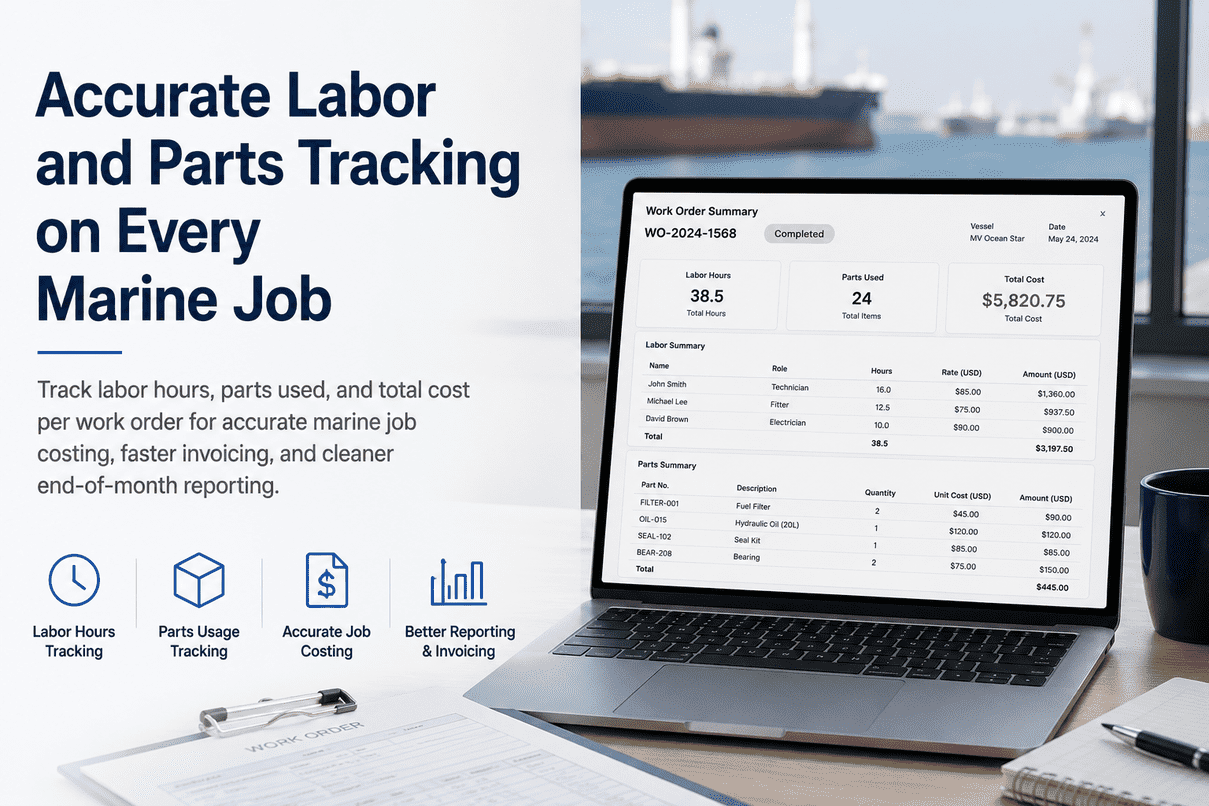
The value of corrective maintenance software is that it captures the full picture of each breakdown automatically. These data points turn a repair from a one-time event into intelligence that lowers the next failure's cost.
Downtime
Total hours the equipment was out of service, categorised as unplanned breakdown versus planned window, with trends by equipment, system, and vessel.
Cost
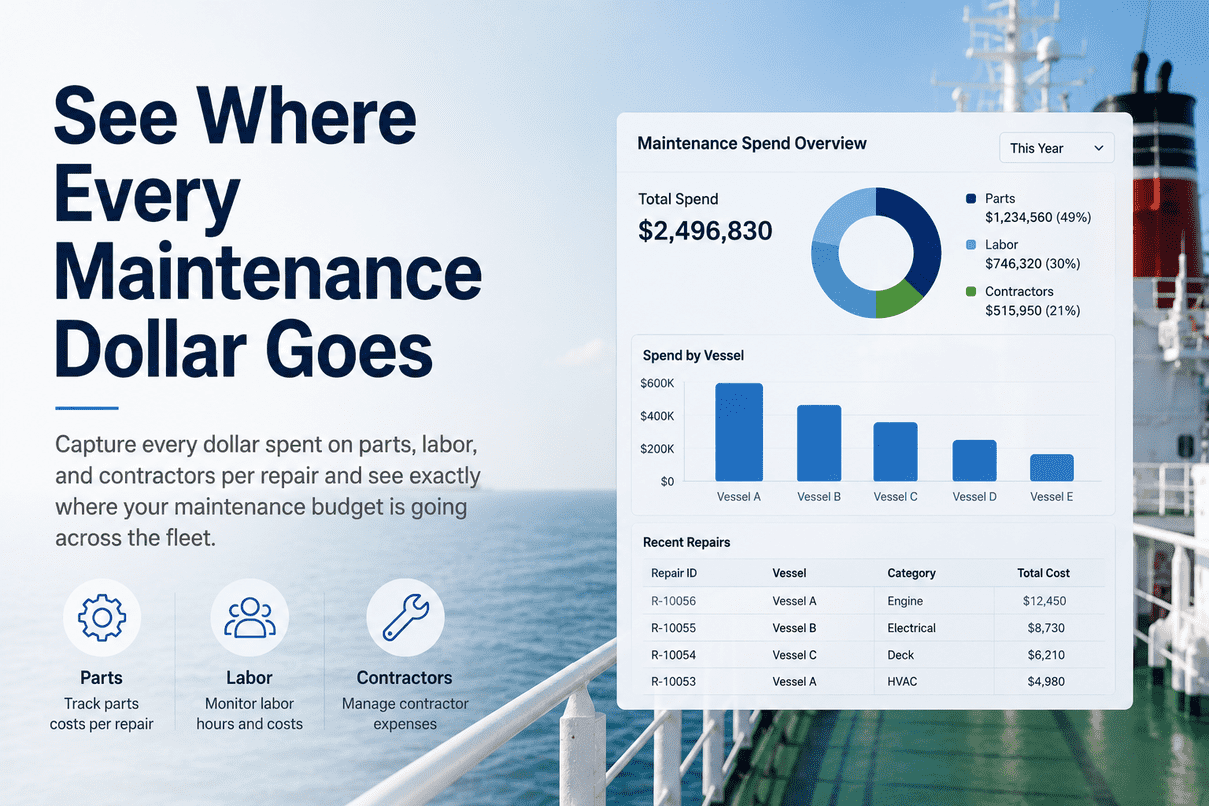
Full repair cost — parts, labor, and external services — attributed to the asset, building a true cost-of-ownership picture for repair-versus-replace calls.
Parts Consumed
Spares drawn from inventory and deducted automatically, linking each breakdown to stock so reorder points reflect real failure rates.
Labor Hours
Actual engineer time per job, feeding MTTR and exposing where diagnosis or repair stages run long and slow recovery down.
Failure Mode
Structured classification of the failure type and root cause, building a searchable failure library for pattern recognition across the fleet.
Evidence Trail
Photos, signatures, and timestamps producing the audit-ready record class surveyors and PSC inspectors expect for every repair.
How Marine Software Tames the Breakdown — and Why It's Needed
A breakdown handled over radio calls, paper notes, and memory is a breakdown that costs more than it should and teaches you nothing. Marine software changes that at every point of the lifecycle, and the maritime context is precisely why a generic tool will not do.
Nothing lost in the moment
When a fault is logged in one system the instant it is found, it cannot be forgotten in the rush of a developing situation — the report, severity, and evidence are captured before attention moves on.
Faster recovery, lower MTTR
Instant access to equipment history, manuals, and the last repair of the same fault compresses the diagnosis stage, while linked inventory tells the engineer immediately whether the spare is aboard.
Works offline at the failure
Breakdowns happen in the engine room where connectivity dies. The job is captured offline on a mobile device at the equipment and syncs ship-to-shore when the link returns — a cloud-only tool stalls exactly when it is needed most.
Cost and downtime captured automatically
Parts, labor, and out-of-service hours are recorded as the job runs, so the true cost of every breakdown is known rather than estimated — the foundation of every repair-versus-replace decision.
Patterns become visible across the fleet
A searchable failure library surfaces the same pump or valve failing across multiple vessels, turning isolated breakdowns into a reliability insight that root-cause analysis can act on.
Corrective feeds the preventive plan
Every closed breakdown and its root cause flow back into the PM strategy, so recurring failures are designed out and the fleet's mix shifts from reactive firefighting toward planned work.
The deeper reason it is needed is that breakdowns are where the cost of disorganisation is highest. A missed PM is a future risk; a mishandled breakdown is money leaving the account right now in off-hire and emergency logistics. Software is what keeps a high-pressure repair controlled, costed, and recorded when the temptation is to fix it fast and write it up never.
Corrective Maintenance Feeds Continuous Improvement
Handled well, corrective maintenance is not just damage control — it is the richest source of reliability data a fleet has. Each breakdown answers questions the maintenance plan should be asking.
Is the PM wrong?
A failure on an asset under planned maintenance suggests the interval is too long or the task incomplete. The breakdown is feedback that the schedule needs tuning.
Is the asset failing?
A falling MTBF on a specific unit flags chronic weakness — a candidate for replacement, redesign, or condition monitoring rather than endless repair.
Are spares right-sized?
Breakdown parts data shows which spares actually get consumed, so critical-stock levels reflect real failure rates instead of guesswork.
Is repair slow?
A high MTTR on certain jobs points to vague procedures or missing parts — fixable with better work-order detail and stocking.
Frequently Asked Questions
What is corrective maintenance on a vessel?
Corrective maintenance is the work done to restore equipment after a fault or failure, as opposed to preventive maintenance done on a schedule to avoid failure. It covers everything from emergency repairs on safety-critical systems to deferred fixes scheduled into a convenient window, and it is tracked from the incident report through to closure with full cost, parts, and downtime data.
What is the difference between emergency and deferred corrective maintenance?
Emergency corrective maintenance addresses a safety-critical or operation-stopping failure that must be fixed immediately, with downtime accruing every minute. Deferred corrective maintenance handles a genuine fault that is not yet critical and can be scheduled into a planned window. Classifying each breakdown correctly protects both safety and the maintenance budget.
What are MTTR and MTBF in maintenance?
MTTR, mean time to repair, is total downtime divided by the number of repairs — the average time to restore an asset after failure. MTBF, mean time between failures, is total uptime divided by the number of breakdowns — the average run before failing. The goal is to decrease MTTR and increase MTBF, and read together they reveal equipment availability.
How does software reduce breakdown downtime?
It compresses the stages of MTTR: faults are logged and detected instantly, equipment history and manuals speed diagnosis, linked inventory confirms spares are aboard, and mobile offline capture lets engineers work at the equipment without connectivity. Faster detection and diagnosis directly lower the hours an asset spends out of service.
Why track the cost of each breakdown?
Capturing parts, labor, and downtime per breakdown builds a true cost-of-ownership picture for each asset. That data drives repair-versus-replace decisions, exposes chronically expensive equipment, supports budgeting from history, and justifies investment in preventive or predictive measures where breakdowns are costing the most.
How does corrective maintenance improve the PM plan?
Every breakdown is feedback. A failure on an asset under planned maintenance signals the interval or task needs adjusting, a falling MTBF flags equipment for deeper intervention, and root-cause analysis records what to change so the fault does not recur. Over time, corrective data shifts the fleet from reactive firefighting toward planned, reliable operation.
Control Every Breakdown, From Alarm to Audit
Severity classification, offline mobile capture, parts and labor tracking, downtime and cost analytics, root-cause libraries, and MTTR and MTBF across the fleet — Marine Inspection runs the whole corrective lifecycle in one purpose-built platform. Book a tailored walkthrough or start a free trial today.