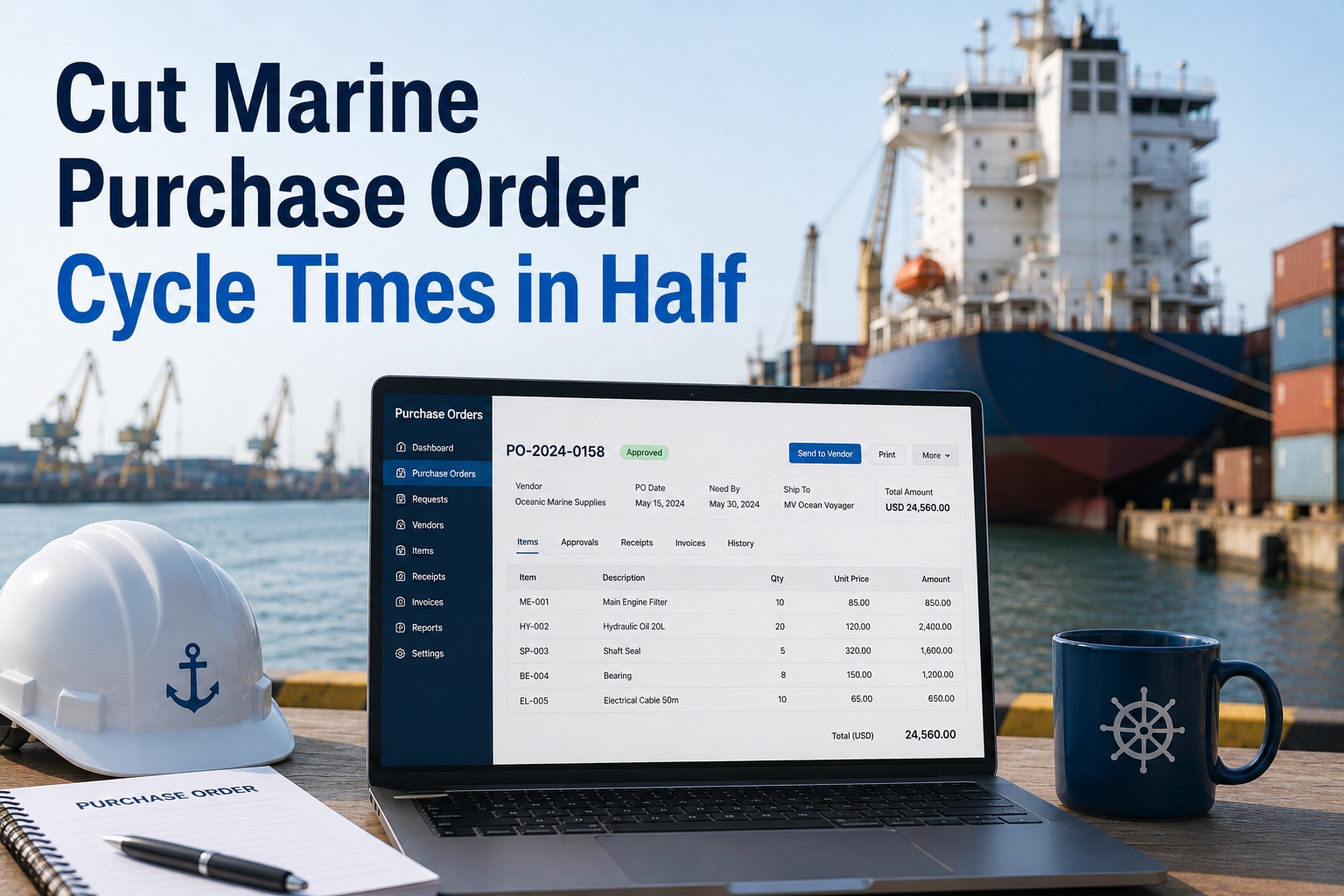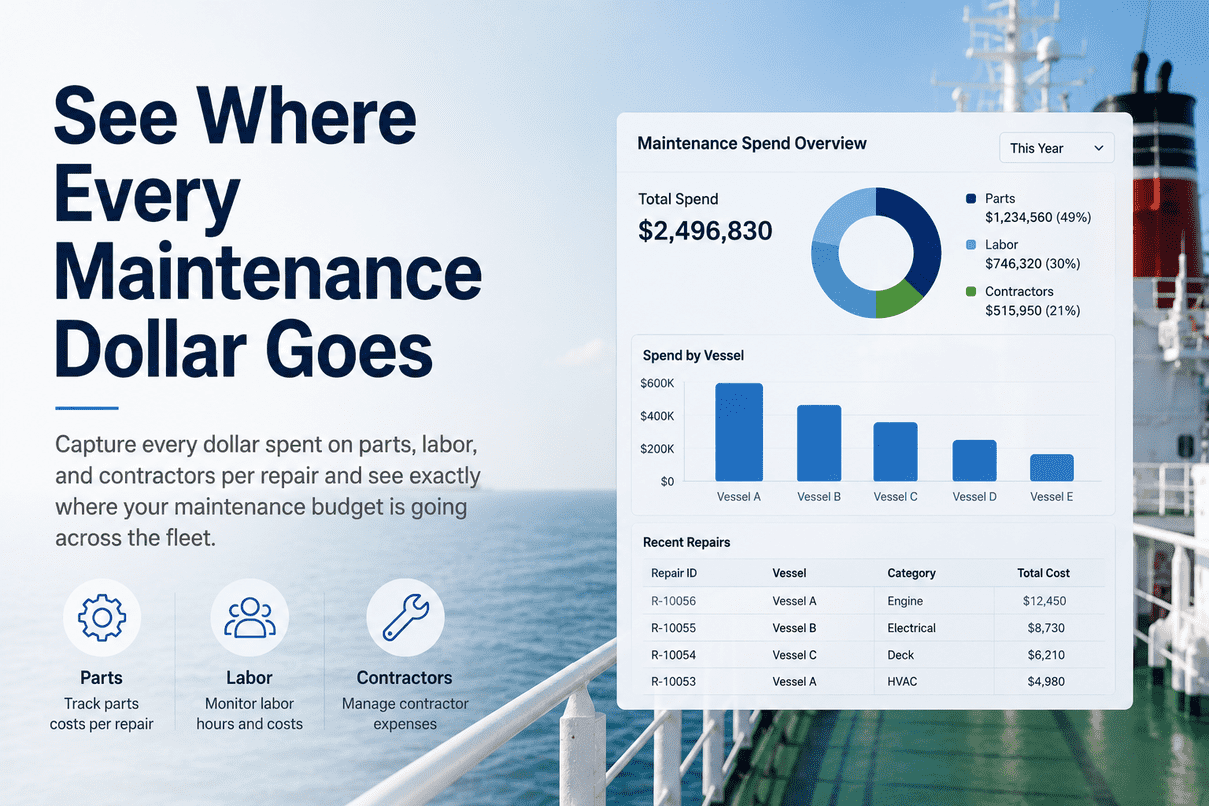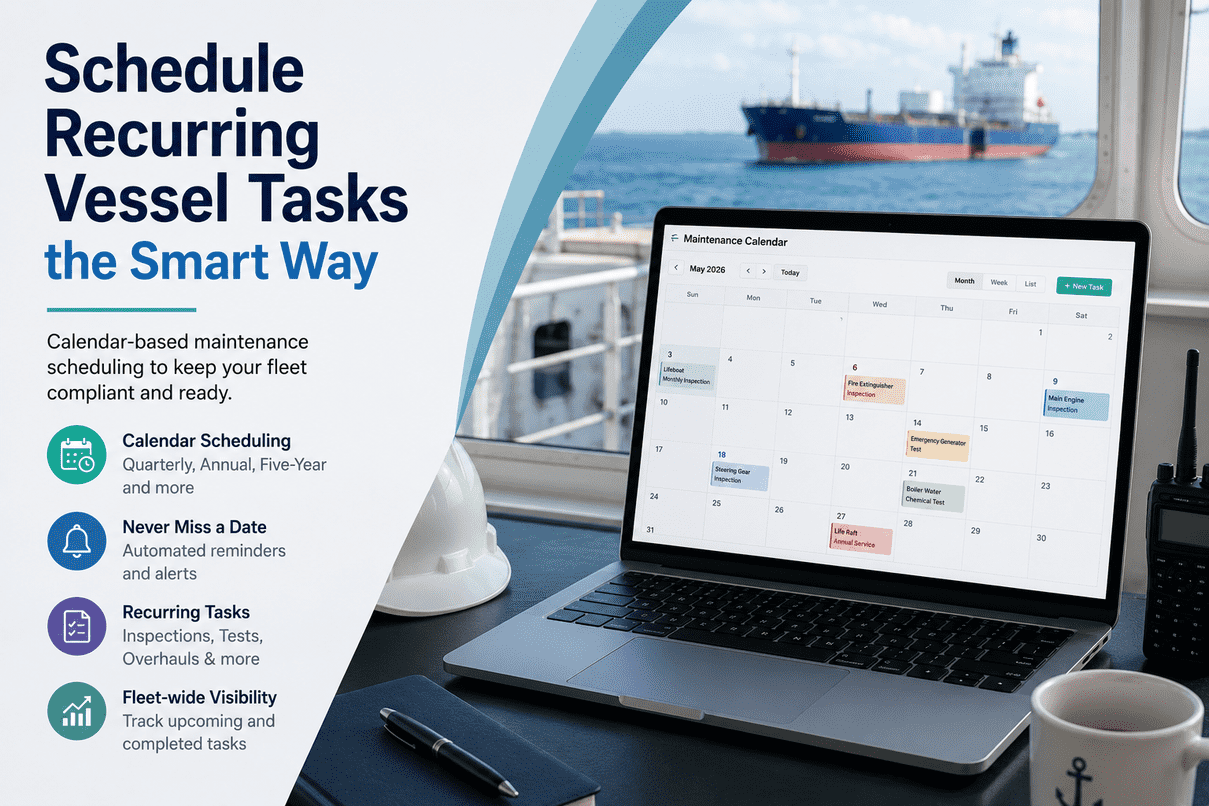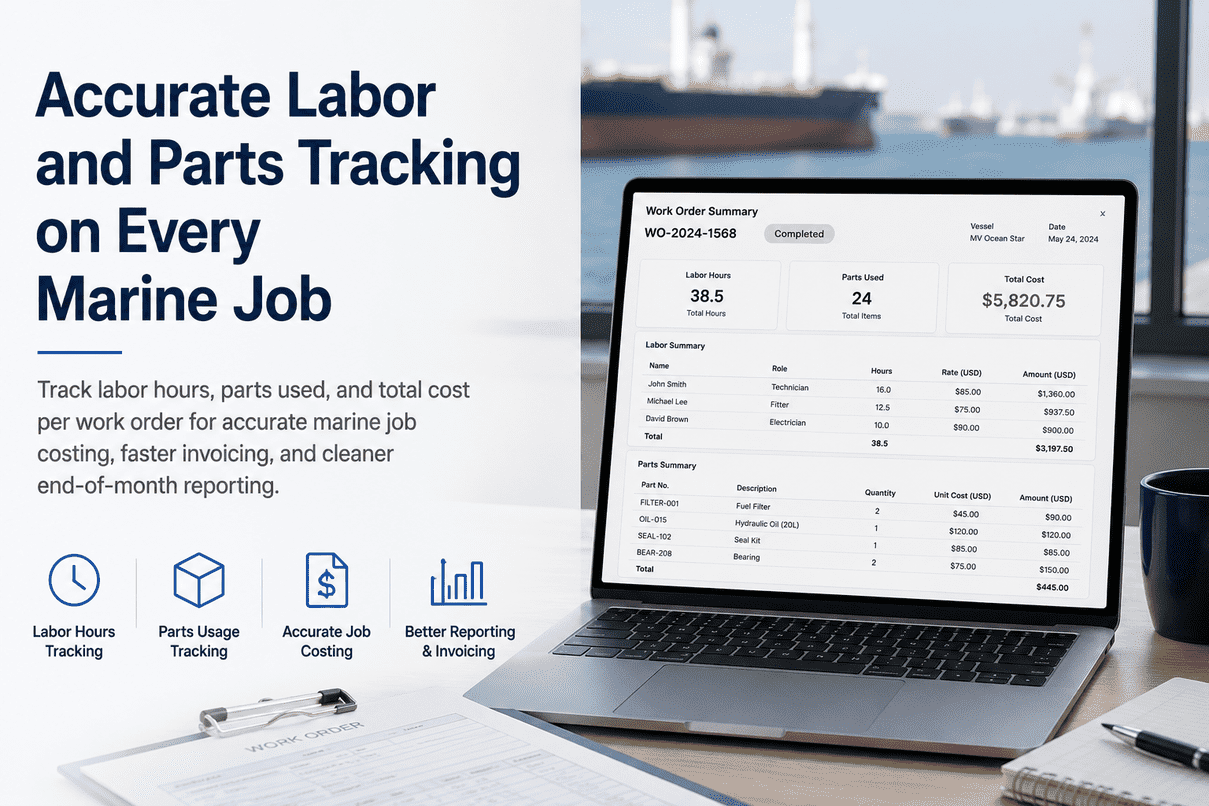
Every marine maintenance job has a true cost, and on most vessels that cost is a guess. The labor hours get rounded or reconstructed from memory at month-end, the parts get pulled from the storeroom without a part number against the job, and the contractor invoice lands weeks later disconnected from the work it paid for. The result is job costing that is fiction — close enough to file, useless for decisions. Accurate labor and parts tracking changes that by capturing two things at the point of work: the actual hours each engineer spends on each job, and the exact parts consumed from inventory against that job. Add any contractor charge and you have the one number every downstream process depends on — the true cost per work order. That single figure feeds accurate job costing, faster and defensible invoicing, cleaner month-end reporting, smarter reorder points, and evidence-based repair-versus-replace decisions. Labor is the largest single component of maintenance cost, and parts are the largest variance category, so getting these two right is most of the battle. This guide breaks down how labor and parts tracking actually works on a marine job, the data each captures, the costing math, and why the discipline pays back across the whole operation.
Why the Work Order Number Holds It All Together
Before any labor or part can be tracked accurately, every job needs a unique, sequential work order number assigned at creation. This number is the primary key that links every downstream record — parts used, labor hours, findings, costs — to one specific job. Without it, maintenance history cannot be searched, reported, or audited, and costs cannot be attributed. In a digital system the number generates automatically; on paper it depends on a numbering discipline that breaks down the moment a job card goes missing. Everything that follows in this guide hangs off that one identifier.
Labor Tracking: Capturing the Largest Cost Accurately
Labor hours represent the largest component of maintenance cost, which makes them the highest-value thing to get right. The principle is simple: engineers log time directly to each work order — clocking in and out per job rather than estimating hours afterward from memory. That actual time, multiplied by the real labor rate including overhead, gives the direct labor cost for the job.
| Data Point | What It Records | What It Enables |
|---|---|---|
| Actual hours per job | Real start and stop time clocked per work order | True direct-labor cost rather than an estimate |
| Hours per engineer | Time attributed to each technician on the job | Capacity planning and productivity insight |
| Estimated vs actual | Planned hours compared with hours taken | Estimation accuracy and interval recalibration |
| Wrench time | Hands-on work versus total clocked time | Exposes lost time from missing parts or staging |
| Total hours per asset | Labor summed across all jobs on a machine | Reveals equipment consuming disproportionate time |
The estimated-versus-actual comparison is quietly powerful. A planned job that consistently takes twice its estimated hours signals that the estimate, or the procedure, needs recalibrating — a feedback loop that sharpens planning over time. As a rule of thumb, when actual hours diverge from the standard by more than fifteen percent on a recurring basis, the standard is wrong and should be adjusted. Total labor hours summed per asset, meanwhile, exposes the machine that is silently eating technician time long before it shows up as a budget problem.
Parts Tracking: Three Jobs in One Field
Parts are the largest variance category in maintenance spend, and uncontrolled they are the most common signal of weak procurement or aging machinery. Tracking them properly means recording the part number, description, and quantity consumed against the work order — and that single act does three things at once.
The critical detail is the part number. Parts used without a part number are untrackable by inventory and uncountable by asset — they simply vanish from the data. Linking each part directly to a work order also prevents double allocation, the common failure where the same spare is claimed against two jobs and the stock count drifts out of reality. When every part is tied to a unique ID with a cost history, technicians see exactly which parts belong to each job, and managers see one consistent number across service, stores, and reporting.
| Aspect | Untracked / Loose | Tracked to Work Order |
|---|---|---|
| Cost attribution | Part cost lost in a general total | Charged to the exact job and asset |
| Inventory accuracy | Manual counts drift over time | Auto-deducted at consumption |
| Double allocation | Same part claimed twice, count wrong | Linked to one WO, prevented |
| Reorder timing | Stockouts trigger emergency shipping | Low-stock alerts before reorder point |
| Usage insight | No view of what actually gets used | Consumption history per component |
The Job Costing Math
With labor and parts captured accurately, job costing becomes simple arithmetic rather than estimation. The total cost of any work order is the sum of three streams, attributed to the asset it was spent on.
Rolled up, these figures answer the questions that control a maintenance budget: average labor hours per work order reveal work complexity and efficiency trends; total cost by asset exposes the equipment consuming disproportionate resources; and the planned-versus-reactive split makes the case for prevention, since emergency work orders routinely cost three to five times their planned equivalent. None of this analysis is possible without the underlying labor and parts data being captured cleanly at the source.
The Payoff: Where Accurate Tracking Returns the Effort
The discipline of tracking labor and parts on every job is not bureaucracy — it pays back across five distinct areas of the operation, each one a direct consequence of having clean job-level data.
How Marine Software Captures It — and Why It's Needed
The reason fleets do not track labor and parts this way on paper is that the capture has to be automatic, at the source, and resilient to the realities of a ship — or it simply does not happen. Purpose-built marine software embeds the capture into the work itself, and the maritime context is precisely why a generic tool falls short.
The deeper reason it is needed comes down to crew rotation and connectivity, the two facts that make a ship different from a workshop. Crews change every few months, so labor and parts knowledge cannot live in one engineer's head or a personal notebook — it has to live in the system. And the work happens where there is no signal, so capture must be offline and at the source. A generic, connectivity-dependent job-costing tool fails on both counts, which is why marine fleets reach for software built for the environment.
Common Tracking Mistakes and How to Avoid Them
Even fleets that intend to track labor and parts often undermine the data with a few recurring habits. Recognising them is the fastest route to clean job costing.