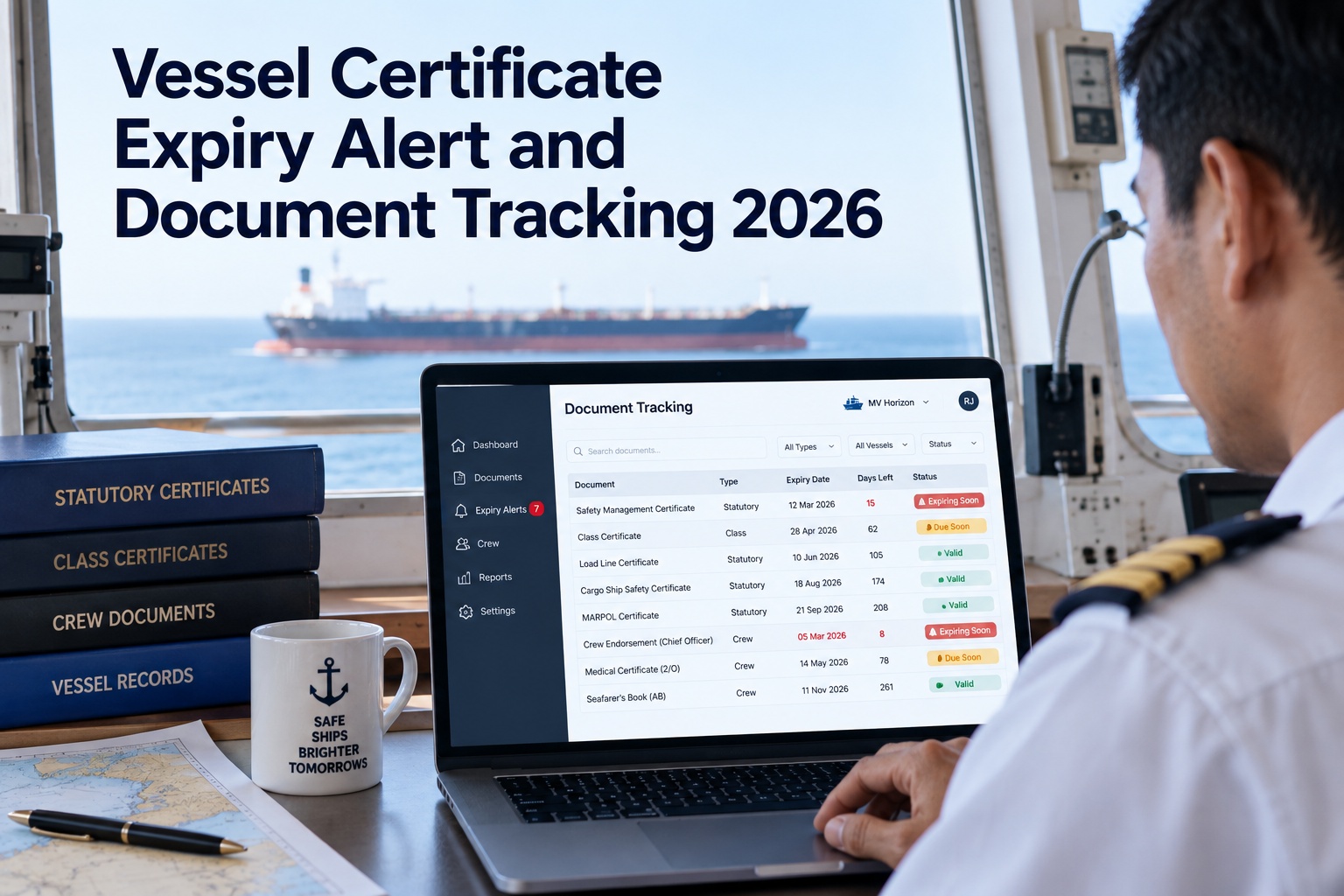
A port state control officer asks for three things before looking at anything mechanical: the crew list, the certificate file and the rest hour records. Within ten minutes she knows whether the vessel is legally crewed and whether its documentation holds. Certificates are checked at the very first stage of an inspection because they are the fastest way to assess an operation, and an expired statutory certificate is treated as a serious deficiency that frequently leads to detention until rectified — at a cost widely put in the range of twenty to fifty thousand dollars a day in lost revenue and port charges before reputational and vetting consequences are counted. What makes this category of failure so frustrating is that it is entirely foreseeable. Every certificate has a known expiry date printed on it, renewal surveys can generally be carried out up to three months early with the new certificate running from the old expiry date, and nothing about the calendar is a surprise. Lapses happen because tracking is distributed across spreadsheets, inboxes and individual memory rather than because anyone was unaware. This page covers why expiry is a system question rather than a diary question, the document classes that need tracking, the rotation-end rule most fleets get wrong, and how escalation should work.
Expiry Is a System Question
The most useful reframing available to a fleet manager is that an inspector or auditor is not really assessing whether one document lapsed. They are assessing whether the operation has a functioning method for making sure documents do not lapse, and the two are judged very differently.
A single expired certificate discovered in isolation may be raised as an observation. What escalates it into something more serious is the absence of the system behind it — no documented tracking procedure, no named person responsible for each document type, no evidence that a pre-joining check was carried out. At that point the finding is no longer about one certificate; it is about a management system that cannot demonstrate control over its own compliance position, which under the ISM framework is a considerably heavier conclusion. The same logic explains why regulatory tolerances are so often misread. Where extensions or short grace arrangements exist, they are safety nets for genuinely exceptional circumstances, not management methods, and a fleet that routinely relies on them is describing its own system failure in the record. To see what an auditor would find in your own tracking as it stands today, arrange a review session with our team.
What Actually Needs Tracking
Certificate management fails most often at the boundaries — between ship documents and crew documents, between statutory and class, between the vessel's file and the office's. A single register covering all classes in the same logic removes the gap where a class survey or inspection uncovers two systems that ignore each other.
| Document class | Typical validity | Renewal characteristics | Exposure if it lapses |
|---|---|---|---|
| Statutory ship certificates | Up to five years for cargo ships under the harmonised system, annually for passenger ships | Renewal survey generally possible up to three months early, with the new certificate running from the old expiry date | Serious deficiency, frequently detention until rectified |
| Annual and intermediate endorsements | Within a window around the anniversary date | Must be endorsed inside the window; a valid certificate without its endorsement is still a finding | Deficiency, and the certificate may be treated as invalid |
| Class certificates and conditions | Aligned to the five-year class cycle | Conditions of class carry their own separate due dates independent of survey windows | Suspension or withdrawal of class if conditions are unmet |
| Crew competency and proficiency | Commonly five years, with revalidation requirements | No grace period — expired is expired from the date printed | Seafarer cannot legally serve; among the top recurring detention causes |
| Medical and training records | Varies by certificate and administration | Training centres fill up around crew-change peaks, so booking lead time matters | Deficiency, crew change disruption, replacement flown in |
| Company documents | Document of Compliance and related instruments on defined cycles | Verification required at intervals; interim instruments have short validity | Affects the whole managed fleet, not one vessel |
The last row is the one that changes the risk calculus. Company-level documents do not fail one ship at a time — a lapse there reaches every vessel under that management, which is why company instruments deserve the same alerting discipline as the vessel-specific ones rather than being treated as an office administrative matter. To put statutory, class, crew and company documents on a single register and see how that reads, open a free trial account.
The Rotation-End Rule
Here is the mistake that produces most crew certificate failures, and it is a logical error rather than an administrative one. Fleets check that a seafarer's documents are valid on the day they join. The relevant test is whether they will still be valid on the planned end-of-rotation date, plus a buffer for a delayed relief.
A certificate expiring in month four of a four-month contract passes a joining-day check and fails in service, at which point the seafarer is technically unqualified for their designated function from the moment of expiry, aboard a vessel in the middle of a voyage. Reliefs are also routinely delayed, so a document valid to the exact rotation end date offers no margin at all. Building the check around rotation end plus buffer converts a recurring emergency into a routine planning input, and it costs nothing beyond changing which date the system compares against. There is a related point about documentation: where a certificate does expire at sea and revalidation is demonstrably under way — application submitted, training booked, service record provided — most regimes handle the situation as a requirement to complete rather than a detention. Evidence of action in progress is therefore worth as much as the renewal itself in the short term. To walk through how rotation-end checking would work against your own crewing cycle, book a short working session.
Escalation, Not Reminders
A reminder that lands in the same inbox every week becomes background noise. What distinguishes a working system is that attention escalates as the window narrows and that each stage reaches a different person with a different authority to act.
Two structural features matter as much as the thresholds. Every document type needs a named owner, because an alert addressed to everyone is addressed to no one, and that named responsibility is itself part of the evidence an auditor looks for. And the office needs a standing forward view — the next sixty days of expiries across the whole fleet on one screen — so the position is known continuously rather than assembled when someone asks. To configure staged thresholds and named owners against your own documents, start a free trial.
Early Renewal Costs Nothing
One detail deserves emphasis because it removes the main argument for leaving renewals late. Renewal surveys can generally be carried out up to three months before expiry, and where the survey is completed inside that window, the new certificate runs from the old expiry date rather than from the survey date.
That means acting early does not shorten the certificate's life. The three months are not consumed, surrendered or wasted — the fleet simply gains three months of scheduling flexibility for free, allowing the survey to be arranged where the vessel happens to be trading and where attendance is straightforward rather than wherever it finds itself when the deadline arrives. Fleets that treat the window as usable planning space rather than as a buffer of last resort remove most of the scramble from the process. The same logic applies to crew documents, where the constraint is usually training-centre availability rather than the certificate itself. To see how early-window planning would change your survey scheduling, request a walkthrough.
Where Alerting Belongs in the Platform
Certificate alerting is only as good as its connection to the rest of the operation. As a standalone reminder tool it produces notifications; embedded in the inspection and maintenance system it produces decisions.
That final point closes the loop back to where this page began. The tracking system is not only the mechanism that prevents a lapse; it is the evidence that a mechanism exists, which is what turns a potential system-level finding into an isolated observation on the rare occasion something does slip. To see the full certificate workflow end to end on your own fleet data, reserve a session with a specialist.