A fleet operating out of Dubai, Fujairah and Abu Dhabi answers to more authorities than a fleet trading anywhere in Europe, and the reporting lines are not parallel. There is the federal registry, the emirate-level maritime authority where the vessel is licensed, the port authority at each terminal, the classification society, and the flag administration if the vessel is not UAE-flagged. Each has its own documentation, its own inspection expectations and its own renewal cycle, and none of them maintains a view of the others. That alone makes a single fleet record more valuable here than in most markets. Then there is the water itself. The Arabian Gulf runs hotter and saltier than open ocean, marine growth accumulates faster, seawater temperatures reduce cooling margins through the summer, and airborne dust finds its way into every filter and cooler on board. Maintenance intervals calculated for temperate operation do not survive contact with a Gulf summer. This page covers the regulatory landscape a UAE operator actually works within, what Gulf conditions do to maintenance and inspection planning, the specific documentation around bunkering and anchorage, and what to require from a system managing all of it.
Regional guide · United Arab Emirates
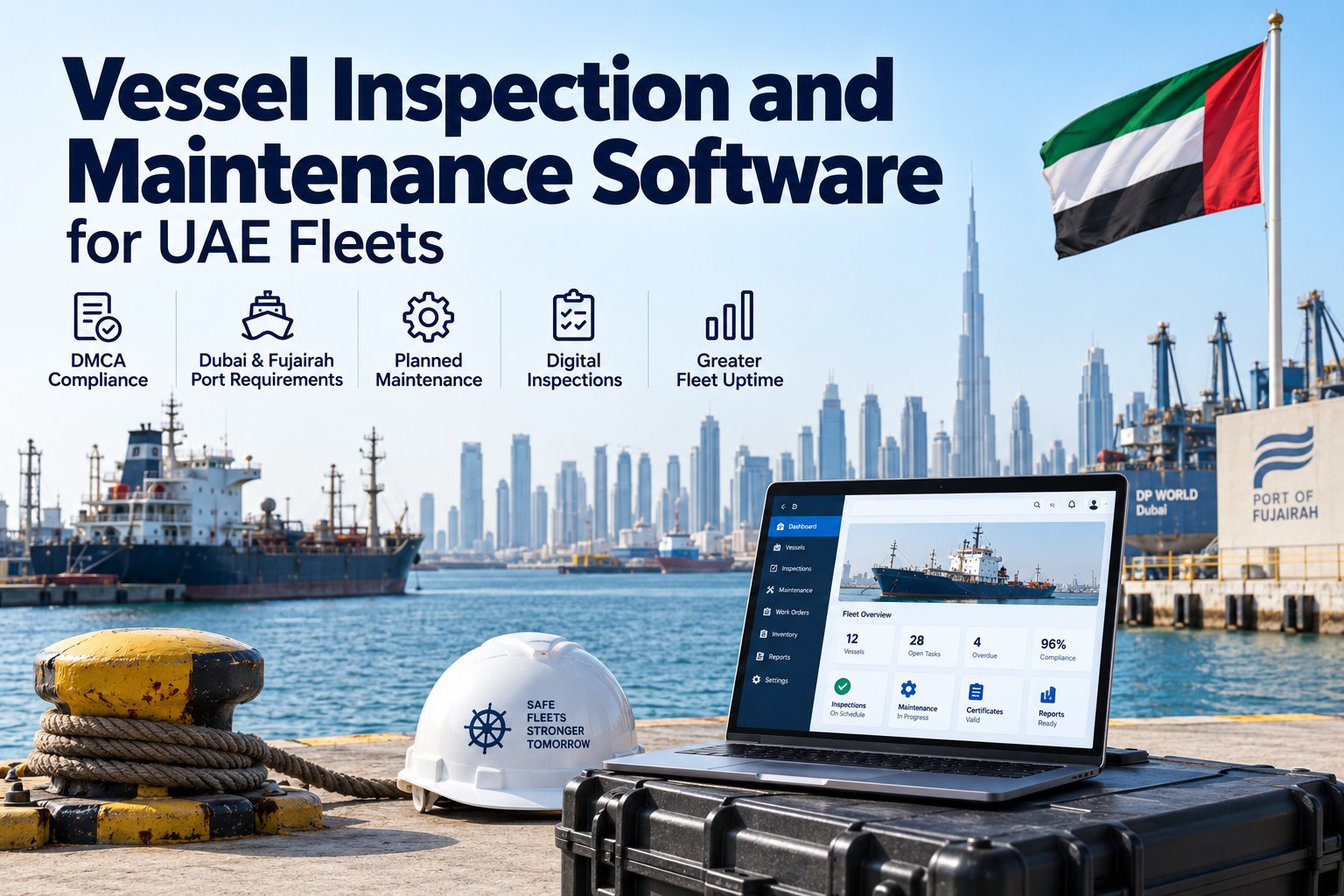
Vessel Inspection and Maintenance Software for UAE Fleets
Built for operators working across Dubai, Fujairah and Abu Dhabi — multiple authorities, overlapping documentation, and maintenance intervals that have to survive a Gulf summer.
Two Registries, One Fleet
The first structural feature to understand is that UAE vessel registration operates at two levels, and which applies depends on the vessel and where it is based.
The Federal Transport Authority for Land and Maritime functions as the national ship registry, while vessels operating in Dubai are registered and licensed through the emirate's own maritime authority, widely known by its earlier designation as the Dubai Maritime City Authority. Registration requirements are set out in the federal maritime commercial law enacted in 2023, which replaced the long-standing earlier code, and in practice both routes require an inspection by an approved body or surveyor confirming the vessel meets technical and safety standards before a certificate is issued. Licensing through the Dubai authority runs as a two-stage process combining online registration with a physical inspection against a published checklist. For operators running mixed fleets — some vessels federally registered, some licensed at emirate level, some under foreign flag — this produces three parallel documentation sets with different renewal rhythms, which is precisely the situation where a consolidated register earns its keep. If your fleet spans more than one of these routes, mapping your current documentation across them in a single session usually clarifies where the gaps sit.
A note on currency
UAE maritime requirements have been actively revised in recent years, including the federal maritime commercial law and the technical standards applied at registration, and requirements differ between emirates. Anything on this page should be treated as orientation rather than as a substitute for confirming current requirements directly with the relevant authority, your classification society or your local agent before acting.
The Authorities a UAE Operator Answers To
Understanding who asks for what is half of compliance planning in this market. The table below sets out the bodies most operators deal with and what each typically wants to see.
| Authority | Typical scope | What it examines |
|---|
| Federal maritime authority | National ship registry and federal maritime regulation | Registration, seaworthiness inspection by approved surveyor, statutory certification, anchorage and traffic regulation |
| Emirate maritime authority | Vessel licensing and local operations within the emirate | Registration and licensing against a published inspection checklist, operating permits, local rules and circulars |
| Port authorities | Terminal and port-specific operations | Port entry documentation, local safety requirements, terminal-specific procedures and permissions |
| Classification society | Class survey and technical standards | Survey cycle, conditions of class, thickness measurement, machinery and structural condition |
| Flag administration | Where the vessel is not UAE-flagged | Statutory certificates, flag circulars, annual safety inspection under that flag's regime |
| Port state control | Foreign-flagged vessels calling at UAE ports | Convention compliance, certificate validity, operational verification, deficiency rectification |
The commercially significant point is the overlap. A single vessel may hold documentation issued by three or four of these bodies simultaneously, each with its own validity period, and an expiry in any one of them can halt operations regardless of how current the others are. Fleets tracking each authority in a separate file rarely have a reliable answer to the only question that matters, which is what falls due next across the whole fleet.
See every authority's paperwork in one forward view
Bring your vessel list and current certificate set. We will build the register, apply the renewal cycles for each issuing body, and show you the next ninety days across the fleet — which is usually the first time an operator sees all of it in one place.
What the Gulf Does to Maintenance Intervals
Maintenance schedules supplied by equipment makers generally assume temperate operation. The Arabian Gulf is not temperate, and the difference is large enough to change planning rather than merely to warrant caution.
Heat and cooling margin
Sustained summer air and seawater temperatures reduce the effectiveness of every cooling circuit aboard. Coolers foul faster, machinery runs closer to its limits, and equipment rated comfortably elsewhere operates with far less headroom here.
Salinity and corrosion
Gulf waters carry higher salinity than open ocean, accelerating corrosion of exposed steel, fittings and coatings. Inspection intervals for hull and deck structure that suit temperate trading may leave too long a gap here.
Marine growth
Warm water supports rapid fouling on hulls, sea chests and cooling intakes, with consequences for fuel consumption and for cooling performance in exactly the season when margins are already thin.
Dust and airborne particulate
Regional dust reaches air filters, ventilation and machinery spaces continuously and heavily during dust events. Filter intervals set for cleaner air are among the first schedules that need shortening.
None of this argues for guesswork. It argues for maintenance intervals set from observed condition in these waters rather than inherited from a manual, which requires consumption and findings history accumulating consistently against each component. That is the practical reason a maintenance record matters more in this environment than in gentler ones — and building a condition history against your own equipment over a season is what turns an assumption into an interval you can defend to a surveyor.
Bunkering, Anchorage and Local Permissions
Two areas generate more region-specific documentation than anything else for operators here, and both are worth handling systematically rather than per occasion.
Bunkering in Dubai operates under defined conditions, and the published requirements are specific enough to check against a vessel before a fixture rather than at the quayside. They include the vessel not being subject to an entry prohibition, holding a local shipping agent, carrying valid classification from a recognised body, and age-related conditions — tankers required to be double-hulled and within a stated maximum age, with older craft required to be classed by a member of the international association of classification societies. Authority inspectors are entitled to attend and verify compliance with safety and marine rules, and operations can be postponed on weather grounds. Fujairah's position as one of the world's major bunkering anchorages means many operators encounter these requirements frequently, and a fleet able to confirm each condition from its own records before committing avoids the expensive version of the conversation.
Anchorage is similarly regulated at federal level, with circulars setting out how merchant vessels are to conduct themselves in UAE anchorages. Because these are issued as circulars rather than embedded in a single code, they are easy to miss and tend to accumulate, which makes a habit of mapping each new circular against the affected vessels worth establishing. It is the same discipline that flag circulars require, applied to a local regulator.
What a UAE Fleet Should Require
The regional characteristics translate into a fairly specific set of requirements, several of which would be optional elsewhere.
01One certificate register covering federal, emirate, port, class and flag documentation together, with renewal cycles applied per issuing body rather than per vessel
02Maintenance intervals adjustable from observed condition, so Gulf-adjusted schedules replace manufacturer defaults with evidence behind the change
03Offline capture, because inspection work happens in engine rooms and at anchorage where connectivity is unreliable regardless of coverage ashore
04Multi-language support, since crews here are typically mixed-nationality and checklist comprehension directly affects data quality
05Evidence packs that can be produced quickly for whichever authority asks, in a form a third party can rely on
06A way to map incoming circulars and local requirements to the specific vessels they affect, rather than filing them by issuing body
The fourth deserves particular emphasis in this market. Crews operating from UAE ports are drawn from across South Asia, Southeast Asia, the Middle East and Eastern Europe, and a checklist item understood only partially produces a confident answer rather than a query — which degrades the record silently. Language support is therefore a data-quality control here rather than a convenience, and seeing a checklist run in your crew's own languages is worth including in any evaluation.
Frequently Asked Questions
Who registers vessels in the UAE?
Registration operates at two levels. The federal transport authority responsible for land and maritime matters functions as the national ship registry, while vessels operating in Dubai are registered and licensed through the emirate's own maritime authority, still widely referred to by its earlier name. Requirements derive from the federal maritime commercial law enacted in 2023, which replaced the long-standing earlier code. Both routes generally require inspection by an approved body or surveyor confirming the vessel meets technical and safety standards before certification is issued, and the Dubai route runs as a two-stage process combining online registration with a physical inspection against a published checklist. Requirements differ between emirates and change over time, so confirm current specifics with the relevant authority.
Map your fleet's registration routes with our team.
Why is documentation harder to manage for a UAE fleet?
Because the reporting lines are not parallel. A single vessel may hold documentation issued by a federal authority, an emirate maritime authority, one or more port authorities, a classification society and, where it is not UAE-flagged, a foreign flag administration — each with its own validity period, renewal process and expectations, and none maintaining any view of the others. An expiry in any one of them can halt operations regardless of how current the rest are. Fleets tracking each authority in a separate spreadsheet or folder rarely have a reliable answer to the question that actually matters, which is what falls due next across the whole fleet. Consolidating them into one forward view is usually the first substantial gain.
Load your certificate set and see the next ninety days.
Do Gulf conditions really change maintenance planning?
Materially, yes. Manufacturer maintenance schedules generally assume temperate operation, and the Arabian Gulf is not temperate. Sustained summer air and seawater temperatures reduce cooling effectiveness across every circuit aboard, so machinery runs with less headroom and coolers foul faster. Higher salinity accelerates corrosion of exposed steel, fittings and coatings. Warm water supports rapid marine growth on hulls, sea chests and cooling intakes, affecting both fuel consumption and cooling performance in the season when margins are already thin. Regional dust loads air filters and ventilation continuously, heavily during dust events. The response is not guesswork but intervals set from observed condition in these waters, which requires findings and consumption history accumulating consistently per component.
Discuss Gulf-adjusted intervals for your equipment.
What should we check before a bunkering operation in Dubai?
Published requirements are specific enough to verify against a vessel before committing rather than at the quayside. They include that the vessel is not subject to an entry prohibition through an official circular, that a local shipping agent is appointed, and that the vessel holds valid classification from a recognised body. Age-related conditions apply — tankers are required to be double-hulled and within a stated maximum age, and craft above that age must be classed by a member of the international association of classification societies. Authority inspectors are entitled to attend and verify compliance with safety and marine rules, and operations may be postponed on weather grounds. Given Fujairah's role as a major bunkering anchorage, most regional operators meet these requirements often. Confirm current conditions with the authority.
Track these conditions per vessel in a trial.
How should local circulars be handled?
The same way flag circulars should be, which is by mapping each one to the specific vessels it affects at the point of receipt rather than filing it by issuing body for later interpretation. Anchorage conduct in UAE waters, for example, has been addressed through federal circulars rather than being embedded in a single consolidated code, so requirements accumulate over time and are easy to miss. The practical risk in a mixed fleet is that a circular applies to some vessels and not others, gets actioned on those where someone happened to notice, and is quietly missed on the rest. Deciding affected vessels immediately, assigning an owner, and recording the action taken turns a stream of circulars into a managed obligation.
See how circulars map to affected vessels.
What matters most for mixed-nationality crews here?
Checklist comprehension, because it affects data quality invisibly. Crews operating from UAE ports are typically drawn from South Asia, Southeast Asia, the Middle East and Eastern Europe, and an officer whose working English is adequate for daily operations may still read a technically worded inspection item only partially. The failure is silent: rather than leaving a blank or raising a query, they answer confidently on partial understanding, and that answer enters the record as verified fact. Displaying checklists, guidance and defect screens in the crew member's own language removes reading comprehension as a variable, while the record and reports remain in English for authorities and class. Offline availability of those language packs matters equally, since inspections happen where there is no signal.
Try a checklist in your crew's languages.
Built for How Fleets Actually Operate Here
Federal registry, emirate authority, port authorities, class and flag — each with its own paperwork and none aware of the others, in water that corrodes, fouls and overheats machinery faster than the maintenance manual assumed. Marine Inspection holds every authority's documentation in one forward view, captures inspections offline in the crew's own language, adjusts maintenance intervals from observed condition, and produces evidence packs quickly for whoever asks. Bring your vessel list and current certificates and we will build the register with you.