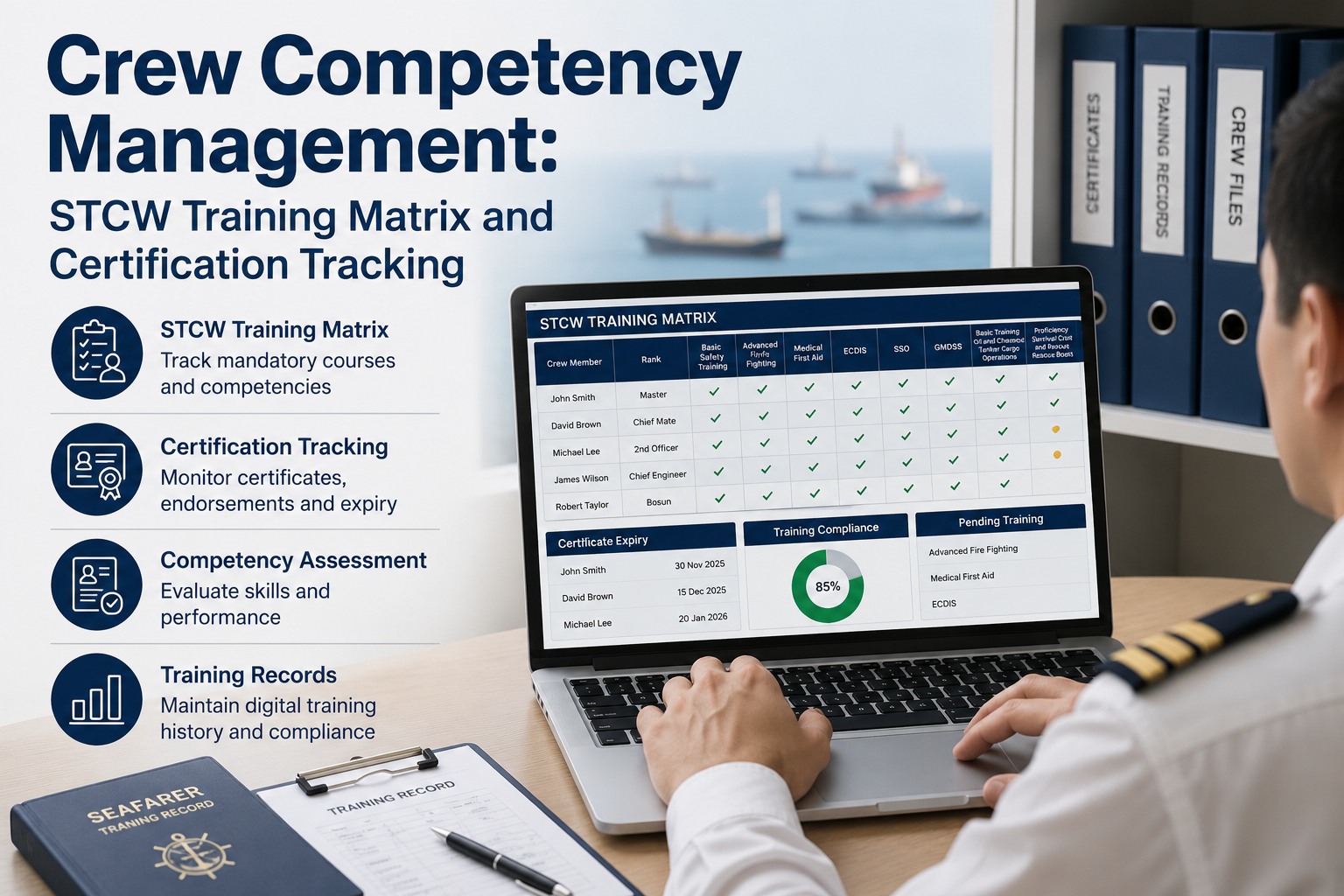
STCW puts people, not equipment, on the front line of maritime safety. Research consistently shows 80 to 85 percent of maritime accidents involve human error — making the Standards of Training, Certification and Watchkeeping Convention the single most consequential framework in commercial shipping. 164 contracting countries enforce STCW through flag state certification and Port State Control. The 2026 environment tightens the bar. IMO Resolution MSC.560(108) effective 1 January 2026 amends Table A-VI/1-4 to add a new mandatory competence on prevention of and response to violence and harassment including sexual harassment, bullying, and sexual assault. The comprehensive STCW review launched in 2024 identified over 400 gaps with a full revision expected by 2027. Manila Amendments (2010) brought mandatory 5-year refresher training for Basic Safety. Special training requirements proliferate — tanker, Ro-Ro, polar, IGF Code, GMDSS, dynamic positioning. Each seafarer carries a stack of certificates with independent expiry dates, refresher cycles, and flag state endorsements. Port State Control verifies certificates, endorsements, and watchkeeping compliance with deficiencies resulting in detention. Insurance underwriters and charterers vetting inspectors enforce the same standard from the commercial side. STCW compliance software replaces spreadsheet drift with per-seafarer certificate tracking, refresher cycle automation, watchkeeping rest hours monitoring, and audit pack assembly. Book a 30-minute STCW demo to see crew certificate tracking on your fleet.
STCW Compliance Software · 2026
Every Seafarer Certified. Every Refresher Tracked. Every Watchkeeping Hour Logged.
Per-seafarer STCW certificate stack tracking, 5-year refresher cycle automation, watchkeeping rest hours compliance, charterer vetting evidence pack.
M/V Pacific Star · Crew STCW Status
28 May · 32 crew tracked
Rank
CoC
BST
AFF
Med
Refresh
Chief Officer
OK
OK
OK
WARN
22mo
Chief Eng
OK
OK
OK
OK
36mo
AB Deck
N/A
OK
OK
OK
28mo
2 alerts · 2 warnings · 1 PSSR refresher per MSC.560(108) Jan 2026
The STCW Certificate Stack Every Seafarer Carries
STCW certification is not one document — it is a stack of independent certificates and endorsements with their own validity periods, refresher cycles, and flag state recognition. Every seafarer must carry the complete stack appropriate to rank and vessel type. A credible platform tracks each certificate as an individual item with countdown to expiry.
CoC
Certificate Of Competency
The senior certificate confirming the holder meets STCW competency standards for a specific rank — Master, Chief Officer, OOW Navigational, Chief Engineer, OOW Engineering, ETO. Issued by flag state. 5-year validity with documentary evidence of recent seagoing service for renewal.
CoP
Certificate Of Proficiency
Specific competency certificates for training categories — Basic Safety Training (PST, FPFF, EFA, PSSR), Advanced Firefighting (AFF), Proficiency in Survival Craft and Rescue Boats (PSCRB), Medical First Aid, Medical Care, Security Awareness, Designated Security Duties.
Special
Specialised Training
Vessel-specific or operation-specific certificates — Tanker Familiarisation, Oil Tanker Advanced, Chemical Tanker Advanced, Gas Tanker Advanced, Ro-Ro Passenger, Polar Code Basic and Advanced, IGF Code Basic and Advanced, Dynamic Positioning Operator.
GMDSS
Radiocommunication Certificate
GMDSS General Operator's Certificate (GOC) or Restricted Operator's Certificate (ROC) per Sea Area operations. STCW Chapter IV. Annual radio survey requires GMDSS-certificated officer aboard. Flag-state-issued.
Medical
Seafarer Medical Fitness
Medical fitness certificate per STCW Regulation I/9 and MLC 2006 Standard A1.2. Issued by flag-approved medical practitioner. Valid maximum 2 years (1 year if under age 18). Eye and colour vision standards. Annual checks for some roles.
The Five-Year Refresher Cycle Mechanics
The 2010 Manila Amendments brought a mandatory 5-year refresher cycle for Basic Safety Training and selected other STCW certificates. The refresher requirement is the single largest source of crew compliance drift and PSC findings. Seafarers move between vessels, between companies, between flag states — each move resets administrative tracking but not the refresher clock. Book a refresher-cycle walkthrough demo to see fleet-wide refresher status on real crew data.
R1
Basic Safety Training Refresher
PST and FPFF require documentary evidence of refresher training every 5 years per A-VI/1-1 and A-VI/1-2. EFA and PSSR exempt from refresher requirement under the 2010 amendments.
R2
Advanced Firefighting Refresher
AFF certificate (A-VI/3) requires refresher every 5 years. Applies to all officers with firefighting responsibility on board. PSC verifies AFF refresher at vessel boarding for relevant rank.
R3
PSCRB & Fast Rescue Boats
Proficiency in Survival Craft and Rescue Boats (A-VI/2-1) and Fast Rescue Boats (A-VI/2-2) require 5-year refresher. Held by senior officers and lifeboat crew.
R4
Medical First Aid & Care
Medical First Aid (A-VI/4-1) and Medical Care (A-VI/4-2) require 5-year refresher. Medical Care held by Master, Chief Officer, and designated medical responder.
R5
Tanker Advanced Training
Oil, Chemical, and Gas Tanker Advanced training (A-V/1-1, A-V/1-2, A-V/2) requires refresher or 3 months sea service every 5 years. Documentary evidence required for endorsement renewal.
The Refresher Training Intervals Matrix
The matrix below maps each STCW refresher requirement to its validity period, refresher trigger, and the evidence flag states and PSC inspectors verify. Scroll horizontally on mobile for the full view.
| Training |
Validity |
Refresher Trigger |
Provider |
Evidence Required |
| Personal Survival (PST) |
5 years |
Every 5 years |
STCW-approved centre |
Refresher certificate |
| Fire Prevention (FPFF) |
5 years |
Every 5 years |
STCW-approved centre |
Refresher certificate |
| Elementary First Aid |
Lifetime (post-2010) |
No refresher required |
STCW-approved centre |
Original certificate |
| PSSR (new 2026 module) |
Lifetime (with update) |
MSC.560(108) anti-harassment |
STCW-approved centre |
Updated PSSR after Jan 2026 |
| Advanced Firefighting |
5 years |
Every 5 years |
STCW-approved centre |
AFF refresher certificate |
| PSCRB |
5 years |
Every 5 years |
STCW-approved centre |
PSCRB refresher certificate |
| Fast Rescue Boats |
5 years |
Every 5 years |
STCW-approved centre |
FRB refresher certificate |
| Medical First Aid |
5 years |
Every 5 years |
Approved medical training |
Medical refresher cert |
| Tanker Advanced |
5 years |
Refresher OR 3mo sea service |
STCW + flag state |
Endorsement renewal |
| Security Officer |
5 years |
Every 5 years |
RSO-approved provider |
SSO refresher certificate |
| GMDSS GOC/ROC |
5 years |
Every 5 years (FCC for US) |
Flag-licensed |
Annual radio survey |
| Medical Fitness |
Max 2 years (1yr under 18) |
Every cycle |
Flag-approved physician |
Medical fitness certificate |
Watchkeeping And Rest Hours Compliance
STCW Chapter VIII and the STCW Code Part A Chapter VIII set mandatory watchkeeping arrangements and minimum rest hours. MLC 2006 Standard A2.3 sets parallel rest hour requirements. The two regimes converge — and the convergence is where compliance most frequently breaks down. The four watchkeeping disciplines below must be tracked continuously, not retrospectively reconstructed before audit.
Rest Hours
Minimum Rest Hours Per Period
Minimum 10 hours rest in any 24-hour period and 77 hours rest in any 7-day period. Rest may be divided into no more than 2 periods, one of which at least 6 hours. Drills permitted to disturb rest but must allow compensatory rest.
Watch System
Watchkeeping Structure
Three-watch system standard — 0000-0400 / 0800-1200 / 1200-1600 / 1600-2000 / 2000-0000. Two-watch system permitted under specific conditions with compensating rest. Bridge and engine room watch structures separate.
Recording
Rest Hours Recording
Schedule of rest hours posted in working language plus English. Records of daily hours of rest of seafarers maintained in standardised format. Records signed by seafarer and by master or master's designate.
PSC Check
PSC Rest Hours Verification
PSC inspectors examine rest hours records during inspections. Non-compliance with STCW Chapter VIII and MLC 2006 A2.3 a recurring PSC finding. Three months of historical records typically requested.
The 2026 STCW Amendments And Special Training Matrix
The 2026 STCW environment combines the MSC.560(108) anti-harassment amendments with the comprehensive review and an expanding catalogue of special training requirements per vessel type. The matrix below maps the current 2026 state. Mobile users scroll horizontally for the full view.
| Amendment / Training |
Reference |
Effective |
Scope |
Tracking Action |
| Anti-Harassment Module |
MSC.560(108) · A-VI/1-4 |
1 January 2026 |
New BST courses from Jan 2026 |
Updated PSSR module verified |
| Comprehensive Review |
2024 IMO review · 400+ gaps |
Full revision expected 2027 |
All STCW chapters |
Monitor draft texts at MSC |
| Polar Code Basic |
STCW Chapter V/4 |
2017 in force |
Ships in polar waters |
Officer Polar Basic certificate |
| Polar Code Advanced |
STCW Chapter V/4 |
2017 in force |
Master + officers polar |
Polar Advanced certificate |
| IGF Code Basic |
STCW Chapter V/3 |
2018 in force |
Crew on IGF Code ships |
IGF Basic certificate |
| IGF Code Advanced |
STCW Chapter V/3 |
2018 in force |
Officers and crew with duties |
IGF Advanced certificate |
| Ro-Ro Passenger Familiarisation |
STCW V/2 |
2010 amendments |
Ro-Ro passenger ships |
Familiarisation per role |
| Dynamic Positioning Operator |
STCW IMO MSC.1/Circ.738/Rev.2 |
2014 updated guidance |
DP-class vessels |
DP operator certificate |
| ETO Recognition |
STCW Chapter III/6 |
Manila 2010 in force 2012 |
Electro-Technical Officer |
ETO CoC tracked separately |
| Security Officer |
STCW VI/5 · ISPS |
2010 in force 2012 |
Designated Ship Security Officer |
SSO 5-year refresher |
STCW Demo · 30 Minutes · No Commitment
See Crew Certificate Tracking On Your Actual Fleet
A 30-minute session with a Marine Inspection product expert. Bring your current crew matrix and recent vetting findings. Walk through certificate stack tracking, 5-year refresher automation, watchkeeping rest hours compliance, 2026 amendments coverage, and PSC and charterer vetting defence pack on real crew data.
Why Crew Training Spreadsheets Fail Every Charterer Vetting
Charterer vetting inspectors (SIRE 2.0, CDI, RightShip) inspect crew certification with the same rigour as Port State Control — often more. The crew matrix spreadsheet fails the vetting test for six recurring reasons. Each reason is structurally solved by purpose-built compliance software.
F1
Crew Rotation Resets Tracking
New joiner replaces sign-off seafarer. New seafarer's certificates entered into spreadsheet. Previous tracking lost. Pattern repeats every crew change. Cumulative refresher dates drift further from reality every rotation.
F2
Refresher Dates Calculated Wrong
5-year refresher window calculated from issue date in spreadsheet but flag state issue date differs by months from course completion. Refresher counted as compliant on incorrect date. Vetting inspector recalculates and finds gap.
F3
Endorsement Versus Certificate Confusion
Certificate of Competency valid. Flag state endorsement under SOLAS V/19 expired separately. Crew member technically uncertified for vessel type. Spreadsheet tracks one date, not both. The vessel sails uncovered.
F4
Special Training Coverage Gaps
Tanker fleet adds container vessel to operations. ETO joins. IGF Code-fuelled vessel arrives. Polar route added. New training requirements introduced for which the spreadsheet has no column. Coverage gaps surface at audit.
F5
Rest Hours Records Reconstructed
Daily rest hours captured in deck logbook. Compilation requested by vetting inspector. 3 months of records reconstructed from logbook in 48 hours. Reconstruction itself reveals MLC 2006 A2.3 non-compliance.
F6
Medical Fitness Slipping Between Visits
Medical fitness certificate valid maximum 2 years (1 year under age 18). Crew member returns from leave. Medical lapsed. Vessel sails. Vetting inspector requests verification at next port. Vessel detained or rejected.
Marine Inspection's STCW Architecture
Marine Inspection's STCW layer is structured to track every seafarer as an individual entity with their own certificate stack, refresher cycle, watchkeeping log, and audit history rather than as rows in a fleet spreadsheet. Four architectural layers handle the regulatory complexity. Book a crew architecture walkthrough demo to apply the platform to your fleet. Start a free trial to evaluate against your current crew spreadsheet.
Layer 1
Per-Seafarer Certificate Stack
Every seafarer tracked as an entity with their full certificate stack — CoC, CoP, special training, GMDSS, medical fitness, flag state endorsements. Each certificate is an individual tracked item with its own issue date, validity, refresher trigger, and alert chain.
Layer 2
Refresher Cycle Automation
5-year refresher windows calculated from course completion not certificate issue date. Refresher booking flows to approved training centres. Alerts at 90 days, 30 days, expiry. Training centre certificate upload direct to seafarer record.
Layer 3
Watchkeeping Rest Hours Engine
Daily rest hours captured per seafarer at point of duty. STCW Chapter VIII and MLC 2006 A2.3 thresholds enforced — minimum 10 hours in 24, minimum 77 hours in 7-day period. Compensatory rest tracking when drills disturb rest. PSC-ready three-month export.
Layer 4
Vetting Defence Pack Engine
SIRE 2.0, CDI, RightShip, or PSC inspector arrives. Master pulls complete STCW defence pack — full crew certificate matrix, refresher history, watchkeeping rest records, medical fitness validity, training centre certificates — in a single export in minutes.
Frequently Asked Questions
What does STCW compliance software do?
STCW compliance software tracks every seafarer as an individual entity with their own certificate stack, refresher cycle, watchkeeping log, and audit history. Five certificate categories covered — Certificate of Competency (CoC) for officer ranks, Certificate of Proficiency (CoP) for training categories like Basic Safety Training and Advanced Firefighting, Specialised Training certificates for tanker / Ro-Ro / polar / IGF Code / dynamic positioning, GMDSS Operator's Certificate per STCW Chapter IV, and Seafarer Medical Fitness per STCW Regulation I/9 and MLC 2006 Standard A1.2. Five-year refresher cycle automation per Manila 2010 amendments with windows calculated from course completion rather than certificate issue date. Watchkeeping rest hours engine enforcing STCW Chapter VIII and MLC 2006 A2.3 thresholds — minimum 10 hours in 24 and minimum 77 hours in 7-day period. 2026 amendments coverage including MSC.560(108) anti-harassment module. Vetting defence pack for SIRE 2.0, CDI, RightShip, and PSC in single export.
What certificates does every seafarer carry?
STCW certification is a stack of independent certificates with their own validity periods. Certificate of Competency (CoC) confirms the holder meets STCW competency standards for a specific rank — Master, Chief Officer, OOW Navigational, Chief Engineer, OOW Engineering, ETO. Issued by flag state. 5-year validity with documentary evidence of recent seagoing service for renewal. Certificate of Proficiency (CoP) for training categories — Personal Survival Techniques (PST), Fire Prevention and Fire Fighting (FPFF), Elementary First Aid (EFA), Personal Safety and Social Responsibilities (PSSR), Advanced Firefighting (AFF), Proficiency in Survival Craft and Rescue Boats (PSCRB), Medical First Aid, Medical Care, Security Awareness, Designated Security Duties. Specialised Training — Tanker Familiarisation plus Oil/Chemical/Gas Tanker Advanced, Ro-Ro Passenger, Polar Code Basic and Advanced, IGF Code Basic and Advanced, Dynamic Positioning Operator. GMDSS GOC or ROC per Sea Area. Seafarer Medical Fitness valid maximum 2 years (1 year if under 18).
What did the 2026 STCW amendments change?
IMO Resolution MSC.560(108) effective 1 January 2026 amends Table A-VI/1-4 of the STCW Code adding a new mandatory competence on prevention of and response to violence and harassment including sexual harassment, bullying, and sexual assault on board ships. The amendments apply to new Basic Safety Training (BST) courses from 1 January 2026. Previously issued BST certificates remain valid without restriction. Refresher courses for A-VI/1-1 (PST) and A-VI/1-2 (FPFF) are not affected as they contain only those tables. Company actions required — verify training providers include the updated PSSR module, review SMS for anti-harassment policies, establish open reporting mechanisms onboard and ashore, ensure all personnel (ship and shore) are covered by appropriate support policies. The comprehensive STCW review launched in 2024 identified over 400 gaps with a full revision expected by 2027 covering all STCW chapters.
What does the 5-year refresher cycle require?
The 2010 Manila Amendments brought mandatory 5-year refresher training for Basic Safety and selected other STCW certificates. Refreshers required every 5 years — Personal Survival Techniques (PST per A-VI/1-1), Fire Prevention and Fire Fighting (FPFF per A-VI/1-2), Advanced Firefighting (AFF per A-VI/3), Proficiency in Survival Craft and Rescue Boats (PSCRB per A-VI/2-1), Fast Rescue Boats (per A-VI/2-2), Medical First Aid (A-VI/4-1), Medical Care (A-VI/4-2), Security Officer (VI/5), and GMDSS GOC or ROC. Tanker Advanced training requires refresher OR 3 months sea service every 5 years. Refreshers NOT required for Elementary First Aid (EFA) and the original Personal Safety and Social Responsibilities (PSSR). MSC.560(108) anti-harassment module applies to new BST courses from 1 January 2026 — previously issued PSSR certificates remain valid. Refresher window must be calculated from course completion date, not from flag state certificate issue date which may differ by months.
What are the STCW rest hours requirements?
STCW Chapter VIII and the STCW Code Part A Chapter VIII set mandatory minimum rest hours for watchkeepers, with MLC 2006 Standard A2.3 setting parallel requirements that align broadly with STCW. Minimum 10 hours of rest in any 24-hour period. Minimum 77 hours of rest in any 7-day period. Rest may be divided into no more than 2 periods, one of which must be at least 6 hours in length. The interval between consecutive periods of rest must not exceed 14 hours. Drills are permitted to disturb rest periods but seafarers must be allowed compensatory rest. Schedule of rest hours posted in working language plus English. Daily records of hours of rest of seafarers maintained in standardised format with signatures by seafarer and master or master's designate. PSC inspectors and charterer vetting inspectors examine rest hours records at boarding with three months of historical records typically requested. Rest hours non-compliance is a recurring PSC finding.
Why do crew training spreadsheets fail vetting inspections?
Six recurring failure modes break crew training spreadsheets at vetting. Crew Rotation Resets Tracking — new joiner replaces sign-off seafarer, new seafarer's certificates entered into spreadsheet, previous tracking lost, pattern repeats every crew change. Refresher Dates Calculated Wrong — 5-year refresher window calculated from issue date in spreadsheet but flag state issue date differs by months from course completion, refresher counted as compliant on incorrect date. Endorsement Versus Certificate Confusion — Certificate of Competency valid but flag state endorsement expired separately, crew member technically uncertified for vessel type. Special Training Coverage Gaps — fleet adds new vessel type, new training requirements introduced for which the spreadsheet has no column. Rest Hours Records Reconstructed — 3 months of records reconstructed from logbook in 48 hours and reconstruction reveals MLC 2006 A2.3 non-compliance. Medical Fitness Slipping Between Visits — medical valid max 2 years but crew member returns from leave with lapsed medical and vessel sails uncovered.
How does Marine Inspection handle STCW compliance?
Marine Inspection's STCW architecture tracks every seafarer as an individual entity with their own certificate stack, refresher cycle, watchkeeping log, and audit history. Four architectural layers handle the regulatory complexity. Layer 1 Per-Seafarer Certificate Stack — every seafarer with full certificate stack tracked including CoC, CoP, special training, GMDSS, medical fitness, flag state endorsements with each certificate as individual item with its own issue date, validity, refresher trigger, alert chain. Layer 2 Refresher Cycle Automation — 5-year windows calculated from course completion not certificate issue date, refresher booking flows to approved training centres, alerts at 90, 30 days, expiry, training centre certificate upload direct to seafarer record. Layer 3 Watchkeeping Rest Hours Engine — daily rest hours captured per seafarer at point of duty with STCW Chapter VIII and MLC 2006 A2.3 thresholds enforced and compensatory rest tracking. Layer 4 Vetting Defence Pack Engine — SIRE 2.0, CDI, RightShip, PSC defence pack in single export. 6-12 week deployment with free trial.
Ready When You Are
Every Seafarer Tracked. Every Refresher On Schedule. Every Vetting Defended.
Five-certificate stack tracking, twelve-row refresher intervals matrix, watchkeeping and rest hours compliance, ten-row 2026 STCW amendments matrix, six spreadsheet failure modes prevented, four-layer STCW architecture — all in one crew compliance platform built for the 2026 vetting reality. Book a 30-minute STCW demo on your actual crew data.