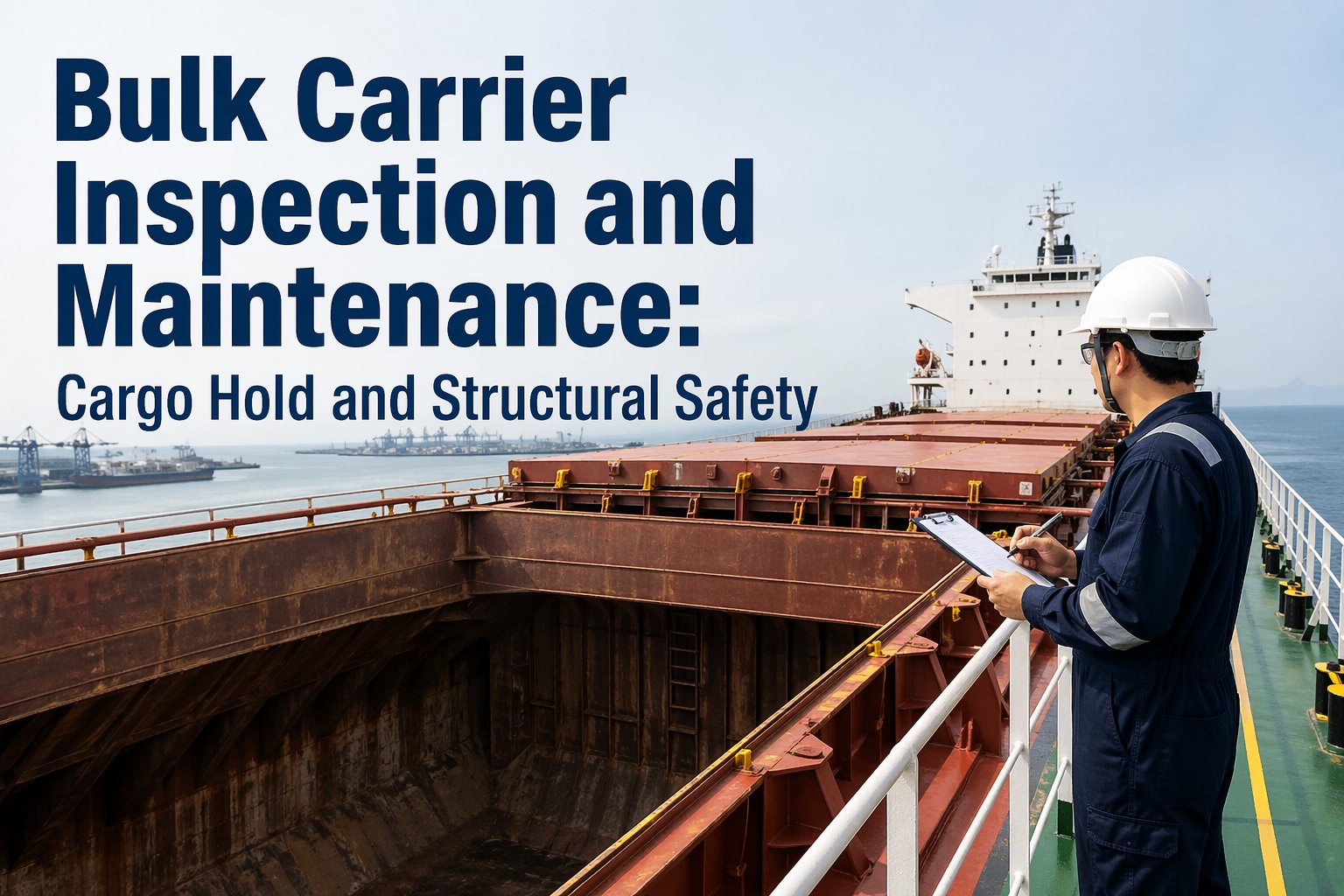
Bulk carriers are the one sector where structural condition is the commercial asset. A tanker is vetted heavily on process and human factors; a bulker is vetted on steel. Hold condition, hatch cover weathertightness, coating grade and thickness measurement results are simultaneously a statutory obligation under the Enhanced Survey Programme and a commercial one under RightShip, and in 2026 those two clocks are running against each other for the first time in a way that materially changes fleet economics. The 2011 ESP Code, adopted as IMO Resolution A.1049(27), governs close-up survey, thickness measurement and tank testing for bulk carriers, and the 2022 amendments under Resolution MSC.525(106) have applied to surveys since 1 July 2024, tightening how coating condition is recorded and what happens when it falls below GOOD. In parallel, all RightShip inspections have been conducted under RISQ 3.2 since 25 February 2026, with age triggers already at eleven years and reaching ten years on 1 January 2027 — and a vessel meeting the age criteria without a valid inspection has its Safety Score downgraded to two out of five. The regulatory clock and the charterer's clock now converge on the same steel. Start a free trial of Marine Inspection and see both tracked in one place.
Two Clocks Running on the Same Steel
Statutory clock
Enhanced Survey Programme
Governed by the 2011 ESP Code, IMO Resolution A.1049(27), with 2022 amendments under MSC.525(106) applying to surveys from 1 July 2024.
Close-up survey of shell frames and bulkheads, thickness measurement of hull structure, and testing of cargo holds, ballast tanks, hatch covers, coamings and fuel tanks.
Fails and the vessel cannot trade
Commercial clock
RightShip RISQ 3.2
All RightShip inspections conducted under RISQ 3.2 since 25 February 2026, developed with input from 22 maritime associations and more than 240 submissions from owners, managers and inspectors.
588 questions across 17 sections, with the inspector applying those relevant to vessel type and trading pattern, including solid bulk and grain sub-sections, hatch covers and structural items.
Fails and the vessel cannot earn
Why the Dry Bulk Sector Is Structurally Different
Every vessel type carries a maintenance obligation. Bulk carriers carry a structural one, and the difference runs through the whole software requirement. The regime exists because of losses: IACS introduced the Enhanced Survey Programme in 1993, twelve bulk carriers were lost in 1994 alone, and the IMO responded by adopting SOLAS Chapter XI-1 and Resolution A.744(18) to bring bulkers and tankers under enhanced inspection. That history is why the survey scope reaches into places other regimes do not. Book a Marine Inspection demo to see structural records held against the same hierarchy your surveyor works through.
The asset degrades continuously
Cargo is abrasive, holds are washed with seawater between voyages, and ballast tanks corrode from the inside. Unlike machinery, which fails discretely and gets overhauled, hull structure deteriorates gradually and the deterioration is only visible during a survey or a hold entry. What you do not measure, you do not know.
The survey scope is not fixed
ESP survey programmes are built individually. Extent of close-up survey and thickness measurement expands where substantial corrosion or structural defects are found, and the programme takes account of the ship's own damage history, that of her sister ships, and general damage trends across the industry.
Cargo damage is a direct liability
Water ingress through a hatch cover into steel, grain or project cargo is a claim, not a deficiency. Weathertight integrity is therefore both a safety item and a commercial exposure, which is why RISQ 3.2 asks specifically whether hatch covers were ultrasonically tested before loading.
Age is a commercial trigger, not just a technical one
RightShip's phased age triggers mean vessel age alone can downgrade a Safety Score to two out of five in the absence of a valid inspection. Nothing about the ship needs to change for its commercial standing to fall.
The Coating Cascade: One Variable That Drives Everything Else
If there is a single thing to take from this guide, it is this. Coating condition is not a cosmetic grade recorded for completeness. It is the variable that determines how much survey work the vessel attracts, how often, and for how long, and it compounds with age. Sign up for Marine Inspection and track coating grade by tank and by hold across the fleet.
How Coating Condition Escalates Survey Burden
GOOD
Baseline obligation only
Hard protective coating maintained in good condition keeps the vessel on the standard survey scope. For bulk carriers built under IACS Common Structural Rules, annual thickness gauging may be omitted entirely where the coating was applied in accordance with the manufacturer's requirements and is maintained in good condition.
Below GOOD
Annual re-examination begins
Under the 2022 ESP Code amendments applying to surveys from 1 July 2024, coating condition rated below GOOD must be recorded, and re-examination moves to an annual cycle. The vessel has now acquired a recurring survey obligation that did not previously exist.
POOR
Ballast tank systems examined annually
Where a hard protective coating is found in poor condition, has not been renewed, was not applied at construction, or where a soft or semi-hard coating has been applied, the corrosion prevention system of ballast tanks is subject to annual examination.
POOR + 20 years
Void space inspections compound
Age multiplies the effect. Examination of double-side skin void spaces applies to bulk carriers exceeding 20 years of age and 150 metres in length, and poor coating condition on older tonnage drives mandatory annual void space inspection. Meanwhile, areas of substantial corrosion identified at previous surveys must have thickness measurements taken, so past findings permanently expand future scope.
The commercial reading
Coating maintenance is the cheapest survey-cost lever available to a bulk carrier operator, and the only one that works in both directions. Maintained coatings on a CSR-built vessel can remove annual thickness gauging altogether. Degraded coatings on a twenty-year-old ship add annual examinations that persist for the rest of her life. The decision is made years before the invoice arrives, which is exactly why coating grade needs to be a tracked, trended field rather than a note in a survey report.
What the Enhanced Survey Programme Actually Requires
ESP is frequently discussed in general terms and rarely laid out as a set of obligations a system has to carry. Below is what the regime demands, and what a platform must hold to serve it. Schedule a walkthrough and test each row against your own vessel records.
Table 1: ESP Obligations and the Records That Satisfy Them
Structural data is not maintenance data
Coating grades by tank and hold, thickness readings held by location with history, close-up survey findings against structural members, hatch cover test results with method and attribution, and docking windows visible to the people scheduling the vessel. Held in one place, trended across cycles, and retrievable at the moment a surveyor asks rather than assembled in the fortnight before.
The RightShip Age Trigger, and What It Costs to Miss
This is the commercial clock, and it is the one that has changed most recently. RightShip is phasing in a requirement for dry bulk and general cargo vessels to hold a valid inspection based purely on age, and the consequence of missing it is automatic rather than discretionary. Start a free trial and map your own fleet against the phases below.
Age Trigger Rollout for Dry Bulk and General Cargo
2025
13 years and older
Phase one. RightShip reported the rollout progressing without delay, supported by a significantly expanded pool of accredited inspectors, and subsequently consolidated the vetting criteria and Safety Score onto a single implementation date per phase.
1 April 2026
12 years and older
Phase two. An acceptable RightShip inspection required for vessels of twelve years and above.
1 July 2026
11 years and older
Phase three, currently in force. The pool of affected tonnage widens substantially at this step, and many operators discover the requirement applies to vessels they consider modern.
1 January 2027
10 years and older
Phase four. The final announced step. Plan inspection slots against this date now rather than in the fourth quarter, because demand concentrates ahead of each trigger.
Score falls to
2 / 5
A vessel meeting the age criteria without a valid inspection has its Safety Score downgraded to two out of five, and a valid inspection is then required to pass a RightShip vetting nomination. The downgrade is triggered by a date, not by a defect, and charterers read the score before they read anything else.
Hatch Covers: The Single Item That Decides Fixtures
Across nearly 5,000 RightShip inspections conducted in 2025 across more than 100 countries and 800 ports, findings concentrated in a consistent set of high-risk areas: enclosed space entry procedures, lifesaving and firefighting equipment, hatch cover condition, machinery space readiness and pilot ladder safety. For a bulk carrier, hatch covers carry the heaviest commercial weight of that group, because they connect directly to cargo damage liability. Book a walkthrough and see hatch cover testing tracked as a scheduled, evidenced activity.
Hose Testing
Established, familiar, and accepted for many purposes
Confirms whether water passes, but does not localise the leak path precisely
Introduces water on deck, with pollution and cargo exposure considerations
Cannot practically be performed with holds loaded
Ultrasonic Testing
Identifies the exact location of a leak path rather than its existence
Indicates the physical condition of seal compression, which predicts future failure
Carries no pollution risk
Can be conducted safely with cargo holds fully loaded, so it works before departure
The change that matters most
RISQ 3.2 asks specifically whether hatch covers were ultrasonically tested before loading, with pre-loading ultrasonic testing strongly recommended for moisture-sensitive cargoes including steel, grain and project cargoes. More significantly, inspectors now require crews to demonstrate competence in operating the testing equipment rather than presenting a maintenance policy. A written procedure is no longer the evidence. The person is. And a single failed hatch inspection directly degrades the vessel's Safety Score, which every charterer and terminal reads before nominating.
Track hatch cover testing as a scheduled activity with method, result, and the named person who performed it.
Inside the Hold: What an Inspector Actually Does
RISQ inspections include a physical hold entry, and knowing precisely what is examined tells you what internal preparation has to cover. The inspector enters a cargo hold and assesses the condition of the bulkhead, the tank top, the bilge, the outfitting inside the hold including handrails and vertical ladders, the coating condition, and tests the water ingress system. External assessment covers mooring areas, main deck and hatch covers. Sign up for Marine Inspection and run the same list internally before someone else does.
01
Bulkhead condition
Corrugation damage from grabs and hard cargo, cracking at connections, and the state of the transverse watertight bulkhead between holds one and two, which carries its own gauging guidance under the ESP Code because of the loss history associated with it.
02
Tank top
Indentation and wastage from grab work and hard cargo discharge. Damage here is cumulative, largely invisible from deck level, and expensive once it reaches the point of steel renewal.
03
Bilge wells and covers
Blocked, damaged or improperly covered bilges are a persistent finding and a direct cargo damage risk. Between-voyage hold maintenance covering cleaning, bilge wells, ventilation and tank top checks is what prevents progressive deterioration.
04
Outfitting and access
Handrails and vertical ladders inside the hold are assessed directly. These are safety-of-access items rather than structural ones, and they fail inspections regularly because nobody owns them in a maintenance plan.
05
Coating condition
The same variable that drives the ESP cascade appears here in a commercial inspection. One condition, two consequences, which is precisely why coating grade belongs in a system rather than a survey report.
06
Water ingress detection system
Tested during the inspection. Required on bulk carriers following the SOLAS Chapter XII measures introduced after the loss record of the 1990s, and a system that does not alarm on test is a serious finding.
The Sister Ship Effect, and Why Fleet Data Changes Your Survey Bill
This is the least appreciated provision in the whole ESP framework, and it converts fleet-wide structural records from a management convenience into a direct cost variable. Schedule a demo and see structural findings compared across sisters rather than filed per vessel.
How survey scope is set
An ESP survey programme is developed for the individual vessel, and the extent of close-up survey and thickness measurement above the Code minimum is influenced by three inputs. The vessel's own damage history. The damage history of her sister ships. And general damage trends across the industry for that vessel type. Where a ship or her sisters have suffered repeated damage in a particular area, that area is identified for additional close-up inspection at renewal.
What this means if your records are fragmented
A recurring defect across three sisters looks like three isolated incidents in three separate files. Nobody connects them, nobody addresses the root cause, and the pattern is eventually identified by a class surveyor building a survey programme — at which point it expands scope on every ship in the series.
What this means if they are not
The same three findings appear as a trend within weeks. The cause is addressed once, across the series, before the next renewal cycle. Fleet-wide structural data is not reporting overhead. It is the mechanism by which you keep survey scope at the Code minimum instead of above it.
Evaluating Software for a Bulk Carrier Fleet
Generic maintenance capability is table stakes. The requirements below are the ones that follow specifically from ESP and RISQ, and they are where shortlists separate. Start a free trial and test them against your own vessels rather than a demo dataset.
Table 2: Buyer Requirements Specific to Dry Bulk
2026 DRY BULK COMPLIANCE REALITY
The statutory floor sits underneath everything else. ISM Code Element 10 requires a documented maintenance system, SOLAS Chapter IX makes ISM mandatory for SOLAS-certified ships, and SOLAS Chapter XII carries additional safety measures specific to bulk carriers. Vetting performance does not substitute for any of it. ESP requirements continue to be amended. The 2011 ESP Code has been supplemented and amended repeatedly, including through MSC.525(106) applying to surveys from 1 July 2024 and subsequent supplements, and IACS UR Z10 series revisions flow into individual society rules. Confirm the current text with your own society rather than relying on any published summary including this one. Survey technology is evolving. Recognition of drone-assisted close-up survey and remote inspection techniques has been advancing within the framework, and acceptance varies by society and by survey type, so verify what your surveyor will accept before planning around it. RightShip phases may be extended. Four phases have been announced through 1 January 2027; treat any further extension as possible and check current requirements directly.
Frequently Asked Questions
What is the Enhanced Survey Programme and which vessels does it apply to?
The Enhanced Survey Programme is the intensified inspection regime for bulk carriers and oil tankers, governed by the 2011 ESP Code adopted as IMO Resolution A.1049(27). It was introduced by IACS in 1993 following a period of severe bulk carrier losses, with twelve bulkers lost in 1994 alone, and reinforced by the IMO through SOLAS Chapter XI-1 and Resolution A.744(18). It requires close-up survey of structural members, thickness measurement of hull structure, and testing of cargo holds, ballast tanks, hatch covers, coamings and fuel tanks. Extent expands where substantial corrosion or structural defects are found, and the survey programme for each vessel is developed individually rather than applied as a fixed checklist.
Why does coating condition matter so much?
Because it is the variable that determines how much survey work the vessel attracts and for how long. Under the 2022 ESP Code amendments applying to surveys from 1 July 2024, coating condition rated below GOOD must be recorded and re-examined annually. Where a hard protective coating is found in poor condition, has not been renewed, was not applied at construction, or where soft or semi-hard coating has been applied, the ballast tank corrosion prevention system is examined annually. Conversely, bulk carriers built under IACS Common Structural Rules may omit annual thickness gauging where coating was applied to the manufacturer's requirements and is maintained in good condition. Coating maintenance is the cheapest lever available, and it works in both directions.
What are the RightShip age triggers and what happens if we miss one?
RightShip is phasing in a requirement for dry bulk and general cargo vessels to hold a valid RightShip inspection based on vessel age. Phase one covered vessels of thirteen years and older during 2025, twelve years and older from 1 April 2026, eleven years and older from 1 July 2026, and ten years and older from 1 January 2027. A vessel meeting the age criteria without a valid inspection has its Safety Score downgraded to two out of five, and a valid inspection is then required to pass a RightShip vetting nomination. The downgrade is triggered by a date rather than by any defect, so it can affect a well-maintained ship purely through inattention to scheduling.
Why is ultrasonic hatch cover testing now expected?
Because it answers questions hose testing cannot. Ultrasonic testing identifies the exact location of a leak path rather than merely confirming that water passes, indicates the physical condition of seal compression so future failure becomes predictable, carries no pollution risk, and can be conducted safely with cargo holds fully loaded — which means it can be performed before departure on a laden vessel. RISQ 3.2 asks specifically whether covers were ultrasonically tested before loading, with pre-loading testing strongly recommended for moisture-sensitive cargoes such as steel, grain and project cargoes. Crucially, inspectors now assess whether crew can operate the equipment rather than whether a policy exists.
How does a finding on one vessel affect her sisters?
Directly, through the survey programme. When class develops the ESP survey programme for a vessel, it takes account of the ship's own damage history, the damage history of her sister ships, and general damage trends across the industry for that vessel type. Where a ship or her sisters have suffered repeated damage in a particular area, that area is identified for additional close-up inspection above the Code minimum at renewal. This makes fleet-wide structural records a direct cost variable rather than a reporting nicety: a pattern you identify and fix across a series stays out of the survey programme, while a pattern a surveyor identifies expands scope on every ship in it.
Do we need separate systems for ESP and RightShip readiness?
No, and running them separately is what causes most of the duplication in this sector. The underlying condition data is the same: coating grade, hold and bulkhead condition, tank top wastage, hatch cover weathertightness, bilge and access condition, water ingress system function. ESP consumes it as survey evidence, RISQ consumes it as inspection readiness, and Port State Control consumes it as compliance. One structural record captured properly at the point of inspection serves all three. What differs is the output format, which is a reporting problem rather than a data collection one, and any platform requiring the same finding to be recorded twice is creating work rather than removing it.
The Steel Is the Asset. Record It Like One.
Coating grades trended by tank and hold, thickness readings held by location across cycles, close-up findings attached to structural members, hatch cover tests with method and named operator, docking windows visible to the chartering desk, and age triggers mapped against RightShip phases — captured offline inside a hold and available the moment a surveyor or an inspector asks.