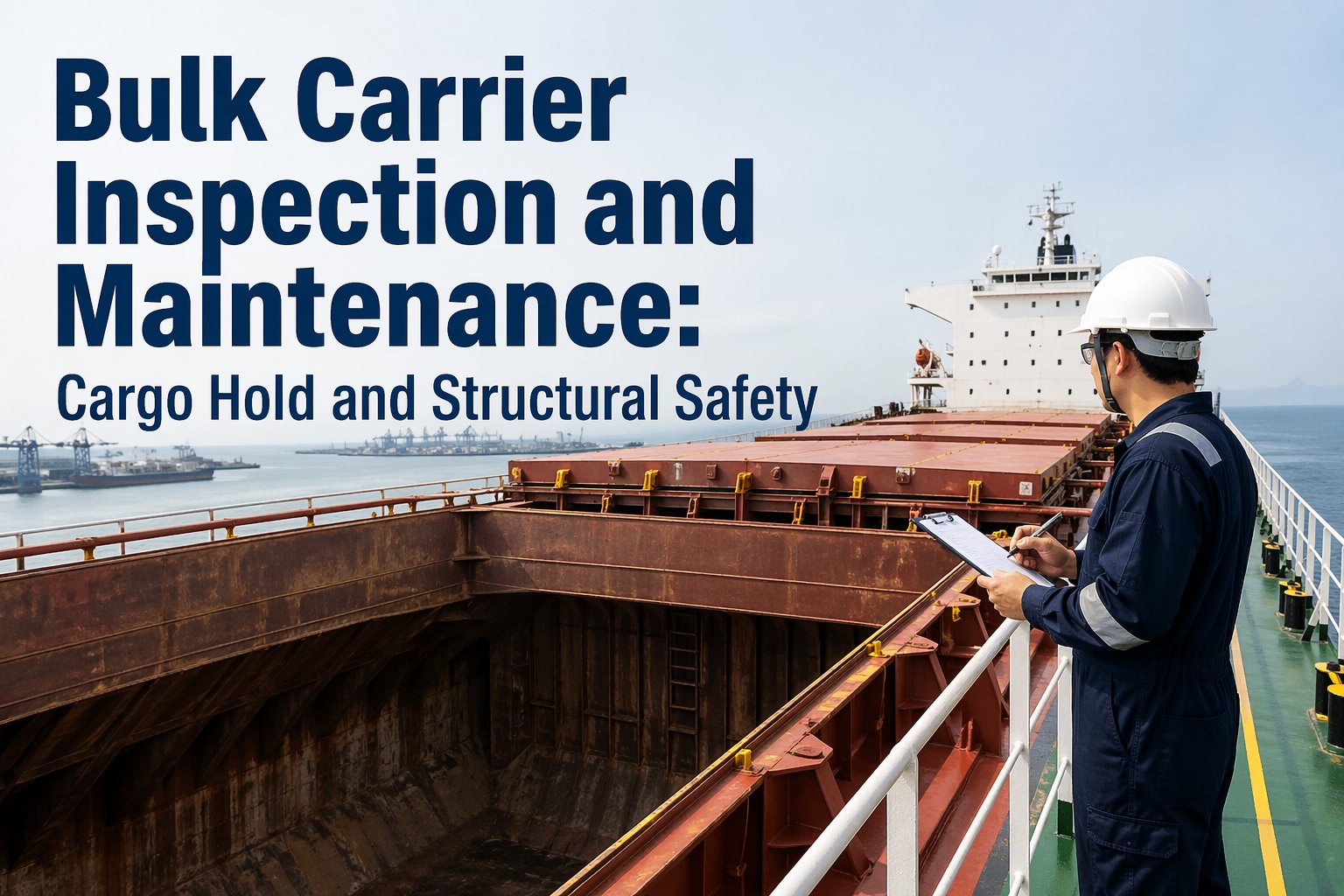
Bulk Carrier Inspection and Maintenance: Cargo Hold and Structural Safety
Bulk carriers account for more catastrophic structural failures than any other vessel type in maritime history — the losses of Derbyshire (1980), MV Flare (1998), and dozens of others in the 1990s drove IMO to adopt SOLAS Chapter XII (Additional Safety Measures for Bulk Carriers) and IACS to develop the Enhanced Survey Programme that fundamentally changed how these vessels are inspected, maintained, and surveyed throughout their operational lives. The structural challenges are inherent to the design: single-deck construction with large cargo hold openings that weaken longitudinal strength, exposure of hold structures to abrasive and corrosive cargoes (iron ore at 2,800-3,200 kg/m3 creates enormous localised loads), repeated high-pressure washing between cargo parcels that accelerates coating breakdown, and the critical vulnerability of the transverse watertight bulkhead between holds No.1 and No.2 at the forward end of the vessel — the area IACS identified as most vulnerable to flooding-induced structural failure. The regulatory framework has intensified: the 2022 ESP Code amendments (Resolution MSC.525(106), in force for surveys from 1 July 2024) now require any coating condition rated below "GOOD" to be recorded and re-examined annually, and for vessels over 20 years old and longer than 150 metres, annual inspections of double-skin void spaces are mandatory if coatings are rated "POOR." From January 2026, SOLAS Chapter II-1 Regulation 3-13 introduces stricter oversight of lifting appliances — all equipment installed on or after this date must be surveyed and tested by a classification society, replacing the previous ILO framework. The 2026 Grain Code amendment formally recognises partially filled holds with untrimmed ends. And drone-based inspections are now formally recognised under the 2025 ESP Code update for close-up surveys and ultrasonic thickness measurements. Marine Inspection provides the digital platform that tracks every structural survey, thickness measurement, coating condition, hatch cover test, and hold inspection across your bulk carrier fleet — book a demo to see how.
Critical Structural Zones: Where Bulk Carriers Fail
Cargo Hold Shell Plating
Side shell, inner bottom, and hopper tank plating subject to abrasion from cargo loading/discharge and corrosion from cargo moisture. Thickness diminution is the primary structural concern — wastage below class limits requires steel renewal.
IACS identified as the most vulnerable area. Forward bulkhead between holds 1 and 2 experiences highest dynamic loads from bow slamming and green seas. Double bottom at this location equally critical.
Bulkhead failure → progressive flooding → loss of vessel (Derbyshire pattern)
Topside Tank Structure
Upper wing tanks: bracket connections, longitudinal stiffener end connections, transverse web frames. Fatigue cracking from cyclic loading. Corrosion in ballast tank environment. Access difficulty delays detection.
Cracking → water ingress to hold → cargo damage / stability loss
Hatch Covers & Coamings
Weathertightness is the primary defence against water ingress. Rubber seals deteriorate, compression bars corrode, cleating devices wear, drain channels block. Hatch cover panel deflection under wave loading.
Tank top plating, floors, and longitudinals subject to extreme localised loads from high-density cargoes (iron ore, bauxite). Cargo impact during loading. Corrosion from ballast water in double bottom tanks.
Tank top failure → ballast/void space flooding → vessel loss
Cross-Deck Strips
Plating between hatch openings — critical for longitudinal strength. Stress concentrations at hatch corners. Fractures at transition between thick deck plating and thinner cross-deck plating propagate across full deck width.
Deck fracture → loss of longitudinal strength → hull girder failure
Enhanced Survey Programme (ESP): The Complete Survey Framework
Bulk Carrier ESP Survey Requirements
Survey Type
Interval
What Is Inspected
Thickness Measurements
Key Requirements
2024 ESP Code Updates
Annual Survey
Yearly
General examination of hull structure, equipment, machinery. Hold inspection where accessible. Hatch cover weathertightness.
Suspect areas only.
Verify no significant deterioration since last survey. Check known problem areas.
Coating below "GOOD" must be recorded and re-examined annually.
Intermediate Survey
2.5 years
More detailed than annual. All ballast tanks examined. Hold structure close-up survey where accessible. Topside tanks.
Suspect areas + representative areas as directed by surveyor.
Single-side skin 100,000+ DWT: two exclusive surveyors jointly for 10-15yr age vessels.
Void spaces with "POOR" coating: annual inspection for vessels 20yr+ and 150m+.
Special Survey (Renewal)
5 years
Complete close-up survey of all structural members. All ballast tanks, cargo holds, void spaces. Hatch covers, coamings, securing. Fore and aft peaks.
Extensive — all representative sections. Minimum 75% of structural members measured at 3rd renewal.
Planning document submitted 6 months before. Staging/access arranged. Two surveyors for 10yr+ vessels of 20,000+ DWT.
Drone-based inspections formally recognised for close-up surveys and UT measurements (2025 update).
As directed by surveyor based on external condition.
Maximum 36 months between bottom inspections. Can coincide with special survey.
No specific ESP Code changes for bottom surveys.
Continuous Survey
Ongoing (alternative to renewal)
Spreads special survey scope over the certificate period. Different holds/tanks surveyed at different annuals.
Progressive — completed across the 5-year cycle.
Survey planning document maintained. All areas covered within cycle. Advantageous for operational continuity.
Same coating condition requirements apply to each surveyed area.
Condition Assessment
As required (pre-sale, pre-charter)
Comprehensive structural assessment for commercial purposes. Goes beyond class survey. Identifies all maintenance needs.
Extensive — often exceeds class requirements.
Often required by buyers/charterers for vessels 15yr+. Independent surveyor preferred.
Coating condition now formally graded — commercial implications for charter.
ESP Code 2022 amendments (MSC.525(106), in force 1 July 2024): any coating below "GOOD" recorded and re-examined annually. Vessels 20yr+ and 150m+: annual void space inspections if coating "POOR." Downgrades in coating condition carry direct commercial consequences.
Hatch Cover Testing: The Weathertightness Barrier
Hatch cover failure is the leading cause of cargo damage claims on bulk carriers and a contributing factor in vessel losses. IACS Recommendation 14 requires testing at intervals not exceeding 12 months. Multiple testing methods exist — each with different capabilities. Book a Marine Inspection demo to see how the platform tracks hatch cover test results and seal replacement schedules.
Ultrasonic Testing: Most reliable method. Transmitter inside hold, receiver outside. Detects exact leak location and relative severity. Weather-independent. Non-destructive. Recommended by IACS and P&I clubs. Results documented as numerical values.
Hose Testing: Water jet directed at seals and joints from outside. Visual inspection inside for water ingress. Simple but dependent on water pressure and angle. Cannot test horizontal surfaces effectively. Weather-dependent.
Chalk Testing: Chalk applied to compression bars, hatch closed, then opened to check chalk transfer to rubber seals. Tests seal contact — not weathertightness. Useful for checking seal compression but limited as sole test method.
Seal Condition: Rubber packing condition is critical — hardened, cracked, deformed, or permanently compressed seals cannot maintain weathertightness regardless of cleating force. Replacement on condition, not just schedule.
Steel-to-Steel Contact: Compression bars and landing pads checked for corrosion, distortion, and wear. Even good seals fail if the steel contact surfaces are uneven. Grinding and welding repair during dry dock.
Drain Channels: Non-return valves in drain channels verified functional. Blocked drains cause water accumulation that overwhelms seal capacity. Regular clearing essential — especially after bulk cargo operations generate dust.
Cargo Hold Maintenance: Between Voyages
Hold Cleaning: Wash down between cargo parcels. High-density cargo residue (iron ore fines, coal dust) accelerates corrosion if left. Cleaning standard depends on next cargo — grain requires hospital-clean holds.
Coating Inspection: Check for coating breakdown, rust bleeding, mechanical damage from grabs/bulldozers. Document condition with photos. Spot-repair damaged areas to prevent spread. Full recoating during dry dock.
Bilge Well Maintenance: Strainer plates clear. Non-return valves functional. Bilge lines tested — blocked bilge wells in holds cause cargo wetting from below. Bilge sounding pipes verified accurate.
Ventilation System: Hold ventilation critical for moisture-sensitive cargoes (grain, sugar, fertiliser). Ventilators functional, closures watertight. Dew point ventilation rules applied. CO2/O2 monitoring for self-heating cargoes.
Tank Top Inspection: Visual inspection for cracks, denting, deformation from heavy cargo impact. Any structural concerns reported immediately. Permanent deformation may indicate overloading or insufficient dunnage.
Ladder & Access: Hold access ladders, platforms, and guardrails inspected for corrosion and damage. Safe access is both a survey requirement and a crew safety issue. Enclosed space entry procedures apply.
2025-2026 Regulatory Updates for Bulk Carriers
JUL 2024
ESP Code Amendments In Force
MSC.525(106): coating below "GOOD" recorded and re-examined annually. Vessels 20yr+/150m+: annual void space inspections if coating "POOR." Commercial consequence: downgrades affect charter appeal.
2025
Drone Inspections Recognised
2025 ESP Code update formally recognises Remote Inspection Techniques (RITs) including drones for close-up surveys and UT thickness measurements. Reduces scaffolding costs and improves safety in hard-to-reach areas.
JAN 2026
Lifting Appliance Requirements
SOLAS II-1 Reg. 3-13: all lifting appliances installed on or after this date must be surveyed and tested by classification society. Moves from ILO to SOLAS safety regime. Structured maintenance and inspection records mandatory.
2026
Grain Code Amendment
Formally recognises partially filled holds with untrimmed ends — a common but previously non-compliant loading condition. Newbuilds: included in grain loading manual and loading computer. Existing vessels: updates optional.
How Marine Inspection Manages Bulk Carrier Compliance
UT measurement data stored per structural location. Wastage rates calculated. Areas approaching class minimum flagged. Steel renewal planning supported by historical trend data.
Coating Condition Tracking
Coating grades recorded per tank/hold with photo evidence. Deterioration tracked over time. "Below GOOD" triggers annual re-examination alert per 2024 ESP Code. Recoating planned for dry dock.
Hatch Cover Test Records
Ultrasonic and hose test results documented per hatch. Seal replacement dates tracked. Compression bar condition recorded. Drain channel maintenance logged. Annual testing compliance verified.
Hold Inspection Records
Post-cleaning inspection, coating condition, bilge well status, ventilation function, tank top condition — documented per hold per voyage. Photo evidence captured. Ready for surveyor or charterer review.
Lifting Appliance Compliance
Crane, derrick, and cargo gear test certificates. Load testing records. Class survey dates tracked. Crew training documented. SOLAS II-1 Reg.3-13 compliance for 2026 requirements.
SOLAS XII
Additional safety measures for bulk carriers
ESP
Enhanced Survey Programme — 2024 amendments in force
2026
Lifting appliance & Grain Code changes
90%+
World cargo tonnage under IACS class rules
Coating Downgrades Now Carry Direct Commercial Consequences
Under the 2024 ESP Code amendments, coatings rated below "GOOD" require annual re-examination — and for vessels over 20 years, "POOR" coatings trigger mandatory annual void space inspections. Marine Inspection tracks every coating grade, every thickness measurement, every survey result, and every hatch cover test to keep your fleet structurally compliant and commercially competitive.
Bulk carrier inspection and maintenance is the structural discipline where history proves the cost of failure — the catastrophic losses of the 1990s drove SOLAS Chapter XII and the IACS Enhanced Survey Programme that now governs how these vessels are surveyed throughout their operational lives. Six critical structural zones (cargo hold shell plating, Hold 1/2 bulkhead, topside tank structure, hatch covers, double bottom, cross-deck strips) each require systematic inspection, thickness measurement, and coating maintenance. The 2024 ESP Code amendments (MSC.525(106)) have raised the standard — any coating below "GOOD" recorded and re-examined annually, with commercial consequences for charter appeal. From 2025, drone-based inspections are formally recognised for close-up surveys. From January 2026, lifting appliance oversight moves to SOLAS safety regime with class society surveys required. The 2026 Grain Code amendment formalises partially filled hold practices. Hatch cover weathertightness — verified through ultrasonic testing, hose testing, and seal condition assessment — remains the primary defence against water ingress and cargo damage. Between-voyage hold maintenance (cleaning, coating inspection, bilge wells, ventilation, tank top checks) prevents the progressive deterioration that ESP surveys are designed to detect. Marine Inspection provides the digital platform that manages ESP survey planning, thickness measurement records, coating condition tracking, hatch cover test results, and hold inspection documentation — book a live demo today.
Frequently Asked Questions
FAQ 01
What is the Enhanced Survey Programme (ESP) for bulk carriers?
The Enhanced Survey Programme is a systematic framework for inspecting and surveying bulk carriers (and tankers) adopted by IMO under Resolution A.744(18) and implemented through IACS Unified Requirements. ESP mandates: annual surveys (general examination, coating condition, hatch covers), intermediate surveys at 2.5 years (detailed ballast tank and hold structure examination), special/renewal surveys every 5 years (complete close-up survey of all structural members with extensive thickness measurements), and bottom surveys (two per certificate period, maximum 36 months apart). For bulk carriers of 20,000+ DWT over 10 years old, at least two class surveyors must jointly conduct renewal surveys. A survey planning document must be submitted to the classification society 6 months before special surveys. The 2022 ESP Code amendments (MSC.525(106), in force from 1 July 2024) introduced stricter coating condition requirements: any coating rated below "GOOD" must be recorded and re-examined annually, with more frequent inspections for older/larger vessels with poor coatings.
FAQ 02
How often must hatch covers be tested for weathertightness?
IACS Recommendation 14 requires hatch cover weathertightness testing at intervals not exceeding 12 months. Ultrasonic testing is the most reliable method — a transmitter is placed inside the hold and a receiver scans from outside, detecting the exact location and relative severity of any leaks with numerical results. Hose testing (water jet from outside, visual inspection inside) is simpler but weather-dependent and cannot effectively test horizontal surfaces. Chalk testing checks seal contact but not actual weathertightness. Beyond periodic testing, hatch covers should be visually inspected before and after every cargo operation for: rubber seal condition (hardening, cracking, permanent compression), compression bar corrosion or distortion, cleating device wear and adjustment, drain channel blockage, and hatch cover panel deflection. P&I clubs consistently list hatch cover failure as the leading cause of cargo damage claims on bulk carriers — making systematic testing and maintenance a direct commercial necessity.
FAQ 03
What changed in the 2024 ESP Code amendments?
The ESP Code amendments adopted through IMO Resolution MSC.525(106) and IACS Unified Requirements came into force for surveys commenced on or after 1 July 2024. Key changes: (1) Any coating condition rated below "GOOD" must now be formally recorded and re-examined at every subsequent annual survey — previously, coating degradation could go untracked between special surveys. (2) For vessels over 20 years old and longer than 150 metres, annual inspections of double-skin void spaces are mandatory if coatings are rated "POOR." (3) These changes carry direct commercial implications — downgrades in coating condition can lead to increased inspection demands, operational delays, and reduced charter appeal. Proactive hull management is now a competitive necessity, not just a class requirement. Additionally, the 2025 ESP Code update formally recognises drone-based Remote Inspection Techniques (RITs) for close-up surveys and ultrasonic thickness measurements, reducing scaffolding costs and improving safety in hard-to-reach structural areas.
FAQ 04
Why is the Hold 1/2 bulkhead the most critical structural area?
IACS analysis concluded that the most vulnerable areas on a bulk carrier are the transverse watertight bulkhead between holds No.1 and No.2 at the forward end of the vessel, and the double bottom at this location. This is because: the forward section experiences the highest dynamic loads from bow slamming and green seas in heavy weather, the corrugated bulkhead structure is subject to both hydrostatic cargo pressure and wave-induced dynamic loads simultaneously, corrosion in this area is often accelerated by high-density cargo residues and bilge water contact, and failure of this bulkhead in a flooding scenario leads to progressive flooding of hold No.1 — the flooding pattern that caused many of the bulk carrier losses in the 1990s (including Derbyshire). SOLAS Chapter XII Regulation 4 requires the transverse watertight bulkhead and double bottom in the forward cargo hold region to have sufficient strength to withstand flooding of the foremost cargo hold. Under Chapter XII, surveyors assess whether reinforcement is needed, and restrictions on cargo type may be imposed for vessels that cannot meet the strength requirements.
FAQ 05
What are the 2026 regulatory changes affecting bulk carriers?
Two significant changes take effect in 2026: (1) SOLAS Chapter II-1 Regulation 3-13 (Lifting Appliances) — effective January 2026, all lifting appliances (cranes, derricks, cargo gear) installed on or after this date must be surveyed and tested by a classification society. This moves oversight from the ILO framework to the SOLAS safety regime. Existing equipment must comply by the first renewal survey after the regulation takes effect. Owners must implement structured maintenance and inspection regimes, maintain onboard records, and ensure crew training. (2) Grain Code Amendment — formally recognises the common practice of partially filled holds in the way of the hatch opening with untrimmed ends, which occurs when vessels reach maximum draught before full hold capacity. For newbuilds, this condition must be included in the grain loading manual and implemented in the loading computer. For existing vessels, updates are optional but may be necessary to meet specific port requirements. These changes reflect the ongoing evolution of bulk carrier regulation toward stricter accountability and formal recognition of actual operational practices.
Book Your Live Demo
Every Thickness Measurement. Every Coating Grade. Every Hatch Cover Test. Tracked.
Marine Inspection manages ESP survey planning, structural thickness records, coating condition tracking, hatch cover test documentation, hold inspection logs, and lifting appliance certificates — the complete platform for bulk carrier operators and surveyors.