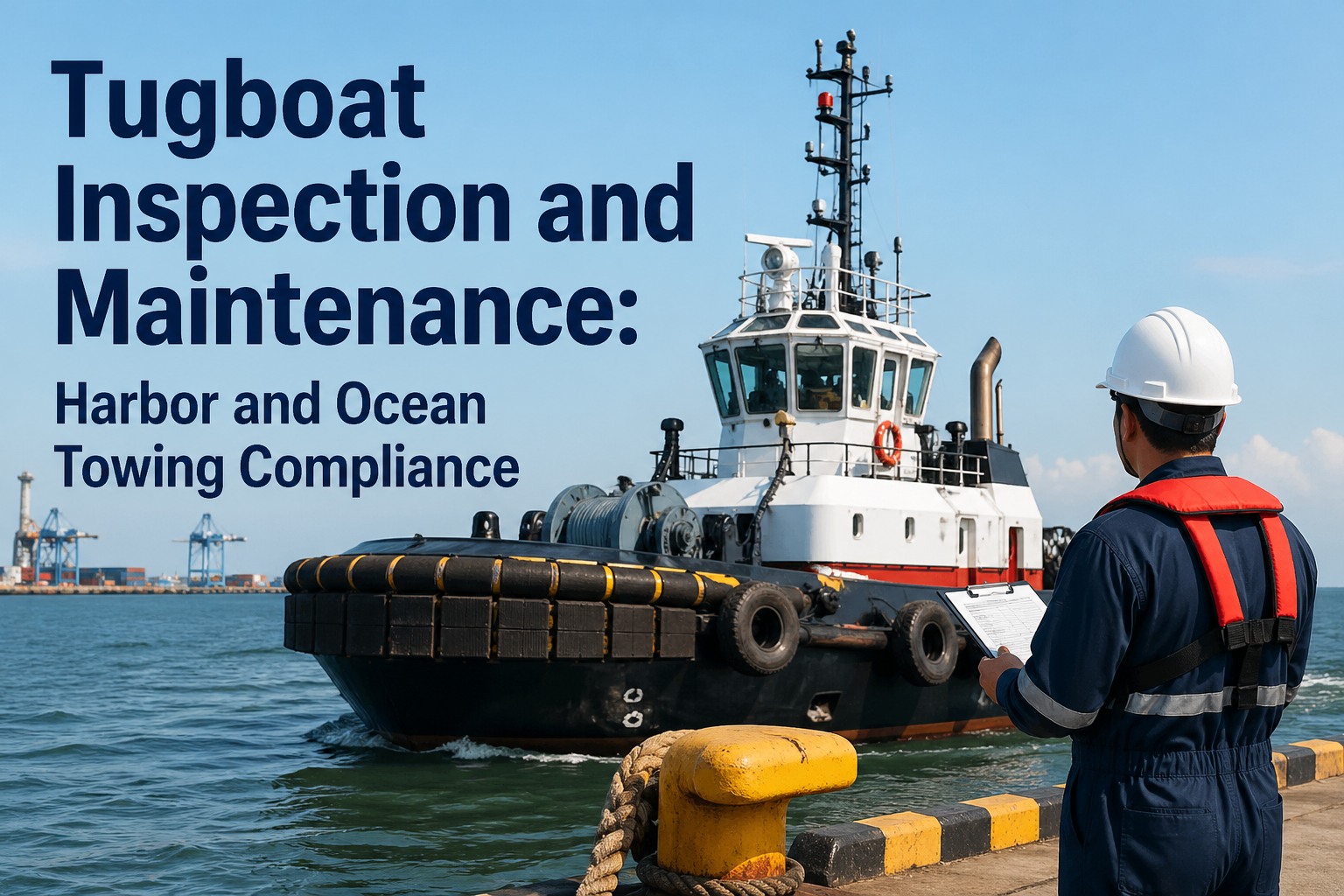
A tugboat looks small next to the 400-metre container ship it's nudging into a berth — but don't be fooled. Modern harbor and ocean tugs carry bollard pulls above 100 tonnes, six-figure daily charter rates, and regulatory scrutiny equal to ships twenty times their size. USCG Subchapter M has turned American towing vessels into formally inspected vessels with Certificates of Inspection since 2018. Classification societies continue to certify bollard pull, girting resistance, and towing gear through regular surveys. And every port authority in the world expects your fendering systems, towline, winch brake, shark jaws and emergency release gear to be in operational condition on the hour the pilot calls for a turn. This guide covers every inspection regime, every tug type, and every piece of gear a harbor or ocean towing operator must keep audit-ready in 2026. Start a free trial of Marine Inspection to digitize Subchapter M, bollard pull, and towing gear documentation across your entire fleet.
The Tugboat Industry in 2026
18,000
Global Harbor Tug Fleet
Supporting 4,000+ active seaports worldwide
$11B
Global Tugboat Market (2023)
Growing at 8–10% CAGR through 2032
July 2018
Subchapter M Phased In
All covered US tugs had COI by 19 Jul 2022
80+ tf
Modern Harbor Tug Bollard Pull
Escort tugs reach 180+ tonnes force
Why Tugboat Inspection is a Regulatory Category of its Own
Tugs sit in a strange regulatory position. They're small vessels — often 25–35 metres length — but their operating profile is punishing: routinely pulling ships fifty times their size at full power, working meters from large moving hulls, and operating on high-repetition short-duration cycles that accelerate gear wear. For years US tugs were effectively "uninspected" under federal rules, which ended when Subchapter M phased in starting July 2016 and finalised by July 2022. Today, every covered US towing vessel carries a Certificate of Inspection, and classification societies globally require bollard pull certification, girting assessments, and towing gear surveys on top of statutory checks. Book a Marine Inspection demo to see how tug operators consolidate Subchapter M, class, and insurance documentation into one platform.
Subchapter M Compliance: The Two-Path Decision Every U.S. Tug Owner Makes
USCG Subchapter M (46 CFR Parts 136–144) is the single biggest regulatory shift in US towing in a generation. Its core idea: every covered towing vessel must obtain a Certificate of Inspection. How you get there is where operators get to choose — and each path has distinct documentation, cost, and oversight profiles. Sign up for Marine Inspection to run either path digitally from day one.
How to Obtain Your Towing Vessel Certificate of Inspection
Towing Safety Management System + Third-Party Organization
Operator adopts a USCG-accepted safety management system (AWO Responsible Carrier Program or equivalent) and engages a Coast Guard-approved Third-Party Organization (TPO) like ABS to conduct audits and surveys.
Annual internal TSMS audit by operator
External TPO audit on intervals set by TSMS
Vessel survey by TPO surveyor, NOT USCG
Better for fleets >3 vessels — scales well
Most larger AWO-member operators on this path
OR
Annual direct USCG inspection
Operator chooses to be inspected directly by U.S. Coast Guard personnel every year, without a formal SMS. Simpler paperwork upfront, but every inspection is by the regulator itself.
Annual Coast Guard inspection by OCMI staff
No TPO engagement required
No formal SMS audit programme
Better for small owner-operators (1–2 vessels)
More direct regulator scrutiny every year
The Tugboat Type Matrix: Five Configurations, Five Inspection Profiles
"Tug" covers very different vessels. A Voith water tractor in Rotterdam and an ASD harbor tug in Houston are both tugboats, but their inspection priorities diverge sharply — different propulsion, different girting risk, different gear. Knowing which class you operate tells you where the inspection findings will appear.
Type 1
Conventional Screw Tug
Single or twin fixed propellers + rudder, towing hook at approx. 0.45 × LOA from aft
Maneuverability
Lower than ASD / tractor
Girting risk
HIGH — hook forward of stern
Bollard pull astern
~50% of ahead pull
Inspection watch
Quick-release, girting prevention, rudder gear
Type 2
ASD — Azimuthing Stern Drive
Two 360° azimuth thrusters under stern, towing winch typically on fore deck (bow first)
Maneuverability
Excellent, 100% pull in any direction
Girting risk
Moderate — over stern operations
Market share 2025
44.6% — dominant new-build type
Inspection watch
Thruster seals, steering gear, centerline skeg
Type 3
Voith Tractor (VSP)
Cycloidal Voith Schneider propellers under bow, towing point aft, keel plate protection
Maneuverability
Instant thrust change in any direction
Girting risk
LOW — propulsion fwd of towing point
Response time
Full ahead to astern in 3 seconds
Inspection watch
VSP blade pitch control, keel plate, skeg
Type 4
Rotor Tug (RT)
Three azimuth thrusters — two forward (tractor) + one aft on centerline — triple Z-drive
Maneuverability
100% ahead/astern; 65% athwartships
Girting risk
LOW — distributed thrust
Single-engine fail
Continues operation on 2 thrusters
Inspection watch
Triple-unit synchronization, redundancy proof
Type 5
Escort Tug
Purpose-built ASD or VSP hull optimized for indirect steering/braking forces at 6–12 knots
Maneuverability
Designed for high-speed indirect mode
Typical role
Laden tanker / LNG carrier escort in fairway
Post-Exxon Valdez
Compulsory escort in many coastal regions
Inspection watch
Dynamic winch, staple, indirect-force certs
Type 6
Carrousel / Carousel Tug
Rotating ring around superstructure with towing point — towline rotates 360° independently of hull
Girting risk
Effectively eliminated
Maneuverability
Steering power up to 5× conventional
Status
Niche — specialized escort fleets
Inspection watch
Ring bearing, winch position sensors
Bollard Pull Testing: The Single Most Important Tug Certification
Horsepower tells you almost nothing about a tug's actual towing capability. Bollard pull — the static tractive force in tonnes-force or kilonewtons — is the only number that matters for planning a tow, pricing a charter, or passing a class survey. Unlike most measurements, bollard pull cannot be calculated mathematically with enough accuracy; it must be tested. That test is a detailed procedure with three distinct output values, each used for a different purpose. Schedule a demo to see how operators digitize bollard pull test records across the fleet.
The Three Bollard Pull Values Every Tug Owner Tracks
100%
Maximum Bollard Pull (MBP)
Maximum tension recorded for ~1 minute at maximum engine output, optimum pitch, still water. Peak number — also called Static Bollard Pull.
Used for: class certification headline figure, marketing spec
~92%
Steady Bollard Pull (SBP)
Steady traction after MBP drops due to cavitation and propeller slip. Measured over 5–10 minutes at constant pull and direction.
Used for: towing plan calculations, operational planning
~75%
Effective Bollard Pull (EBP)
Traction available in an open seaway, accounting for environmental losses — wind, wave, current. Typically estimated at 75% of SBP.
Used for: ocean towing power-reserve calculations
Test Conditions Required for a Valid Certificate
Water depth: minimum 20 m under keel OR 2× draft at amidships
Weather: calm, low wind, minimum traffic — currents falsify readings
Instrument: calibrated dynamometer, deviation < ±2%
Rudder: close to 0° — conditions must stay static
Towline geometry: bollard-to-hook level avoids friction
Witness: class surveyor (ABS, BV, LR, DNV etc.) present
Stop Tracking Bollard Pull Certs in PDFs and Filing Cabinets
Dynamometer data, surveyor sign-offs, witness photos, 5-year expiry tracking — all in one place, searchable, fleet-wide, ready for class or charterer on demand.
Towing Gear Inspection: Where Most Findings Appear
Subchapter M Part 140 Subpart F explicitly covers towing gear — and it's the single area where inspectors find the most problems. Under design loads of 2× bollard pull (with progressive reductions above 51 tonnes-force BP), every load-bearing item needs inspection records, wear limits and replacement intervals tracked. Miss one and you're looking at a COI condition or worse. Sign up for Marine Inspection to build a digital towing gear register in minutes.
Towline / Tow Wire
Wire rope per ISO 4309 discard criteria: broken wires in outer strand, reduction in nominal diameter, corrosion, deformation, core protrusion. Synthetic towlines checked for UV degradation, chafe, internal damage. Length and working load documented.
Daily visual + quarterly thorough exam
Towing Winch & Drum
Brake holding test at 100% rated pull annually (per class), emergency release function, render-recover logic test, drum flange condition, spooling and layering inspection, hydraulic system pressure test and leak check.
Annual load test + monthly function test
Towing Hook & Quick Release
Manual release and remote quick-release function test — critical girting prevention. Hook body NDT for fatigue cracks, trigger mechanism wear, pin retention, release hydraulic circuit integrity. Remote release indicator lamps on bridge.
Weekly release function + annual NDT
Towing Bitts, Staples & Pennant
Load-bearing bitts welded to main deck must be examined for weld integrity, deck insert plate distortion, paint breakdown indicating stress cracks. Staples and bow / stern pennants inspected for shock-load damage and smith-line wear.
Annual visual + 5-yearly NDT
Shark Jaws & Towing Pins
Hydraulic closure force, pin SWL certification, jaw wear gauge, hold-open function, emergency release. On AHTS-capable tugs: pennant deployment and retrieval function, retractable pin operation under simulated load.
Quarterly + annual thorough exam
Fairleads & Roller Arrangements
Stern roller condition, bow fairlead lip wear, tow pin sleeve rotation, internal roller assembly lubrication and bearing play. Staple fairlead on ASD tugs — critical wear point for towline chafe and abrasion.
Monthly + annual wear survey
Fendering Systems: The Silent Workhorses of Harbor Towing
A harbor tug pressed against a 400,000-tonne laden tanker hull transmits enormous forces through its fenders — not its frames. Fender failure means direct hull-on-hull contact, paint damage, hull dents, and insurance claims for both vessels. Subchapter M requires fendering adequate for normal operations, and every class society has its own design and inspection rules. The layout varies by tug type, but the components are remarkably consistent.
Tugboat Fendering System — Key Positions & Inspection Points
BOW
Pudding Fender / Bow Beard
Large rope-yarn or high-density rubber nose fender — the primary contact surface during push operations. Inspect for compression set, attachment chains, chafing on the hull, and water-saturation in yarn-pudding types which can freeze and crack in winter.
SIDE
Cylindrical & D-Fenders
Extruded rubber fenders wrapping the main working side of the hull. Inspect for rubber degradation (UV / ozone), splits at attachment points, missing bolts, worn shackles, delamination between rubber and reinforcement chains. Replace sections showing more than 25% wall-thickness loss.
STERN
Cone / Stern Fender
Block-type or cone fender critical for ASD tugs operating bow-out. Inspect stern attachment welds, rubber face condition, bolt torque, and check for energy-absorption degradation. Stern fender wear accelerates with "push-pull" harbor operations.
DECK
Side Walk & Quarter Fenders
Lower-energy fenders protecting deck-level contact when the tug rolls alongside a vessel. Inspect rub-strake continuity, end-cap condition, rubber aging. Often overlooked but important for preventing paint damage on high-value vessels (cruise, LNG, yacht).
Often-missed finding: fender attachment hardware (bolts, U-bolts, chains, shackles). The rubber looks fine but the hardware is corroded, worn or loose — the #1 cause of fender loss at sea.
Subchapter M: The Requirements Inspectors Actually Check
Across Parts 136 through 144, Subchapter M is detailed, but certain sections drive the majority of findings. Here's what to prioritize before an inspection or TPO audit.
Part 140
Operations
General vessel operation, personnel records, safety orientation, fall-overboard prevention, work vests, stability, hatches, navigation underway and assessment, towing gear, towing safety, recordkeeping, marine casualty reporting, official logbooks.
Part 141
Lifesaving Equipment
Survival craft stowage and equipment, inflatable survival craft placards, skiffs as survival craft, lifejackets, immersion suits, visual distress signals, line-throwing appliance. Training requirements for crew on lifesaving equipment use.
Part 142
Fire Protection
Fire extinguishing and detection equipment, fire pumps, fire mains and hoses, fire-detection systems, additional fire-extinguishing equipment, inspection / testing / maintenance and records, crew fire response training.
Part 143
Machinery & Electrical Systems
Main propulsion, auxiliary machinery, steering gear, electrical distribution, battery arrangements, bilge systems, ventilation — design, arrangement and inspection requirements tailored to towing vessel operating profile.
Part 144
Construction & Arrangement
Structural integrity, watertight boundaries, hull attachment of deck equipment including tow bits and winches, accommodation arrangement, escape routes — critical foundational items that rarely fail but can generate lasting COI conditions when they do.
Part 138
TSMS + TPO Framework
For operators on the TSMS option: Safety Management System contents, responsibilities, audit schedule, Third-Party Organization accreditation, surveyor qualifications, documentation retention, non-conformity procedures.
Girting: The Tug Operator's Worst Nightmare
Girting (or girding) is the sudden capsize of a towing vessel when its towline comes at right angles to the hull — the assisted ship's forward motion pulls the tug sideways through the water, deck-edge immerses, water floods in, capsize follows. It has killed tug crews for a century. Every serious tug inspection looks for the controls that prevent it.
HIGH RISK
Conventional Tugs
Towing point at ~0.45×LOA. Historical accident pattern — towline rides forward during tow failure, tug pulled sideways, capsize in seconds.
MODERATE
ASD Tugs (Stern Ops)
When operating over the stern with winch aft, girting risk returns. Side-stepping above 2–2.5 knots becomes difficult; sudden towline load can girt.
LOW RISK
Tractor / Rotor / Carrousel
Propulsion forward of towing point (tractor) or independently rotating towing ring (carrousel) substantially reduces or eliminates girting capsize moment.
Girting Prevention Controls Every Inspector Checks
Remote quick-release at master position, tested weekly with documented function
Crew trained in emergency release and practiced in towline parting drills
Master and winch operator in direct communication throughout every tow operation
Tug stability booklet includes girting-loading conditions and critical heel angles
Hydraulic / electric release systems have independent backup (emergency hand pump)
No towline modifications or unauthorised substitutions outside approved SWL
The Cost of a Tug Inspection Failure
For a tug operator, a COI deficiency isn't just paperwork. It's lost charter windows, insurance premium hikes, and in worst cases loss of operating authority at specific ports or terminals.
$15K+
Daily revenue lost when a harbor tug is COI-suspended for Subchapter M non-compliance
5 years
COI validity cycle — miss an annual inspection and the clock resets from zero
12%
Average maintenance cost increase 2023–2025 driven by spare-part inflation and regulatory retrofits
$1M+
Exhaust-gas cleaning retrofit cost — EPA Tier IV / California zero-emission harbor craft mandates
How Digital Inspection Software Changes Tug Operations
Tug fleets running on paper lose on two fronts: they spend too much time assembling documentation for audits, and they generate too many findings because paper logs make wear trends invisible. A cloud-based inspection platform turns both problems around. Book a demo to see tug-specific templates in action.
TSMS Documentation
Internal audit schedules, non-conformity tracking, CAR workflows, document control — everything TPOs ask to see, instantly retrievable with full revision history.
Bollard Pull Tracking
Last test date, dynamometer readings, witness data, 5-year expiry alerts, photo evidence — queryable by vessel, fleet or class notation.
Towing Gear Register
Every wire, winch, hook, fairlead, staple and shackle with SWL, test certificate, NDT date, discard criteria alert — PSC / TPO-ready in one export.
Fender Condition Surveys
Position-mapped digital walk-arounds with photo evidence per fender, wear-rate trending, replacement forecasting — catch degradation before it costs hull damage claims.
Crew Certification Tracking
Every crew member's towing-vessel endorsement, STCW, medical certificate, drug test status in one roster — no more compliance gaps when a tow is called in at 2am.
Incident & Near-Miss Logging
Marine casualty reporting per 46 CFR 140.915, internal near-miss capture, root-cause tagging, trend dashboards — the data TSMS audits and USCG examiners ask for first.
Pass Every Subchapter M Audit on the First Try
From daily towing-gear checks to 5-yearly bollard pull certs, from TPO audit prep to COI renewal — Marine Inspection puts every tug inspection document on one fleet-wide platform.
2026 Tugboat Inspection Readiness Checklist
Pressure-test your fleet before the inspector or TPO auditor boards. The items below are the highest-hit-rate findings across harbor and ocean towing.
Harbor & Ocean Tug Inspection Quick-Check
Certificates & Compliance
USCG Certificate of Inspection valid with current annual endorsement (US-flag)
Class survey status — annual, intermediate, docking — all within validity windows
Bollard pull certificate current (5-year cycle or on propulsion modification)
TSMS external audit cycle met and internal audit schedule current (TSMS option)
Towing Gear & Deck
Towline condition logged — no discard-criteria breaches on wire or synthetic rope
Winch brake-holding test at 100% rated pull within 12 months
Towing hook remote quick-release function-tested and logged weekly
Staples, bitts, fairleads — annual visual, 5-year NDT current
Shark jaws / tow pins — hydraulic force, wear, SWL markings verified
Hull, Fender & Stability
Fendering system intact — bow pudding, cylindrical sides, stern cone, quarter fenders
Fender attachment hardware — bolts, chains, shackles — corrosion-free
Stability booklet aboard with girting loading conditions included
Watertight boundary integrity — weathertight hatches, manhole covers dogged
Machinery, Electrical & Emergency
Main propulsion, steering, thrusters tested and logged
Fire detection and extinguishing systems within service intervals (Part 142)
Life-saving appliances — rafts, PFDs, immersion suits, signals (Part 141)
General alarm, man-overboard alarm, engine-room fire alarm — operational
Crew towing-vessel endorsements, drug/alcohol test records, medical certificates
Frequently Asked Questions
Which US towing vessels are covered by Subchapter M?
Subchapter M applies to all US-flag towing vessels except towing vessels under 26 feet — unless that under-26 tug is moving a barge carrying oil or hazardous materials, in which case it's covered regardless. Foreign towing vessels on international voyages remain under SOLAS rather than Subchapter M.
Which Subchapter M compliance option is better — TSMS or USCG?
Neither is universally better. Fleets of 3+ vessels typically prefer TSMS — the administrative overhead is amortised, scheduling is flexible with the TPO, and the AWO Responsible Carrier Program is USCG-accepted as a valid TSMS. Single-vessel owner-operators often prefer annual USCG inspection — simpler paperwork, no TPO fee, direct regulator relationship. The decision usually tracks fleet size and in-house SMS capacity.
How often does bollard pull need to be re-certified?
Bollard pull certificates are typically issued for 5 years by major classification societies, and mandatory re-testing is triggered by significant propulsion modifications (engine swap, propeller change, major drive-train rebuild). Class rules and charter contracts vary — oil-majors and LNG terminals often require a bollard pull certificate within the last 12 months for pre-hire acceptance, regardless of the class 5-year cycle.
What's the difference between Maximum, Steady and Effective Bollard Pull?
Maximum Bollard Pull (MBP) is the peak reading achievable for ~1 minute at full power in still water — the headline figure. Steady Bollard Pull (SBP) is the sustained value over 5–10 minutes, after cavitation and propeller slip reduce peak output. Effective Bollard Pull (EBP) is the estimated real-world figure in open seaway accounting for wind, wave and current losses — typically 75% of SBP. Always use EBP for ocean-towing power-reserve calculations.
What is girting and how do inspectors check for prevention?
Girting (or girding) is when a tug's towline pulls it sideways at right angles — the assisted vessel's motion drags the tug through the water, deck-edge submerges, and the tug can capsize in seconds. Inspectors check four prevention controls: (1) remote quick-release at master's position tested weekly, (2) crew trained and drilled in emergency release, (3) stability booklet includes girting loading conditions and critical heel angles, (4) backup hand-pump or independent circuit for release system. Conventional tugs face higher girting risk than tractor or rotor designs because of towing-point location.
Do I need a bollard pull test for a brand-new tug?
Yes. A witnessed bollard pull test is part of the new-build acceptance process, conducted with a class society surveyor present, and forms the initial Certificate of Bollard Pull. In exceptional cases where a physical test isn't possible, a "Certificate of Calculated Bollard Pull" may be issued based on model testing and theoretical analysis — but most charterers and insurers expect an actual measured certificate, so calculated-only certificates are rare in commercial practice.
Digitize Your Entire Tug Fleet Inspection Stack
Subchapter M, TSMS, bollard pull, towing gear registers, fender surveys, crew certs — one cloud platform, fleet-wide, accessible on any mobile or desktop.