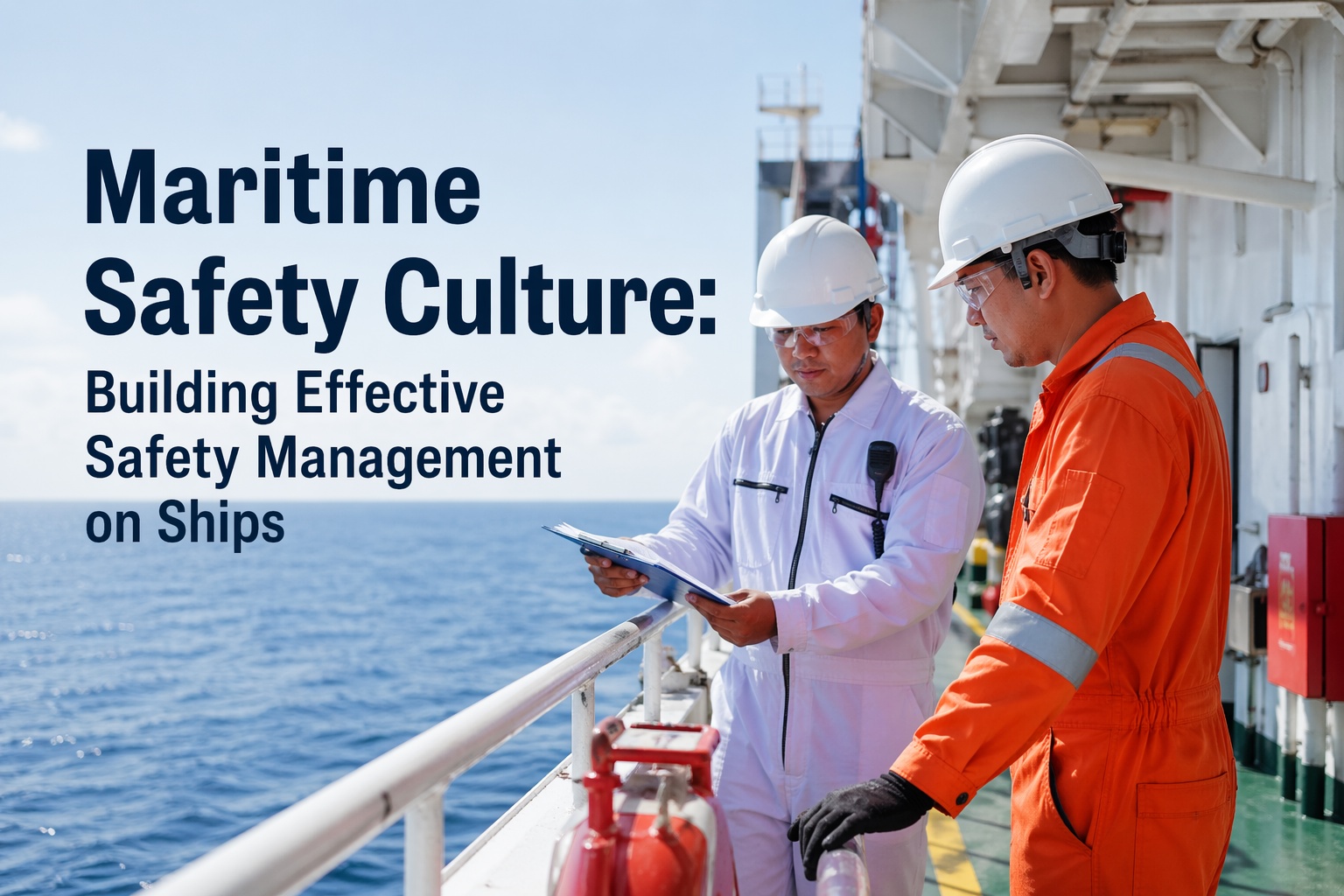
Between 2014 and 2022, human factors accounted for 80.7% of the 23,814 reported maritime casualties and incidents according to the European Maritime Safety Agency — a proportion that has remained stubbornly consistent across all ship types, all flags, and all trades for nearly a decade. Allianz Global Corporate & Specialty's analysis of nearly 15,000 marine liability claims found human error to be the primary factor in 75% of the value of all claims analysed — equivalent to over $1.6 billion in losses. The ISM Code was adopted in 1993 precisely to address this: requiring shipping companies to establish Safety Management Systems that go beyond equipment and procedures to embed safety into organisational behaviour. But three decades later, the gap between ISM compliance and genuine safety culture remains the most significant risk factor in maritime operations. The difference is measurable: Heinrich's safety pyramid — validated by analysis of over 75,000 accident reports — established that for every major accident there are approximately 29 minor injuries and 300 near-misses. A vessel that reports 5 near-misses per month but has 2 incidents doesn't have few hazards — it has a culture that suppresses reporting. OCIMF's TMSA 3 programme made this explicit: Element 1 (Management, Leadership, and Accountability) and the enhanced human factors focus in SIRE 2.0 inspections now assess crew awareness and understanding of procedures in practice, not just hardware condition. The commercial consequences are direct — a strong TMSA score is often a prerequisite for securing charters with oil majors, and SIRE 2.0 findings on crew competency affect vessel acceptability. IMCA's 2024 Safety Statistics show the industry LTIR at 0.3 per million hours worked (down from twice that in 2010), with 52% of lost-time injuries being "line of fire" related — the type of injury that behavioural observation programmes are specifically designed to prevent. To see how Marine Inspection transforms safety data from compliance paperwork into operational intelligence that prevents incidents, book a Marine Inspection demo.
The ISM Code Framework: From Compliance to Culture
The ISM Code provides 13 elements that form the skeleton of every Safety Management System. But a skeleton without muscle — without genuine crew engagement, leadership commitment, and feedback systems — produces compliance paperwork rather than operational safety. ISM Code Section 9.1 states that the SMS must include procedures ensuring non-conformities, accidents, and hazardous situations are reported, investigated, and analysed with the objective of improving safety. The IMO's near-miss reporting circular (MSC-MEPC.7/Circ.7) adds the essential cultural element: a "just culture" where crew provide safety information without fear of retribution. Book a Marine Inspection demo to see how the platform delivers ISM compliance with genuine operational intelligence.
Safety Culture Maturity: Reactive to Interdependent
Building Blocks: What to Implement and How to Measure It
| Building Block | What It Means | Implementation Steps | KPIs to Track | Common Failure Mode | TMSA 3 Alignment |
|---|---|---|---|---|---|
| Just Culture | Non-punitive reporting. Distinguish honest error, at-risk behaviour, and reckless conduct. | Written policy. Training for all. Management demonstrates commitment through action. Guarantee confidentiality for reporters. | Crew survey: "I feel safe reporting mistakes." Near-miss volume trend. Anonymous vs named report ratio. | Declaring "no blame" but punishing the first reporter. Crew learn fast — reporting stops permanently. | Element 1: Leadership & Accountability |
| Near-Miss Reporting | Capturing hazardous conditions before they cause harm — the leading indicator of safety performance. | Simple digital forms (<2 min). Instant DPA notification. Investigate every report. Feedback to reporter within 7 days. Fleet-wide lesson sharing. | Reports per vessel per month (target: 10+). Report-to-closure time. Reporter satisfaction. Fleet sharing frequency. | Reports collected but never investigated. "Black hole" effect — crew stop reporting when nothing changes. | Element 4: Hazard Identification |
| Behavioural Safety Observations | Structured observation of work practices — positive (recognising safe behaviour) and corrective (identifying at-risk behaviour). | Officer-led observation programme. Structured cards. Both positive and corrective. Trends analysed monthly. Discussed at safety meetings. | Observations per officer per month. Positive-to-corrective ratio (target: 3:1+). Trend by category (PPE, procedures, housekeeping). | Only corrective observations (fault-finding). Crew perceive surveillance, not support. Programme abandoned. | Element 3: SIRE 2.0 human factors focus |
| Safety Meetings | Structured forums for two-way safety communication — not one-way instruction. | Monthly shipboard safety committee. Weekly toolbox talks. Crew contribute agenda items. Actions tracked to closure. Minutes distributed. | Meeting frequency. Attendance rate. Crew-raised agenda items (vs management-raised). Actions raised vs closed within target time. | Pre-written minutes. No genuine discussion. Same issues raised month after month without resolution. | Element 2: Safety Communication |
| Root Cause Analysis | Investigating beyond "what happened" to "why it happened" — targeting system failures, not individual blame. | Trained investigators (DPA, Masters, senior officers). 5 Whys, Fishbone, or TapRooT methodology. Corrective actions target root causes. 30-day completion target. | Investigations completed within 30 days. "Human error" as sole root cause (should be <10%). Recurrence rate of similar incidents. | Stopping at "crew didn't follow procedure" without asking why (fatigue, language, training, design, pressure). | Element 4: Risk Assessment & Investigation |
| Leading & Lagging KPIs | Measuring both safety effort (leading) and safety outcomes (lagging) to drive proactive improvement. | Define KPIs per vessel and fleet. Dashboard with real-time tracking. Monthly review. Vessel benchmarking. Industry comparison. | Leading: near-miss rate, observation rate, drill completion, CA closure rate. Lagging: LTIF, TRCF, PSC detentions, ISM NCs. | Measuring only injuries (lagging). No leading indicators. No trend analysis. KPIs collected but never acted upon. | Element 12: Measurement & Improvement |
| Management of Change | Systematic assessment of risk when operational conditions change — new crew, new equipment, new trade, new regulations. | MOC procedure in SMS. Risk assessment triggered by defined changes. Communication to affected personnel. Verification of implementation. | MOC assessments completed vs changes identified. Time from change identification to risk assessment. Communication verification. | Changes implemented without risk assessment. New crew or equipment introduced without updated procedures. | Element 7: Management of Change |
| Cyber Risk Management | Protecting OT and IT systems from cyber threats — now mandatory in SMS per MSC.428(98) and TMSA 3 Element 13. | Asset inventory. Network segmentation. Incident response plan. Annual crew training. Regular vulnerability assessment. Ship-shore comms security. | Crew cyber awareness training completion. Vulnerabilities identified vs remediated. Incident response drill frequency. | Treating cyber as IT-only (not OT). No ship-shore comms security. 828 maritime cyber incidents in 2025 (103% increase). | Element 13: Maritime Security (Cyber) |
The Near-Miss Feedback Loop: Report → Investigate → Act → Communicate
How Marine Inspection Builds Safety Culture Digitally
Conclusion
Maritime safety culture is the operational discipline that determines whether a vessel's Safety Management System prevents incidents or merely documents them after the fact. The data is unambiguous: 80.7% of maritime casualties involve human factors (EMSA 2014-2022), 75% of marine liability claim value stems from human error (AGCS), and Heinrich's pyramid confirms that every fatality is preceded by 29 minor injuries and 300 near-misses that could have been caught. The ISM Code provides the 12-element regulatory framework, but implementation quality determines whether it produces genuine safety improvement or compliance theatre. TMSA 3 and SIRE 2.0 have raised the bar — assessing crew competency, human factors awareness, and safety culture maturity rather than just hardware condition. The building blocks (just culture, near-miss reporting, behavioural observations, safety meetings, root cause analysis, leading/lagging KPIs, management of change, cyber risk management) must each be implemented genuinely, measured honestly, and improved systematically. The journey from reactive to interdependent safety culture takes up to five years of consistent effort — but the alternative is continuing to lose $1.6 billion to human error while counting injuries instead of preventing them. Marine Inspection provides the digital platform that connects every element of safety management into operational intelligence — book a live demo today.