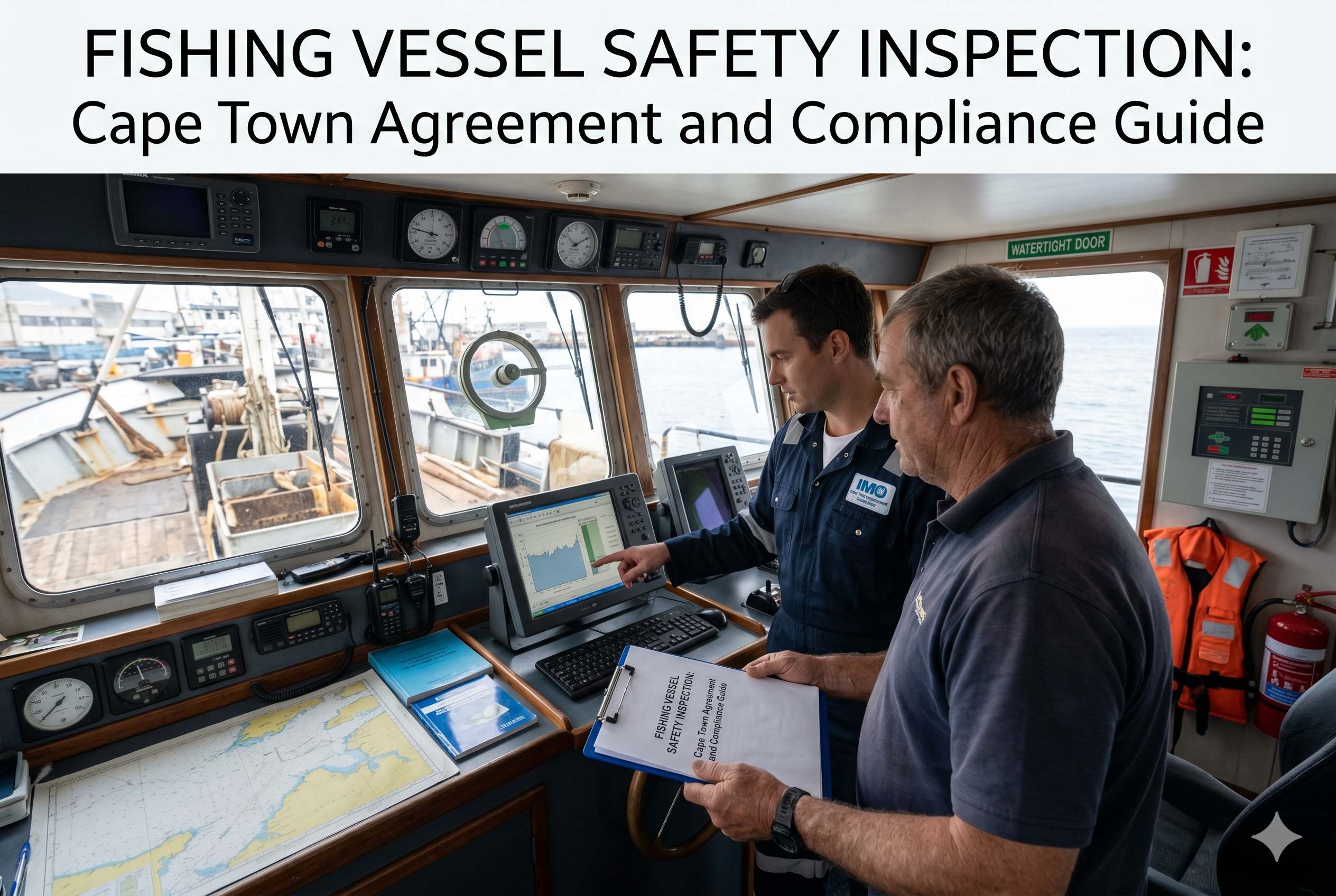
Fishing is the deadliest commercial occupation on the planet — the ILO estimates up to 24,000 fishers die each year on the world's 4.6 million fishing vessels, a fatality rate up to 30 times higher than the average worker. After 50 years of false starts — the failed 1977 Torremolinos Convention, the failed 1993 Protocol, missed 2022 deadlines — the global treaty finally has a date. On 24 February 2026, Argentina deposited its instrument of accession at IMO headquarters in London, pushing the 2012 Cape Town Agreement past the threshold of 22 ratifying states with 3,600+ qualifying vessels. The treaty enters into force in February 2027. For the first time in maritime history, fishing vessels of 24 metres and above will operate under a binding international safety regime — and every flag state, port state, vessel owner and skipper needs to be ready. Start a free trial of Marine Inspection to digitize your fishing fleet's compliance ahead of the 2027 deadline.
Fishing Vessel Safety in 2026 — The Numbers Behind the New Treaty
Feb 2027
Cape Town Agreement Enters Force
15 years after adoption — first global treaty for fishing vessel safety
28 / 3,754
Ratifying States & Qualifying Vessels
Threshold: 22 states with 3,600 vessels — now exceeded
45,000+
Vessels Coming Under CTA
All fishing vessels 24m or 300 GT and above globally
24,000
Annual Fisher Fatalities (ILO)
10× higher than merchant and passenger shipping combined
Why the 2027 Cape Town Agreement Changes Everything
Until 2027, fishing vessels have effectively been excluded from the global maritime safety regime. SOLAS — the world's foundational ship safety convention — explicitly excludes fishing vessels from its scope. STCW excludes fishing vessel personnel. National rules vary wildly: Norway, Iceland and Denmark run tight regimes; many West African and Asian states run almost none. The Cape Town Agreement closes that gap. Once in force, every 24m+ fishing vessel calling a Port State signatory's harbour faces the same minimum safety standard — design, construction, equipment, stability, life-saving, fire protection, communications, inspection. For operators, the lesson is direct: prepare your fleet now, while the 12-month entry-into-force runway is still open. Book a Marine Inspection demo to see how fishing fleet operators digitize CTA-aligned inspection workflows.
The Four Pillars of Global Fishing Vessel Safety
The Cape Town Agreement doesn't operate alone. It's the fourth and final piece in a four-treaty framework — three already in force, one entering force in 2027 — that together regulate vessel safety, crew training, working conditions, and IUU fishing controls.
Cape Town Agreement (2012)
Vessel Safety
Mandatory safety standards for fishing vessels of 24m+ — design, construction, equipment, stability, life-saving, fire protection, radio, inspection regime, port state control rights.
STCW-F (1995)
Crew Training
Certification and minimum training for fishing vessel personnel: skippers, officers (deck and engine), radio operators on vessels 24m+ or 750 kW+. Entered into force 2012.
Work in Fishing Convention C188 (2007)
Working Conditions
Decent working conditions: minimum age, hours of rest, medical certification, work agreements, accommodation, food, repatriation, social security. Applies to vessels of all sizes; stricter for 24m+.
Port State Measures Agreement (2009)
IUU Fishing
Combats illegal, unreported and unregulated fishing through port state measures — vessel pre-arrival info, denial of port entry, in-port inspections of fishing vessels suspected of IUU activity.
From Torremolinos to Cape Town: A 50-Year Journey to Force
The Cape Town Agreement is the third attempt to bring international fishing vessel safety into legal force. Two earlier conventions failed. Understanding why the 2012 text finally crossed the line — and when each milestone happened — explains why operators need to act now.
1977
Torremolinos Convention
First international treaty on fishing vessel safety adopted in Spain. Never entered into force — too complex for emerging fishing nations to implement.
1993
Torremolinos Protocol
Revised provisions adopted to address technical difficulties with the 1977 text. Also failed to attract sufficient ratifications to enter force.
2012
Cape Town Agreement Adopted
Replaces and updates both prior instruments. Adopted 11 October 2012. Threshold for force: 22 states with 3,600 qualifying vessels (24m+ on the high seas).
2019
Torremolinos Declaration
48 states (later 51) publicly commit to ratifying CTA by October 2022 — the 10th anniversary. Major fishing nations including UK, Argentina, Indonesia, Peru sign on.
2022
10th Anniversary — Threshold Missed
Despite the Torremolinos commitments, ratifications stall at 17 states / 1,925 vessels. IMO Secretary-General urges accelerated accessions.
24 Feb 2026
Argentina Crosses the Threshold
Argentina deposits instrument of accession at IMO London — 28th state, 467 vessels added, total 3,754 qualifying vessels. CTA passes both thresholds.
Feb 2027
Cape Town Agreement Enters Force
12 months after Argentina's accession. Flag states must incorporate CTA into national law. Port states gain right to inspect foreign fishing vessels for compliance.
What the Cape Town Agreement Actually Requires
The CTA covers eight functional areas of fishing vessel safety. Each maps to a specific chapter of the Agreement and its Annex (the Torremolinos Protocol of 1993, as amended). Operators heading into 2027 should know which areas drive most class society and port state findings. Sign up for Marine Inspection to deploy CTA-aligned digital inspection templates for your fleet.
01
Construction, Watertight Integrity & Equipment
Hull strength, watertight bulkheads, openings, doors, scuttles, ventilators, freeboard. Construction standards equivalent to passenger or cargo ships scaled for fishing operations.
02
Stability & Seaworthiness
Intact and damage stability criteria, including loaded conditions with full and partial catch, ice accretion in northern fisheries, fuel and water consumption variations, and free-surface effect of liquid catches.
03
Machinery & Electrical Installations
Main propulsion, auxiliary machinery, steering gear, electrical distribution, emergency power, fuel systems — designed for periodically unattended machinery spaces where applicable.
04
Fire Protection, Detection & Extinction
Structural fire protection in accommodation and machinery spaces, fixed extinguishing systems, portable extinguishers, fire detection and alarm systems, firefighter outfits, escape routes.
05
Protection of Crew
Bulwarks, guard rails, walkways, working deck arrangements, freeing ports, openings to fish-handling spaces — preventing the fall-overboard incidents that account for 30% of all fishing fatalities.
06
Life-Saving Appliances & Arrangements
Lifeboats, life rafts, lifejackets, immersion suits, lifebuoys, EPIRBs, line-throwing appliances. Drills, training, and maintenance. Personal flotation device (PFD) requirements on deck.
07
Emergency Procedures, Musters & Drills
Muster lists, abandon-ship procedures, fire drills, emergency response training, language and communication requirements for multi-national crews common in distant-water fleets.
08
Radio Communications & Navigation Equipment
GMDSS-aligned communications by sea area, AIS for ≥45m vessels, VHF, MF/HF, satellite EPIRB, SART, radar, electronic position fixing, electronic chart system, autopilot.
Get Your Fishing Fleet Cape Town-Ready Before 2027
Construction, stability, life-saving, fire, radio — eight CTA chapters, one digital platform, fleet-wide visibility for skippers, fleet managers and flag state inspectors.
The Reality of Fishing Fatalities: Why the CTA Matters
The case for the Cape Town Agreement is not abstract. Fishing's safety record is the worst of any commercial sector globally — and the gap between developed and developing fisheries is brutal.
Fishing Fatality Rates Compared (deaths per 100,000 workers per year)
US commercial fishing
100+
UK fishing (1996–2005)
115×
Alaskan crab fleet (peak years)
300+
Guinea / West Africa small-scale
500
Lake Victoria (FAO data)
1,800
Vessel Size Tiers: Which Rules Actually Apply to You
"Fishing vessel" covers everything from a 6-metre artisanal canoe to a 130-metre factory trawler. The applicable safety regime depends almost entirely on length and the waters fished. Here's how the regulatory layers stack across vessel sizes.
<12m
Small / Artisanal
81% of global fishing fleet
CTA does NOT apply
National flag state rules only
FAO Voluntary Guidelines for Small Fishing Vessels
ILO C188 (where ratified)
12–24m
Coastal
Significant national fleet share
CTA does NOT apply (24m+ threshold)
FAO Code of Safety for Fishermen Part B
National flag state rules (often stricter)
ILO C188 with extended provisions
24m+
Industrial / High-Seas
~45,000 vessels worldwide
FULL Cape Town Agreement applies
STCW-F crew certification mandatory
ILO C188 prescriptive standards
Port state inspection rights from 2027
45m+
Distant-Water
Pelagic trawlers, longliners, factory ships
CTA + GMDSS-aligned radio (full)
AIS Class A mandatory
Stricter stability + life-saving
FAO PSMA enforcement focus
The Two Killers: Vessel Disasters and Falls Overboard
Across two decades of NIOSH data, two causes account for nearly 80% of all commercial fishing fatalities. Every CTA chapter, every safety equipment line, every drill exists primarily to prevent one or the other. Knowing the controls that work — and the ones that don't — is what separates compliant fleets from headline statistics.
47%
Vessel Disasters
Capsizing, flooding, sinking, fires
Stability loss: overloaded catch, free-surface effect of liquid loads, ice accretion, asymmetric flooding
Hull failure: fatigue, corrosion, prior damage, age (especially >25 years)
Engine room fire: fuel leaks, electrical faults, hot work, machinery space oil mist
Watertight failure: hatches not properly secured, downflooding through ventilators
CTA controls: stability assessments, watertight integrity surveys, fire detection and suppression, structural fire protection
30%
Falls Overboard
Crew lost over the side, often without PFD
Brutal data: 100% of US fall-overboard victims 2000–2014 were NOT wearing a PFD when they drowned
Rough weather: deck wash, vessel pitch and roll, snagged gear pulling crew over
Working alone: night watches, single-person tasks on open deck, no man-overboard alarm
Fatigue: long hours, irregular rest, increased misstep risk
CTA controls: bulwarks/guard rails, freeing ports, deck arrangements; ILO C188 hours-of-rest; PFD requirements; working-alone procedures
Essential Safety Equipment for Cape Town-Ready Vessels
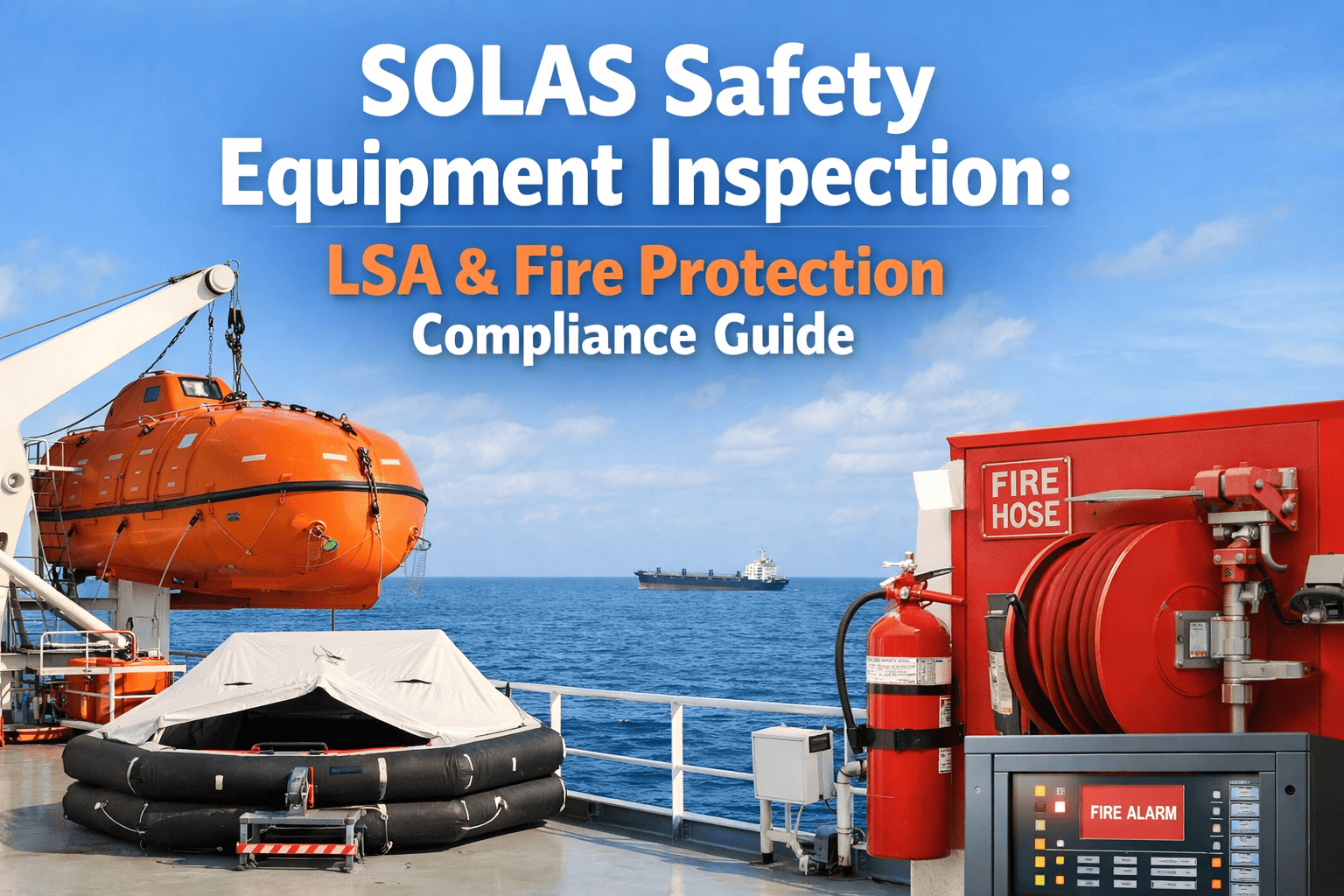
The CTA's life-saving and fire safety chapters mandate a specific equipment loadout. Some items are familiar from SOLAS; others are uniquely fishing-vessel rules. Each should be inspection-logged, dated, and ready to demonstrate to a port state officer. Book a demo to digitize your equipment register.
LSA
Inflatable Liferafts
Capacity for total persons onboard, hydrostatic release units, annual servicing at approved station, certificates onboard.
LSA
Personal Flotation Devices
SOLAS-approved or work vest equivalents. Mandatory wear in many jurisdictions for crew on open deck. Fall-overboard data justifies daily-wear policy regardless.
LSA
Immersion Suits
One per crew member in cold-water fisheries. Annual inspection for seal integrity, zipper function, light battery, whistle attachment.
RADIO
EPIRB (406 MHz Satellite)
Required for vessels operating >3 nm offshore in many jurisdictions. Battery expiration tracked, hydrostatic release tested, registration current with national authority.
RADIO
SART & AIS-SART
Search and rescue transponders carried in liferafts. Annual function test. Critical for SAR coordination after vessel disaster.
FIRE
Fixed CO2 / Foam System
Engine room and high-risk machinery space coverage. Annual servicing, weight or pressure checks, release pull verification, signage.
FIRE
Portable Extinguishers
Strategic placement at galley, machinery, crew accommodation, bridge. Monthly visual, annual servicing, hydrostatic test at 5-year intervals.
FIRE
Fire Detection & Alarm
Smoke detectors in accommodation, heat detectors in galley, machinery space coverage. Central alarm panel, weekly testing, battery checks.
NAV
Radar & AIS
Class A AIS for vessels 45m+, Class B otherwise. Radar for collision avoidance and weather observation. Annual radio survey.
DECK
Bulwarks, Rails & Freeing Ports
Minimum height, structural integrity, drainage capacity. The first physical barrier against falling overboard — often modified or removed during fishing operations and incorrectly reinstated.
MED
Medical Stores & First Aid
Required by ILO C188. Onboard medicine cabinet, first-aid training, telemedical advice arrangements, fitness to work medical certification (mandatory under C188).
DECK
Man-Overboard Alarm & Recovery
Personal locator beacons, MOB-recovery training, retrieval gear. Fall-overboard victims survive minutes — recovery speed determines outcome.
STCW-F: Crew Certification That Crosses Borders
The Cape Town Agreement covers the vessel; STCW-F (in force since September 2012) covers the people on it. From 2027, port state officers will increasingly check both. STCW-F sets the certification framework for skippers, navigation officers, engineers and radio operators on fishing vessels of 24m+ or 750 kW+ propulsion. Sign up to track every crew certificate digitally.
STCW-F Certification Categories — Who Needs What
II/1
Skipper Fishing Unlimited
Vessels 24m+ in unlimited waters
II/2
OICNW Fishing Unlimited
Officer in charge, navigation watch, unlimited waters
II/3
Skipper Fishing Limited
Vessels 24m+ in limited waters
II/4
OICNW Fishing Limited
Officer in charge, navigation watch, limited waters
II/5
Chief / 2nd Engineer
Vessels with main propulsion 750 kW or more
II/6
Radio Personnel
GMDSS / radiocommunication duties certification
II/7
Renewal & Updating
Continued proficiency for skippers, officers, engineers
III/1
Basic Safety Training
All fishing vessel personnel — fire, sea survival, first aid, personal safety
The Cost of Skipping the 2027 Runway
Operators waiting until enforcement begins will be on the back foot. The 12 months between Argentina's accession and February 2027 is the window to upgrade. Beyond that, the consequences of non-compliance are severe.
Detention
Port State Control Inspection
From 2027, port states can detain non-CTA-compliant fishing vessels of 24m+. Lost catch, missed market windows, demurrage costs.
Insurance
Premium Increases / Cover Loss
Underwriters will adjust risk profiles based on CTA compliance. Some policies may exclude vessels failing port state inspections.
Markets
Buyer & Certification Loss
EU, US and Japanese buyers tightening seafood traceability and safety due-diligence — CTA non-compliance becomes a sourcing red flag.
Liability
Civil & Criminal Exposure
When a vessel is lost or a fisher dies, post-2027 investigations will measure the operator against CTA standards — not just national rules.
How Digital Inspection Software Closes the CTA Compliance Gap
Manual paper logs are a 20th-century answer to a 21st-century compliance regime. Digital inspection platforms transform CTA readiness from an end-of-year scramble into an always-current operational baseline.
01
Stability & Loading Records
Digital stability bookkeeping, loading condition records, ice-accretion calculations — the data CTA flag state surveyors will request first.
02
Equipment Inventory & Service Dates
Liferaft service intervals, EPIRB battery dates, fire system charges, immersion suit inspections — alerts at 90 / 60 / 30 days before expiry.
03
Crew Certification Tracking
Every STCW-F certificate, ILO C188 medical fitness, basic safety training, refresher dates — fleet-wide roster always current for port state inspection.
04
Drill Logs & Muster Records
Fire drills, abandon-ship drills, MOB recovery exercises, equipment familiarization — timestamped, photo-documented, exportable.
05
Mobile Inspection Capture
Crew complete daily safety walks, weekly equipment checks, monthly stability assessments on phone or tablet — works offline at sea, syncs in port.
06
Port State Inspection Pack
When the inspector boards, generate a CTA evidence pack in seconds — certificates, drill logs, equipment status, recent corrective actions all in one export.
Don't Wait for February 2027 — Start Compliance Now
Build digital evidence trails through the runway period, train your crew on digital workflows, and walk into Year One of CTA enforcement audit-ready instead of scrambling.
2026–2027 Fishing Vessel Inspection Readiness Checklist
Use this to pressure-test your fleet during the runway to entry-into-force. Items below are the highest-impact, port-state-inspector-favourite checkpoints.
Cape Town Agreement Pre-Force Quick-Check
Documentation & Certification
Fishing Vessel Safety Certificate (under CTA from 2027) — flag state survey current
STCW-F certificates — skipper, OICNW, engineer, radio operator endorsements valid
ILO C188 Fishermen's Work Agreements signed and onboard
Medical fitness certificates current for all crew (ILO C188 mandatory)
AIS registration / MMSI / EPIRB registration with national authority
Stability, Hull & Construction
Stability information booklet current, accessible to skipper, ice-accretion data included
Watertight integrity — hatches, doors, ventilators tested and operational
Hull condition — corrosion mapping, structural defect log, dry-docking interval current
Loading conditions documented, free-surface effects accounted for
Life-Saving & Fire Safety
Liferafts serviced annually at approved station, certificates onboard
Lifejackets / PFDs sufficient for total persons + extras for working watches
Immersion suits per crew member (cold water fisheries) — inspected annually
EPIRB hydrostatic release in date, battery life tracked, registration current
Fixed fire-extinguishing system serviced, portable extinguishers within service
Fire detection / alarm system tested weekly, log maintained
Crew Protection & Drills
Bulwarks, guard rails, freeing ports — physical condition verified
Working alone and night-watch protocols — written and crew-trained
Fire drills, abandon-ship drills, MOB recovery — at intervals required by flag state
Hours of rest records (ILO C188) — minimum 10 hours in any 24-hour period
Multi-language muster lists where multinational crew operates
Frequently Asked Questions
When does the Cape Town Agreement actually enter into force?
February 2027 — exactly 12 months after Argentina's instrument of accession on 24 February 2026, which crossed both the 22-state and 3,600-vessel thresholds. Once in force, ratifying states must incorporate CTA into their national legislation and enforce it as they would any other maritime safety regulation.
Which fishing vessels are covered by the Cape Town Agreement?
Vessels of 24 metres in length and over (or 300 GT and above) operating on the high seas. About 45,000 vessels worldwide fall into this scope. Smaller vessels (under 24m) — which represent 81% of the global fishing fleet — are not covered by CTA but may fall under FAO Voluntary Guidelines and national flag state rules.
Why aren't fishing vessels covered by SOLAS?
SOLAS specifically excludes fishing vessels from its scope. The IMO recognized in the 1970s that fishing vessels need a tailored regime — different operational profile, different stability concerns, different equipment needs — leading to the 1977 Torremolinos Convention, the 1993 Protocol, and ultimately the 2012 Cape Town Agreement.
What's the difference between the Cape Town Agreement and STCW-F?
CTA covers the vessel — design, construction, equipment, stability, life-saving. STCW-F (in force since September 2012) covers the crew — certification and training for skippers, officers, engineers and radio operators on vessels 24m+ or 750 kW+. They're complementary instruments. From 2027 onwards, port state officers will check both.
What is ILO Convention 188 and how does it apply to my vessels?
ILO Work in Fishing Convention C188 (in force since November 2017) sets minimum working conditions for fishers worldwide. It applies to all fishing vessels of any size in ratifying states, with stricter prescriptive standards for vessels 24m+ or with voyages of three days or more. Areas covered: Fishermen's Work Agreements, hours of rest, accommodation, food, medical care, mandatory medical fitness certificate, social protection.
My country hasn't ratified CTA — does it still affect my operations?
Yes — port state control is the lever. Even if your flag state has not ratified CTA, when your vessel calls a port of a ratifying state, it can be inspected against CTA standards. With 28 contracting states and counting, the geographic envelope of port state inspections expands continuously. Most major fishing nations and trading hubs are ratifying.
How does digital inspection software help with CTA compliance specifically?
Marine Inspection pre-loads CTA-aligned digital templates covering all eight chapters: construction surveys, stability records, machinery checks, fire system audits, life-saving inventory, crew protection logs, drill records, and radio communications testing. Captains capture evidence on mobile (online or offline), shore teams maintain fleet-wide visibility, and port state inspectors get a one-export evidence pack instead of a paper search through five binders.
February 2027 is Closer Than It Looks
Cape Town Agreement compliance, STCW-F certification tracking, ILO C188 working conditions, port state inspection readiness — all on one platform built for fishing vessel operators.