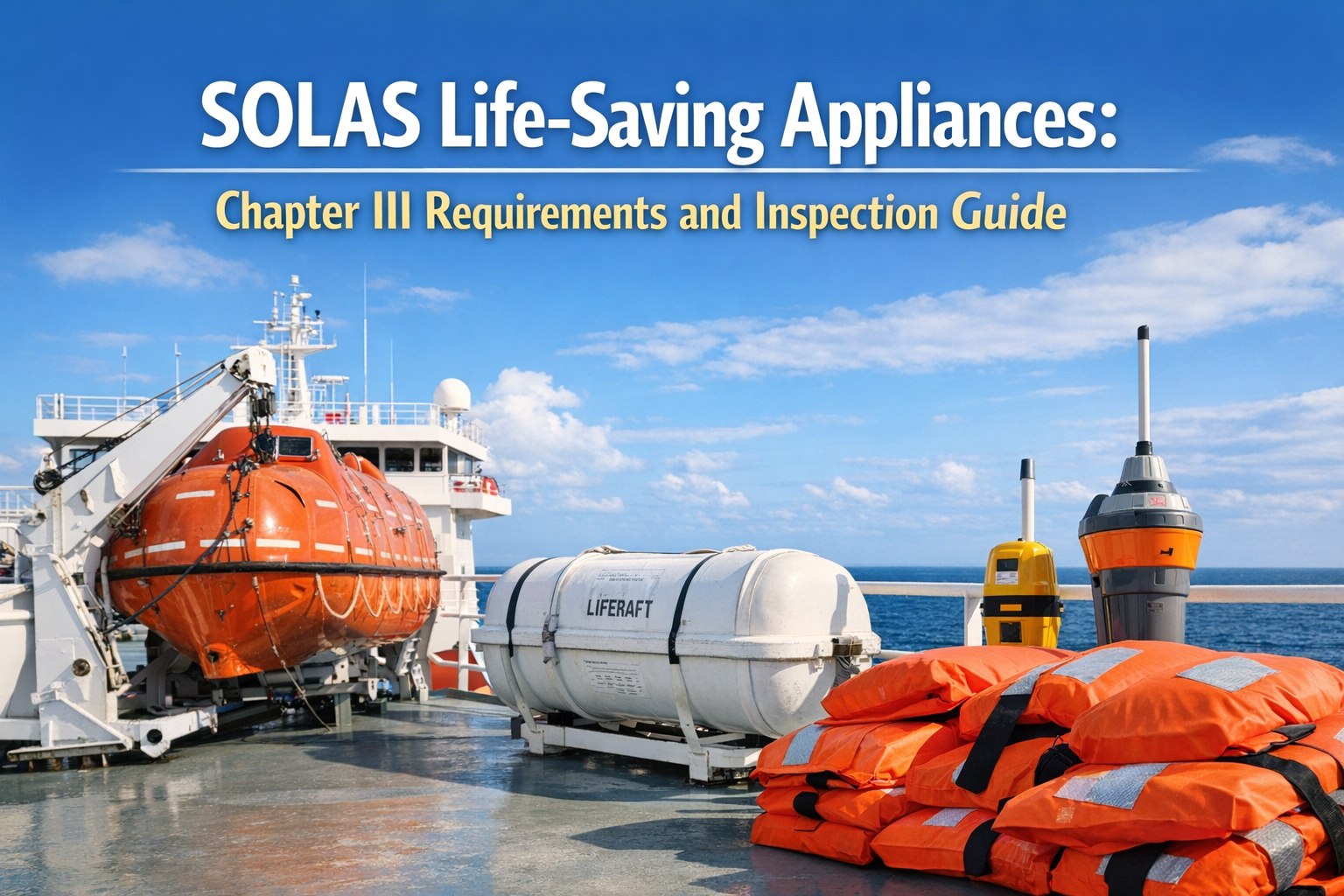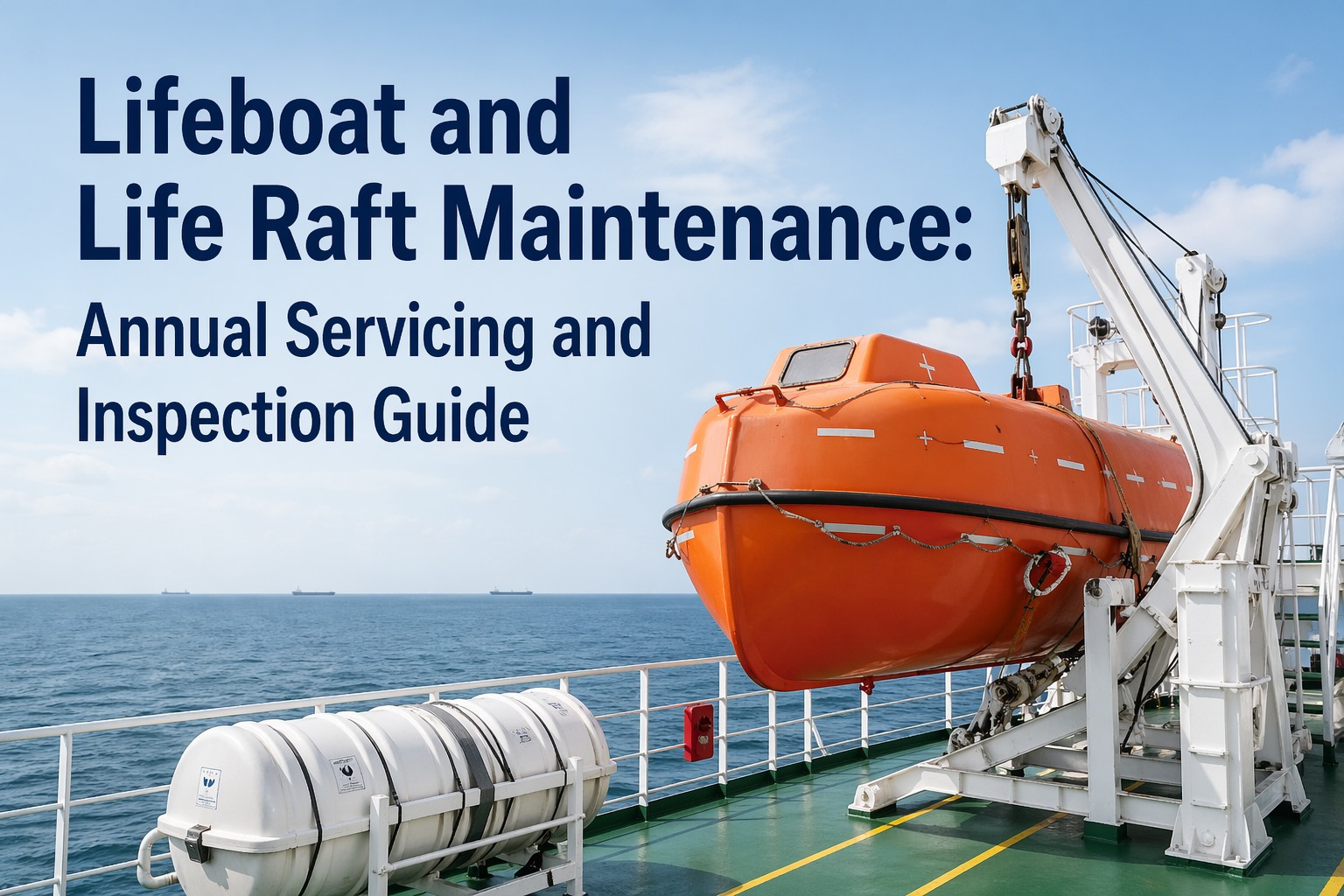
Life-saving appliances are the equipment your crew will depend on when everything else has failed — and SOLAS Chapter III mandates that they must be in working order and ready for immediate use at all times, before departure and throughout the voyage. This is not aspirational language; it is a regulatory requirement that PSC officers enforce at every boarding. An expired life raft service certificate, a lifeboat engine that won't start, a corroded on-load release hook, a davit wire fall past its renewal date, or a hydrostatic release unit beyond its expiry — any one of these turns a routine inspection into a vessel detention. Resolution MSC.402(96) established the framework for maintenance, thorough examination, operational testing, overhaul, and repair of lifeboats, rescue boats, launching appliances, and release gear. The service provider must hold valid authorisation certificates for each specific equipment type per MSC.402(96) Section 8. Resolution MSC.554(108), effective 1 January 2026, introduces amendments addressing lifeboat release mechanisms and lowering speeds. The maintenance regime spans from weekly visual inspections through monthly engine runs and davit tests, quarterly waterborne launches, annual thorough examinations by authorised service providers, to five-yearly overhaul, load testing, and recertification. For inflatable life rafts, servicing at approved stations at intervals not exceeding 12 months is mandatory — and a valid raft service with an expired HRU equals non-compliant, because PSC inspectors check both dates independently. Marine Inspection already provides an LSA checklist with 70+ inspection items across 9 safety categories — book a demo to see how automated scheduling, service tracking, and PSC-ready documentation work across your fleet.

LSA Maintenance Intervals at a Glance
Weekly
Visual inspection of all lifeboats, davits, life rafts, and associated equipment. Verify readiness for immediate use.
Monthly
Lifeboat engine run (min 3 minutes). Turn out lifeboats from stowed position. Equipment inventory check. HRU expiry verified.
Quarterly
Launch each lifeboat with crew, manoeuvre in water. Rescue boat waterborne exercise. Davit and winch operational test.
Annual
Thorough examination by authorised service provider. Life raft servicing at approved station. Release gear operational testing. Davit load test.
5-Yearly
Complete overhaul. Load testing of davits and winches. Structural assessment. Wire fall replacement. Recertification.

Complete LSA Maintenance Schedule

Lifeboat, Life Raft & Rescue Boat — Maintenance Requirements
Equipment / Task Frequency Regulatory Basis Who Performs Key Actions
Lifeboat Visual InspectionWeeklySOLAS III/20Ship's crew (designated officer)Hull condition, davit condition, hook position, equipment stowage, painter condition, drain plugs fitted.
Lifeboat Engine RunMonthlySOLAS III/20, MSC.402(96)Ship's crew (engineer)Run engine minimum 3 minutes (if ambient temp permits). Check gearbox, fuel level, cooling water, battery charge, exhaust.
Lifeboat Turn-OutMonthlySOLAS III/20Ship's crewMove lifeboats from stowed position without crew aboard. Test launching appliance function. Weather/sea permitting.
Lifeboat Waterborne Launch3 MonthsSOLAS III/19.3.4.3Assigned operating crewLaunch with crew, manoeuvre in water, test engine under load, test steering, recovery. Different boat each drill.
Free-Fall Lifeboat Launch6 MonthsSOLAS III/19.3.3.4Assigned crew onlyFree-fall launch with operating crew. Simulated launch every 6 months if admin extends to 12 months. MSC.535(107) amendments.
On-Load Release Gear TestAnnualMSC.402(96), MSC.1/Circ.1206/Rev.1Authorised service providerOperational testing of hook assemblies, pins, bearings, welds. Partial load test. Full engage/release/reset sequence. Photographic evidence.
Lifeboat Annual Thorough ExamAnnualMSC.402(96) Section 8Authorised service provider (certified per manufacturer)Structural assessment, engine/propulsion, manoeuvring, power supply, bailing, equipment inventory against LSA Code list. Detailed report issued.
Davit & Winch Annual InspectionAnnualMSC.402(96)Authorised service providerDavit structure: corrosion, misalignment, deformation. Wire/sheave condition. Lubrication. Brake system. Winch motor. Limit switches.
Davit Load Test5 YearsMSC.402(96)Authorised service provider / approved facilityOverload test sequence: 25%, 50%, 75%, 100% overload with deflection measurement. Wire fall replacement. Certificate issued valid 5 years.
Inflatable Life Raft Service12 Months maxSOLAS III/20.8.1, A.761(18)Approved service station (flag state authorised)Inflate raft, inspect for damage, verify all equipment vs packing list, replace expired pyrotechnics/rations, test mechanical components. Certificate issued.
HRU Replacement2 Years maxSOLAS III/20, manufacturer specsShip's crew or service stationReplace regardless of condition. Some manufacturers require annual replacement. Expired HRU = non-compliant even if raft is serviced.
Rescue Boat MaintenanceMonthly launch / Annual serviceSOLAS III/19.3.3.6, MSC.402(96)Ship's crew (monthly) / Authorised provider (annual)Monthly: launch with crew, manoeuvre, engine test. Annual: outboard serviced by approved mechanic, full sea trial, hull inspection.
Pyrotechnics ReplacementBefore expiry (typically 3-4 years)SOLAS III/6, LSA Code Ch.IIIShip's crew (check) / supply (replace)Parachute rockets, hand flares, buoyant smoke signals. Check monthly. Replace before expiry date. Minimum 12 rockets on bridge, 2 per survival craft.
Life Raft Container & CradleWeekly visual / Monthly detailedSOLAS III/20Ship's crewContainer: no damage, moisture ingress, or deformation. Cradle: quick-release hook functional. Lashing straps not chafed. HRU connected and within date.
5-Year Complete Overhaul5 YearsMSC.402(96)Authorised service provider / shore facilityThorough examination of all components. Load testing. Wire fall renewal. Structural integrity assessment. Complete recertification. Detailed report.
A valid raft service with an expired HRU = non-compliant. PSC inspectors check both dates independently. Service provider must hold valid authorisation per MSC.402(96) Section 8 for each specific equipment brand/model.

What PSC Inspectors Check First

Port State Control officers have a hierarchy of LSA items they verify — and the items that generate the most detentions are consistently the same. These are not obscure technicalities; they are the maintenance items most commonly missed.

On-Load Release Hooks: Not tested, stiff, or corroded. Davit wire falls past renewal date. These are direct life-safety items that trigger serious deficiency notices. Annual operational testing is mandatory.
HRU Expiry Date: The most commonly missed item. Inspectors check HRU date independently of raft service date. A 2-year-old HRU with a freshly serviced raft = non-compliant vessel.
Life Raft Service Certificate: Annual service label missing, outdated, or issued by a non-approved service company. The service station must be authorised by the flag state administration.
Lifeboat Engine Start: PSC may request a lifeboat engine start during inspection. An engine that won't start on the first or second attempt indicates inadequate monthly testing. Battery condition critical.
Pyrotechnic Expiry Dates: Checked monthly — 3-4 year shelf life from manufacture date. Expired flares must be replaced before expiry. Retained only if within count requirements.
Safety Equipment Certificate: Issued during statutory survey. Must be valid. LSA deficiencies found during PSC may result in conditions or withdrawal of the SEC, making the vessel unable to trade.

2026 LSA Code Amendments: What Changed

Resolution MSC.554(108) introduces amendments to the LSA Code effective 1 January 2026, addressing lifeboat release mechanisms and launching appliance lowering speeds. These apply to equipment installed on or after 1 January 2026. Sign up for Marine Inspection to track compliance with new and existing requirements.

Lowering Speed Requirements
New formula: S = 0.4 + 0.02H (H = height from davit head to waterline in light condition). Minimum speed 1.0 m/s (prevents excessively slow launching). Maximum 1.3 m/s for fully loaded boats. Speed-limiting device mandatory.
Release Mechanism Clarity
Clear identification required: on-load vs off-load release systems. Each type subject to different operational and testing requirements. Prevents confusion during drills and servicing.
Free-Fall Drill Guidance
MSC.535(107): Simulated launches authorised for routine drills. Simulation equipment must handle static and dynamic loads per LSA Code safety factors. Reduces risk during training while maintaining competency.

How Marine Inspection Manages LSA Compliance

Automated Service Scheduling
Every maintenance interval (weekly to 5-yearly) scheduled per equipment item. Overdue alerts to vessel, superintendent, and fleet manager. Life raft service, HRU replacement, and davit load test dates tracked individually.
70+ Item LSA Checklist
Structured inspection across 9 safety categories. Mandatory fields prevent missed items. Photo evidence capture. Debrief findings linked to corrective actions. PSC-ready documentation at all times.
Certificate & Expiry Tracking
Safety Equipment Certificate, life raft service certificates, davit load test certificates, HRU expiry dates, pyrotechnic dates, EPIRB battery expiry — all tracked per item with countdown alerts.
Service Provider Records
Authorised service provider details per equipment type. MSC.402(96) Section 8 authorisation verification. Inspection and test reports archived. Service history per lifeboat, davit, and raft.
An Expired HRU Makes Your Entire Life Raft Non-Compliant
Marine Inspection tracks every HRU expiry, every raft service date, every davit load test, every release gear inspection, and every pyrotechnic replacement — because the equipment your crew depends on in an emergency must be verified, serviced, and documented to a standard that survives PSC scrutiny.

Conclusion

Life-saving appliance maintenance is the shipboard discipline where the gap between compliance and competence is measured in lives — a lifeboat that launches successfully in a drill because the davit was load-tested, the release gear was operationally tested by an authorised service provider per MSC.402(96), the engine runs because it was tested monthly for a minimum 3 minutes, and the wire falls were renewed within the 5-year cycle. For inflatable life rafts, the 12-month maximum service interval at flag-state-approved stations, combined with 2-year HRU replacement (regardless of condition), pyrotechnic replacement before expiry, and container/cradle weekly visual checks form the maintenance chain that keeps survival craft deployment-ready. The 2026 LSA Code amendments (MSC.554(108)) add lowering speed formula requirements and release mechanism clarity for new installations. PSC enforcement is relentless on LSA items — on-load release hooks, HRU dates, raft service certificates, engine starts, pyrotechnic expiry, and Safety Equipment Certificate validity are verified at every boarding. Marine Inspection provides the digital platform that automates the entire LSA maintenance schedule, tracks certificates and expiry dates per equipment item, maintains 70+ item inspection checklists, and archives service provider records — book a live demo today.

Frequently Asked Questions

FAQ 01
How often must life rafts be serviced?
Inflatable life rafts must be serviced at intervals not exceeding 12 months by service stations approved by the flag state administration and authorised by the raft manufacturer, per SOLAS III/20.8.1 and Resolution A.761(18). During servicing, the raft is fully inflated, inspected for damage to fabric and seams, and all equipment is verified against the SOLAS packing list. Expired pyrotechnics, water, and food rations are replaced. Mechanical components (inflation cylinders, relief valves, boarding ramps) are tested. The service station issues a certificate valid for 12 months — this certificate must be available on board for PSC inspection. The service interval may be extended to 17 months in exceptional circumstances with flag state approval, but standard practice is strict 12-month servicing.
FAQ 02
How often must the HRU be replaced?
Hydrostatic Release Units must be replaced at maximum 2-year intervals regardless of their apparent condition — some manufacturers require annual replacement depending on model specifications. The HRU is the mechanism that automatically releases the life raft if the vessel sinks (activates at 1.5-4 metres depth). An expired HRU makes the entire life raft assembly non-compliant, even if the raft itself has a valid service certificate — PSC inspectors check both dates independently. HRU expiry should be verified monthly during routine life raft container inspections. When replacing the HRU, verify that the replacement unit is compatible with the specific raft model and that the weak link, painter, and lashing arrangement are correctly configured for float-free operation.
FAQ 03
Who can perform the annual lifeboat inspection?
The annual thorough examination of lifeboats, rescue boats, launching appliances, and release gear must be performed by a service provider holding valid authorisation certificates for each specific equipment type (lifeboat brand/model, release gear type, winch/davit manufacturer), as required by MSC.402(96) Section 8. The service provider's personnel must be certified and trained by the equipment manufacturer. Ship's crew perform weekly/monthly maintenance, but the annual thorough examination requires external authorised service. Upon completion, the service provider issues a detailed inspection and test report certifying operational readiness and structural fitness. This documentation must be retained on board for review by flag state authorities or classification societies during annual and renewal surveys.
FAQ 04
How often must lifeboats be launched and manoeuvred in water?
Each lifeboat must be launched with its assigned operating crew aboard and manoeuvred in water at least once every three months during an abandon ship drill per SOLAS III/19.3.4.3. Monthly, all lifeboats (except free-fall) must be turned out from their stowed position without crew aboard to test launching appliance function. Free-fall lifeboats must be free-fall launched with assigned crew every six months per SOLAS III/19.3.3.4 — the administration may extend this to 12 months if simulated launching is conducted every six months. During waterborne exercises, the engine must be run under load, steering tested, and recovery procedures practised. Different lifeboats should be exercised at successive drills to ensure all boats are tested. Rescue boats must be launched with assigned crew monthly and manoeuvred in water.
FAQ 05
What is the davit load test cycle?
Davit load testing is required every 5 years per MSC.402(96). The test follows an overload sequence: unloaded baseline measurements, then progressive loading at 25%, 50%, 75%, and 100% overload with deflection measurements and structural verification at each stage, followed by unloading with residual deflection evaluation. Wire falls are typically renewed during the 5-year overhaul. The davit load test certificate is valid for 5 years and must be available on board. Between load tests, annual inspections by authorised service providers check davit structure for corrosion, misalignment, and deformation, wire and sheave condition, lubrication, brake systems, winch motors, and limit switches. On-load release gear requires separate annual operational testing including the full engage/release/reset sequence under partial load.
Book Your Live Demo
The Equipment Your Crew Depends On Must Be Ready When It Matters
Marine Inspection automates LSA maintenance scheduling, tracks every service date, certificate expiry, and HRU replacement across your fleet — 70+ inspection items, 9 safety categories, zero missed deadlines.
70+
LSA inspection items tracked
12 mo
Max life raft service interval
2 yr
Max HRU replacement cycle
5 yr
Davit load test & overhaul cycle