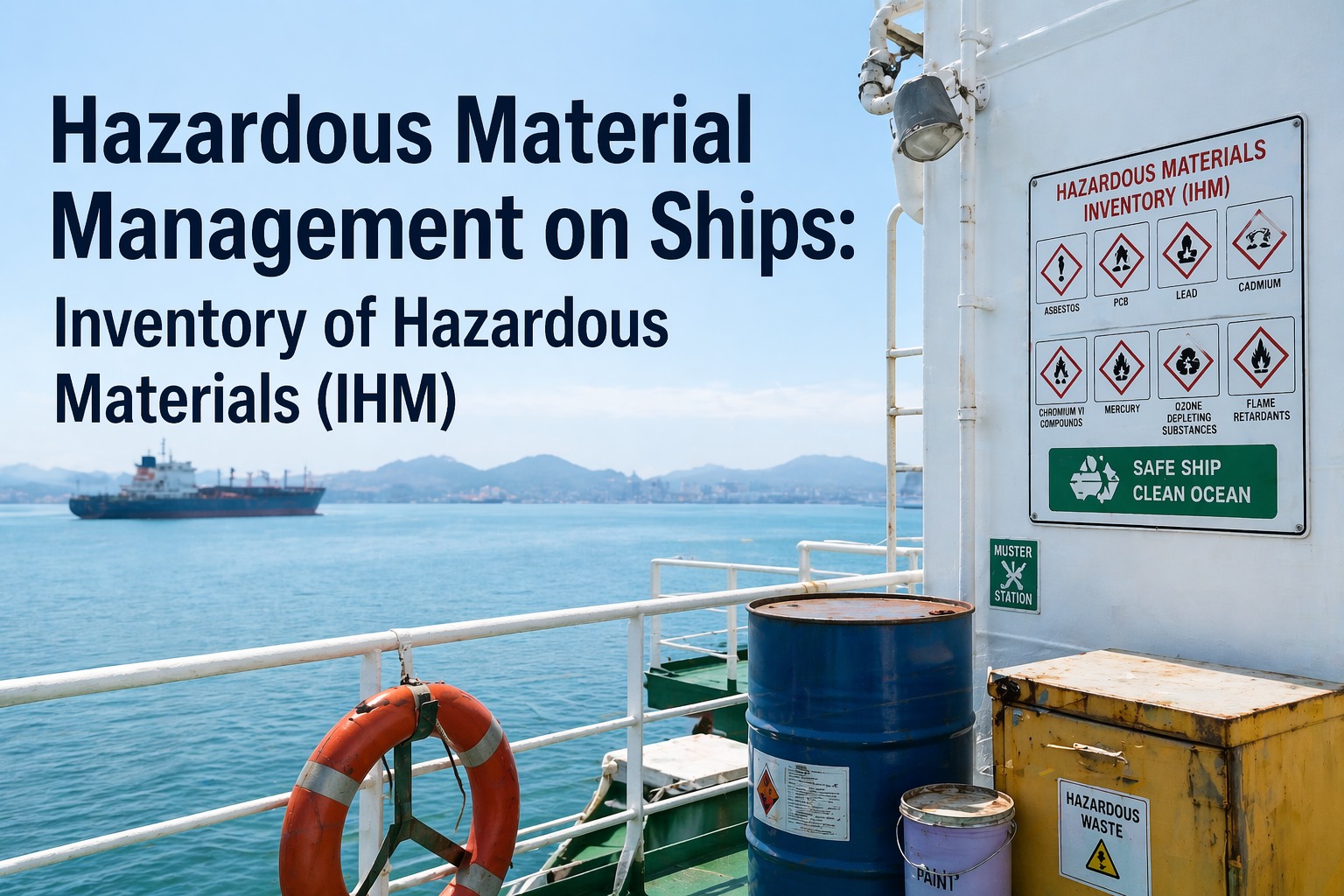
The Hong Kong International Convention for the Safe and Environmentally Sound Recycling of Ships (HKC) entered into force on 26 June 2025 — transforming the Inventory of Hazardous Materials from a compliance document into an operational requirement with real enforcement. Every ship of 500 GT and above must now maintain a certified IHM listing all hazardous materials in the vessel's structure and equipment, updated throughout the ship's entire operational life, and verified through initial, renewal, and additional surveys. For EU-flagged ships and all vessels visiting EU ports, the EU Ship Recycling Regulation (EU SRR No. 1257/2013) has been in force since 31 December 2020 with even stricter requirements — 15 hazardous materials versus 13 under the HKC, and mandatory recycling at facilities listed on the European List of Approved Ship Recycling Facilities. The materials involved are genuinely dangerous: asbestos in engine room insulation releases carcinogenic fibres when damaged; PCBs in older electrical equipment and paint are persistent environmental toxins; lead and mercury in batteries, paints, and instruments cause neurological damage; ozone-depleting substances in refrigeration and fire suppression systems destroy the atmospheric ozone layer; and TBT in anti-fouling coatings is toxic to marine life at extremely low concentrations. Since 1 January 2011, no asbestos-containing materials are permitted on board ships — even for repairs. Ships built before 1 July 2002 may contain legally installed asbestos that must be managed through an Asbestos Management Plan. Non-compliance with IHM requirements results in port state detention, fines, and reputational damage that affects charter availability. For superintendents and safety officers, IHM management is the intersection of environmental compliance, crew health protection, and vessel commercial viability. To see how Marine Inspection digitalises IHM maintenance, material declaration tracking, and supplier compliance across your fleet, book a Marine Inspection demo.

Dec 2020
EU SRR in force for all EU-flagged ships and vessels calling at EU ports
Jun 2025
Hong Kong Convention enters into force globally. 24 ratifying countries, 57%+ world tonnage.
Now
All ships 500 GT+ must carry ICIHM or SoC IHM. Existing ships: first renewal survey on or after 26 Jun 2025.
Jun 2030
Full harmonisation with statutory surveys required. Complete IHM integration into survey cycle.

IHM Part I, Part II, Part III: What Each Contains

Part I — Structural & Equipment Materials

What: All hazardous materials contained in the ship's structure and equipment — materials that are an integral part of the vessel.

When prepared: During construction (new builds) or by survey of existing ships. Must be maintained and updated throughout the vessel's operational life.

Examples: Asbestos in insulation, PCBs in electrical equipment, lead in paint, mercury in instruments, ODS in refrigeration, TBT in anti-fouling coatings, heavy metals in electronic components.

Certification: Verified by initial survey. International Certificate on IHM (ICIHM) or Statement of Compliance (SoC IHM) issued.

Part II — Operationally Generated Wastes

What: Wastes generated during the ship's normal operation that are potentially hazardous at the recycling facility.

When prepared: Before the vessel is sent for recycling — not required during operational life. Prepared by shipowner once the decision to recycle is made.

Examples: Bilge water, fuel oil residues (sludge), oily rags, used filters, sewage, cargo residues, incinerator ash, chemical cleaning residues.

Part III — Stores

What: Regular consumable goods carried on board that may contain hazardous materials but are not integral to the ship's structure.

When prepared: Before the vessel is sent for recycling — not required during operational life. Prepared by shipowner at end of operational life.

Examples: Paints, cleaning chemicals, lubricating oils, spare parts containing hazardous substances, batteries, fluorescent tubes, medical waste.

The 15 Hazardous Materials: What Must Be Inventoried

Hazardous Materials Listed Under HKC & EU SRR
# Hazardous Material Where Found on Ships Health / Environmental Risk Regulation
1AsbestosEngine room insulation, gaskets, brake linings, pipe lagging, fire-resistant panelsMesothelioma, lung cancer, asbestosis. Carcinogenic fibres released when damaged.Banned on new ships since 2002 (SOLAS II-1/3-5). No ACMs allowed on board since Jan 2011.
2PCBsOlder electrical equipment (transformers, capacitors), paint, caulking, insulationPersistent organic pollutant. Bioaccumulates. Causes cancer, immune/reproductive damage.HKC + EU SRR. Prohibited in new installations.
3Ozone-Depleting SubstancesRefrigeration, air conditioning (CFCs, HCFCs), fire suppression (halons)Destroys atmospheric ozone layer. Controlled under Montreal Protocol.HKC + EU SRR. New installations prohibited.
4TBT Anti-FoulingHull anti-fouling paint systems (older vessels)Extremely toxic to marine organisms at trace concentrations. Causes imposex in gastropods.HKC + EU SRR. AFS Convention banned TBT since 2008.
5Cadmium & CompoundsBatteries, pigments, coatings, soldering, electronic componentsKidney damage, bone disease, carcinogenic. Toxic to aquatic organisms.HKC + EU SRR. Above threshold concentration.
6Chromium VIPaints, primers, anti-corrosion coatings, chromium platingCarcinogenic. Causes respiratory sensitisation, skin ulceration.HKC + EU SRR. Above threshold concentration.
7Lead & CompoundsPaints, batteries, cable sheathing, bearing alloys, soldersNeurological damage, kidney damage, reproductive harm. Cumulative toxin.HKC + EU SRR. Above threshold concentration.
8Mercury & CompoundsThermometers, barometers, switches, fluorescent tubes, batteriesNeurological damage, kidney damage. Bioaccumulates in marine food chain.HKC + EU SRR. Above threshold concentration.
9PBBs / PBDEsFlame retardants in textiles, electronics, insulation foam, cable insulationEndocrine disruption, persistent environmental pollutant.HKC + EU SRR. Above threshold concentration.
10Radioactive SubstancesOlder navigational instruments, smoke detectors, level gaugesRadiation exposure. Cancer risk from prolonged contact.HKC + EU SRR.
11Certain Shortchain Chlorinated ParaffinsPaints, rubber, sealants, metalworking fluidsPersistent, bioaccumulative, toxic to aquatic organisms.HKC + EU SRR.
12Organotin Compounds (as anti-fouling)Anti-fouling paint systemsToxic to marine organisms. Banned under AFS Convention.HKC + EU SRR.
13CybutryneAnti-fouling paints (biocide)Toxic to aquatic organisms. Endocrine disruption potential.HKC + EU SRR.
14PFOSFire-fighting foams, coatings, cleaning agentsPersistent organic pollutant. Bioaccumulates. Banned under Stockholm Convention.EU SRR only (not HKC). Additional EU requirement.
15HBCDDInsulation foam (polystyrene), textilesPersistent, bioaccumulative, reproductive toxin.EU SRR only (not HKC). Additional EU requirement.
EU SRR lists 15 hazardous materials (items 1-15). HKC lists 13 (items 1-13). PFOS and HBCDD are additional EU requirements. All materials above threshold concentrations must be inventoried.

IHM Maintenance: Keeping the Inventory Current

An IHM is not a one-time document — it must be maintained and updated throughout the vessel's operational life. Every new installation, repair, or modification that introduces or removes hazardous materials must be reflected in the inventory. Book a Marine Inspection demo to see how the platform automates IHM maintenance with supplier declaration tracking.

Material Declarations (MDs): Every supplier providing equipment, materials, or components must provide a Material Declaration confirming whether hazardous materials are present. Collect MDs for all new installations, repairs, and replacements. Review before installation.
Supplier Declarations of Conformity (SDoCs): Suppliers declare conformity with hazardous material restrictions. SDoCs must be retained as evidence of compliance. Link SDoCs to specific equipment/material installations.
Designated Person (Hazmat Expert): IMO Guidelines (Res. MEPC.379(80)) require a qualified hazmat expert to be appointed for ongoing IHM maintenance. Reviews MDs and SDoCs. Updates IHM Part I when materials change.
IHM Update Trigger Events: New equipment installation, major repair or conversion, material replacement (e.g., insulation, gaskets, paint), addition or removal of fire suppression systems (ODS/PFOS implications), anti-fouling system changes.
Survey Cycle: Initial survey (IHM Part I verification). Renewal survey every 5 years. Additional survey after significant changes. ICIHM reissued at each renewal. Flag state or RO conducts surveys.
Asbestos Management Plan: Ships built before July 2002 that still contain asbestos must maintain an AMP per MSC/Circ.1045. Documents location, condition, and management procedures for all ACMs on board. Regular condition monitoring required.

How Marine Inspection Manages IHM Compliance

Digital IHM Part I Management
Ship-specific IHM Part I maintained digitally. Update workflow triggered by new installations or modifications. Amendment history preserved. Survey-ready at any time.
Material Declaration Tracking
MDs and SDoCs collected from every supplier for every new installation. Linked to specific equipment. Automated alerts when declarations are missing before installation approval.
Survey & Certificate Tracking
ICIHM/SoC IHM certificate dates, renewal survey due dates, flag state/RO survey records. Automated expiry alerts ensure certificates remain valid.
Asbestos Management Plan
For pre-2002 vessels: ACM location register, condition monitoring records, management procedures, and remediation tracking — documented per MSC/Circ.1045 requirements.
IHM Non-Compliance Means Port Detention, Fines, and Lost Charters
With the Hong Kong Convention now in force and EU SRR actively enforced, IHM compliance is not optional. Marine Inspection ensures your IHM Part I is current, your material declarations are collected, your certificates are valid, and your fleet is ready for PSC inspection in any port worldwide.

HKC vs EU SRR: Key Differences

Hong Kong Convention
Applicability: Ships 500 GT+ flagged by ratifying parties (24 countries, 57%+ tonnage)
Hazmat List: 13 hazardous materials
Certificate: International Certificate on IHM (ICIHM)
Non-party ships: Statement of Compliance (SoC IHM) when entering HKC party jurisdiction
In force: 26 June 2025
Recycling facilities: Must be authorised by competent authority. Document of Authorization required.
EU Ship Recycling Regulation
Applicability: EU/EEA/UK-flagged ships AND third-party flagged ships visiting EU ports (500 GT+)
Hazmat List: 15 hazardous materials (13 HKC + PFOS + HBCDD)
Certificate: IHM certificate per EU SRR requirements
Non-EU ships: Must carry IHM when calling at EU ports or anchorages
In force: Since 31 December 2020
Recycling facilities: Must be on European List of Approved Ship Recycling Facilities. Stricter environmental/labour standards.

Conclusion

The Inventory of Hazardous Materials has transitioned from a voluntary environmental initiative to an enforced international requirement with the Hong Kong Convention entering into force on 26 June 2025, joining the EU Ship Recycling Regulation that has been in force since December 2020. All ships of 500 GT and above must carry a certified IHM Part I listing hazardous materials in the vessel's structure and equipment — maintained and updated throughout the ship's operational life through Material Declarations and Supplier Declarations of Conformity from every supplier. The 13 hazardous materials under HKC (15 under EU SRR) include asbestos, PCBs, ozone-depleting substances, TBT, heavy metals, radioactive substances, and flame retardants — materials that cause cancer, neurological damage, reproductive harm, and environmental destruction when improperly handled during recycling. IHM maintenance requires a designated Hazmat expert, systematic MD/SDoC collection, update triggers for every installation or modification, and a 5-year renewal survey cycle. Pre-2002 vessels with asbestos require Asbestos Management Plans per MSC/Circ.1045. Non-compliance results in port state detention, fines, and commercial consequences. Marine Inspection provides the digital platform that keeps IHM Part I current, tracks material declarations from suppliers, manages survey certificates, and documents asbestos management — book a live demo today.


Frequently Asked Questions

FAQ 01
What ships must carry an IHM?
All ships of 500 GT and above must carry a certified Inventory of Hazardous Materials. Under the Hong Kong Convention (in force 26 June 2025), ships flagged by ratifying parties must carry an International Certificate on Inventory of Hazardous Materials (ICIHM). Ships flagged by non-party states require a Statement of Compliance (SoC IHM) when entering the jurisdiction of an HKC party. Under the EU Ship Recycling Regulation (in force since December 2020), all EU/EEA/UK-flagged ships AND all third-party flagged vessels visiting EU ports or anchorages must carry a certified IHM. Existing ships must obtain ICIHM or SoC IHM at the first renewal survey on or after 26 June 2025, with full harmonisation with other statutory surveys required by 26 June 2030.
FAQ 02
What is the difference between IHM Part I, Part II, and Part III?
Part I lists hazardous materials that are part of the ship's structure and equipment — asbestos in insulation, PCBs in electrical equipment, lead in paint, ODS in refrigeration, etc. Part I must be prepared during construction or by survey of existing ships and maintained throughout the operational life. Part II lists operationally generated wastes (bilge water, fuel residues, used filters, cargo residues) and Part III lists stores (paints, chemicals, batteries, spare parts containing hazardous substances). Parts II and III are only prepared when the decision is made to send the vessel for recycling — they are not required during the operational life. Only Part I requires certification and ongoing maintenance during the vessel's service.
FAQ 03
What happens if asbestos is found on a ship?
Since 1 January 2011, no asbestos-containing materials are permitted on board ships — not even for repairs or replacements (SOLAS Regulation II-1/3-5). Asbestos was banned on new ships from 1 July 2002. If asbestos is discovered on a vessel, the shipowner must notify the flag state immediately. The flag state decides whether to issue an exemption certificate or give the shipowner a timeframe for removal per MSC/Circ.1045. When asbestos cannot be immediately removed, an Asbestos Management Plan (AMP) must be maintained on board documenting the location, condition, and management procedures for all ACMs. Condition monitoring must be conducted regularly. Removal must be performed by qualified specialists following strict containment and disposal procedures. The IHM Part I must accurately record all asbestos locations and conditions.
FAQ 04
How is the IHM kept up to date?
IMO Guidelines (Resolution MEPC.379(80)) require a system for continual IHM update. This involves: collecting Material Declarations (MDs) and Supplier Declarations of Conformity (SDoCs) from all suppliers for every new installation, repair, or component replacement. A designated Hazmat expert reviews declarations and updates IHM Part I when materials containing hazardous substances are installed or removed. The IHM is updated whenever equipment is replaced, insulation is changed, paint systems are modified, fire suppression systems are altered, or any other change introduces or removes listed hazardous materials. The renewal survey (every 5 years) verifies the IHM is current, and additional surveys may be conducted after significant changes. EU SRR Article 11 provides that failure to implement an IHM maintenance procedure on board may trigger a detailed port state inspection.
FAQ 05
What are the consequences of IHM non-compliance?
Non-compliance with IHM requirements can result in: port state detention (vessel detained until IHM deficiency is rectified), financial penalties from flag state or port state authorities, commercial consequences (vessels without valid IHM certification may be rejected by charterers, particularly for trades involving EU ports), reputational damage affecting future charter availability, and complications when the vessel is eventually sold for recycling (incomplete IHM delays the recycling process and increases costs). Under EU SRR, EU-flagged vessels may only be recycled at facilities on the European List of Approved Ship Recycling Facilities — recycling at a non-approved facility is a violation. Flag states, port states, and classification societies all play enforcement roles. The IHM requirement applies regardless of the vessel's planned remaining operational life.
Book Your Live Demo
IHM Compliance Is Now Mandatory Worldwide. Is Your Fleet Ready?
Marine Inspection manages IHM Part I digitally, tracks material declarations from every supplier, monitors ICIHM/SoC certificate validity, and documents asbestos management — the complete platform for superintendents managing hazardous materials across a fleet.
Jun 2025
HKC entered into force
500 GT
All ships above must carry IHM
15
Hazardous materials (EU SRR)
5 yrs
IHM renewal survey cycle