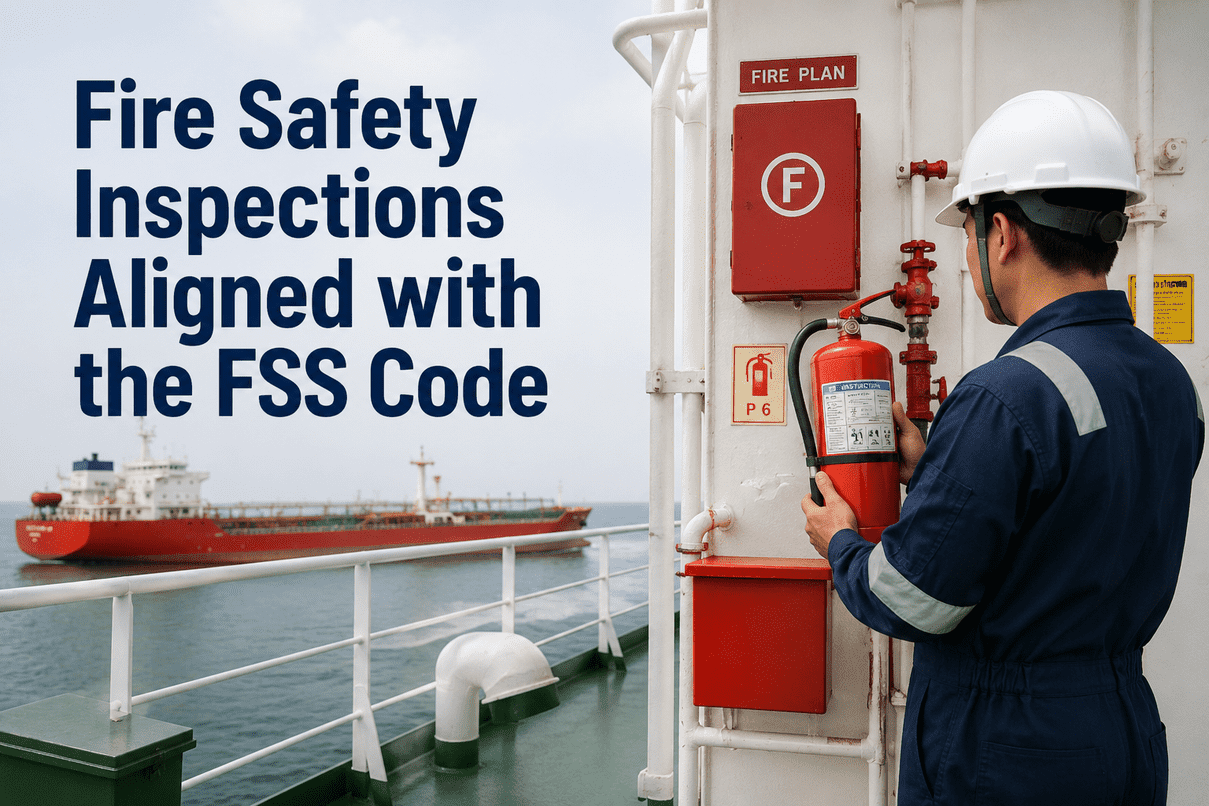
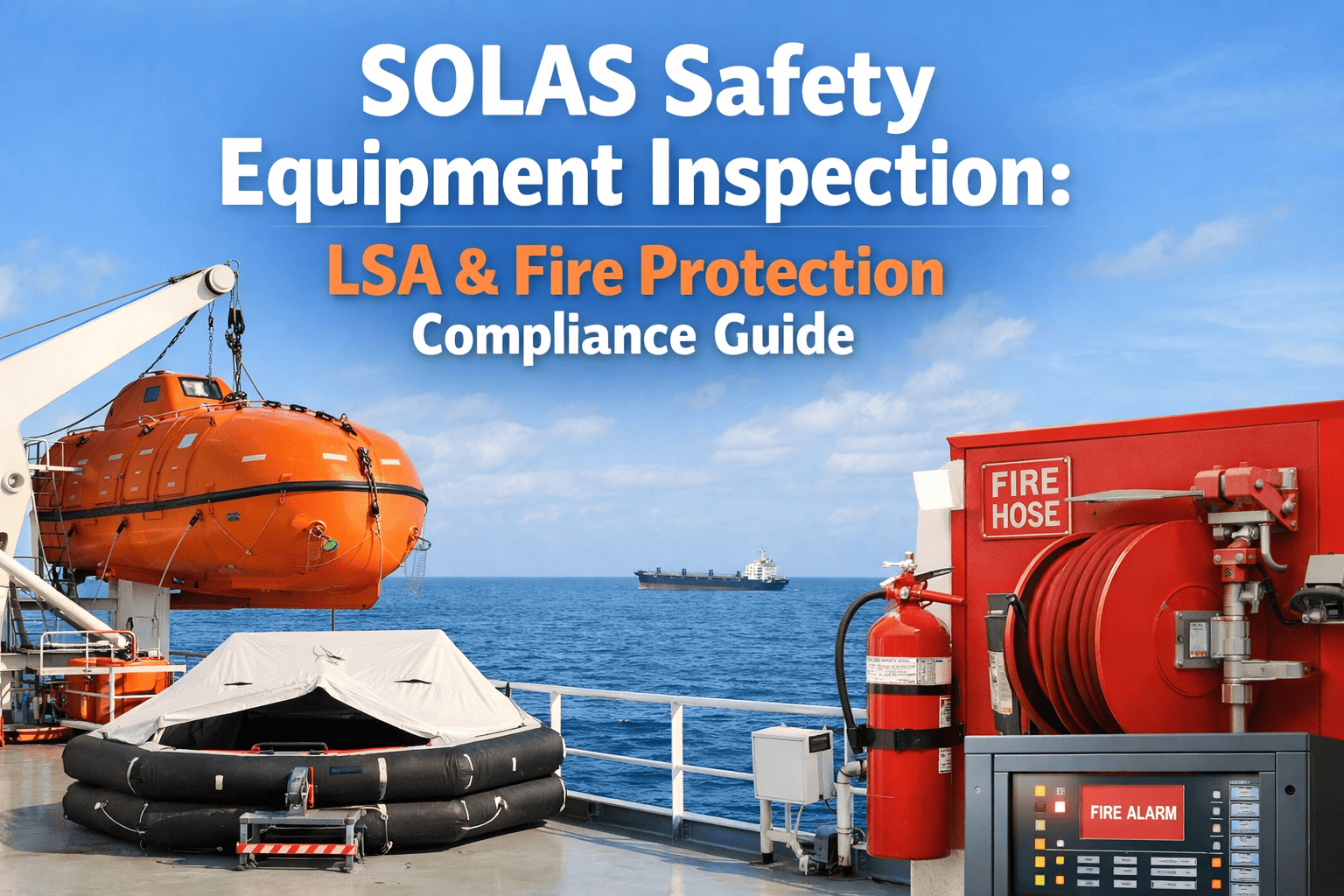
Fire safety accounted for 17.2 percent of all PSC deficiencies in the Paris MOU region in 2024 — the single largest category, ahead of every other inspection finding type by a wide margin. The 2026 environment tightens the bar further. SOLAS Chapter II-2 amendments effective January 1, 2026 ban PFOS-based firefighting foams onboard with existing ships required to replace stock by the first survey after the cutover. New cargo ship control stations now require fire detection systems. Ro-Ro and vehicle decks require individually addressable detectors driven by electric vehicle fire risks. The FSS Code — Fire Safety Systems Code referenced by SOLAS II-2 — provides the 17 chapters of detailed technical specifications covering detection, alarm, fixed suppression, portable extinguishers, fire pumps, personal firefighter equipment, means of escape, and structural fire protection. Fire pump fails to start on weekly test, hydrant outlets corroded, hose hydrostatic certificates expired, fire dampers seized, fire control plan out of date, CO2 system pressure low — every one of these surfaces in PSC deficiency reports weekly and triggers detention recording in serious cases. Fire safety inspection software runs FSS Code-aligned digital checklists, automated service-interval tracking, photo evidence capture, and PSC-ready audit pack assembly. Book a fire safety inspection demo to see how the platform addresses the largest single PSC deficiency category on your fleet.
Fire Safety Inspection Software · 2026
Detection. Suppression. Extinguishers. Pumps. Drills. Every Fire System Zone Tracked.
FSS Code-aligned digital checklists across structural fire protection, detection and alarm, fixed suppression, portable extinguishers, fire pumps, and personal firefighter equipment — built for the 17.2% PSC deficiency reality.
M/V Pacific Star · Fire Safety Zone Map
Live · 28 May
The Six FSS Code System Categories Every Inspection Covers
The Fire Safety Systems (FSS) Code referenced by SOLAS Chapter II-2 contains 17 chapters of technical specifications organized into six functional system categories. Every credible fire safety inspection covers all six. Book a system-walkthrough demo to see how each category maps to your fleet.
01
Structural Fire Protection
Class A/B/C divisions, main vertical zones, fire-resistant bulkheads, fire dampers, ventilation shut-downs, thermal insulation, fire doors with self-closing function. PSC verifies fire dampers function and fire doors close without obstruction.
02
Fire Detection & Alarm
FSS Code Chapter 9 — photoelectric and ionization smoke detectors in accommodation and escape routes, fixed-temperature and rate-of-rise heat detectors in galleys and machinery spaces, manual call points at escape routes, central alarm panel on bridge with battery backup.
03
Fixed Suppression Systems
FSS Code Chapters 5, 6, 7 — CO2 fixed gas, foam, water mist, deluge, dry powder. Category A machinery spaces require fixed system. CO2 cylinders pressure-verified annually, seals intact, activation circuits tested, no isolated zones on detection panel.
04
Portable & Semi-Portable Extinguishers
FSS Code Chapter 4 plus IMO A.951(23) — monthly visual checks, annual service by competent person, CO2 cartridge weight-check annually, hydrostatic test every 5-10 years per type, spare charges for 100% of CO2 and 50% of others.
05
Fire Pumps & Hydrants
FSS Code Chapter 12 — main fire pumps duty and standby, emergency fire pump independent of main power, fire main pressure verified, hydrants at required spacing, hose hydrostatic test every 5 years, nozzles dual-purpose jet and spray.
06
Personal Firefighter Equipment
FSS Code Chapter 3 — fireman's outfit (boots, gloves, helmet, axe, lifeline), SCBA with 1200 litre minimum air capacity, spare SCBA cylinders, EEBD (Emergency Escape Breathing Device), low-location lighting at escape routes.
The FSS Code Inspection & Servicing Interval Matrix
The matrix below maps every fire safety item to its required inspection or servicing interval, responsible party, and the evidence PSC inspectors verify. The intervals are not aspirational — they are FSS Code-mandated and missed intervals are the leading source of fire safety detentions. Scroll horizontally on mobile for the full view. Book a servicing-interval walkthrough demo to map your fleet's current schedule against the regulatory baseline.
| Fire Safety Item |
Interval |
Responsible Party |
Evidence Required |
| Fire detection system test |
Weekly per zone rotation |
Chief officer + electrician |
Test log + zone identification |
| Fire pump weekly test |
Weekly · operational test |
Chief engineer |
Engine log + pressure reading |
| Fire main pressure verification |
Weekly + pre-departure |
Chief officer + chief engineer |
Pressure log + photo of gauge |
| Portable extinguisher visual |
Monthly |
Safety officer |
Tag entry + photo + position |
| Portable extinguisher service |
Annual by competent person |
Approved service provider |
Service certificate + tag |
| Portable extinguisher hydrostatic |
Every 5-10 years per type |
Approved service provider |
Hydrostatic test certificate |
| CO2 cylinder pressure check |
Annual weight verification |
Approved service provider |
Weight log + certificate |
| Fire damper function test |
Quarterly |
Chief officer |
Operation log + photo |
| Fire door self-closing test |
Weekly visual + monthly function |
Safety officer |
Test log + photo |
| SCBA pressure + service |
Monthly + annual service |
Safety officer + approved provider |
Cylinder pressure log + cert |
| Fire control plan review |
After every modification |
Master + DPA |
Updated plan + master signature |
| Fire drill |
Monthly cargo · weekly passenger |
Master |
Drill record + crew participation |
The Nine Top PSC Fire Safety Deficiencies The Software Prevents
Paris MOU and Tokyo MOU data is unambiguous about where fire safety failures recur. Nine top deficiency patterns generate the substantial majority of fire safety detentions across global MOUs. Each prevention pathway is structurally built into the inspection software workflow. Book a deficiency-prevention demo to see how the platform addresses each one on your fleet.
01
Fire Pump Fails Weekly Test
Pump fails to start during PSC observation. Software enforces weekly start workflow with run-time, pressure reading, and battery condition log captured at the moment of test.
02
Fire Detection Zone Faulted
Panel shows isolated or faulted zone during inspection. Software tracks zone test rotation, fault history, and remediation per zone with photo evidence of the cleared panel.
03
Fire Dampers Seized
Damper does not operate when tested during PSC. Software enforces quarterly function test with photo of each damper closing fully, lubrication record, and corrosion observations.
04
Hose Hydrostatic Certificates Expired
5-year hose hydrostatic test certificate expired. Software tracks each hose individually with 12-month and 6-month expiry alerts. No surprise expirations during PSC.
05
CO2 System Pressure Low
Cylinder weight reading below specification. Software tracks each cylinder weight history with trend detection — sustained weight loss flags before reaching detention threshold.
06
Hydrant Outlets Corroded
Outlet seized, damaged, or corroded during PSC verification. Software photo-captures every hydrant at monthly visual with corrosion observations and lubrication record.
07
Fire Control Plan Out Of Date
Modification on board not reflected in fire control plan. Software triggers plan review workflow after every captured modification with master signature on updated plan.
08
PPE Incomplete Or Expired
Fireman's outfit incomplete, SCBA cylinder expired, EEBD expired during PSC. Software tracks each PPE item individually with expiry countdown and inventory checklist.
09
Drills Not Conducted Or Documented
Fire drill missed or undocumented. Software enforces monthly drill (weekly passenger) with master signature, crew participation log, time records, deficiencies identified.
Fire Safety Demo · 30 Minutes · No Commitment
See How The Platform Addresses Your Fleet's Fire Safety Risk
Fire safety is the single largest PSC deficiency category — 17.2% of all Paris MOU findings. Book a 30-minute demo with a Marine Inspection product expert. Bring a recent PSC inspection report or your current fire safety register. Walk through the six-category FSS Code framework, twelve-row servicing interval matrix, nine-deficiency prevention workflow, and the 2026 amendments compliance pack on your real data.
No sales pressure · Free trial available after the demo · Bring your own data
The 2026 SOLAS II-2 Amendments Impact Matrix
The 2026 SOLAS Chapter II-2 amendments reshape fire safety requirements across PFOS foam, cargo ship control stations, and Ro-Ro vehicle decks. The matrix below maps each amendment to its scope, effective date, and required action. Mobile users scroll horizontally for the full view.
| Amendment |
Scope |
Effective Date |
Required Action |
| PFOS foam ban |
All PFOS-containing firefighting foams |
1 January 2026 (new ships) |
Replace stock + manufacturer certification |
| PFOS foam ban (existing) |
Existing ships with PFOS foam |
First survey after 1 Jan 2026 |
Replace by first survey + dispose per env regs |
| Cargo ship control stations |
Fire detection in control stations |
1 January 2026 (new ships) |
Install addressable detection system |
| Ro-Ro vehicle deck detection |
Individually addressable detectors |
1 January 2026 (new ships) |
Replace zone detection with addressable |
| Ro-Ro fire monitors |
Remotely controlled fire monitors |
1 January 2026 (new ro-ro) |
Install autonomous monitor system |
| EV fire risk provisions |
Electric vehicle fire detection |
1 January 2026 (vehicle decks) |
EV-specific detection + suppression |
| Bunker flashpoint certification |
Fuel suppliers certify min 60°C |
1 January 2026 |
Update BDN verification workflow |
| Fire Training Manual update |
Tailored to specific vessel |
Continuous · vessel-specific |
Vessel-specific FTM on board |
2026 Amendments Demo · Free 30 Minutes
See 2026 SOLAS II-2 Compliance Built Into Every Inspection
PFOS foam replacement, cargo ship control station detection, Ro-Ro addressable detectors, EV fire risk provisions, bunker flashpoint certification — all 2026 amendments are pre-loaded into the platform. Book a focused demo to see the compliance pack on your vessels.
30 minutes · Your fleet's data · Real demo, not a sales pitch
The Six Workflows Fire Safety Inspection Software Should Cover
Beyond the basic checklist, six workflows separate a credible fire safety inspection platform from a static PDF library. Each addresses a recurring operational pattern that paper checklists or generic apps cannot match for safety officers and masters.
A
Weekly Fire Detection & Pump Test
SOLAS-mandated weekly fire detection test by zone rotation and weekly fire pump operational test structured as guided workflows with timer, pressure capture, and zone identification.
B
Monthly Extinguisher Visual Round
Every portable extinguisher captured monthly with photo, position confirmation, tag entry, and corrosion observations. Service tag expiry alert at 90 days. No surprise PSC deficiencies on expired tags.
C
Drill Documentation Workflow
Monthly cargo or weekly passenger fire drill captured with master signature, crew participation log, time records, deficiencies identified, follow-up actions assigned. SOLAS II-2/15 records assembled rather than reconstructed.
D
Annual Service Coordination
Approved service stations upload extinguisher service certificates, CO2 cylinder weight reports, SCBA service certificates, hose hydrostatic test certificates directly. Annual service aligned to port rotation.
E
2026 Amendments Compliance Pack
PFOS foam replacement tracking, cargo ship control station detection verification, Ro-Ro addressable detector status, EV fire risk provisions, bunker flashpoint certification all consolidated.
F
PSC Fire Safety Defence Pack
PSC inspector arrives. Master pulls fire safety defence pack — weekly tests, monthly visuals, drill records, service certificates, fire control plan, CO2 weight history — in a single export. Defence assembled in minutes.
Why Marine Inspection For Fire Safety Inspection
Marine Inspection delivers a safety-officer-first fire safety inspection platform on the six-category FSS Code framework, twelve-row servicing interval matrix, nine-deficiency prevention focus, eight-row 2026 amendments coverage, and six workflow capabilities. Book your fire safety demo to see the platform built for the 17.2% PSC fire safety reality. Free trial available — sign up here.
FSS Code Chapter Coverage
Chapter 3 personal firefighter equipment, Chapter 4 portable extinguishers, Chapters 5-7 fixed suppression, Chapter 9 detection and alarm, Chapter 12 fire pumps and water mist — every chapter mapped into the inspection workflow.
2026 Amendments Pre-Loaded
PFOS foam ban, cargo ship control station detection, Ro-Ro addressable detectors, EV fire risk provisions, bunker flashpoint certification — all amendments mapped to fleet equipment with build-date logic.
Per-Item Tracking
Every extinguisher, every CO2 cylinder, every hose, every SCBA, every detector zone tracked individually with expiry countdown and alerts at 90 and 30 days. No spreadsheet drift, no surprise PSC deficiencies.
Mobile-First Offline Capture
Engine room, paint locker, pump room, accommodation, cargo deck all supported offline. Auto-sync on connectivity. Photo evidence per inspection with GPS coordinates and timestamp.
Service Provider Integration
Approved service providers upload extinguisher certificates, CO2 weight reports, SCBA service records, hose hydrostatic certificates directly. Annual service aligned to port rotation rather than crisis-driven.
PSC Defence Pack On Demand
PSC inspector arrives. Master pulls fire safety defence pack — weekly tests, monthly visuals, drill records, service certificates, fire control plan, CO2 weight history — in a single export in minutes.
Frequently Asked Questions
What does fire safety inspection software do?
Fire safety inspection software runs FSS Code-aligned digital checklists across the six SOLAS Chapter II-2 system categories — structural fire protection, fire detection and alarm, fixed suppression systems, portable and semi-portable extinguishers, fire pumps and hydrants, and personal firefighter equipment. Weekly, monthly, quarterly, and annual workflows guide officers of the watch, chief officers, chief engineers, safety officers, masters, and approved service providers through their respective FSS Code duties. Per-item tracking covers every extinguisher, CO2 cylinder, hose, SCBA, and detector zone with countdown to expiry and alerts at 90 and 30 days. 2026 amendments coverage includes PFOS foam ban, cargo ship control station detection, Ro-Ro addressable detectors, EV fire risk provisions, and bunker flashpoint certification. PSC defence pack assembled in a single export including weekly tests, monthly visuals, drill records, service certificates, fire control plan, and CO2 weight history. The simplest way to see the platform is to book a 30-minute demo with a product expert.
Why does fire safety account for 17.2% of PSC deficiencies?
Fire safety accounted for 17.2 percent of all PSC deficiencies in the Paris MOU region in 2024 — the single largest category, ahead of every other inspection finding type by a wide margin. The reasons are structural. Fire safety touches every part of the ship — structural divisions, detection in every accommodation cabin, suppression in every machinery space, extinguishers at every required station, hoses at every hydrant, drills with every crew change. Each component has its own inspection interval and expiry date. Spreadsheet tracking drifts. Paper logs go missing. Service intervals slip past expiry. By the time PSC boards, multiple items have lapsed simultaneously — fire pump fails to start, hose certificate expired, fire damper seized, CO2 system pressure low, fire control plan out of date, drill not documented. Digital inspection software solves the structural problem with per-item tracking, automated alerts, photo evidence, and PSC-ready audit pack assembly. Book a demo to see how the platform addresses the 17.2% on your fleet.
What did the 2026 SOLAS II-2 amendments change?
Multiple amendments reshape fire safety requirements effective 1 January 2026. PFOS foam ban — all firefighting foams containing PFOS banned for use and storage onboard. New ships must comply from 1 January 2026. Existing ships must replace PFOS-based foam by the first survey after that date, with operators obtaining manufacturer certification confirming PFOS content below permitted thresholds and disposing of legacy foam per environmental regulations. Cargo ship control stations now require fire detection systems on new ships. Ro-Ro and vehicle decks require individually addressable detectors driven by electric vehicle fire risks. Remotely controlled fire monitors required on new Ro-Ro vessels following the EU-funded LASH FIRE Project findings on ro-ro ship fire safety. EV-specific fire detection and suppression for vehicle decks. Bunker flashpoint certification — fuel suppliers must certify minimum 60°C flashpoint on Bunker Delivery Notes. Fire Training Manual must be vessel-specific. Book a demo to see the 2026 compliance pack on your fleet's vessels.
What are the top fire safety PSC deficiencies?
Nine top deficiency patterns generate the substantial majority of fire safety detentions across global MOUs. Fire Pump Fails Weekly Test — pump does not start during PSC observation, prevented by software-enforced weekly start workflow with run-time, pressure reading, and battery condition log. Fire Detection Zone Faulted — panel shows isolated or faulted zone, prevented by zone test rotation with photo evidence of cleared panel. Fire Dampers Seized — damper does not operate, prevented by quarterly function test with photo of each damper closing fully. Hose Hydrostatic Certificates Expired — 5-year certificate expired, prevented by per-hose tracking with 12-month and 6-month alerts. CO2 System Pressure Low — cylinder weight below specification, prevented by individual cylinder weight history with trend detection. Hydrant Outlets Corroded — outlet seized or damaged, prevented by monthly visual with photo capture. Fire Control Plan Out Of Date — modification not reflected, prevented by plan review workflow after every captured modification. PPE Incomplete Or Expired — fireman's outfit, SCBA, EEBD all tracked individually with expiry. Drills Not Conducted Or Documented — prevented by master-signature workflow.
What are the FSS Code servicing intervals?
The FSS Code and supporting IMO resolutions define a hierarchy of intervals. Weekly — fire detection system test per zone rotation by chief officer plus electrician, fire pump operational test by chief engineer, fire main pressure verification by chief officer plus chief engineer, fire door self-closing visual by safety officer. Monthly — portable extinguisher visual by safety officer with tag entry and photo, fire door function test, SCBA cylinder pressure check, fire drill (weekly for passenger vessels). Quarterly — fire damper function test by chief officer with operation log and photo, life jacket visual inspection. Annual — portable extinguisher service by competent person per IMO A.951(23) with service certificate, CO2 cylinder weight verification, SCBA service by approved provider, fire pump performance test. Every 5-10 years per type — portable extinguisher hydrostatic test by approved provider. Every 5 years — hose hydrostatic test. After every modification — fire control plan review by master plus DPA with updated plan and master signature.
Who can perform fire safety inspections on board?
MSC.1/Circ.1432 distinguishes between crew-level and shore service requirements. Ships' officers can perform routine monthly inspections — detector sampling, extinguisher visual checks, fire pump operational tests, fire main pressure verification, fire door function tests, fire damper operation, hydrant outlet visuals. Safety officer typically coordinates the monthly extinguisher visual round and SCBA cylinder pressure checks. Chief officer coordinates weekly fire pump tests, fire main pressure, fire detection zone rotation tests, and fire dampers. Chief engineer responsible for the fire pump operational test and engine-room fire systems. Master coordinates monthly cargo or weekly passenger fire drills with crew participation. Approved service providers (shore) handle annual extinguisher servicing, CO2 cylinder weight verification, SCBA service and annual maintenance, hose hydrostatic testing, fire pump performance testing, and detection system annual function test. The platform structures handoffs between crew-level inspections and shore-service workflows so nothing slips between them.
How does Marine Inspection handle fire safety inspection?
Marine Inspection delivers a safety-officer-first fire safety inspection platform on the six-category FSS Code framework (structural fire protection, detection and alarm, fixed suppression, portable extinguishers, fire pumps and hydrants, personal firefighter equipment), twelve-row servicing interval matrix mapped to FSS Code requirements, nine-deficiency prevention focus on the recurring PSC failure points, eight-row 2026 SOLAS II-2 amendments matrix, and six workflow capabilities. Per-item tracking with countdown and alerts at 90 and 30 days. Service provider integration with approved providers uploading certificates directly. Mobile-first offline capture for engine room, paint locker, pump room, and accommodation environments. PSC defence pack assembled in a single export. 6-12 week deployment for typical mid-size fleets. The fastest way to see how the platform applies to your specific fleet is to book a 30-minute demo with a product expert — bring your most recent PSC inspection report and walk through deficiency prevention on real data.
Ready For Your Fire Safety Demo
17.2% Of PSC Deficiencies Is Too Big A Risk To Manage With Spreadsheets
Six FSS Code categories, twelve-row servicing interval matrix, nine-deficiency prevention focus, eight-row 2026 amendments matrix, per-item tracking, service provider integration, PSC defence pack — all in one safety-officer-first platform built for the 2026 fire safety reality. Book your 30-minute demo. Bring your last PSC inspection report. See the deficiency prevention workflow on your actual data.