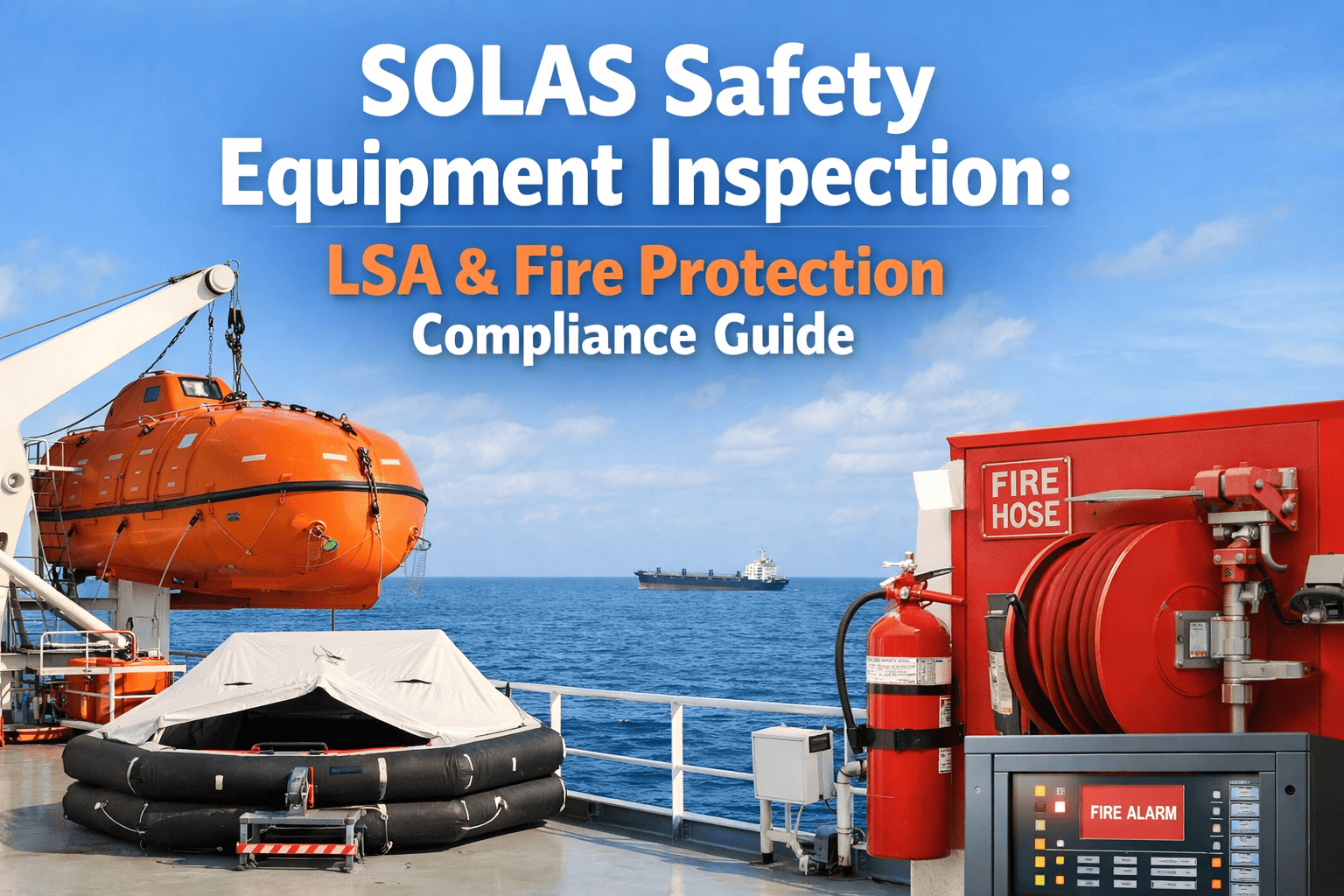
When Port State Control steps aboard, they are not browsing — they are hunting. Expired life raft servicing records, a lifeboat davit with a missed monthly test, a fire detection zone showing a fault on the panel, an EPIRB with an expired hydrostatic release unit — any one of these turns a routine inspection into a vessel detention. SOLAS Chapter III (Life-Saving Appliances) and Chapter II-2 (Fire Protection) set the most rigorously enforced equipment standards in international shipping. This guide covers every inspection interval, every critical requirement, and every common failure point — structured so your officers can use it operationally, not just for reference. Ship operators ready to move from paper logs to digital inspection records can sign up free on Marine Inspection's platform and have their first LSA checklist running today.
SOLAS Safety Equipment — Chapter Overview
SOLAS Chapter III
Life-Saving Appliances (LSA)
Lifeboats & Rescue Boats
Life Rafts (Inflatable & Rigid)
Life Jackets & Immersion Suits
Life Buoys & MOB Equipment
EPIRB, SART & Pyrotechnics
Muster & Embarkation Systems
LSA Code · SOLAS III/20 · III/36
+
SOLAS Chapter II-2
Fire Protection & Detection (FFA)
Fire Detection & Alarm Systems
Fixed Fire-Fighting Systems
Portable Fire Extinguishers
Fireman's Outfits & SCBA
Fire Pumps & Hydrant Systems
Fire Doors & Structural Divisions
FSS Code · SOLAS II-2/Reg 14 · FTP Code
Master Inspection Schedule — LSA & FFA
SOLAS prescribes specific inspection frequencies for every category of safety equipment. The table below covers the complete schedule required under SOLAS Ch. III Regs. 20.6, 20.7 and Ch. II-2 Reg. 14.2.2.1 — the exact regulations PSC inspectors reference when checking your records.
Life-Saving Appliances (LSA)
Lifeboat — Engine Test
III/20.6.1
Lifeboat — Turn Out from Stowed Position
III/20.7.1
Lifeboat / Rescue Boat — Full Launch
III/19.3.4.3
LSA Equipment — Full Inspection
III/20.7.2
Life Raft — Servicing
III/20.8.1
EPIRB — Self-Test
IV/GMDSS
HRU (Hydrostatic Release Unit)
III/20.8.3
Pyrotechnics (Flares) — Expiry Check
III/20.7.2
Fire-Fighting Appliances (FFA)
Emergency Fire Pump — Run Test
II-2/Reg 10
Fire Detection & Alarm System
II-2/Reg 7
Portable Fire Extinguishers — Visual Check
II-2/Reg 14
Fire Hoses & Nozzles — Pressure Test
II-2/Reg 10
Fixed CO₂ / Halon System — Inspection
FSS Code Ch.5
Fireman's Outfit (SCBA / BA Sets)
II-2/Reg 10
Fire Doors — Operational Test
II-2/Reg 9
Weekly
Monthly
3-Monthly
Annual
Part 1 — Life-Saving Appliances (LSA): Inspection Requirements
Weekly Checks
Engine started and run for not less than 3 minutes — fuel, oil pressure, cooling water confirmed
Lifeboat turned out from stowed position — checked for freedom of movement
All release gear visually inspected — no corrosion, seizing, or deformation
Monthly Checks
Full inspection of all LSA equipment including lifeboat inventory list (SOLAS III/20.7.2)
All on-load and off-load release mechanisms operated and confirmed functional
Rescue boat launched (or simulated where weather prevents) with full crew assignment
Davit wire, sheaves, blocks, and falls inspected for wear, corrosion, and kinking
Skates, gripes, and boat hook confirmed in position — painter and sea painter rigged
Annual / Survey Requirements
Wire falls renewed — or load-tested per classification society / flag state requirements
Complete davit maintenance — greasing, load-testing, and certification by approved service station
Hydrostatic release units (if fitted) renewed as per manufacturer's expiry date
Lifeboat inventory — complete check against SOLAS LSA equipment list, replace expired items
Rescue boat outboard motor serviced by approved mechanic — full sea trial conducted
The 10-minute embarkation standard (cargo ships) and 3-minute standard (passenger ships) for launching all survival craft must be verified during drills and demonstrable to PSC.
Monthly Visual Checks
Container condition — no visible damage, moisture ingress, or deformation of GRP or fibreglass container
Lashing and cradle condition — quick-release hook functional, straps not chafed or corroded
HRU (Hydrostatic Release Unit) — expiry date checked monthly, must be within date
Painter line — correctly rigged to ship's structure for float-free deployment
SOLAS certificate / servicing label — confirm within annual servicing interval
Annual Servicing Requirements
Serviced at an approved servicing station — not exceeding 12 months from last service date
Service record label affixed to container with station name, date, and certificate number
HRU renewed — maximum 2-year service life or as per manufacturer's date, whichever sooner
CO₂ inflation cylinder weight checked — no more than 5% below manufacturer's stated weight
A life raft whose HRU has expired is considered non-compliant regardless of the raft's own service date. PSC inspectors check both dates independently.
SOLAS IV / GMDSS
Self-test conducted monthly — green LED confirmed operational
Battery expiry date checked — replacement required before expiry
HRU expiry date independent of EPIRB — check both separately
MMSI registration confirmed current with flag state
Mounting bracket — free-float mechanism unobstructed
SOLAS IV / LSA Code Ch.VII
Self-test monthly — confirm operational indicator response
Battery replacement date — within manufacturer's recommended interval
Stowage location confirmed — accessible from survival craft launching areas
Two units required on cargo ships of 300 GT and above
SOLAS III/Reg. 6 · LSA Code Ch.III
Expiry dates checked monthly — 4-year shelf life from manufacture date
Expired flares replaced before expiry — retained onboard only if within count requirements
Minimum: 12 parachute rockets (bridges), 2 per lifeboat/raft (survival craft)
Storage — cool, dry, secure locker, accessible in emergency
Part 2 — Fire Protection & Detection (FFA): Inspection Requirements
SOLAS Chapter II-2 and the FSS (Fire Safety Systems) Code are the primary references for fire protection compliance. Alongside SOLAS, schedule a demo to see how Marine Inspection structures fire system maintenance and weekly test records for instant PSC retrieval.
SOLAS Structural Fire Protection — Division Classifications
A-60
Highest Protection
Steel construction, insulated to prevent passage of smoke & flame for 60 minutes. Required between high-risk and accommodation spaces.
A-0
Steel — No Insulation
Prevents passage of smoke and flame. No insulation requirement. Used for separation between lower-risk areas.
B-Class
30-min Fire Resistance
Non-combustible materials. Prevents passage of flame for 30 minutes. Used in internal subdivision of accommodation spaces.
C-Class
Non-Combustible Only
Constructed of approved non-combustible materials. No requirement to limit smoke/flame passage or temperature rise.
Weekly Tests
Fire detection control panel — panel powered, no latent faults or zone alarms outstanding
Alarm test conducted — at least one detector zone tested and alarm confirmed audible on bridge
All fault indicators cleared or reported — outstanding faults documented with corrective action
CO / flammable gas detection system — sensor status confirmed on panel, no active alarms
Annual / Survey Inspection
All smoke, heat, and flame detectors individually tested — detector zone map verified against panel
Detector heads cleaned — dust and grease contamination removed from sensing elements
Alarm circuits tested end-to-end — all sounders, visual alarms, and remote indicators confirmed
Automatic fire dampers — all manually released and confirmed operational, then reset
Service record updated — approved service company certificate issued and retained onboard
Pressure gauge — in green zone, seal intact, no signs of tampering
Weight check — CO₂ extinguishers weighed against stated charge weight
Annual service — by approved technician with service label affixed
Location — correct position per fire control plan, accessible and visible
Correct type — foam/CO₂/dry powder confirmed appropriate for the protected space
5-year hydrostatic test — cylinder proof-tested per manufacturer's schedule
CO₂ system — cylinder weights confirmed, manifold pressure gauges in range
Release controls — access clear, seals intact, no unauthorised activation risk
Sprinkler system (if fitted) — pressure maintained, no closed/defective heads
Water mist / foam system — activation control tested (without discharge) annually
Annual service by approved specialist — certificate issued and retained onboard
Fire control plan — current, posted in weathertight holder at ship's exterior access
Fireman's Outfit — Required Components (SOLAS II-2/Reg. 10)
Protective Clothing
Fire-resistant outer suit protecting skin from heat and flame — inspected monthly for integrity, seam condition, and reflective strip visibility
Boots & Gloves
Rubber, electrically non-conductive. Checked for cracking, sole separation, and proper fit. Replaced if any defect is found.
Safety Helmet
Rigid, fire-resistant with visor. Inspected for cracking, strap condition, and secure fit. No more than 10 years from manufacture.
Safety Lamp (3 hrs)
Battery tested monthly — minimum 3 hours operational life confirmed. Intrinsically safe type required for use in flammable atmospheres.
Fireman's Axe
Checked monthly — blade sharp and undamaged, insulated handle in good condition. Stowed in fireman's outfit locker.
SCBA (Self-Contained BA)
Cylinder pressure checked monthly — minimum 90% charge. Face seal, harness, demand valve, and low-pressure alarm tested. Annual service required.
Top 8 PSC Deficiency Failures — LSA & FFA
These are the most frequently cited safety equipment deficiencies in Paris MoU, Tokyo MoU, and USCG Port State Control reports. Knowing where other operators are cited helps prioritise where your own inspection focus should be sharpest. Sign up for Marine Inspection to track all of these against scheduled inspection dates automatically.
01
Life Raft HRU Expired
HRU service date and EPIRB battery expiry are the most commonly missed items — inspectors check both independently. A valid raft service with an expired HRU = non-compliant.
02
Fire Detection Fault Not Cleared
Outstanding zone faults on the fire detection panel left unresolved between inspections. PSC treats an uncleared panel fault as an inoperative detection system — grounds for deficiency.
03
Lifeboat Release Mechanism
On-load release hooks not tested, stiff, or showing corrosion. Davit wire falls not within renewal date. These are direct life-safety items and trigger serious deficiency notices.
04
SCBA Cylinder Under Pressure
BA cylinder below 90% charge found during inspection. Monthly pressure checks must be recorded — a single low-pressure cylinder without corrective action record is a PSC deficiency.
05
Fire Extinguisher Overdue Service
Annual service label missing, outdated, or issued by a non-approved service company. CO₂ extinguishers without weight records are also frequently cited.
06
Pyrotechnics Expired
Parachute flares past their 4-year expiry date found in bridge locker or survival craft. No replacement ordered or documented. Expired pyrotechnics cannot be counted toward required inventory.
07
Fire Control Plan Outdated
Fire control plan not reflecting current vessel layout or equipment — post-modification plans not updated. Plan must be posted in a weathertight holder at ship's exterior access points.
08
Missing Weekly / Monthly Records
No written record of weekly engine tests or monthly LSA inspections. SOLAS III/20.6 and 20.7 require documented evidence — verbal confirmation is not accepted by PSC.
Never Miss an Inspection Again
Digitize Your LSA & FFA Records on Marine Inspection
Automated weekly, monthly, and annual inspection schedules. Timestamp sign-offs. Photo evidence attached to each record. Instant retrieval during PSC and class surveys.
Start your free trial — first vessel configured in under 10 minutes.
Frequently Asked Questions
How often must life rafts be serviced under SOLAS?
Inflatable life rafts must be serviced at intervals not exceeding 12 months under SOLAS III/Reg. 20.8.1, though flag state administrations may extend this to 17 months in remote areas. Servicing must be performed by an approved servicing station. Additionally, the hydrostatic release unit (HRU) has its own independent expiry date — usually 2 years from manufacture — which must be checked separately from the raft's service date. A raft with a valid service but an expired HRU is non-compliant for PSC purposes.
What are the SOLAS requirements for the number of fireman's outfits?
SOLAS II-2/Regulation 10 requires cargo ships to carry at least two fireman's outfits, stored ready for immediate use in separate locations so that both are not disabled by a single fire. Passenger ships require more based on the ship's size and passenger capacity. Each outfit must include protective clothing, boots, gloves, helmet, safety lamp, axe, and a self-contained breathing apparatus (SCBA). All components must be maintained in serviceable condition and inspected monthly.
What is the difference between LSA and FFA under SOLAS?
LSA (Life-Saving Appliances) covers equipment used to survive a maritime emergency — lifeboats, life rafts, life jackets, immersion suits, life buoys, EPIRBs, SARTs, and pyrotechnics. These fall under SOLAS Chapter III and the LSA Code. FFA (Fire-Fighting Appliances) covers equipment used to detect, contain, and fight fire — detection systems, fixed suppression systems, portable extinguishers, fire hoses, fireman's outfits, and structural fire protection. These fall under SOLAS Chapter II-2 and the FSS Code. Both are inspected during PSC, class surveys, and SIRE vetting.
Can Marine Inspection be used to manage both LSA and FFA inspection records?
Yes. The platform covers the complete spectrum of safety equipment maintenance — LSA inspection logs, FFA weekly tests, life raft servicing due dates, EPIRB/HRU expiry tracking, SCBA pressure records, and fire extinguisher annual service schedules. All records are timestamped, sign-off enabled, and cloud-stored for instant retrieval.
Book a 20-minute demo to see the full safety equipment module configured for your vessel type.