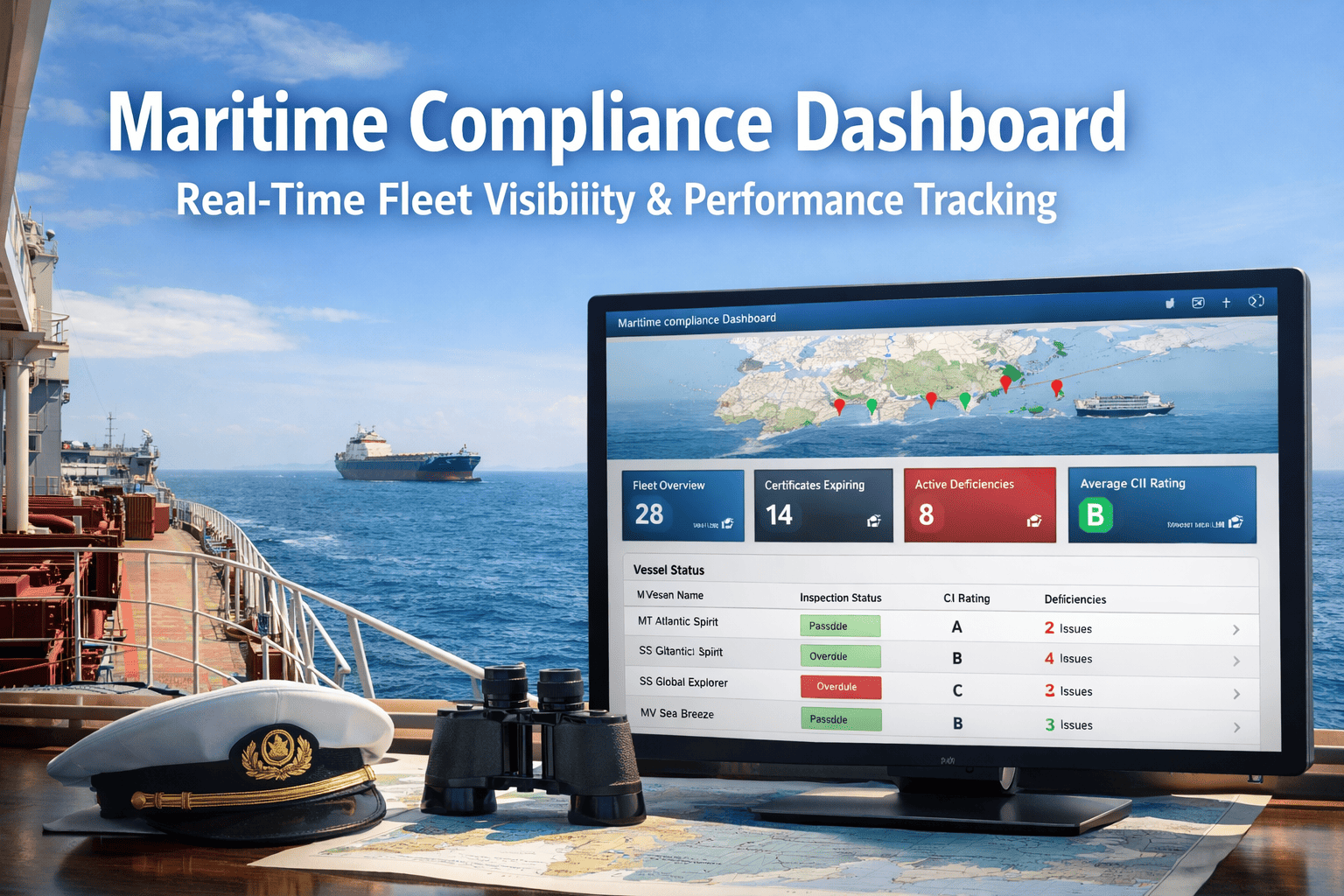
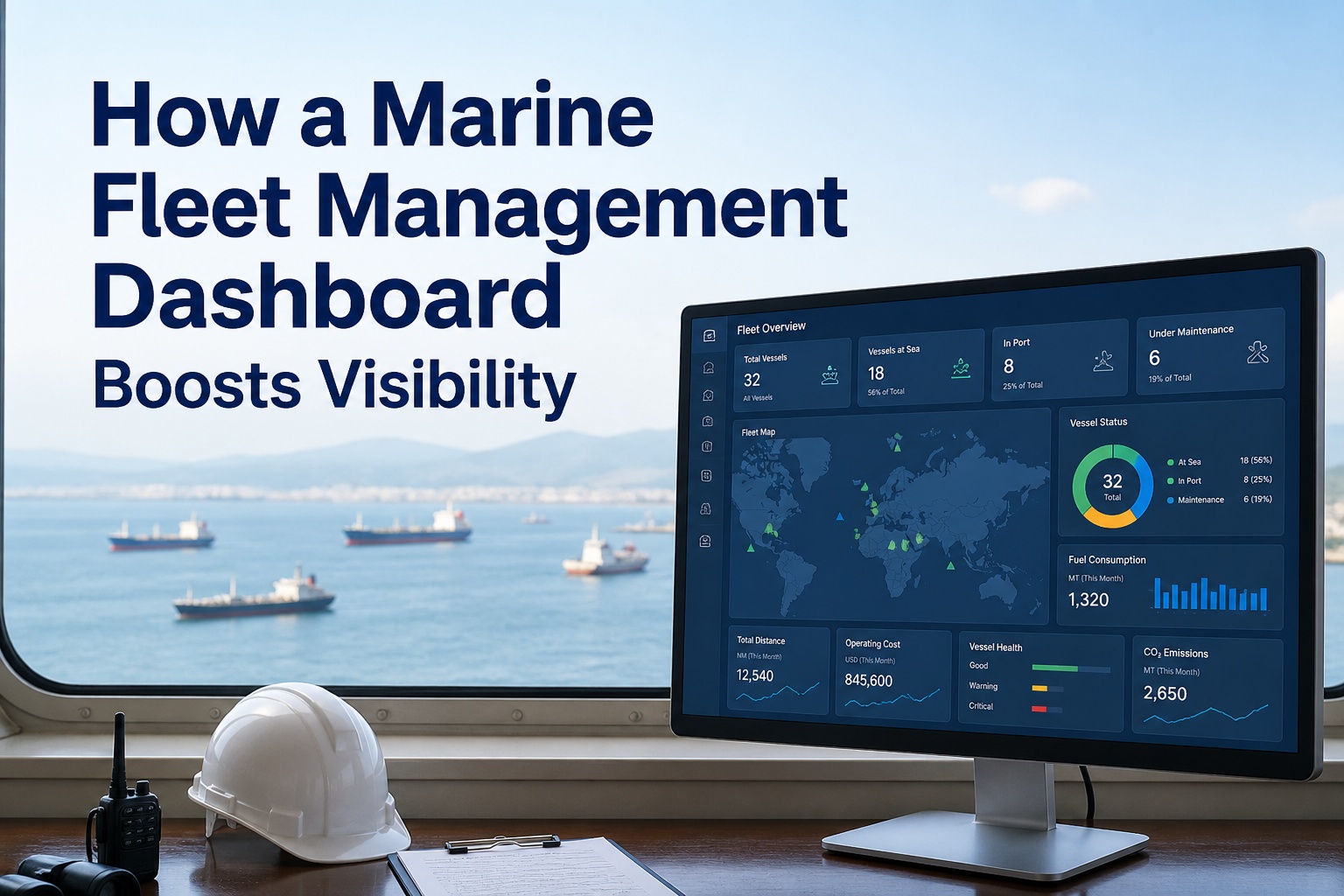
Most ship managers know their fleet is compliant. Very few can prove it in under 60 seconds. When a Port State Control officer steps aboard, when a charterer asks for your fleet's CII rating history, or when an auditor wants six months of inspection records across 12 vessels — the difference between a dashboard and a drawer full of spreadsheets becomes very expensive, very fast. A maritime compliance dashboard isn't a reporting tool. It's the operational nerve centre that separates reactive fleet management from the kind of real-time visibility that prevents detentions before they happen.
Why Fleet Visibility Is Now a Business-Critical Metric
1 in 6
Vessels inspected by PSC receive at least one deficiency notice annually
< 60 sec
Time it should take to pull any compliance record during a live inspection
CII + EU ETS
Two overlapping emissions frameworks now require continuous vessel-level tracking
90 / 60 / 30
Days — the alert window that prevents certificate lapses before they become deficiencies
What a Maritime Compliance Dashboard Actually Does
A compliance dashboard consolidates every vessel's operational, regulatory, and safety status into a single screen — updated in real time, accessible from anywhere. It replaces the "call the captain" approach with structured data that DPAs, fleet managers, and superintendents can act on before problems escalate. The best dashboards don't just display information — they surface the right alert, for the right vessel, at the right time. Sign up for Marine Inspection's free trial to see what a fully configured fleet compliance dashboard looks like for your vessels.
The 6 Things Every Fleet Dashboard Must Show
1
Certificate Status
Every statutory and class certificate across the fleet — with expiry countdowns and renewal alerts
2
Open Deficiencies
All outstanding PSC deficiency notices, internal audit findings, and corrective actions — by vessel and priority
3
Drill & Training Compliance
Monthly drill completion rates, overdue items, and STCW certification gaps for every crew member
4
Planned Maintenance Status
Overdue jobs, upcoming critical maintenance, and equipment hours-to-service across the fleet
5
CII & Emissions Tracking
Current CII rating trajectory, EU ETS position, and fuel consumption benchmarks per voyage
6
Inspection History
Complete PSC, SIRE, flag state, and internal inspection records — searchable, filterable, downloadable
The RAG Model: How Fleet Managers Read Status at a Glance
The most effective maritime dashboards use a Red / Amber / Green (RAG) status model — the same framework Port State Control and classification societies use internally. Every vessel gets a rolled-up compliance score based on open items. A DPA managing 15 vessels shouldn't need to open 15 vessel files to know where the risks are. The dashboard tells them instantly.
GREEN — Compliant
✓ All certificates valid > 30 days
✓ No open PSC deficiencies
✓ All drills completed on schedule
✓ Planned maintenance up to date
✓ CII rating on track (A or B)
No immediate action required
AMBER — Attention Needed
⚠ Certificate expiring within 30 days
⚠ 1–2 minor deficiencies open
⚠ Drill overdue < 14 days
⚠ Maintenance job past due < 30 days
⚠ CII rating trending toward C
Review and schedule corrective action
RED — Immediate Action
✗ Certificate expired or lapsing < 7 days
✗ Open PSC deficiency — detention risk
✗ Critical safety drill not conducted
✗ Safety-critical maintenance overdue
✗ CII rating D or E — reporting risk
Escalate to superintendent immediately
The KPIs Your Dashboard Should Track — and Why Each One Matters
Not all metrics are created equal. The KPIs below are the ones that directly correlate with PSC detention rates, insurance premiums, and charterer vetting scores. A dashboard that tracks only maintenance misses the picture. One that surfaces all six categories gives fleet managers the complete view. Schedule a demo to see how Marine Inspection maps these KPIs to your specific fleet type.
Certificate Compliance Rate
% of statutory and class certificates current across the fleet. Target: 100%. Any lapse triggers PSC detention risk and potential off-hire.
Safety-Critical
PMS Overdue Rate
% of planned maintenance jobs past their due date. High rates predict breakdowns, increase insurance exposure, and signal poor SMS execution.
Operational
Deficiency Close-Out Rate
% of PSC and audit deficiencies closed within the required timeframe. Repeated open deficiencies trigger targeted PSC inspection regimes.
Safety-Critical
Drill Completion Rate
Monthly drills completed on time vs scheduled. SOLAS Reg. III/19 requires monthly drills; gaps are among the most common PSC deficiency categories.
SOLAS
CII Rating Trajectory
Current annual efficiency ratio vs target. Tracks whether each vessel is on course for an A–C rating or heading for mandatory corrective action under MARPOL Annex VI.
Environmental
Crew Cert Coverage
% of crew with valid STCW certificates relative to their assigned role. A single gap in a safety role is grounds for PSC deficiency under STCW manning requirements.
SOLAS / STCW
Managing Compliance Without a Dashboard vs. With One
Without a Dashboard
Certificate tracking
Spreadsheet updated manually — expires discovered after the fact
PSC inspection prep
Hours hunting records across email threads, shared drives, paper files
Deficiency follow-up
DPA chases individual vessels by phone — status unknown until reported
Fleet overview
No single view — requires compiling vessel-by-vessel reports manually
CII monitoring
Calculated retrospectively — issues found at year-end, too late to correct
Audit readiness
Days of preparation — gaps found during the audit itself
With Marine Inspection Dashboard
Certificate tracking
Auto-alerts 90, 60, 30 days before expiry — renewals never missed
PSC inspection prep
Any record pulled in < 60 seconds from any device, onboard or ashore
Deficiency follow-up
Open items visible fleet-wide with assigned owner, due date, and status
Fleet overview
RAG status for every vessel on one screen — updated continuously
CII monitoring
Live trajectory tracking with scenario planning — course-correct mid-year
Audit readiness
Always ready — every record structured, signed, and cloud-accessible
Who Uses the Dashboard — and What Each Role Sees
A well-designed maritime compliance dashboard isn't one-size-fits-all. Different roles need different views of the same data. A DPA managing a 20-vessel fleet needs a different lens than the chief officer responsible for a single vessel's maintenance schedule.
DPA / Fleet Manager
Fleet-wide RAG overview, cross-vessel certificate status, deficiency trends, upcoming PSC port calls, CII fleet average
Goal: See the whole picture — act on the 20% that needs attention
Superintendent
Vessel-level PMS status, upcoming drydock items, critical equipment alerts, work order approvals, budget vs actual maintenance cost
Goal: Prevent breakdowns and manage maintenance spend across assigned vessels
Chief Officer / Master
Onboard drill schedule, crew certificate status, upcoming planned maintenance, open deficiencies for their vessel, safety equipment checks
Goal: Keep the vessel operationally compliant and crew-ready at all times
Crew Manager / HR
STCW certificate coverage by vessel, crew rotation planning, medical fitness expiry, rank-based certification gaps, familiarization records
Goal: Ensure every billet on every vessel has a qualified, certified seafarer
See Your Fleet's Compliance Status in Real Time
One Dashboard. Every Vessel. Total Visibility.
Marine Inspection gives DPAs, superintendents, and masters a unified compliance dashboard — certificates, drills, deficiencies, maintenance, and CII tracking, all in one place.
Start your free trial today — your first vessel is set up in under 10 minutes.
Frequently Asked Questions
What is a maritime compliance dashboard?
A maritime compliance dashboard is a centralized digital platform that displays the real-time compliance, safety, and operational status of one or more vessels. It aggregates data on certificates, drills, maintenance, deficiencies, crew certifications, and emissions (CII/EU ETS) into a single interface — enabling fleet managers and DPAs to monitor and act on compliance gaps before they become PSC deficiencies or detentions.
How does fleet visibility reduce PSC detention risk?
Most PSC detentions result from deficiencies that were either unknown to shore management or identified too late to correct before port arrival. A real-time dashboard surfaces these gaps weeks in advance — expiring certificates, overdue drills, open deficiencies — so corrective action happens before the inspection, not during it. Operators with structured digital records also satisfy inspection requirements faster and with greater credibility.
Does Marine Inspection track CII ratings and emissions?
Yes. The platform includes CII trajectory tracking per vessel, allowing fleet managers to monitor whether each vessel is on course for an A–C rating or heading toward a D/E outcome requiring corrective action under MARPOL Annex VI. This is increasingly important as EU ETS and FuelEU Maritime regulations add additional reporting layers that demand continuous, vessel-level data.
Can the dashboard be used by both onboard and shore-based teams?
Yes — and this is one of its core strengths. The same data is accessible in real time by onboard officers (master, chief officer) and shore-based staff (DPA, superintendent, crew manager). Records updated onboard are instantly visible ashore, and alerts triggered by the system reach both parties. This eliminates the communication lag that causes most compliance gaps in multi-vessel operations.
Sign up free and add your first vessel to see the shared access model in action.
How long does it take to set up Marine Inspection for a fleet?
A single vessel can be configured — vessel details, certificates, crew roster, and drill schedule — in under 10 minutes. For larger fleets, Marine Inspection's onboarding team offers guided setup sessions.
Book a 20-minute demo and the team will walk through setup live using your vessel type as the example.