How to Choose the Best Marine Inspection Software: Fleet Manager’s Guide
A fleet superintendent opens five browser tabs, three Excel sheets, and a WhatsApp thread just to answer one question from a harbor master: "Is your IAPP certificate current?" Across the world's 100,000+ commercial vessels, this scene plays out every single day. The global marine management software market hit $4.55 billion in 2025 and is racing toward $7.12 billion by 2030 — yet most fleet managers still pick software the wrong way, choosing on price or brand name instead of the features that actually prevent detentions, penalties, and compliance failures. Whether you manage 3 vessels or 300, this guide cuts through the noise and tells you exactly what to look for, what to avoid, and how Marine Inspection's platform — used by fleets from Singapore to Los Angeles — delivers audit-ready compliance in under 60 seconds. Operators who start a free trial today consistently report zero compliance penalties and 40% fewer admin hours within their first quarter.
Marine Software Market at a Glance — 2025
$4.55B
Global Market Size
marine management software market value in 2025, growing at 9.4% annually
42%
Prioritize Predictive Tools
of maritime operators now prioritize predictive maintenance and compliance solutions
92%
Need Electronic Records
of class certification renewals now require electronic maintenance records — paper is being phased out
22%
Less Downtime
reduction in operational downtime reported by fleets using purpose-built digital platforms
Why Choosing the Wrong Marine Software Costs More Than You Think
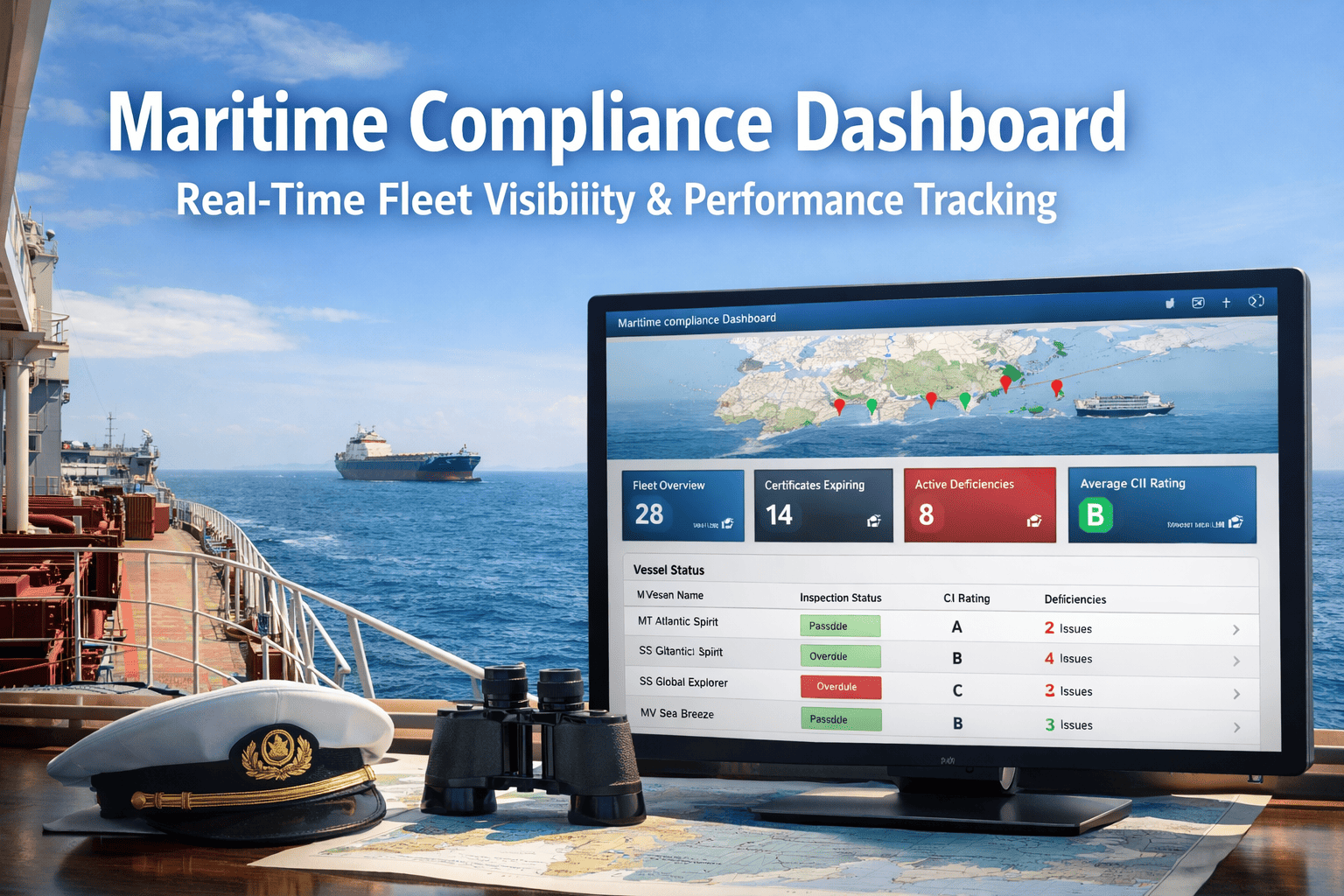
Most fleet managers underestimate the real cost of the wrong tool. It's not just the subscription fee — it's the detention days, scrambled inspections, and expired certificates discovered at the worst possible moment. Three forces are making this decision more critical than ever. Fleet managers who see Marine Inspection's compliance dashboard in action immediately understand how the right software turns regulatory pressure into a competitive advantage.
Paper-Based Systems Are Becoming a Legal Liability
The Problem
Retrieving records manually during a harbor master visit takes 30+ minutes on average. Expired certificates discovered on the spot trigger fines of $5,000–$25,000 or vessel detention at $12,000+ per day. Class societies now audit electronic records for 92% of certification renewals — actively phasing out paper.
What Good Software Does
Stores all certificates digitally with auto-renewal alerts at 90, 60, and 30 days. Any document retrievable in under 60 seconds. Signed PDF reports generated instantly on any device. Marine Inspection users report zero penalties and audit-ready readiness at every inspection.
IMO & Flag State Regulations Are Accelerating
The Problem
MARPOL Annex VI, SOLAS 2026 amendments, CII ratings, SEEMP Part III, new Norwegian Sea and Canadian Arctic ECAs effective March 2026 — the compliance calendar is packed and unforgiving. Missing one deadline can cost you your operating license, not just a fine.
What Good Software Does
Built-in IAPP, SEEMP, CII, BDN, and Annex VI modules — native features, not third-party add-ons. Automated DJPL reporting, fuel consumption tracking, and OPS usage logs. Marine Inspection links all IMO documentation into one audit-ready dashboard accessible from any device.
Dispersed Fleets Need Real-Time Visibility
The Problem
When vessels span dozens of ports across time zones, a spreadsheet updated weekly creates dangerous blind spots. Nearly 30% of global shipping routes face restricted real-time data sync. Older vessels — 42% of global fleets — lack compatible hardware for many advanced platforms.
What Good Software Does
Works fully offline on the vessel — all checklists, records, and certificates accessible without internet — then auto-syncs when connectivity returns. Shore-based superintendents maintain live fleet visibility as vessels sync at each port. No special hardware required.
The 12 Non-Negotiable Features: Your Evaluation Checklist
Run every software candidate through this checklist before you sit through a single sales demo. If a platform can't check all 12 boxes, keep looking. Operators who start a free trial with Marine Inspection find every one of these covered from day one — no add-ons, no extra modules.
12-Point Software Evaluation Checklist for Fleet Managers
If a platform can't confirm all 12, keep looking — your next harbor master won't wait
Full Offline Mode
Must work completely without internet. Test it on the vessel, not in a demo room. Should auto-sync when connection returns.
Automated Certificate Alerts
Reminders at 90, 60, and 30 days before every expiry — IAPP, SEEMP, classification, ISM — without any manual setup.
MARPOL / IMO Built-In Modules
Annex VI, CII tracking, BDN management, SEEMP Part III — native features, not third-party add-ons that break during updates.
Multi-Vessel Fleet Dashboard
See every vessel's certificate health, inspection status, and open findings across your entire fleet in one real-time screen.
Mobile-First Design
Crew complete inspections on a phone in under 6 minutes. If it takes 20 minutes on mobile, crew won't use it — period.
Instant PDF Reports + E-Signatures
Signed, audit-ready inspection reports generated directly from the mobile app — no printing, no emailing, no version chaos.
CMMS Integration Capability
Connects to existing maintenance scheduling and procurement systems — no more double data entry or manual reconciliation.
Role-Based Access Controls
Captain, chief engineer, superintendent, and shore team each see exactly the right data — nothing more, nothing less.
Photo, Video & Audio Capture
Attach rich media to incidents and findings in-app. Video reports dramatically reduce follow-up time and miscommunication with control rooms.
Configurable Inspection Templates
Build and adapt checklists for your vessel types without a developer. Your tanker and your ferry have different requirements.
Onboarding Under 7 Days
If deployment takes 3 months, crew will resist it and the vendor will blame your team. Fast onboarding signals good UX design.
Verifiable ROI Track Record
Demand specific numbers from references: downtime reduction %, admin hours saved per week, penalty-free inspection rate. Vague answers mean absent results.
Feature Comparison: Marine Inspection vs. Generic Platforms
Not all platforms are built for the maritime world. Here's how purpose-built marine inspection software compares to generic CMMS tools and paper-based systems on the criteria that actually matter during a port state control inspection. Fleet managers who've made the switch sign up free and see the difference within days.
30+ min
Paper: Document Retrieval
Crew scrambles through binders during inspection. Expired certificates discovered on the spot lead to fines of $5,000–$25,000 or detention.
< 60 sec
Digital: Instant Retrieval
All records searchable and retrievable in seconds. Certificate status always current. Audit-ready reports generated on demand from any device.
40%
Admin Hours Saved
Fleet managers using Marine Inspection report a 40% reduction in administrative hours within their first quarter of adoption.
Zero
Penalties with Digital Tracking
Operators using Marine Inspection report zero compliance penalties. Auto-alerts prevent expired certificates. Every document audit-ready at all times.
3 months
Typical ROI Timeline
Most fleets reach positive return on investment within 3 months. One avoided detention day alone covers a full year of software costs.
How to Choose in 5 Steps: Your Decision Framework
The biggest mistake fleet managers make is letting a vendor's demo drive the decision. Here's a structured five-step process that keeps you in control — and surfaces the right answer in under two weeks.
Step 1
Assess
Document Your Real Pain Points
Write down 3 things that went wrong at your last harbor master inspection
Identify your biggest certificate or compliance gap right now
That list becomes your real requirements document — not a vendor's feature sheet
Outcome
Clear requirements that no vendor can talk you out of
Step 2
Filter
Apply the 12-Point Checklist
Run every shortlisted vendor through all 12 criteria above
Drop any platform that can't confirm all 12 without caveats
This typically cuts 8 options to 2–3 serious contenders in under an hour
Outcome
A shortlist of 2–3 platforms worth your time
Step 3
Test
Test Offline on a Real Vessel
Request free trial and test offline mode in a low-signal berth
Time how long a new crew member takes to complete one inspection
Under 10 minutes from scratch is your benchmark for mobile usability
Outcome
Real-world proof before any financial commitment
Step 4
Verify
Demand Real ROI Numbers
Ask for specific metrics from current customers — not testimonials
Request: downtime reduction %, admin hours saved, penalty-free record
A confident vendor will have these ready. Vague answers are a red flag.
Outcome
Evidence-based decision, not a demo-room impression
Step 5
Pilot
Start Small, Scale Fast
Pilot on 2–3 vessels for 30 days before fleet-wide rollout
Track admin time, inspection speed, and certificate alert accuracy
Good platforms show clear wins in month one — not month twelve
Outcome
ROI proven before full fleet commitment
6 Red Flags That Should Make You Walk Away
Vendor demos are designed to impress, not inform. Watch for these six warning signs during any marine software evaluation — they signal problems that will cost your fleet far more than a bad subscription fee ever will.
No True Offline Mode
If the answer to "does it work without internet?" is anything other than a clear yes, your remote-waters operations are immediately at risk every time signal drops.
6–12 Week Onboarding Timeline
Long implementations mean the system is overly complex or poorly designed for maritime crews. Expect low adoption and a vendor who blames your team when it fails.
No Marine-Specific Compliance
Generic inspection tools don't understand MARPOL, CII, SEEMP, or SOLAS. You'll spend months building what should have come standard — and still end up with gaps.
Can't Show Real ROI Numbers
Vendors without specific customer metrics — actual percentages, not quotes — likely don't have satisfied customers to point to. Ask for hard numbers and watch the reaction.
No Free Trial or Pilot Option
Refusing to let you test before committing signals everything about a vendor's confidence in their own product. If they won't pilot it, walk away without hesitation.
Desktop-Only Interface
Crew work on phones and tablets at berth, in engine rooms, and on deck. A platform without a true mobile-first app is already a decade behind real maritime operations.
Expert View
"The marine software market has changed more in the last 18 months than in the previous decade. The convergence of stricter IMO regulations, class society requirements for electronic records, and the growing cost of detention days means fleet managers can no longer treat software selection as an IT decision — it's a compliance decision. The fleets that are thriving aren't running newer vessels. They're running better systems. Purpose-built platforms give superintendents real-time visibility into certificate status, inspection history, and compliance documentation across every vessel in the fleet — turning what was once a reactive scramble into a standing state of readiness."
Maritime Digital Operations Review
Fleet Management & Compliance Technology · Global Maritime Sector
Start with the Platform That Passes Every Point on This List
Marine Inspection is purpose-built for commercial fleet managers who need inspections, certificate tracking, compliance documentation, and harbor master readiness under one roof — with offline mobile access designed for real-world maritime operations across the world's most challenging routes.
What is marine inspection software and why do fleet managers need it?
Marine inspection software is a digital platform that replaces paper checklists, binders, and spreadsheets with a centralized, mobile-accessible system for vessel inspections, certificate tracking, compliance documentation, and maintenance records. Fleet managers need it because class societies now audit electronic records for 92% of certification renewals, harbor masters can inspect at any port without notice, and the cost of a single detention day ($12,000+) far exceeds the annual cost of any modern software solution.
How is marine inspection software different from general CMMS software?
General CMMS platforms are built for factories and land-based facilities — not vessels. Marine inspection software is purpose-built for the maritime world, with offline-first architecture for low-connectivity environments, MARPOL and SOLAS compliance modules built in, multi-vessel fleet dashboards, OPS/shore power documentation, CII and SEEMP tracking, and inspection workflows designed around how crews actually work on board. Adapting a generic CMMS to maritime compliance typically takes months and still leaves critical gaps that harbor masters will find.
Does marine inspection software work without internet on remote vessels?
It depends entirely on the platform — this is one of the most important questions to test before committing. Marine Inspection is designed offline-first: all inspection checklists, compliance records, maintenance logs, and certificates are accessible and completable fully offline on the vessel, then automatically synced when connectivity returns. This is essential for archipelago operations, remote fishing grounds, or low-bandwidth berths. Always test offline functionality on an actual vessel during your evaluation, not in a vendor's demo environment.
How quickly can a fleet see ROI from marine inspection software?
Fleets using Marine Inspection typically see measurable ROI within 3 months. Specific outcomes reported include a 40% reduction in admin hours, 18% less scheduled downtime, and zero compliance penalties. The fastest wins come from eliminating last-minute certificate renewal scrambles, reducing harbor master inspection prep from 30+ minutes to under 60 seconds, and cutting the overhead of manual report generation. One avoided detention day alone — at $12,000+ — typically covers a full year of software costs and then some.
What compliance standards should good marine inspection software cover?
At minimum, a credible platform should natively cover: MARPOL Annex VI (IAPP certificates, SEEMP Part II/III, CII ratings, BDN records, fuel consumption reporting), SOLAS safety management documentation, ISM Code compliance records, ballast water management certificates, garbage management plans, and OPS/shore power usage logs. For fleets operating in Indonesian waters or other Tokyo MOU jurisdictions, the software should also support harbor master inspection readiness across all of these documentation categories. Marine Inspection covers every item listed above as a native feature — not an add-on.
Is there a free version of Marine Inspection for small fleets?
Yes. Marine Inspection offers a free plan for small teams with no credit card required. Operators who start on the free plan consistently see enough benefit — reduced admin time, cleaner inspection records, eliminated paper chaos — that they upgrade to the full cloud solution within weeks. Onboarding typically takes under a week, and the free plan lets you verify the platform works for your specific vessel types and routes before any financial commitment whatsoever.
Ready to Pass Every Inspection with Confidence?
Marine Inspection helps fleet managers digitize vessel inspections, track certificates, document compliance, and stay audit-ready at every port — with offline mobile checklists, automated alerts, and fleet-wide dashboards built for commercial maritime operations worldwide.