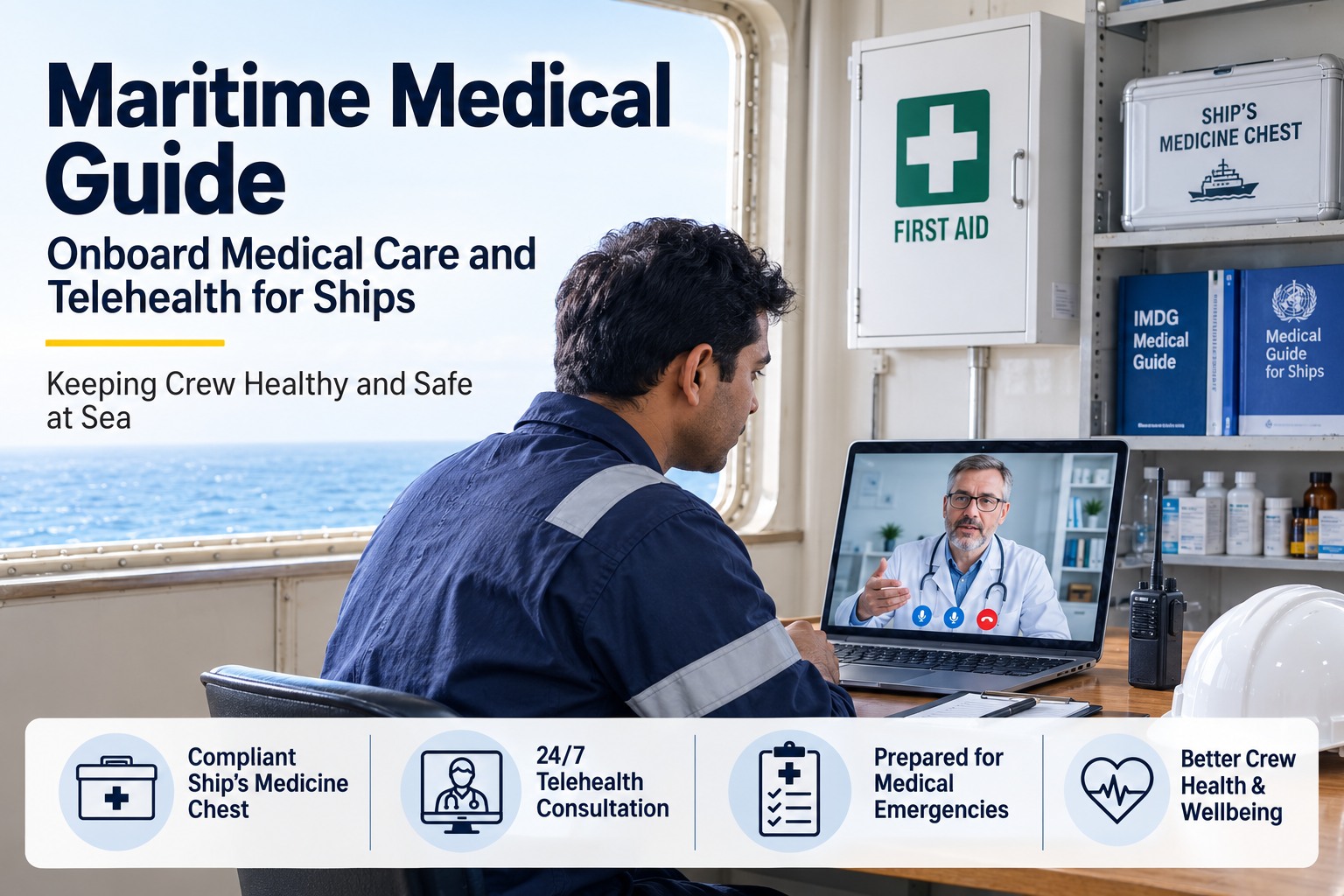
When a seafarer collapses in the engine room a thousand miles from the nearest port, there is no ambulance to call and no doctor down the corridor. On the overwhelming majority of merchant ships, the person who responds is not a physician but a shipmate — a designated officer with a few weeks of medical training, an onboard medicine chest, a medical guide, and a satellite link to a doctor ashore. That improvised clinic is what stands between an ill or injured crew member and a preventable death at sea. International law recognises this and builds a framework around it: the Maritime Labour Convention requires every ship to carry a medicine chest, medical equipment, and a medical guide, subject to regular inspection, and to have round-the-clock access to free medical advice by radio or satellite. Larger ships on longer voyages must carry a qualified doctor; the rest rely on a trained crew member supported from shore. For a master or the officer in charge of medical care, this is both a legal duty and a genuine life-or-death responsibility — and modern telemedicine has transformed what that improvised clinic can achieve. This guide covers the legal framework, the ship's medicine chest and medical equipment, the medical guides that direct treatment, telemedical assistance and how it works, seafarer medical fitness and pre-employment examinations, and the medical emergency and evacuation chain. Because onboard medical readiness comes down to inventory, equipment checks, certification, and records, book a Marine Inspection demo to see medical stores and crew health records managed in one place.
Crew & training · maritime medical care
Maritime Medical Guide: Onboard Medical Care & Telehealth for Ships
A guide for masters and medical officers — the legal framework, the ship's medicine chest and equipment, medical guides, telemedical assistance, seafarer medical fitness, and the emergency and evacuation chain.
The chest
Medicines and equipment, prescribed by flag and inspected regularly
The guide
The reference that directs a non-doctor's treatment decisions
The link
24-hour telemedical advice from a doctor ashore
The Legal Framework
Onboard medical care is governed principally by the Maritime Labour Convention, whose Regulation 4.1 sets the core obligations. The guiding principle is that seafarers should receive health protection and medical care as comparable as possible to what is available to workers ashore. See compliance records in a demo.
Medicine chest and guide
Every ship must carry a medicine chest, medical equipment, and a medical guide, the specifics prescribed by the competent authority and subject to regular inspection — scaled to ship type, number of persons, and voyage nature and duration.
A doctor on larger ships
Ships carrying 100 or more persons and ordinarily engaged on international voyages of more than three days must carry a qualified medical doctor responsible for medical care.
Trained person in charge
On ships without a doctor, the person in charge of medical care who is not a physician must have satisfactorily completed medical-care training meeting the STCW Convention's requirements.
Radio-medical advice, free, 24/7
The competent authority must ensure, by a prearranged system, that medical advice by radio or satellite is available to ships at sea 24 hours a day, at no cost to the ship regardless of flag.
Care at no cost to the seafarer
The shipowner bears the cost of medical care for a sick or injured seafarer, including medicines, treatment, medical transport, and repatriation where necessary.
These obligations are cumulative and inspected. A port state or flag inspection will check that the chest is present, correctly stocked to the flag's prescribed list, in date, and properly recorded, and that the person in charge of medical care holds the required training. A deficient medicine chest or an untrained medical officer is a finding, and on flags with weaker enforcement it is also a real risk to the crew.
The Ship's Medicine Chest and Equipment
The medicine chest is the physical heart of onboard care. Its contents are set by the flag state, informed by international recommendations, and scaled to the vessel — but the categories are broadly consistent. See inventory tracking in a demo.
Medicines
A prescribed range covering pain relief, infection, cardiovascular and respiratory conditions, gastrointestinal and allergic problems, and more — commonly aligned with the WHO Model List of Essential Medicines and grouped by therapeutic category.
The emergency medical kit
A kit of potent medicines for acute emergencies, labelled for use only by a qualified practitioner or the person in charge of medical care under telemedical advice or prescription — reflecting that some drugs are given only on a doctor's remote instruction.
Medical equipment
Diagnostic and treatment equipment: blood-pressure and temperature measurement, oxygen and resuscitation equipment, wound care and suturing supplies, splints and immobilisation, and instruments for the person in charge to examine and treat.
The defibrillator
Automated external defibrillators are increasingly carried and, on some flags, required — a decisive intervention for cardiac arrest, where minutes matter and the nearest hospital is days away.
Antidotes for cargo
Ships carrying dangerous goods require additional antidotes and first-aid materials matched to the specific hazards, guided by the Medical First Aid Guide for use in accidents involving dangerous goods.
The ship's hospital
Larger vessels carry a dedicated hospital space — a berth and facilities to isolate and care for a sick or injured crew member away from the accommodation, particularly important for infectious illness.
The management discipline the chest demands is often underestimated. Medicines expire and must be replaced; controlled drugs require secure storage and a strict register; the inventory must be reconciled against the flag's prescribed list; and every use must be recorded. An inspection checks not just that items exist but that they are in date, correctly quantified, and properly logged — which is a continuous records task, not an annual restock.
The chest is a records task, not an annual restock
Keep the Medicine Chest In Date and Inspection-Ready
Expired medicines, an inventory that drifts from the flag's prescribed list, an unlogged controlled-drug register — these are the medicine-chest findings that surface at inspection. Marine Inspection tracks medical stores and expiry dates, flags what needs reordering before it lapses, records usage and controlled-drug registers, and keeps the medical-officer certification alongside — so the chest is always inspection-ready. Book a 30-minute demo to see medical inventory tracking, or start a free trial today.
The Medical Guides
A medicine chest is useless without the knowledge to use it. The onboard medical guide is the reference that lets a non-doctor diagnose, decide, and treat, and it is a mandatory carriage item under the MLC.
International Medical Guide for Ships
The WHO's standard reference since 1967, now in its third edition, consistent with the WHO Model List of Essential Medicines and the International Health Regulations. It provides diagnosis and treatment guidance for the range of conditions a ship may face, organised for use by non-medical crew.
The ship's medicine chest companion
Guidance on the contents, storage, and use of the medicine chest itself, so the person in charge knows what each medicine is for and how to administer it safely.
Industry guides
The ICS International Medical Guide for Seafarers and Fishers offers a modern, practical reference written by maritime medical experts for use on all ships and in shore support centres.
The Medical First Aid Guide (MFAG)
Specific guidance for accidents involving dangerous goods, giving first-aid treatment for chemical exposure and poisoning matched to the cargo carried.
These guides are not merely carried; they are used in conjunction. A guide directs the initial assessment and treatment, the medicine chest supplies the means, and the telemedical service confirms or refines the plan. The person in charge of medical care is trained specifically to work this combination — the guide is the standard reference for that STCW medical-care training.
Telemedical Assistance
The single greatest advance in onboard care is the doctor who is not on board. Telemedical Assistance Services connect a ship to shore-based physicians around the clock, and they transform what a trained crew member can safely attempt. See medical event logging in a demo.
Free and 24/7
Under the MLC, radio or satellite medical advice must be available to ships at sea 24 hours a day at no cost. A prearranged national system provides the doctor at the other end of the link.
Guided remote treatment
The shore doctor takes a history relayed by the crew, interprets vital signs and symptoms, and directs treatment — including authorising medicines from the emergency kit that the crew may not administer on their own judgement.
Modern telehealth tools
Beyond voice, modern services use data, images, and video where connectivity allows, letting a shore physician see a wound or read a monitor — a step change in remote diagnostic quality.
The decision to divert or evacuate
Crucially, the TMAS doctor helps judge whether a case can be managed on board, needs a diversion to port, or warrants medical evacuation — a decision with major safety and cost implications that no master should make alone.
The practical value is judgement borrowed from ashore. A trained crew member can perform a great deal under instruction that they could never safely initiate alone, and the shore doctor's remote assessment prevents both under-reaction — a serious condition managed too lightly — and over-reaction, an unnecessary and costly diversion. Good telemedical support depends on the crew's ability to relay accurate information, which is exactly what the medical-care training and a well-kept medical log enable.
Seafarer Medical Fitness
The best onboard care is the illness that never sails. Pre-employment and periodic medical examinations screen seafarers for fitness before and during their careers, reducing the medical emergencies that occur at sea. See medical-certificate tracking in a demo.
The medical certificate
Seafarers must hold a valid medical fitness certificate meeting STCW Code A-I/9 and the ILO/IMO guidelines, issued by a doctor recognised by the competent authority. It confirms fitness for the demands of life and work at sea.
One certificate, dual purpose
A single certificate can satisfy both STCW and MLC requirements where it meets A-I/9 and the ILO/IMO guidelines, though individual flags may impose their own format and approved-doctor lists — the UK ENG1 being a widely accepted example.
Validity and expiry at sea
Certificates run for a defined period, commonly up to two years for adults. If a certificate expires during a voyage, a limited extension typically allows obtaining a new examination at the next port, subject to flag and company policy.
Pre-employment examination
The PEME assesses vision, hearing, cardiovascular health, and freedom from conditions that could become emergencies at sea, protecting both the seafarer and the crew who would have to treat them far from help.
Medical fitness is a prerequisite that connects directly to certification management: a lapsed medical can block a certificate revalidation entirely, and a seafarer whose medical expires mid-contract faces a scramble at the next port. Tracking medical-certificate validity alongside professional certification is part of keeping a crew both compliant and healthy.
The Medical Emergency and Evacuation Chain
When a serious case does occur, the response follows a chain, and knowing it in advance is what makes the difference under pressure.
1
Assess and stabilise. The person in charge of medical care performs the primary assessment using the medical guide, stabilises the casualty, and gathers the vital signs and history the shore doctor will need.
2
Contact the TMAS. Reach the telemedical service without delay, relay the information accurately, and follow the shore doctor's guided treatment, including any emergency-kit medicines they authorise.
3
Decide the disposition. With the TMAS doctor, determine whether the case is manageable on board, requires diverting to the nearest suitable port, or needs evacuation — weighing distance, weather, and the casualty's condition.
4
Coordinate evacuation. If evacuation is needed, involve the relevant maritime rescue coordination centre. A medical evacuation at sea — by helicopter or transfer craft — is complex, weather-dependent, and itself hazardous, so it is reserved for cases that genuinely require it.
5
Record everything. Document the assessment, the advice received, the treatment given, and the outcome — for continuity of care ashore, for the owner's obligations, and for any subsequent review.
Every link depends on preparation done long before the emergency: a stocked and in-date chest, a trained person in charge, a working communication link, and a crew that has rehearsed the chain. The medical record created along the way is not an afterthought — it is what allows the receiving hospital to continue care, what evidences the owner met its duty, and what informs prevention. Onboard medical care is, at its core, a capability to be maintained continuously: the stores in date, the equipment working, the certification current, and the records complete. That is a management task as much as a clinical one. Book a demo to see medical stores, certification, and records in one system.
Frequently Asked Questions
What medical facilities must a ship carry?
Under MLC Regulation 4.1, every ship must carry a medicine chest, medical equipment, and a medical guide, the specifics prescribed by the flag state and subject to regular inspection, scaled to the ship type, number of persons, and voyage. Ships carrying 100 or more persons on international voyages of more than three days must also carry a qualified doctor.
Who provides medical care on a ship without a doctor?
A designated person in charge of medical care — usually a senior officer — who has completed medical-care training meeting STCW requirements. They are not a physician but are trained to assess, treat, and manage cases using the onboard medical guide and medicine chest, supported by telemedical advice from a doctor ashore.
What is telemedical assistance at sea?
A Telemedical Assistance Service connects a ship to shore-based doctors, available 24 hours a day at no cost under the MLC. The shore physician takes a relayed history, interprets symptoms and vital signs, directs treatment including authorising emergency-kit medicines, and helps decide whether a case can be managed on board or requires diversion or evacuation.
What is the International Medical Guide for Ships?
The WHO's standard medical reference for ships, first published in 1967 and now in its third edition, consistent with the WHO Model List of Essential Medicines and the International Health Regulations. It provides diagnosis and treatment guidance organised for use by non-medical crew, and is a mandatory carriage item supporting the MLC's medical-care requirements.
What is a seafarer medical fitness certificate?
A certificate confirming a seafarer is medically fit for work at sea, meeting STCW Code A-I/9 and the ILO/IMO guidelines and issued by a doctor recognised by the competent authority. A single certificate can satisfy both STCW and MLC where it meets these standards, though flags may impose specific formats such as the UK ENG1. Certificates are typically valid up to two years.
What happens in a medical evacuation at sea?
After assessment and telemedical consultation, if a case cannot be managed on board or by diverting to port, evacuation is coordinated through the relevant maritime rescue coordination centre, typically by helicopter or transfer craft. Because evacuation at sea is complex, weather-dependent, and hazardous, it is reserved for cases that genuinely require it, and the decision is made with the shore doctor.
Who pays for a seafarer's medical care?
Under the MLC, the shipowner bears the cost of medical care for a sick or injured seafarer at no cost to the individual, including medicines, treatment, examinations, medical transport, and repatriation where necessary. Medical care must be available both on board and, when the ship is in port, ashore.
Medical readiness, always current
Keep Medical Stores, Certification, and Records Ready
Track the medicine chest inventory and expiry dates against the flag's prescribed list, flag reorders before medicines lapse, maintain controlled-drug registers, hold medical-officer training and seafarer fitness certificates with alerts, and record every medical event and telemedical consultation. Marine Inspection turns onboard medical readiness from a periodic scramble into a continuously current capability. Book a tailored demo, or start a free trial today.