A single impaired watchkeeper can put a ship on the rocks. Drug and alcohol use degrades exactly the faculties a seafarer needs most — judgement, reaction time, coordination, perception, and communication — and shipping is unusually exposed to the problem, because the long hours, disrupted sleep, isolation, and stress of life at sea are themselves drivers of substance abuse. The industry's answer is a layered regime of policy, prohibition, and testing that now reaches every commercial vessel. Since the 2010 Manila Amendments, the STCW Convention has for the first time set a mandatory alcohol limit, and the tanker sector, driven by OCIMF vetting, has pushed most operators to outright zero-tolerance dry-ship policies backed by unannounced testing. For an HR manager or designated person ashore, the obligation is no longer simply to have a policy — it is to run a defensible programme: the right testing scenarios, the right specimen methods, a clean chain of custody, medical review of positives, and documentation that survives a tanker vetting inspection or a post-incident investigation. This guide sets out the legal limits, the OCIMF and flag-state framework, the six testing scenarios, the testing methods and their detection windows, chain of custody and confirmation, and how to build a policy that holds up. Because a compliant programme lives or dies on records and scheduling, and both are exactly what a purpose-built system handles, book a Marine Inspection demo to see testing and certification records managed in one place.
Crew & training · drug & alcohol control
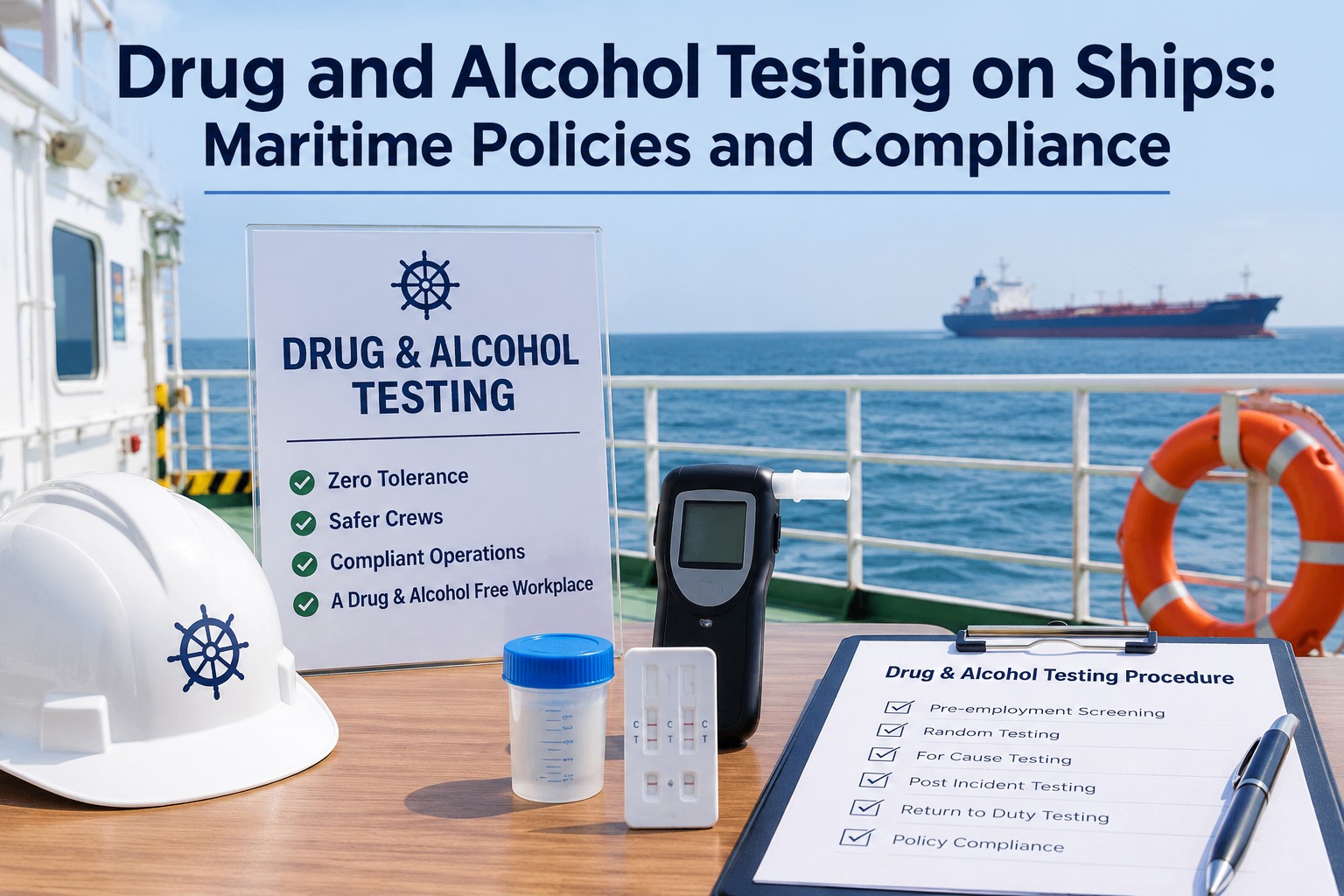
Drug and Alcohol Testing on Ships: Maritime Policies & Compliance
A guide for HR managers and DPAs — the STCW alcohol limit, OCIMF and flag-state requirements, the six testing scenarios, specimen methods and detection windows, chain of custody, and building a policy that survives vetting and post-incident scrutiny.
0.05%
STCW maximum blood alcohol on duty
0.25 mg/l
STCW maximum breath alcohol on duty
4 hours
STCW guidance: no alcohol before watch
Zero
Typical tanker and offshore tolerance
The Legal Framework
Four layers of authority govern drugs and alcohol at sea, and a compliant policy must satisfy all of them at once. They stack from a global baseline up to the strictest commercial and national requirements. See policy compliance tracking in a demo.
STCW
The mandatory baseline
The 2010 Manila Amendments, Section A-VIII/1 on Fitness for Duty, require each administration to set a limit of not greater than 0.05% blood alcohol content or 0.25 mg/l alcohol in the breath for masters, officers and seafarers performing designated safety, security and marine environmental duties. This was the first mandatory alcohol limit under STCW, in force from 1 January 2012.
OCIMF
The tanker standard
The Oil Companies International Marine Forum's Guidelines for the Control of Drugs and Alcohol Onboard Ship set the de facto standard for tankers and offshore vessels, emphasising pre-employment and unannounced testing. Most tanker operators run zero-tolerance policies to satisfy vetting.
ICS / ILO
Guidance and welfare
The International Chamber of Shipping guidelines and ILO drug-and-alcohol abuse prevention requirements inform company policy design, and are reinforced by the ISM Code's requirement to manage risks to safe operation.
Flag & port
National overlays
Flag states may impose stricter limits, and port states add local law. US waters are notably strict: zero alcohol consumption is required from 24 hours before entering until departure, and the Coast Guard requires testing within 32 hours of a serious marine incident.
The important mental model is that these are cumulative, not alternative. A tanker calling at a US port operates under STCW's baseline, OCIMF's zero-tolerance vetting expectation, its flag state's rules, and USCG requirements simultaneously — and must satisfy the strictest of each. STCW guidance in Part B also recommends seafarers consume no alcohol within four hours of going on watch, a practical rule many companies fold into policy.
The Six Testing Scenarios
A credible programme does not simply test at random. It defines distinct triggers, each with its own purpose, and applies them consistently. These six scenarios are the backbone of OCIMF-aligned policy.
1
Pre-employment
Screening before a seafarer joins, verifying they meet the company standard before they ever stand a watch. Hair testing, with its long detection window, is well suited to this scenario.
2
Random / unannounced
The deterrent core of a dry-ship policy. Selection must be genuinely unpredictable, spread evenly through the year, and never pre-notified. Operators may select by individual or by group, such as a whole vessel or crew.
3
For-cause / reasonable suspicion
Triggered by observed behaviour, appearance, or performance suggesting impairment. Requires trained supervisors who can document the specific grounds for the suspicion.
4
Post-incident
Following an accident, injury, or near-miss, to establish whether impairment was a factor. Time-critical: US rules require testing within 32 hours, and if a testing company cannot reach the ship within two hours, the master must collect samples.
5
Periodical
Scheduled testing tied to medical examinations or routine intervals, catching sustained use that random sampling might miss and confirming ongoing fitness for duty.
6
Return-to-duty / follow-up
Applied after a positive result and any rehabilitation, often under a last-chance agreement, with a structured schedule of unannounced follow-up tests to confirm sustained abstinence.
Random testing carries a numerical expectation: programmes should meet a defined annual random testing rate — the percentage of the covered population tested per year — with selection made by a scientifically valid method giving every seafarer an equal chance each time. The rate and the even spread are what make the deterrent credible; a programme that tests everyone in March and no one thereafter is predictable, and predictability defeats the purpose.
Vetting-ready records, not scattered paperwork
Track Every Test, Every Scenario, Every Seafarer
A tanker vetting inspector will ask for your testing records, your random-selection method, and your annual rate — and expect them in minutes. Marine Inspection records drug and alcohol test results by scenario and seafarer, tracks the annual random rate against target, flags pre-employment screening before sign-on, and keeps the documentation an OCIMF-aligned programme demands. Book a 30-minute demo to see it on your fleet, or start a free trial today.
Testing Methods and Detection Windows
Alcohol and drugs are tested differently, and among drug tests the choice of specimen determines what a test can see and how far back. Matching method to scenario is a core policy decision. See method and result tracking in a demo.
Method
Detects
Window & use
Breath (EBT)
Current alcohol impairment
Immediate. Evidential Breath Testing devices for pre-duty and random alcohol checks; the shipboard front line
Urine
Recent drug use
Days. The workplace standard for drugs; easy collection, well-established cut-offs
Oral fluid
Very recent drug use
Short. Non-invasive swab, simple collection, harder to adulterate; good for for-cause
Hair
Longer-term pattern of use
Up to about 90 days. Ideal for pre-employment screening and detecting sustained use
A comprehensive drug panel should cover, at minimum, marijuana, cocaine, amphetamines including methamphetamine, opiates and opioids, phencyclidine, benzodiazepines, and methadone. The list of safety-sensitive positions subject to testing should be defined and reviewed periodically, and the panel itself kept current as substances of concern evolve. Alcohol is confirmed with an evidential breath device or a blood or urine sample; drugs are screened and then confirmed by a separate laboratory method.
Chain of Custody and Confirmation
This is where programmes are won or lost legally. A positive result that cannot be defended procedurally is worse than useless — it exposes the company to a wrongful-dismissal claim. Every step exists to make the result unassailable.
1
Collection. A single-use kit appropriate to the specimen, collected under controlled conditions to prevent tampering, adulteration, or substitution.
2
Chain of custody. Documented tracking of every specimen from the point of collection to the laboratory and final disposal, accounting for its integrity at each handover. A break here is a "fatal flaw" that can void the result.
3
Initial screen. A first analytical pass against a designated cut-off. A specimen at or above the cut-off is not yet a confirmed positive.
4
Confirmatory test. A second analysis on a different portion of the original specimen, typically gas or liquid chromatography with mass spectrometry, to identify and quantify the specific substance.
5
Medical Review Officer. A qualified physician reviews a confirmed positive, contacts the seafarer, and checks whether a legitimate prescription or medical explanation accounts for the result before it is declared.
6
Cut-off levels. Positive or negative is decided against defined cut-offs, commonly mirroring recognised standards such as SAMHSA, set to account for passive exposure and reduce false positives.
Two principles protect everyone. First, an initial screen is never acted on alone — confirmation by a separate, more specific method is mandatory before any consequence. Second, the Medical Review Officer step exists precisely because a seafarer on a declared, legitimate prescription can produce a technically positive result; the MRO distinguishes lawful medication from prohibited use. This is why company policy must require crew to declare prescribed medication to the master on joining or on prescription.
Building a Defensible Policy
A drug and alcohol policy is only as good as its clarity and its consistency. These are the elements an HR manager or DPA must get right, and the ones a vetting inspector or a tribunal will examine. See documentation management in a demo.
A clear prohibition
Unambiguous statement of what is banned — possession, use, and being unfit for duty — and the limits that apply. Most operators now prohibit possession and consumption outright.
Defined testing regime
The scenarios that trigger testing, the methods used, the annual random rate, and the selection method — written down, so the programme is demonstrably systematic rather than arbitrary.
Prescription declaration
A duty on crew to declare prescribed medication to the master on joining or when prescribed on board, so legitimate medicine is never mistaken for prohibited use.
Consequences stated in advance
The disciplinary outcome of a confirmed positive, up to and including termination, set out clearly so it is understood before any test, not disputed after one.
Confidentiality and dispute rights
Confidential handling of results, the right to challenge through confirmation and MRO review, and where policy allows, access to an assistance or rehabilitation route.
Training and awareness
Programmes so crew understand the policy and supervisors can recognise and document reasonable suspicion, embedded in a broader drug-free workplace culture.
The balance a good policy strikes is between deterrence and welfare. Substance abuse among seafarers is frequently downstream of the very conditions of the job — fatigue, isolation, stress — so the most defensible programmes pair firm testing with a route to help, rather than treating every case purely as a disciplinary matter. Many companies build in an assistance or last-chance provision precisely because the goal is a safe ship, not merely a punished seafarer.
Why This Is a Records Problem
Everything above converges on documentation. A policy that is perfectly designed but poorly recorded fails at the only moments that matter: a vetting inspection, a post-incident investigation, or an employment dispute.
Vetting inspections
Tanker vetting expects to see the policy, the testing records, the random-selection method, and the achieved annual rate. Scattered paperwork or gaps become observations that jeopardise the vessel's commercial acceptability.
Post-incident defensibility
After an incident, the company must show it operated a genuine programme. Timely testing records and a clean chain of custody are the evidence; their absence is itself a finding.
Employment disputes
A dismissal on a positive result must rest on a defensible procedure — documented collection, confirmation, and MRO review. The record is the defence.
Random-rate evidence
Proving the annual random rate was met, evenly through the year, requires tracking selections and completions continuously — not reconstructing them at year end.
Prescription declarations
A logged declaration of prescribed medication, held against the seafarer, is what allows a later positive to be resolved correctly through the MRO rather than wrongly through discipline.
This is the practical case for a system rather than a filing cabinet. Drug and alcohol control is not a single event but a continuous programme generating records against every seafarer, every voyage, and every scenario — records that must be complete, retrievable, and defensible on demand. A purpose-built platform holds the policy, the test results, the random-rate tracking, the prescription declarations, and the certification alongside, so that when an inspector, an investigator, or a tribunal asks, the answer is already assembled. Book a demo to see drug and alcohol records managed end to end.
Frequently Asked Questions
What is the alcohol limit for seafarers?
Under the STCW Convention's 2010 Manila Amendments, Section A-VIII/1, each administration must set a limit of not greater than 0.05% blood alcohol content or 0.25 mg/l alcohol in the breath for masters, officers and seafarers performing designated safety, security and environmental duties. Flag states and companies may impose stricter limits, and tanker operators commonly enforce zero tolerance.
What does OCIMF require for drug and alcohol testing?
OCIMF's Guidelines for the Control of Drugs and Alcohol Onboard Ship set the de facto tanker standard, emphasising pre-employment screening and unannounced random testing to a defined annual rate, with clear chain-of-custody and confirmation procedures. Most tanker operators adopt zero-tolerance policies to satisfy vetting requirements under regimes such as SIRE.
What are the different types of drug and alcohol testing on ships?
Six scenarios: pre-employment before joining; random and unannounced during service; for-cause or reasonable-suspicion based on observed behaviour; post-incident following an accident or near-miss; periodical tied to medicals or intervals; and return-to-duty or follow-up after a positive result and rehabilitation.
Which testing methods are used and how far back do they detect?
Breath testing detects current alcohol impairment immediately. For drugs, urine detects recent use over days and is the workplace standard; oral fluid detects very recent use over a short window and is hard to adulterate; and hair detects a longer pattern of use up to around 90 days, making it well suited to pre-employment screening.
What is chain of custody in drug testing?
Chain of custody is the documented tracking of a specimen from collection through the laboratory to final disposal, accounting for its integrity at every handover. A break in the chain is treated as a fatal flaw that can void the result, which is why controlled collection and rigorous documentation are essential to a defensible programme.
What happens if a seafarer tests positive?
An initial screen at or above the cut-off is confirmed by a separate, more specific laboratory method, typically gas or liquid chromatography with mass spectrometry. A Medical Review Officer then reviews the confirmed positive and checks for a legitimate prescription before it is declared. Consequences follow company policy and can include termination, sometimes with an assistance or rehabilitation route.
Are there special rules for US waters?
Yes. US requirements are notably strict: zero alcohol consumption is required from 24 hours before entering US waters until departure, and the Coast Guard requires drug and alcohol testing within 32 hours of a serious marine incident. If a testing company cannot reach the vessel within two hours of an incident, the master must conduct alcohol testing and collect specimens.
One programme, fully documented
Make Your D&A Programme Inspection-Ready
Record test results by scenario and seafarer, track the annual random rate against target, log prescription declarations, hold the policy and chain-of-custody documentation, and keep it all retrievable the moment a vetting inspector, investigator, or tribunal asks. Marine Inspection turns a scattered paper trail into a defensible programme you can prove in minutes. Book a tailored demo to see it on your fleet, or start a free trial today.