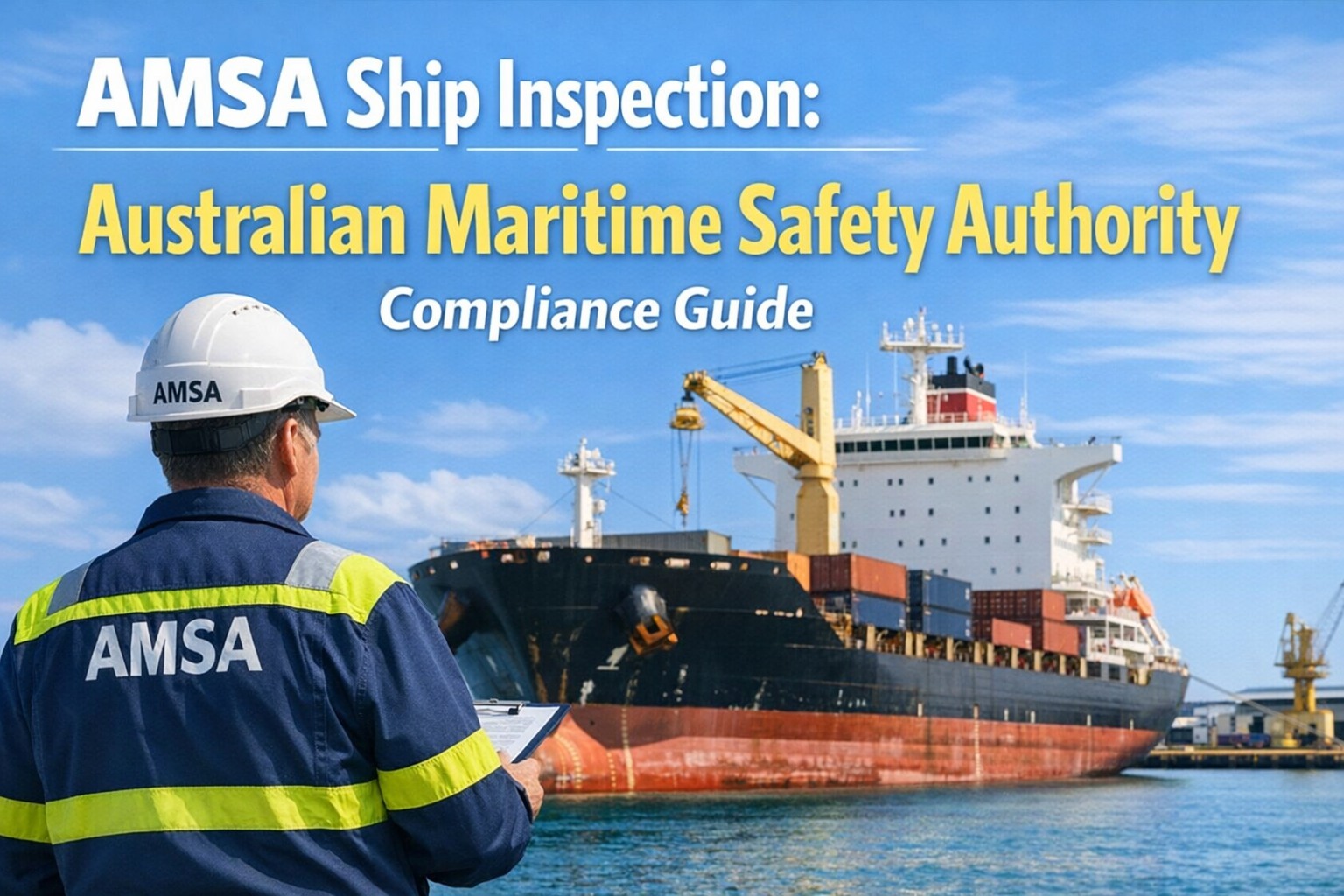
AMSA Ship Inspection: Australian Maritime Safety Authority Compliance Guide
Australian fleet operators face an intensifying compliance environment in 2026. The Australian Maritime Safety Authority will conduct a minimum of 2,400 port state control inspections this year — prioritised through a risk-based targeting model that directs resources toward vessels most likely to harbour deficiencies. With ISM-related findings topping the deficiency charts for the third consecutive year, domestic commercial vessel detentions rising 41% in detainable deficiencies, and new SMS requirements now mandatory since June 2025, operators who rely on paper-based systems and reactive maintenance are the ones filling AMSA's detention statistics. Fleet operators preparing for AMSA's heightened scrutiny can start a free trial of Marine Inspection's compliance platform to centralise inspection records, maintenance logs, and deficiency tracking before the next surveyor arrives.
AMSA Inspection Landscape: 2025-2026 at a Glance
2,400+
PSC Inspections Planned
Minimum target for 2025-2026 under risk-based targeting
27.6%
ISM Deficiencies
Largest share of detainable deficiencies in 2024
5.9%
PSC Detention Rate
2024 rate consistent with 10-year rolling average of 5.8%
+41.4%
Detainable Deficiency Rise
DCV detainable deficiencies up from 140 to 198 in 2025
What Is AMSA and Why Does It Matter to Your Fleet?
The Australian Maritime Safety Authority is Australia's national maritime safety regulator, established under the Australian Maritime Safety Authority Act 1990. AMSA's mandate spans four critical areas: enforcing the safe operation of ships, preventing ship-sourced marine pollution, providing navigational safety infrastructure, and delivering national search and rescue services. For vessel operators, AMSA is the authority that can board your vessel, catalogue every deficiency, and issue detention notices that ground your operations until rectification — and all of it feeds into international databases visible to every port state control authority across the Tokyo MOU and Indian Ocean MOU regions. Operators who book a Marine Inspection demo can see how digital compliance workflows keep vessels audit-ready before AMSA arrives.
AMSA's Dual Enforcement Authority
Port State Control (PSC)
Inspects foreign-flagged vessels calling at Australian ports
Member of Tokyo MOU and Indian Ocean MOU
Uses Shipsys database for risk-based vessel targeting
Vessels eligible for inspection every 6 months
Detention records shared across international PSC databases
Flag State Control (FSC)
Regulates Australian-flagged vessels worldwide
Enforces National Law Act 2012 for domestic commercial vessels
Issues Certificates of Survey under Marine Order 503
Accredits marine surveyors for periodic and renewal surveys
Conducts focused inspection campaigns on priority safety issues
AMSA's National Compliance Plan 2025-2026: What Operators Must Know
AMSA's National Compliance Plan is not aspirational guidance — it is the published enforcement roadmap that tells you exactly where inspectors will focus their attention for the coming year. The 2025-2026 plan identifies specific compliance priorities across both foreign-flagged and domestic commercial vessels, and operators who align their maintenance and documentation systems to these priorities position themselves on the right side of every inspection. Here is what the plan targets — and how Marine Inspection's platform helps you stay ahead of each priority.
2025-2026 Compliance Priorities
Shipboard Maintenance
Continued focus from 2023-2024 — inspectors verify that planned maintenance systems are implemented, not just documented. ISM Code maintenance requirements are the primary enforcement lens.
Pilot Ladder Safety
Safety compliance approach with industry education followed by targeted PSC and FSC inspections. AMSA is engaging with pilot associations to reinforce safety expectations on ladder arrangements.
Cargo Securing Practices
Education campaign running in parallel with Marine Order 32 Focused Inspection Campaign to ascertain compliance levels across vessel types.
Seafarer Welfare & MLC
Joint inspections with the Fair Work Ombudsman focusing on MLC requirements and Seagoing Industry Award 2020 Schedule A wage compliance on temporary licence vessels.
Lithium-Ion Battery Safety
New comprehensive guidance for installation, operation, and maintenance of Li-ion battery systems on DCVs. Focused assessments during Certificate of Survey and Certificate of Operations processes.
Fatigue Management & SMS
New SMS requirements mandatory since June 2025 for all DCVs. Fatigue remains one of the most significant hazards in DCV operations — inspectors will verify effective implementation.
How AMSA's Risk-Based Targeting System Works
Understanding how AMSA selects vessels for inspection is critical to managing your fleet's compliance posture. AMSA does not inspect vessels randomly — it uses a sophisticated risk profiling system built on data from the Tokyo MOU's APCIS database, the Indian Ocean MOU, and its own Shipsys inspection database. Every vessel calling at an Australian port has a calculated risk rating that determines when and how thoroughly it will be inspected. The system categorises vessels into three risk tiers, each with different inspection windows and priority levels.
AMSA Risk Profiling: How Your Vessel Gets Selected
1
Risk Factor Calculation
AMSA's Shipsys database calculates a risk rating using: vessel type, vessel age, flag state performance (Tokyo MOU Black/Grey/White List), recognised organisation performance, inspection history, deficiency history, and detention records over the preceding 36 months.
2
Ship Risk Profile Assignment
Vessels are classified into one of three risk categories — High Risk Ship (HRS), Standard Risk Ship (SRS), or Low Risk Ship (LRS) — calculated automatically in the PSC database system.
3
Inspection Window Applied
Each risk category determines the inspection interval. The time window resets after every inspection, creating a continuous compliance cycle.
HIGH RISK
2 – 4 months
Inspection interval
Priority I when window closes. Overriding factors (e.g., Class suspension, recent casualty) can trigger immediate inspection regardless of window status.
STANDARD RISK
5 – 8 months
Inspection interval
Most vessels fall here. Within the time window, vessel is Priority II (may be inspected). After window closes, becomes Priority I (will be inspected).
LOW RISK
9 – 18 months
Inspection interval
Requires flag state on Tokyo MOU White List, RO with high performance, no detentions in preceding 36 months, and clean deficiency record.
Know Your Risk Profile. Own Your Compliance.
Marine Inspection tracks your fleet's inspection history, deficiency trends, and certificate expiry dates — giving you real-time visibility into the factors that determine your AMSA risk rating. Reduce your risk profile systematically, not reactively.
Top AMSA Deficiency Categories: Where Vessels Fail
Understanding what AMSA inspectors find most often — and what leads to detention — is the fastest way to prioritise your compliance investments. The data from 2024 and 2025 reveals persistent patterns that operators can address proactively with the right systems in place. Operators who sign up for Marine Inspection gain digital checklists mapped to each of these deficiency categories.
Detainable Deficiency Breakdown: PSC Inspections
ISM Code / Safety Management
27.6%
Fire Safety
15.1%
Water/Weathertight Conditions
13.0%
Life-Saving Appliances
11.4%
Structural Conditions
8.1%
Labour Conditions (MLC)
4.9%
What the Data Tells Operators
60%+
of all DCV detainable deficiencies concentrate in just three categories: structural conditions, SMS implementation, and fire safety
2.73
deficiencies per PSC inspection in 2025 — above the 10-year rolling average of 2.29 — driven by higher-risk vessel targeting
198
detainable deficiencies on DCVs in 2025, up 41.4% from 140 in 2024 — serious safety issues in structural conditions and SMS persist
The AMSA Inspection Process: Step by Step
Whether you are operating a foreign-flagged vessel calling at Australian ports or an Australian domestic commercial vessel, understanding the inspection workflow helps you prepare systematically rather than scramble when the surveyor appears on the gangway. AMSA inspections follow a structured process — and every stage creates documentation that either demonstrates compliance or generates deficiencies that feed your vessel's risk profile for future inspections.
AMSA PSC Inspection Workflow
Pre-Arrival
AMSA's Shipsys database identifies eligible vessels. Risk profile determines priority. Marine surveyors are assigned based on port and vessel type.
Initial Inspection
Covers 22 inspection areas: hull condition, ISM Code, wheelhouse, radio, deck, engine room, crew accommodation, certificates, and safety equipment.
Deficiency Assessment
Each finding categorised by type (structural, operational, human factors, ISM, MLC). Severity determines whether a deficiency is detainable or requires rectification within a time frame.
Enforcement Action
Options range from deficiency notation to detention notice. For DCVs: prohibition notice, direction notice, or detention notice under the National Law Act 2012. Vessel cannot sail until rectification confirmed.
Follow-Up & Record
Results recorded in Shipsys, Tokyo MOU APCIS, and IOMOU databases. Detention records affect vessel's risk profile and flag state performance metrics across all future port calls worldwide.
If you operate a domestic commercial vessel in Australia, your compliance obligations are governed by the Marine Safety (Domestic Commercial Vessel) National Law Act 2012 and Marine Order 503. Every DCV is required to have a Certificate of Survey — unless specifically exempt — and must meet design, construction, stability, and safety equipment standards set out in the National Standard for Commercial Vessels (NSCV). Since June 2025, all DCVs must also have an effective Safety Management System. Schedule a demo to see how Marine Inspection supports SMS implementation and survey tracking.
DCV Survey Framework Under Marine Order 503
New Vessels
Must meet full NSCV standards for construction, subdivision, stability, fire safety, machinery, and equipment
Vessels 35m+ must be constructed to Class rules for construction, machinery, anchoring, and electrical systems
NSCV applies to all other aspects regardless of vessel size
Surveyed by accredited marine surveyor or recognised organisation
Existing Vessels
Vessels in operation before 1 July 2013 under previous state/territory regimes
Must comply with new periodic survey requirements since July 2018
Safety equipment and EPIRB requirements must meet current NSCV standards
Option to voluntarily upgrade to full new-vessel NSCV compliance
Transitional Vessels
Existing vessels that have been altered, changed operations, or relocated geographic areas
Must undergo full initial survey if service category upgraded or area of operation changes
Renewal survey required if lightship displacement varies by 4% or LCG by 2%
Standards set out in Schedule 2 of Marine Order 503
NSCV Coverage Areas
Part B – General RequirementsPart C – Design & ConstructionStability & SubdivisionFire ProtectionMachinery & ElectricalSafety Equipment (C7A)Navigation & CommunicationsAnchoring SystemsLPG SystemsFast Craft Standards
AMSA's Initial Inspection Checklist: The 22 Areas Inspectors Cover
When an AMSA marine surveyor boards your vessel, they work through a structured initial inspection checklist covering 22 distinct areas. Each area generates specific findings that determine whether deficiencies are issued and at what severity level. Knowing what inspectors look for — and having the documentation ready before they ask — is the difference between a clean inspection and a detention notice.
AMSA Ship Initial Inspection Checklist Areas
1 External Hull & Pre-Boarding
2 ISM Code Compliance
3 Wheelhouse & Navigation
4 Radio & GMDSS
5 Monkey Island & Masts
6 External Superstructure & Deck
7 Life-Saving Appliances
8 Fire Protection Systems
9 Emergency Systems
10 Pollution Prevention
11 Crew Accommodation
12 Engine Room General
13 Steering Gear
14 Crew Certification (STCW)
15 Working & Living Conditions (MLC)
16 Mooring Arrangements
17 Stability & Load Lines
18 Ballast Water Management
19 Cargo Operations
20 Tanker-Specific Areas
21 Container & General Cargo
22 Australian FSC Additional Items
Area 22 applies specifically to Australian-flagged vessels and includes Medical Locker Certificate (MO10), Fire Fighting Appliance Certificates (MO15), Medical Fitness Certificates (MO9), Lift Certificates (MO12), and Liferaft Certificates (MO25).
Digital Checklists Mapped to Every AMSA Inspection Area
Marine Inspection provides pre-built checklist templates covering all 22 AMSA inspection areas — with photo evidence capture, crew task assignments, and corrective action workflows that keep your documentation current and audit-ready at all times.
A detention is not just an inconvenience — it is a cascading event that damages your vessel's risk profile, your flag state's performance metrics, your recognised organisation's standing, and your commercial reputation across every port in the Tokyo MOU and Indian Ocean MOU regions. For domestic commercial vessels, AMSA can issue prohibition notices, direction notices, or detention notices under the National Law — each preventing the vessel from operating until the high-risk deficiency is rectified and verified.
Detention: The Cascade Effect
Immediate
Vessel grounded until all detainable deficiencies rectified
Port fees, crew costs, and charter penalties accumulate daily
Follow-up inspection required before release — inspector must return and verify
Short-Term
Detention recorded in Tokyo MOU APCIS and IOMOU databases
Risk profile upgraded — shorter inspection window for future port calls
Detention history follows vessel for 36 months in risk calculations
Flag state performance affected — impacts all vessels under same flag
Commercial reputation damage with charterers, terminals, and insurers
Expert Review: Positioning Your Fleet for AMSA Compliance in 2026
Industry Analysis
The 2025-2026 AMSA compliance landscape reveals a clear enforcement trajectory: more targeted inspections, stricter consequences, and an expanding definition of what constitutes adequate safety management. The 41.4% increase in detainable DCV deficiencies between 2024 and 2025 — despite an overall decrease in deficiencies per inspection — signals that AMSA is finding fewer issues but more serious ones, precisely because the risk-based targeting model is working as intended.
For operators, the strategic response is integration rather than escalation. The same maintenance records that prevent ISM deficiencies during PSC inspections satisfy the planned maintenance requirements AMSA has prioritised since 2023. The same crew competency documentation that averts STCW findings during port state control supports the SMS implementation now mandatory for all DCVs. And the same digital evidence trail — photos, timestamps, corrective action records — that demonstrates compliance to an AMSA marine surveyor also satisfies classification society requirements and commercial vetting expectations.
The operators who consistently avoid detention are not the ones who prepare specifically for AMSA inspections. They are the ones whose daily operational systems produce compliance evidence as a natural byproduct of doing their work. That is the difference between inspection preparation and inspection readiness — and it is the reason digital platforms that unify maintenance, inspection, and documentation workflows are becoming operationally essential rather than administratively convenient. Schedule a walkthrough to see how Marine Inspection builds that readiness into your daily operations.
Conclusion
AMSA's enforcement model is clear: risk-based targeting concentrates inspection resources on vessels most likely to have deficiencies, and ISM Code compliance failures remain the single largest category driving detentions. With 2,400+ PSC inspections planned for 2025-2026, mandatory SMS implementation for all domestic commercial vessels, focused inspection campaigns on pilot ladders, lithium-ion batteries, and cargo securing, and joint MLC compliance activities with the Fair Work Ombudsman — Australian fleet operators face a regulatory year that rewards systematic preparation and penalises reactive compliance. Every maintenance record you document today builds the evidence trail that satisfies tomorrow's inspector. Every deficiency you track digitally prevents the corrective action gap that triggers detention. And every crew competency record you maintain strengthens the ISM and SMS compliance that AMSA scrutinises most heavily. Marine Inspection provides the platform that connects these daily operations into one audit-ready system — sign up today to bring your fleet's AMSA compliance into one place.
Get Your Fleet AMSA-Ready
From PSC inspection preparation to DCV survey tracking, Marine Inspection connects every compliance requirement — maintenance logs, checklist completion, crew certifications, deficiency tracking, and corrective action evidence — into one platform built for Australian fleet operators navigating AMSA's risk-based enforcement regime.
What is AMSA and what authority does it have over vessel inspections?
AMSA — the Australian Maritime Safety Authority — is Australia's national maritime safety regulator established under the AMSA Act 1990. It has dual enforcement authority as both a port state control authority (inspecting foreign-flagged vessels in Australian ports under the Tokyo MOU and Indian Ocean MOU) and a flag state authority (regulating Australian-flagged vessels worldwide under the National Law Act 2012). AMSA can issue deficiency notices, prohibition notices, direction notices, and detention notices that prevent vessels from operating until safety issues are resolved.
How many PSC inspections does AMSA conduct annually?
AMSA conducted 2,264 initial PSC inspections in 2024 and has set a minimum target of 2,400 PSC inspections for 2025-2026. In addition, AMSA conducted 2,481 initial DCV inspections in 2025, up from 2,275 in 2024. These figures do not include follow-up inspections required after deficiencies or detentions. AMSA's inspection volume is prioritised through a risk-based targeting model that concentrates resources on higher-risk vessels.
What are the most common reasons for AMSA vessel detention?
ISM Code deficiencies have been the most prevalent category of detainable deficiency for three consecutive years, accounting for 27.6% of all detainable deficiencies in 2024. Fire safety holds the second-highest share at 15.1%, followed by water/weathertight conditions at 13.0% and life-saving appliances at 11.4%. For domestic commercial vessels specifically, structural conditions, SMS implementation failures, and fire safety collectively account for over 60% of all detainable items.
What is the NSCV and which vessels must comply with it?
The National Standard for Commercial Vessels provides design, construction, stability, and equipment standards for all domestic commercial vessels in Australia. New vessels must meet the full NSCV. Vessels 35 metres and above must also be constructed to Classification Society rules for construction, machinery, anchoring, and electrical systems. The NSCV covers stability, fire protection, machinery, electrical systems, safety equipment, navigation, communications, anchoring, and specialised standards for fast craft, novel vessels, and vessels used for special work.
How does AMSA's risk-based targeting decide which vessels to inspect?
AMSA uses its Shipsys database to calculate a risk rating for each vessel based on multiple factors: vessel type, age, flag state performance on the Tokyo MOU Black/Grey/White List, recognised organisation performance, inspection history, deficiency records, and detention history over the preceding 36 months. Vessels are categorised as High Risk (inspected every 2-4 months), Standard Risk (5-8 months), or Low Risk (9-18 months). The algorithm also assigns Priority I (must be inspected) or Priority II (may be inspected) status based on whether the vessel's inspection window has closed.