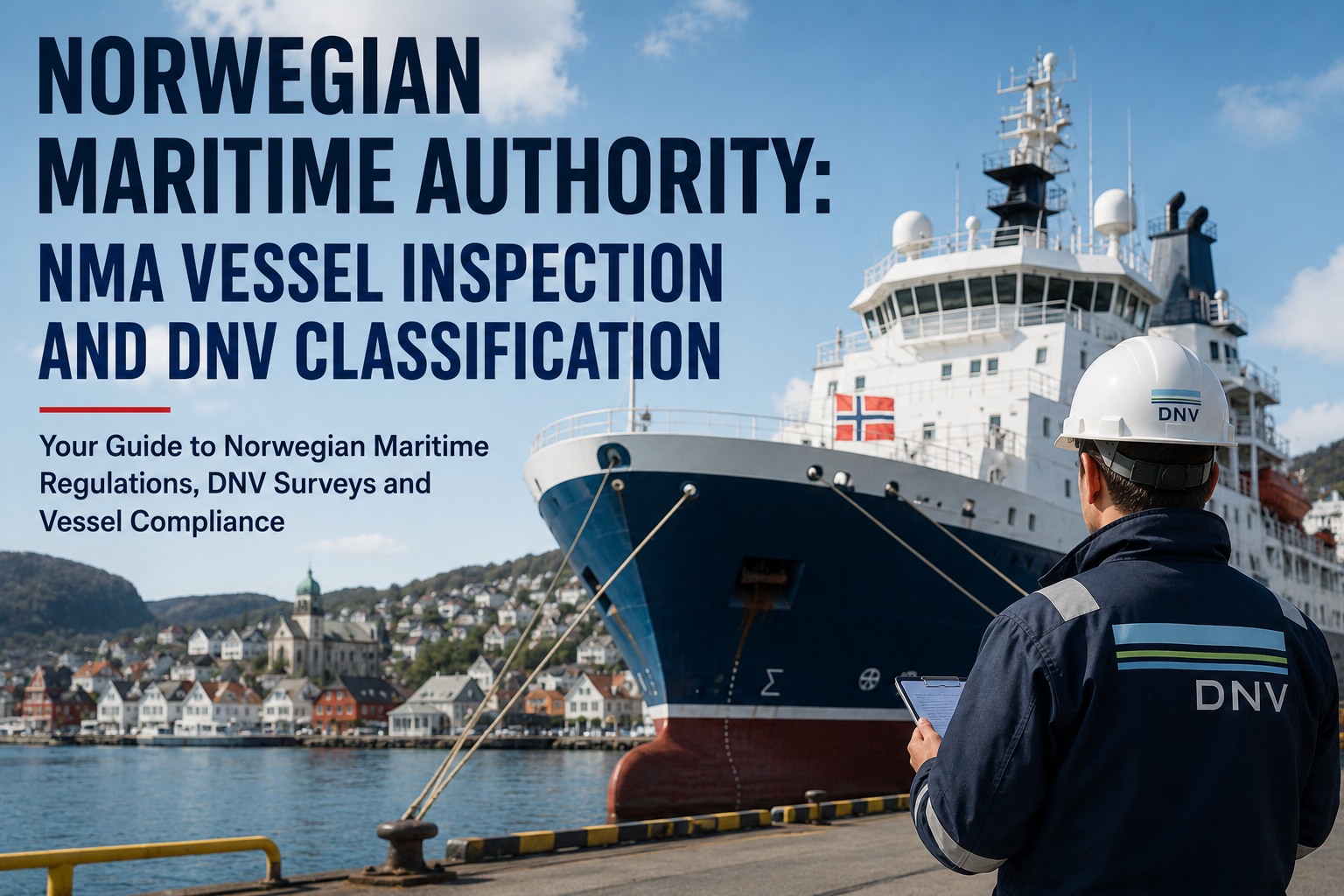
Norway runs two ship registers, and the choice between them shapes everything that follows. The Norwegian Ordinary Ship Register — NOR — is the domestic register. The Norwegian International Ship Register — NIS — was created as a competitive international register to keep Norwegian-owned ships under the Norwegian flag, improve their competitive position in foreign trade, and sustain employment for Norwegian seafarers, while permitting foreign crew on their home countries' pay conditions. Both fly the same flag and sit under Norwegian jurisdiction, but they carry different trading scopes and different supervisory arrangements. Layered onto that is a distinctive delegation structure: all NIS ships of 500 gross tons and upwards have been delegated to recognised organisations under a formal Class Agreement, leaving the Norwegian Maritime Authority as direct supervisor for smaller and non-delegated tonnage. And in the background sits DNV — headquartered in Norway, one of the leading IACS societies, publishing rule editions on a fixed annual cycle that Norwegian operators plan around. This guide covers the two registers and what distinguishes them, the NMA's role and the Class Agreement delegation, DNV's rule cycle, the registration process including bareboat entry, and the Norwegian-specific regulatory obligations that arrive through the EEA. Start free trial or book a demo to keep certificates, survey dates, and inspection records current across a Norwegian-flagged fleet.
REGIONAL COMPLIANCE · NORWAY
NOR or NIS? The Register You Choose Sets Your Supervisor
Two Norwegian registers, one flag — but different trading scope and, crucially, different supervision. Every NIS ship of 500 GT and up is delegated to a recognised organisation. Below that, the NMA supervises you directly.
In this guide
The two registers
NMA and the Class Agreement
DNV's rule cycle
Registration and bareboat entry
EEA obligations
The Two Registers
Norwegian vessels of 15 metres or more must be registered in NOR or NIS unless registered in a foreign register. A third register, BYGG — the shipbuilding register — is optional and available for vessels of 10 metres overall and upwards.
NOR
Norwegian Ordinary Ship Register
The domestic register, managed by the NMA and physically located in Bergen, holding roughly 12,000 commercial and non-commercial vessels. Ships exceeding 15 metres and mobile offshore installations must be registered; smaller vessels may register voluntarily. Ship registration in Norway was codified back in 1902.
NIS
Norwegian International Ship Register
An international, competitive register for self-propelled passenger and cargo ships, hovercraft, drilling platforms and other mobile installations. Established to keep Norwegian-owned ships under the Norwegian flag, improve competitiveness in foreign trade, and maintain Norwegian seafarer employment — while opening employment to foreign crew on their homeland's pay conditions.
i
Both registers deliver the same legal foundation. Ships registered in NIS fly the Norwegian flag and are subject to Norwegian jurisdiction, with Norway's ordinary shipping legislation applying subject to some exceptions and NIS-specific rules. Registration ensures legal protection of registered rights and forms part of public control over ships and their owners, while securing protection for shipowners and mortgagees. Norway's comprehensive code of maritime law is recognised in the field as sophisticated and predictable, which gives creditors assurance that the flag represents a secure and professional alternative — a point that matters directly to ship finance.
The NMA and the Class Agreement
The Norwegian Maritime Authority — Sjøfartsdirektoratet — was established in 1962 in Oslo and relocated to Haugesund in 2006 under a government decentralisation programme, while the ship registers remain headquartered in Bergen. Its supervisory reach is defined by a delegation structure that operators must understand.
A
NIS ships of 500 GT and upwards
All have been delegated to recognised organisations pursuant to the Class Agreement. For these vessels the RO carries the statutory workload, and the operator's day-to-day relationship is with class rather than the authority.
B
Where the NMA supervises directly
The NMA is the supervisory authority for NIS ships below 500 gross tons, and for NIS ships of 500 GT and upwards that are not delegated. It supervises, inspects, and issues trading certificates itself.
C
Optional delegation for cargo ships
The issuing of international trading certificates for cargo ships of 500 gross tons and upwards may be delegated to class on the owner's request, under Annex III of the Class Agreement — a choice the owner makes rather than a default.
D
Mobile offshore units are different
Delegation for mobile offshore units is mainly limited to hull and machinery, ISPS, ISPP, EIAPP and IAPP, under Annexes I and VI of the Class Agreement — so the NMA retains a broader direct role for offshore tonnage than for cargo ships.
The NMA's mandate extends beyond commercial shipping. It manages NIS, NOR and the shipbuilding register; it sorts under the Ministry of Environment for matters concerning environmental issues connected to a specific ship and protection of the marine environment; it assists the offshore safety regulator in implementing petroleum legislation on the Norwegian shelf; and it is responsible for supervision of pleasure vessels. The directorate is headed by the Director General of Shipping and Navigation.
Delegated or not, the evidence is yours
Class Holds the Certificate. You Hold the Condition.
Whether your statutory work sits with an RO under the Class Agreement or with the NMA directly, the vessel's actual condition, survey status and defect history remain the operator's responsibility — and the thing every surveyor reads. Marine Inspection tracks certificate validity and survey due dates per vessel with expiry alerts, runs structured inspections, and follows defects to verified closure.
DNV and the Rule Cycle
DNV is headquartered in Norway and is a leading IACS recognised organisation, providing classification, statutory certification and verification services to the Norwegian fleet and far beyond. Its rule-publication rhythm is predictable, which makes it plannable.
Annual editions
DNV publishes rule editions on a fixed cycle — the July 2025 edition of its rules and standards for classification of ships and offshore units entered into force on 1 January 2026, following a hearing process, with 119 documents published in that edition alone.
Who needs to track them
DNV identifies the audience explicitly: design offices, shipyards, suppliers, owners and managers, and flag States. A rule edition is not solely a shipyard concern — it reaches operators through survey scope and requirements applied in service.
Contracted-before flexibility
The rules may be applied to projects contracted before the entry-into-force date provided all parties agree — useful where a newbuilding straddles editions and the parties prefer the newer text.
Norwegian shelf notation
The edition revised requirements for the (N) notation for the Norwegian continental shelf, aligning with the updated acknowledgement of compliance handbook and reflecting the regulator's change of name from the Petroleum Safety Authority to Havtil.
Registration and Bareboat Entry
Registration into the Norwegian registers follows a defined document path, and bareboat registration into NOR is a good illustration of the sequence and its requirements.
1
Name approval and call sign
Names of vessels of 15 metres and more must be approved before registration. A Norwegian call sign is assigned on receipt of the Application for Certificate of Name if one has not been assigned previously.
2
Home port and notification
The desired home port is selected from the approved list for NOR and NIS, and the notification of bareboat registration must be signed with binding signature by the owner or the appointed Norwegian process agent or representative.
3
Tonnage certificate
A tonnage certificate must be issued or approved by the NMA's section for cargo vessels prior to registration. Certificates approved or issued by a recognised organisation may be accepted for cargo vessels of 500 gross tons and above in international trade.
4
Class delegation agreement
The shipowner must have a written agreement with the classification society for delegation according to Annex III of the Class Agreement — the formal instrument behind the delegation structure described above.
5
Trading or safety certificates before sailing
A valid trading certificate or safety certificates must be on board before the vessel may sail, issued after document control and a survey of the vessel. Where voluntary delegation to an RO has been chosen, the RO instead sends a Declaration of Safety to the NMA prior to registration.
6
Primary register consent
For bareboat registration, the primary register must give its consent to the ship's bareboat registration — the underlying register's agreement is a precondition, not a formality to be assumed.
EEA Obligations and Environmental Rules
Norway's position outside the EU but inside the EEA produces a compliance picture that catches operators out, because EU instruments reach Norwegian-flagged ships through the EEA Agreement.
Norwegian-flagged ships face both the Hong Kong Convention and the EU Ship Recycling Regulation. Norway is a Hong Kong Convention party, with the international certificate on inventory of hazardous materials required from 26 June 2025. And although Norway is not an EU Member State, it is bound by the EU Ship Recycling Regulation through the EEA Agreement — which means Norwegian-flagged ships must use the EU substance list and recycle at facilities on the European List of Ship Recycling Facilities. Applying both regimes simultaneously is stricter than applying either alone, and NMA circulars cover IHM, HKC and ship recycling accordingly.
The same dual-track logic shows up elsewhere. Norwegian-flagged vessels face PFAS restrictions from two directions — the SOLAS Chapter II-2 ban on PFOS-containing firefighting foam taking effect 1 January 2026, and the EU regulation phasing out PFAS firefighting foam. An operator planning foam replacement against only one of those instruments risks a compliant-under-one, non-compliant-under-the-other outcome. The practical rule for Norwegian flag is to check whether an EU maritime instrument reaches Norway through the EEA before assuming non-EU status exempts the fleet.
What This Means in Practice
For a Norwegian fleet operator, the structure resolves into a handful of disciplines that determine how smoothly the regulatory relationship runs.
Know who supervises each vessel
Delegated NIS tonnage above 500 GT deals primarily with the RO; smaller and non-delegated NIS ships deal with the NMA directly. The correspondence route, survey booking and certificate issuance all follow from that.
Treat the Class Agreement as a live document
Annex III governs delegation of international trading certificates for cargo ships on request; Annexes I and VI limit the scope for mobile offshore units. The annex determines what class can and cannot issue for your vessel.
Plan around DNV rule editions
Editions enter force on a fixed date and reach owners and managers, not only yards. Check whether a newbuilding, conversion or notation change straddles an edition boundary before the specification is frozen.
Check EEA reach on every EU instrument
Non-EU status does not mean exemption. Ship recycling and PFAS restrictions both reach Norwegian tonnage, and applying both the international and EU regimes together is the safe default.
Keep survey and certificate status current
A valid trading or safety certificate must be aboard before sailing, issued only after document control and survey. Certificate and survey tracking is therefore a sailing precondition, not administration.
Maintain the evidence base
Whoever holds the delegation, the operator holds the condition. Inspection findings, defect close-outs and maintenance history are what support the certificates a surveyor is asked to renew.
The through-line is that Norway's system is unusually well documented and unusually layered — two registers, a formal delegation agreement with defined annexes, a class society with a fixed rule cadence, and an EEA channel that imports EU maritime law. Every one of those layers reads the same underlying evidence: valid certificates, current surveys, closed deficiencies, and a maintenance record that supports them. Operators who keep that base continuously current satisfy the NMA, the RO, and any port state with the same material. Those who assemble it per event carry avoidable risk into a system that documents everything. Book a demo to see certificates, survey dates, and inspection history as one current record.
Frequently Asked Questions
What is the difference between NOR and NIS?
NOR is the Norwegian Ordinary Ship Register, the domestic register managed by the NMA and located in Bergen, holding around 12,000 commercial and non-commercial vessels. NIS is the Norwegian International Ship Register, a competitive international register for self-propelled passenger and cargo ships, hovercraft, drilling platforms and other mobile installations, created to keep Norwegian-owned ships under the Norwegian flag and permitting foreign crew on their homeland's pay conditions. Both fly the Norwegian flag and are subject to Norwegian jurisdiction.
Book a demo.
Which vessels must be registered in Norway?
Norwegian vessels of 15 metres or more must be registered in NOR or NIS unless registered in a foreign register, and mobile offshore installations must also be registered. Smaller vessels may register voluntarily. The BYGG shipbuilding register is optional and available for vessels of 10 metres in overall length and upwards.
Book a demo.
Who supervises Norwegian-flagged ships?
It depends on size and delegation. All NIS ships of 500 gross tons and upwards have been delegated to recognised organisations under the Class Agreement. The Norwegian Maritime Authority is the supervisory authority for NIS ships below 500 gross tons and for NIS ships of 500 GT and upwards that are not delegated — supervising, inspecting and issuing trading certificates itself.
Book a demo.
Can class issue trading certificates for Norwegian ships?
Yes, on request. Issuing international trading certificates for cargo ships of 500 gross tons and upwards may be delegated to the classification society at the owner's request under Annex III of the Class Agreement. For mobile offshore units, delegation is mainly limited to hull and machinery, ISPS, ISPP, EIAPP and IAPP under Annexes I and VI.
Book a demo.
What does a bareboat registration into NOR require?
Name approval for vessels of 15 metres and above and assignment of a Norwegian call sign; selection of an approved home port; a notification signed with binding signature by the owner or appointed Norwegian process agent; a tonnage certificate issued or approved by the NMA (or by a recognised organisation for cargo vessels of 500 GT and above in international trade); a written class delegation agreement under Annex III; valid trading or safety certificates aboard before sailing, issued after document control and survey; and consent from the primary register.
Book a demo.
When does the current DNV rule edition apply?
DNV publishes on a fixed annual cycle — the July 2025 edition of its rules and standards for the classification of ships and offshore units entered into force on 1 January 2026, comprising 119 published documents. The rules may be applied to projects contracted before the entry-into-force date provided all parties agree. The edition is relevant to design offices, shipyards, suppliers, owners and managers, and flag States.
Book a demo.
Do EU maritime rules apply to Norwegian-flagged ships?
Often, yes, through the EEA Agreement. Although Norway is not an EU Member State, it is bound by the EU Ship Recycling Regulation via the EEA — so Norwegian-flagged ships must use the EU substance list and recycle at facilities on the European List of Ship Recycling Facilities. Norway is also a Hong Kong Convention party, with the international IHM certificate required from 26 June 2025, meaning both regimes apply together.
Book a demo.
What are the PFAS firefighting foam restrictions for Norwegian ships?
Two instruments apply. The SOLAS Chapter II-2 ban on firefighting foam containing PFOS takes effect on 1 January 2026, and an EU regulation phases out PFAS firefighting foam, reaching Norwegian tonnage through the EEA. Planning foam replacement against only one of the two risks a result that satisfies one regime while breaching the other.
Book a demo.
Two Registers, One Standard of Evidence.
Whether the NMA supervises directly or a recognised organisation holds the delegation, what gets examined is the same: valid certificates, current survey status, closed deficiencies, and maintenance history that supports them. Marine Inspection tracks certificate validity and survey due dates per vessel with expiry alerts, runs structured inspections, and follows defects through to verified closure — one record for every layer of the Norwegian system. This guide is an overview, not legal or class advice; refer to current NMA circulars and DNV rules for a specific vessel.