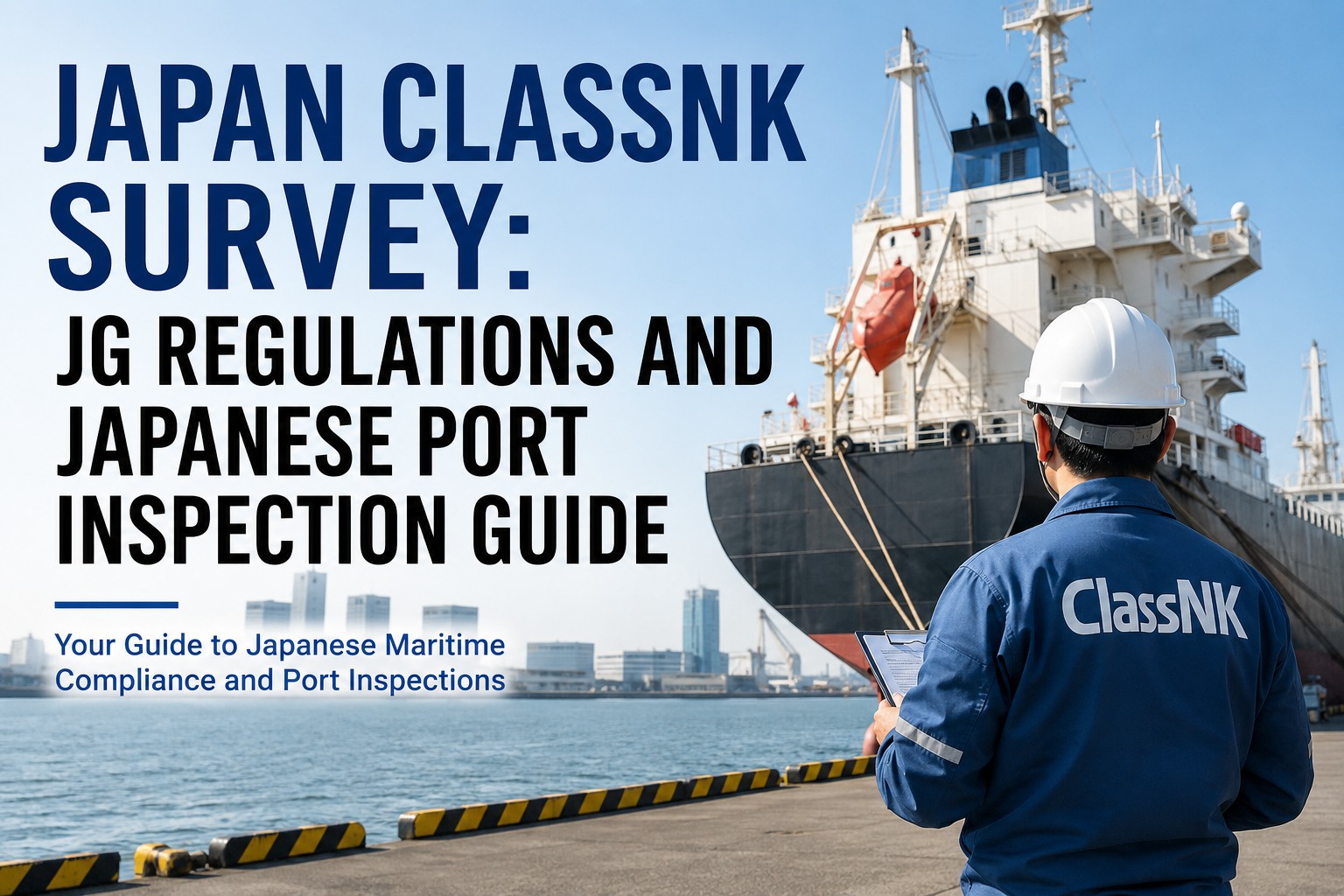
Japan's maritime regulatory system has a feature that surprises operators arriving from other jurisdictions: the government inspects things itself. In most flag States, statutory survey work is delegated almost entirely to recognised organisations, and the administration is a signature on a certificate. Japan retains a direct inspection role through what the industry shorthand calls JG — the Japanese Government marine administration — whose inspectors attend equipment testing personally, and whose District Transport Bureaus conduct ship inspections under the Ship Safety Law. Alongside JG sits ClassNK, the Nippon Kaiji Kyokai, founded in 1899 and now the world's largest classification society by number of ships, holding delegated authority from more than a hundred countries and territories. For an operator trading to Japan or building there, the practical question is which body's requirement applies to a given item, and what evidence each expects. Equipment fitted to a Japanese-flagged ship must meet technical standards in Japanese national law, and JG inspects it directly. A ship's structure and machinery are surveyed to ClassNK rules. And whatever flag she flies, a vessel calling at a Japanese port meets a founding Tokyo MOU member with a reputation for meticulous inspection. This guide separates those layers: ClassNK's role and survey regime, the JG equipment approval system and why it catches manufacturers out, the Ship Safety Law inspection cycle, and what operators trading to Japan should have in order. Start free trial or book a demo to keep class and statutory survey dates, certificates, and equipment records current.
REGIONAL COMPLIANCE · JAPAN
ClassNK and JG: Japan's Two-Layer Inspection System
Most flag States delegate statutory work and sign the certificate. Japan keeps inspectors in the room — JG attends equipment testing personally, while ClassNK surveys the ship. Knowing which layer applies is the whole game.
282m
GT on the ClassNK register
9,592
Vessels classed — largest by ship count
100+
Countries delegating authority to ClassNK
ClassNK: What It Is and What It Does
Nippon Kaiji Kyokai has been classifying ships since 1899 and became the first society in history to pass 200 million gross tons on its register. By late 2025 it held over 9,592 vessels totalling more than 282 million gross tons, making it the world's largest classification society by number of ships.
Classification against its own rules
ClassNK develops its own technical rules and surveys newbuildings and existing ships against them. The rules cover far more than hull structure — propulsion systems, electrical and electronic systems, safety equipment, and cargo handling gear all fall within scope.
Statutory work for flag States
It performs statutory surveys and certification on behalf of flag States under international conventions, codes and national statutes — holding delegated authority from more than 100 countries and territories, with new authorisations still being added.
A global surveyor network
Although headquartered in Japan, its surveyors work at shipbuilding and repair yards and in ports around the world, examining ships wherever they are needed — so ClassNK class does not tie a vessel to Japanese attendance.
Research and rule development
It conducts fundamental research on hull strength and risk analysis for tankers, bulk carriers and container ships, contributed to the IACS Common Structural Rules for bulk carriers, and has published guidelines for emerging technologies including wind-assisted propulsion systems with dedicated class notations.
The rule-making structure is committee-based: a technical committee develops and revises classification rules and survey guidelines against evolving standards, while a marine committee including shipowner representatives shapes rules for vessel management, operations and safety. Under its mid-term planning, ClassNK has prioritised decarbonisation work with industry partners, including research on alternative fuels such as ammonia, and has aligned environmental guidance with IMO instruments on matters like underwater radiated noise.
The Class Survey Cycle
ClassNK class is maintained through a structured survey schedule tied to the certification cycle — the same architecture used across IACS societies, and the first thing a technical manager taking on a vessel needs to map.
01
Plan approval and newbuilding survey
Plan approval is the foundational step in classification, followed by survey during construction. The choice of society is typically fixed at construction and recorded on the ship's certificates — ClassNK is the dominant society for Japanese-built tonnage.
02
Annual survey
Conducted every twelve months, verifying the vessel remains in compliance with class requirements in service. The lightest scope in the cycle, but the most frequent point of contact.
03
Intermediate survey
The mid-cycle examination with expanded scope over the annual, scaled to the vessel's age and type.
04
Special survey on the five-year cycle
The major renewal survey, generally aligned with certificate renewal and drydocking so major work concentrates into a single yard period. Continuous survey programmes offer a rolling alternative.
i
Coordinating class and statutory surveys is where the savings are. Classification societies run five-year cycles with intermediate, annual and continuous survey programmes, while SOLAS certificates carry their own intervals — Safety Equipment and Safety Radio certificates on annual survey, Safety Construction on five-yearly renewal with intermediates. Scheduling safety-equipment surveys during annual class surveys reduces surveyor mobilisation cost, combining intermediate class surveys with construction inspections reduces downtime, and aligning special surveys with five-year certificate renewals concentrates heavy work into one drydock. Operators who plan these as separate calendars pay for the same attendance twice.
JG: Where the Japanese Government Inspects Directly
This is the layer that distinguishes Japan, and the one that catches equipment manufacturers and newbuilding teams out. Marine equipment installed on Japanese-flagged ships must comply with technical standards set in Japanese national law — and JG officers inspect that equipment themselves.
1
Preliminary inspection
Applied for per item of equipment. Requires design inspection and a performance test for each individual unit. The application must be made at least two months before testing begins.
2
Type approval
On the premise of mass production. Requires documentary examination, performance testing and factory investigation for the prototype — a deeper process covering the manufacturing system, not just the sample.
Attendance by a JG inspector is mandatory at testing — for both preliminary inspection and type approval. In some special cases JG may nominate a recognised organisation surveyor to attend instead, but the default is the government's own inspector in the room. This differs materially from certification schemes where a notified body's involvement suffices, and it means test scheduling has to accommodate JG availability rather than the manufacturer's convenience. Equipment specified in SOLAS, MARPOL and COLREG is subject to this inspection regime.
When the Surveyor Steps Aboard, the Work Should Already Be Done
A professional operation keeps the vessel in a documented, maintained, survey-ready condition at all times — validity of certificates confirmed, class and statutory survey dates verified, shipboard records properly maintained. Marine Inspection tracks survey due dates with expiry alerts, holds equipment and certificate records per vessel, and follows defects to verified closure so nothing is discovered on the day.
Applying to JG: The Practical Route
For an overseas manufacturer, the procedural details matter more than the principles, because the application route is specific and the lead times are real.
Where to apply
Overseas manufacturers apply to the Kanto District Transport Bureau — JG's representative office in Yokohama — for both preliminary inspection and type approval, submitting the application with supporting documents. Preliminary inspection requires two sets of each item; type approval one set.
Fees and timing
The inspection fee is paid in advance at submission. For preliminary inspection, the application must be lodged at least two months before testing starts — a lead time that has to be built into newbuilding and refit programmes rather than discovered late.
Type approval consultation
For type approval, applicants consult the Inspection and Measurement Division of the Maritime Bureau at administration headquarters, in addition to the district bureau route.
Quality system evidence
Type approval requires quality control standards covering acceptance inspection of materials, intermediate inspection during the manufacturing process, acceptance inspection of subcontracted and purchased equipment, and in-house final inspection standards.
Marking requirements
Equipment marking must carry the name, model, dimensions, method of use, date of manufacture, serial number, manufacturer, and the type approval number — details that become a compliance issue if omitted at production.
Test reports from registered societies
Test reports where a surveyor of a registered classification society — ClassNK is registered — witnessed the approval test and signed the results form part of the evidence package.
Two specific traps are worth flagging. Manufacturers of lifeboats, liferafts and launching appliances are directed to consult JG in advance, because JG imposes its own requirements at periodical inspection for maintenance. And there are items required only for Japanese-flagged ships — dye markers being the standard example — which do not appear on an international equipment list and are easily missed when specifying for a Japan-flag newbuilding. For containers, the manufacturer's assurance under the CSC Convention is required, and where radio equipment is involved, a copy of the type examination certificate issued by the Minister of Internal Affairs and Communications.
The Ship Safety Law Inspection Cycle
Japanese domestic ship inspection runs under the Ship Safety Law, with a clear division of responsibility by vessel size and a defined inspection rhythm.
Who inspects what
District Transport Bureaus and Maritime Branch Offices, as the competent maritime authorities, inspect vessels above 20 gross tons. The Japan Craft Inspection Organization handles vessels below 20 gross tons, excluding certain specific vessel types.
Periodical inspection
An examination of an operational vessel taken for the first time, or on the expiry date of the ship inspection certificate — the renewal point of the domestic certification cycle.
Interim inspection
An examination taken between periodical inspections, on a three-year rhythm — the domestic analogue of an intermediate survey.
Streamlining exemptions
Items already cleared through preliminary inspection may be exempt from re-inspection when installed, and manufacturing-process inspection may be waived for construction and maintenance work carried out at certified manufacturing sites.
Those exemptions are the payoff for the front-loaded JG equipment regime: the effort invested in preliminary inspection and type approval, and in getting a manufacturing site certified, reduces inspection burden downstream. An operator or yard that engages with the approval system early converts a bureaucratic cost into an operational saving; one that treats it as an afterthought pays the inspection cost repeatedly.
Calling at Japanese Ports
For the foreign-flag operator, the relevant layer is port state control. Japan is a founding member of the Tokyo MOU, and its inspection culture is exacting.
ClassNK's own guidance on PSC states the principle plainly: a shipowner must always ensure the ship is properly maintained and operated so that she remains in conformance with applicable international standards. Careful maintenance and operation go a long way toward avoiding unnecessary problems during an inspection.
What a PSC inspection is
A check of the documents and certificates on board, combined with a condition survey of the vessel — covering safety of life and property, prevention of pollution, and living and working conditions.
Why PSC exists
To complement flag State supervision, which is often insufficient, and to eliminate substandard ships. It is a backstop, not a substitute for the owner's own responsibility.
Preventing deficiencies
Most lapses can be prevented by regular operational checks, maintenance and repair of machinery and equipment — the ordinary work of a well-run ship, done consistently.
The documentary side
Maintaining shipboard records properly, confirming the validity of all certificates and documents, and verifying the survey dates of all relevant class and statutory surveys — the checks that turn a good ship into a good inspection.
That last point is the connective tissue across every layer of the Japanese system. ClassNK surveys establish the technical position; JG's direct inspection regime governs the equipment fitted; the Ship Safety Law sets the domestic inspection rhythm; and PSC tests the whole picture on arrival. All four read the same underlying evidence — whether certificates are valid, whether survey dates have been verified, whether equipment carries the approvals it should, and whether shipboard records support the claim. Operators who keep that record continuously current meet each layer with the same material. Those who assemble it before each event carry the risk of the one certificate nobody checked. Book a demo to see class dates, certificates, and equipment records as one current system.
Frequently Asked Questions
What is ClassNK?
Nippon Kaiji Kyokai, founded in 1899, is a Japanese ship classification society and one of the world's largest — holding over 9,592 vessels totalling more than 282 million gross tons as of late 2025, making it the largest by number of ships. It surveys and classifies ships against its own technical rules, performs statutory surveys and certification on behalf of flag States, and holds delegated authority from more than 100 countries and territories.
Book a demo.
What does JG mean in Japanese maritime regulation?
JG refers to the Japanese Government marine administration. Unlike systems where statutory work is fully delegated, JG inspects statutory marine equipment directly — equipment installed on Japanese-flagged ships must comply with technical standards in Japanese national law, and JG officers inspect it themselves. Equipment specified in SOLAS, MARPOL and COLREG falls within the regime.
Book a demo.
What is the difference between preliminary inspection and type approval?
Preliminary inspection is applied for per item of equipment and requires design inspection and a performance test for each unit. Type approval is for mass production and requires documentary examination, performance testing and factory investigation of the prototype, including quality control standards covering material acceptance, in-process inspection, subcontracted equipment and final in-house checks. Attendance by a JG inspector is mandatory at testing for both.
Book a demo.
Where do overseas manufacturers apply for JG approval?
To the Kanto District Transport Bureau, JG's representative office in Yokohama, for both preliminary inspection and type approval, submitting the application with supporting documents and paying the inspection fee in advance. Preliminary inspection applications must be lodged at least two months before testing starts. For type approval, applicants also consult the Inspection and Measurement Division of the Maritime Bureau at headquarters.
Book a demo.
Are there equipment requirements unique to Japanese-flagged ships?
Yes. Some equipment requirements apply only to Japanese-flagged ships — dye markers are the commonly cited example — and these do not appear on standard international equipment lists, so they are easily missed when specifying a Japan-flag newbuilding. Separately, manufacturers of lifeboats, liferafts and launching appliances are directed to consult JG in advance because of JG's own requirements at periodical inspection for maintenance.
Book a demo.
What inspections does the Ship Safety Law require?
Periodical inspection is taken when a vessel first enters service and on the expiry of the ship inspection certificate; interim inspection is taken between periodical inspections, on a three-year rhythm. District Transport Bureaus and Maritime Branch Offices inspect vessels above 20 gross tons, while the Japan Craft Inspection Organization handles those below 20 gross tons, excluding certain vessel types.
Book a demo.
How should class and statutory surveys be coordinated?
By planning them as one calendar rather than several. Class runs five-year cycles with intermediate, annual and continuous survey options, while SOLAS certificates carry their own intervals. Scheduling safety-equipment surveys during annual class surveys reduces mobilisation cost, combining intermediate class surveys with construction inspections reduces downtime, and aligning special surveys with five-year certificate renewals concentrates major work into one drydock period.
Book a demo.
How should a vessel prepare for PSC in Japan?
By being genuinely maintained rather than prepared. A PSC inspection combines a check of documents and certificates with a condition survey. Most deficiencies can be prevented through regular operational checks, maintenance and repair — supported by properly maintained shipboard records, confirmed validity of all certificates and documents, and verified survey dates for every relevant class and statutory survey.
Book a demo.
One Record. Every Layer of the Japanese System.
ClassNK surveys, JG equipment approvals, Ship Safety Law inspections and port state control all read the same evidence: valid certificates, verified survey dates, approved equipment, and shipboard records that support the claim. Marine Inspection keeps survey due dates and certificate validity per vessel with expiry alerts, holds equipment and inspection records, and tracks defects to verified closure — retrievable whichever inspector is standing in front of you.
Overview only · Not legal or class advice · Refer to current ClassNK rules and JG requirements