Fatigue is the quietest hazard on any ship. It leaves no scorch marks and trips no alarms, yet it sits behind an outsized share of maritime casualties — studies attribute more than 80% of accidents to human error, and fatigue is repeatedly named among its leading contributors. One survey found that one in four seafarers had fallen asleep while on watch. The regulatory response is the hours of rest regime: a set of hard numerical limits under the Maritime Labour Convention 2006 and the STCW Convention that cap how long a seafarer may work and mandate how much rest they must receive. For a master or crew manager, these rules are deceptively simple to state and genuinely difficult to keep — because a ship is a 24-hour operation where drills, port calls, cargo work, and emergencies all press against the same finite hours. And the records that prove compliance are inspected: Port State Control reviews the previous thirty days of work and rest hours at random, and systemic breaches can escalate from a deficiency to a detention that holds the vessel in port until the company demonstrates corrective action. This guide sets out the exact limits, the critical difference between the MLC and STCW ceilings, what counts as rest and what does not, the permitted exceptions, the science of fatigue behind the numbers, and how Port State Control actually enforces them. Rest-hour compliance is fundamentally a recording and scheduling problem — one that a purpose-built system solves. To see automated rest-hour tracking with violation alerts before they happen, book a Marine Inspection demo.
Crew & training · hours of rest
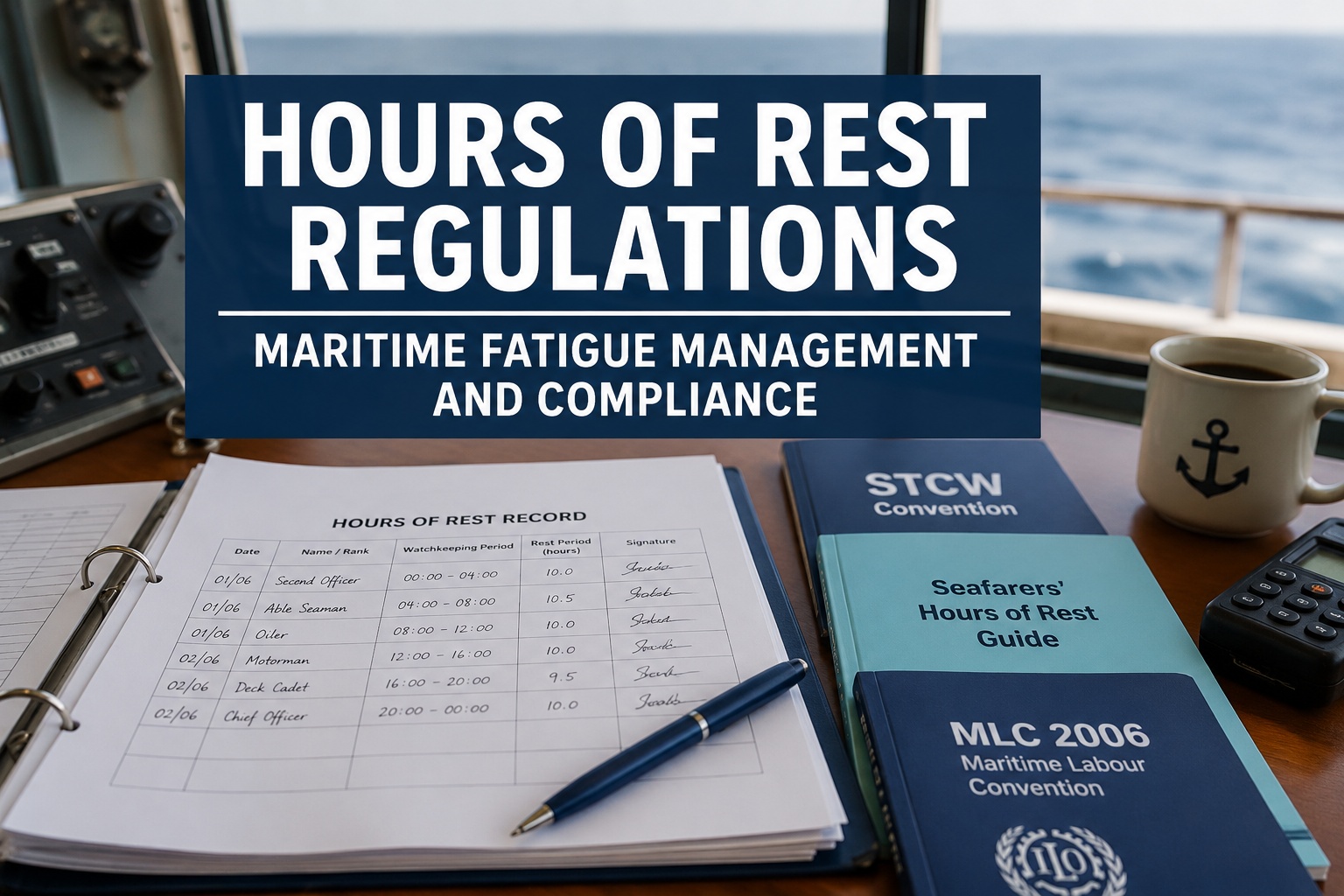
Hours of Rest Regulations: Maritime Fatigue Management & Compliance
A guide for masters and crew managers — the exact MLC and STCW limits, what counts as rest, permitted exceptions and compensatory rest, the science of fatigue, and how Port State Control enforces the rules.
10 hrs
Minimum rest in any 24-hour period
77 hrs
Minimum rest in any 7-day period
6 hrs
One rest period must be at least this long
30 days
Records PSC reviews at inspection
The Rules, Exactly
The regime rests on a small set of numbers that every master and crew manager must know without looking them up. They come from MLC Regulation 2.3 and STCW Chapter VIII, and a compliant schedule satisfies all of them at once. Scroll the table on mobile.
Minimum Hours of Rest — the Core Limits
Flag states may implement the regime as either a minimum-rest standard or a maximum-work standard, but the practical target most operators track is the minimum-rest formulation above, because it maps directly onto the daily record. Records must be maintained for each seafarer and signed by both the seafarer and the master or an authorised officer: the seafarer is responsible for reporting hours accurately, and the master for reviewing, approving, and acting on them.
The Difference That Catches Vessels Out: MLC vs STCW
Here is the subtlety that produces unexpected deficiencies. The rest limits are largely identical between the two conventions — but the work ceilings are not, and a vessel must satisfy both simultaneously. See dual-standard tracking in a demo.
MLC 2006 — Regulation 2.3
Minimum 10 hours rest per 24 hours
Minimum 77 hours rest per 7 days
Maximum 14 hours work per 24 hours
Maximum 72 hours work per 7 days
The stricter weekly work cap
STCW — Chapter VIII
Minimum 10 hours rest per 24 hours
Minimum 77 hours rest per 7 days
Same daily rest structure applies
Implies up to 91 hours work per 7 days
168 hours minus 77 rest hours
The trap is the weekly work cap. STCW's rest minimum of 77 hours leaves a theoretical 91 working hours in a week, but the MLC independently caps work at 72 hours in any seven-day period. A schedule that satisfies STCW's rest rule can still breach the MLC's tighter work ceiling — so the binding limit is always the stricter of the two. A vessel must comply with both at once, and the only safe practice is to track against the most restrictive figure at every point. This is precisely the kind of dual-constraint arithmetic that manual spreadsheets get wrong.
What Counts as Rest — and What Does Not
Compliance often fails not on the numbers but on the definition. Rest means a period during which the seafarer is completely free from all duties and responsibilities and may use the time at their own discretion. Several things that feel like rest do not qualify.
Counts as rest
Time genuinely free of all duty; sleep; a meal break only if the seafarer is truly off duty and free to use the time as they wish; off-watch time with no callout obligation.
Does not count as rest
Being on call or on standby; drills, musters, and firefighting or lifeboat exercises; any callout to duty; work performed during a nominal rest period, however brief; time spent on required administrative tasks.
Drills deserve particular attention. Musters, firefighting, and lifeboat drills must be conducted in a way that minimises the disturbance of rest periods and does not induce fatigue — a drill scheduled into a rest period does not merely fail to count as rest, it interrupts a protected recovery block and can break the two-period rule. Short interruptions are the silent killer of compliance: a fifteen-minute callout can split a rest period into a third fragment, converting a compliant day into a breach that a paper log filled in from memory the next morning will never reveal.
Catch the breach before it happens
Rest-Hour Tracking That Alerts Before the Limit, Not After
A spreadsheet tells you a rule was broken yesterday. A purpose-built system warns you before it breaks — flagging when a planned drill will split a rest period, when a callout has pushed a seafarer toward the 14-hour interval, or when the weekly total is approaching the MLC cap. Marine Inspection tracks work and rest against both the MLC and STCW limits, records signatures, retains the audit trail, and produces the 30-day view Port State Control asks for. See it on your fleet — book a 30-minute demo.
Exceptions and Compensatory Rest
The rules are not absolute. The conventions recognise that a ship must sometimes work its crew beyond the limits, but they fence the exception tightly and attach an obligation. See exception logging in a demo.
When exceptions apply
Overriding operational reasons and situations concerning the immediate safety of the ship, persons on board, or cargo, and to give assistance to other ships or persons in distress at sea. Emergencies such as fire, collision, or grounding qualify.
The master's authority
The master may require a seafarer to work the hours necessary for the immediate safety of the ship, and may suspend the rest schedule until the situation is normalised. This authority is genuine but narrow.
Compensatory rest
Once the exceptional situation ends, the seafarer must be given adequate compensatory rest. The exception defers rest; it does not cancel it. Compensatory rest must be provided as soon as practicable.
Document honestly
Any deviation must be recorded with the reason. The single most damaging habit at inspection is back-filling logs to hide breaches; a documented, justified exception is defensible, a falsified clean record is not.
There is also a route for planned, regular exceptions: flag states may permit them through collective bargaining agreements, but any such CBA must meet or exceed the underlying MLC and STCW protections. The exception mechanism exists for the genuine unpredictability of the sea — not as a management tool for chronic under-manning, which is what inspectors are trained to detect.
The Science Behind the Numbers
The limits are not arbitrary. They are grounded in the physiology of sleep and the body clock, set out in the IMO's Guidelines on Fatigue, MSC.1/Circ.1598, approved in 2019 as six modules covering the company, the seafarer, awareness and training, ship design, the administration, and port authorities.
The window of circadian low
Independent of prior sleep, fatigue is most severe in the early morning, between roughly 3 and 5 a.m. — the window of circadian low. Investigations find fatigue-related incidents cluster between midnight and 6 a.m.
Sleep debt accumulates
Rest lost is not simply recovered by one long sleep. Debt builds across days, which is why the weekly 77-hour floor matters as much as the daily 10-hour one.
Rest quality, not just quantity
Circadian rhythm means night rest is more restorative than day rest. Managers applying the hours must recognise that fragmented or daytime rest is lower quality even when it satisfies the numbers.
The post-lunch dip
A second alertness trough occurs between about 3 and 5 p.m. Watch systems and demanding tasks scheduled across these dips carry elevated risk.
Watch-system effects
The choice between six-on-six-off and four-on-eight-off patterns materially affects sleepiness among watchkeepers. Watch design is a fatigue decision, not just a rostering one.
Fatigue is a hazard, not a trait
The guidelines are explicit that fatigue is not a sign of weakness and does not simply come with the job. It is a hazard to be managed through design, manning, and operational policy.
Fatigue Risk Management Beyond the Minimums
Meeting the numerical limits is the floor, not the ceiling. The IMO encourages integrating a fatigue risk management approach into the ship's Safety Management System under the ISM Code, moving from bare compliance to actual fatigue control.
1
Analyse voyage schedules. Identify port-intensive periods where arrivals, departures, and cargo work compress rest, and plan manning and watch systems around the peaks rather than the average.
2
Review manning levels. Chronic breaches are usually a manning problem wearing a scheduling disguise. Minimum safe manning must meet peak workload and emergency conditions, not just steaming.
3
Design watch systems deliberately. Choose watch patterns with the window of circadian low in mind, and adjust for port-intensive operations rather than defaulting to one pattern for all conditions.
4
Train for fatigue awareness. Seafarers should understand circadian rhythm, sleep debt, the window of circadian low, and practical countermeasures — taught so they can relate it to themselves personally.
5
Encourage honest reporting. A culture where seafarers report cumulative fatigue without fear is worth more than a perfect-looking log. Real records enable real intervention.
6
Monitor and cross-check daily. Department heads reviewing records daily catch drift before it becomes a systemic breach, and automated alerts prevent violations before they occur rather than documenting them after.
The distinction between a fatigue risk management system and mere hours-of-rest compliance is the distinction between managing the hazard and merely recording it. The regulations set a floor that a well-run vessel treats as the beginning of the conversation.
How Port State Control Enforces It
None of this is theoretical, because the records are inspected and the consequences are real. Work and rest hour compliance is a major focus of Port State Control inspections worldwide, and a master should understand exactly how an inspection unfolds. See the inspection-ready record in a demo.
The 30-day review
Inspectors review work and rest hour records for the previous 30 days, checking them against the limits and cross-referencing them with other ship records for consistency.
What triggers a deficiency
Records that are incomplete, inconsistent, unsigned, or show clear violations; logs that contradict cargo, bridge, or engine records; and a general lack of awareness of the regulatory limits among crew.
From deficiency to detention
Isolated errors usually draw a deficiency and a requirement to correct. Systemic violations — multiple crew, multiple days, no corrective action — can become a detainable deficiency under the MLC, holding the vessel until corrective measures are demonstrated, which can take days.
The wider exposure
Beyond detention, consequences can include financial penalties, withdrawal of the Declaration of Maritime Labour Compliance, and in fatigue-related incidents, liability, crew claims, and jeopardised P&I cover.
The consistency test
The fastest way to fail is a record that disagrees with reality. Rest logs that do not match port timings, drill records, or cargo operations signal falsification, and inspectors are trained to find the discrepancy.
The uncomfortable truth is that most rest-hour deficiencies are not caused by genuinely overworked crews so much as by poor recording of reasonable schedules — logs kept from memory, signatures collected late, exceptions undocumented, and breaches invisible until an inspector spots them. The compliance problem and the recording problem are, in practice, the same problem.
Turning Compliance Into a System
Pulling it together, hours-of-rest compliance is a continuous data discipline, and the vessels that struggle are almost always the ones relying on paper filled in after the fact.
Record in real time
Capture work and rest as it happens, not reconstructed from memory the next day. Real-time capture is the only kind that survives cross-checking against other records.
Track against both conventions
Check every schedule against the stricter of the MLC and STCW limits automatically, so the 72-hour weekly work cap is never breached while chasing the 77-hour rest rule.
Alert before the breach
Staged warnings as a seafarer approaches a limit let the master re-plan a drill or a watch before a violation occurs, rather than documenting it afterward.
Capture signatures and exceptions
Seafarer and master approval on every record, with any exception logged and justified at the time — the defensible position at inspection.
Retain the audit trail
Three years of signed records held and instantly retrievable, producing the 30-day PSC view on demand rather than assembling it under inspection pressure.
Connect to manning decisions
Patterns of near-breaches are evidence for a manning review. The record becomes a management tool, not just a compliance artefact.
Rest-hour regulation exists because fatigue is a genuine and deadly hazard, and the numbers — 10 hours in 24, 77 in 7, one block of at least 6, no more than 14 between — are the floor beneath which safety erodes. But the gap between a compliant ship and a detained one is rarely the schedule. It is the record: whether it was kept honestly and in real time, whether it tracks both conventions, and whether it can be produced the moment an inspector asks. That is a solvable problem, and solving it protects the crew and the vessel at the same time. Book a demo to see rest-hour compliance made automatic.
Frequently Asked Questions
What are the minimum hours of rest for seafarers?
Under both the MLC 2006 and STCW, a seafarer must receive a minimum of 10 hours of rest in any 24-hour period and 77 hours in any 7-day period. The rest may be divided into no more than two periods, one of which must be at least 6 hours long, and the interval between two consecutive rest periods must not exceed 14 hours.
What is the difference between the MLC and STCW rest rules?
The rest minimums are essentially identical, but the work ceilings differ. The MLC caps work at 14 hours per 24 and 72 hours per 7 days, while STCW's 77-hour rest minimum implies up to 91 work hours per week. Because a vessel must satisfy both conventions at once, the binding limit is always the stricter — the MLC's 72-hour weekly work cap.
Does time on call count as rest?
No. Rest means being completely free from all duties and able to use the time at one's own discretion. Being on call or standby does not count, nor do drills, musters, callouts, or work performed during a nominal rest period. A meal break counts only if the seafarer is genuinely off duty during it.
Can the rest hours ever be exceeded?
Yes, but narrowly. Exceptions apply for the immediate safety of the ship, persons, or cargo, for assisting others in distress, and for emergencies such as fire or collision. The master may suspend the schedule for immediate safety, but the seafarer must then be given adequate compensatory rest as soon as practicable, and the deviation must be recorded with its reason.
How long must rest hour records be kept?
Records must be maintained for each seafarer, signed by both the seafarer and the master or an authorised officer, and kept on board for at least three years. Port State Control reviews the previous 30 days at inspection, so the recent record must be complete, consistent, and signed at all times.
What happens if rest hours are breached?
Incomplete, inconsistent, or clearly non-compliant records draw a deficiency and a requirement to correct. Systemic violations across multiple crew and days with no corrective action can become a detainable deficiency under the MLC, holding the vessel in port. Further exposure includes fines, withdrawal of the Declaration of Maritime Labour Compliance, and liability or jeopardised P&I cover in fatigue-related incidents.
Why is fatigue such a serious issue at sea?
Studies attribute more than 80% of maritime accidents to human error, with fatigue among the leading contributors, and one survey found one in four seafarers had fallen asleep on watch. Fatigue is most severe during the window of circadian low between about 3 and 5 a.m., when many fatigue-related incidents occur. The IMO's Guidelines on Fatigue, MSC.1/Circ.1598, address managing it.
Compliance you can prove in seconds
Make Rest-Hour Compliance Automatic
Record work and rest in real time, track every schedule against both the MLC and STCW limits, get staged alerts before a limit is breached, log exceptions and signatures as they happen, retain three years of audit-ready records, and produce the 30-day Port State Control view on demand. Marine Inspection turns the hardest part of crew compliance into something the system handles for you. Book a tailored demo to see it on your fleet, or start a free trial today.