FuelEU Maritime: EU Shipping Emissions Guide 2026 Marine Inspection
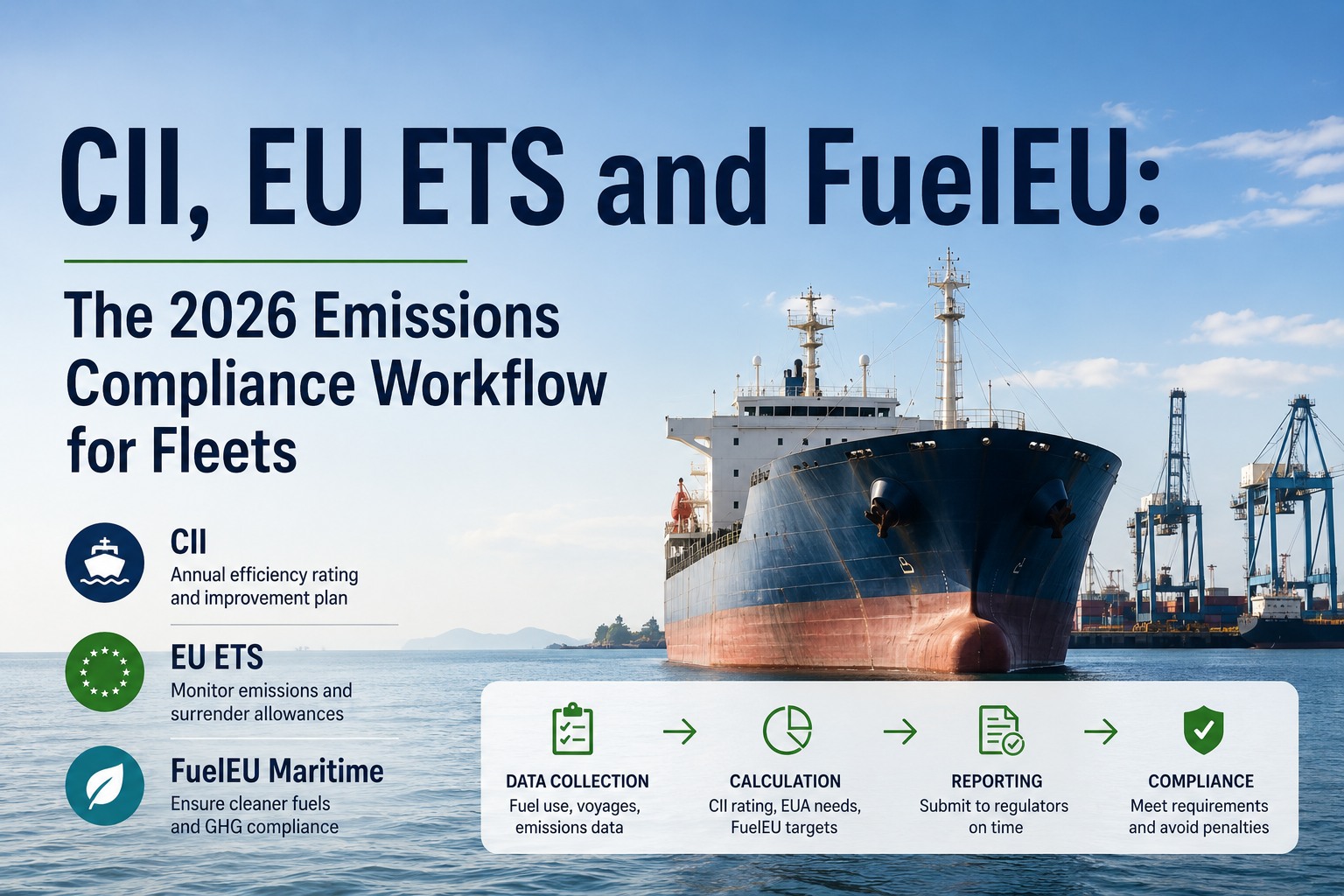
FuelEU Maritime is the regulation that changes the fundamental economics of maritime fuel — for the first time, it's not just what comes out of the smokestack that matters, but the full lifecycle emissions of every drop of fuel from extraction to combustion. Entered into force on January 1, 2025, this EU regulation requires all commercial ships above 5,000 GT calling at EU/EEA ports to progressively reduce the greenhouse gas intensity of their onboard energy, starting with a 2% reduction and reaching 80% by 2050. Measured on a well-to-wake basis in gCO2e/MJ, the regulation covers CO2, methane, and nitrous oxide across the entire fuel supply chain. The ISM company (typically the ship's technical manager) bears compliance responsibility — and non-compliance triggers a fixed penalty of approximately EUR 2,400 per tonne of VLSFO-equivalent deficit. Combined with the EU ETS extension to maritime (which puts a carbon price on tank-to-wake emissions), FuelEU creates a two-layer cost structure that makes fuel strategy the central commercial decision for any fleet trading into Europe. This guide covers the GHG intensity limits, well-to-wake methodology, compliance flexibility mechanisms (banking, borrowing, pooling), penalty calculations, shore power requirements, and the 2026 reporting timeline. Start a free trial of Marine Inspection to track fuel consumption data, emissions reporting, and compliance documentation across your fleet.
FuelEU Maritime: Key Numbers
91.16
Baseline (gCO2e/MJ)
2020 fleet average — all reductions measured against this
2%
2025 Target
First reduction period: 2025-2029
80%
2050 Target
Maximum reduction — effectively mandating zero-carbon fuels
~EUR 2,400
Penalty / Tonne
Per tonne VLSFO-equivalent deficit — makes non-compliance expensive
GHG Intensity Reduction Trajectory
FuelEU sets progressively tighter limits on the average GHG intensity of energy used onboard. The trajectory starts modest but accelerates sharply from 2035, making fuel transition planning essential years before deadlines hit.
2025-2029
-2%
89.34 gCO2e/MJ
Achievable with operational efficiency + minor biofuel blending. Most conventional vessels comply with optimisation.
2030-2034
-6%
85.69 gCO2e/MJ
Requires measurable fuel switching — biofuel blends, LNG, or compliance pooling. Shore power mandatory for container/passenger ships at TEN-T ports.
2035-2039
-14.5%
77.94 gCO2e/MJ
Steep acceleration. Significant alternative fuel adoption needed. RFNBO sub-target may apply from 2034.
2040-2044
-31%
62.90 gCO2e/MJ
Conventional fossil fuels cannot meet this target. Fleet must be substantially transitioning to low/zero-carbon fuels.
2045-2049
-62%
34.64 gCO2e/MJ
Zero-carbon fuels dominant. Green hydrogen derivatives, e-fuels, advanced biofuels required at scale.
2050
-80%
18.23 gCO2e/MJ
Near-zero GHG intensity. Only renewable and zero-carbon fuels will comply.
Well-to-Wake: How GHG Intensity Is Measured
FuelEU is the first maritime regulation to account for the full lifecycle emissions of fuel — not just what's burned onboard. This "well-to-wake" approach means the origin and production method of your fuel matters as much as its consumption. Book a Marine Inspection demo to see how fuel documentation and emissions tracking works in practice.
Well-to-Tank (WtT)
Upstream Emissions
Extraction/acquisition of feedstock, processing/refining, transportation to conversion site, conversion to fuel product, transportation and bunkering. For biofuels: includes cultivation, land-use change, and processing. For RFNBOs: includes electricity source and synthesis.
Tank-to-Wake (TtW)
Onboard Emissions
Combustion emissions (CO2, CH4, N2O), fugitive methane emissions (methane slip from LNG engines), and any other GHG releases between fuel tanks and exhaust. Uses Global Warming Potential of 100 years: CH4 = 28x, N2O = 265x.
Geographic Scope of Energy Covered
100%
of energy used on voyages between two EU/EEA ports and energy used at berth in EU/EEA ports
50%
of energy used on voyages between an EU/EEA port and a non-EU port (in either direction)
FuelEU offers three flexibility mechanisms that let fleet managers optimise compliance across vessels and years — turning regulatory cost into a strategic advantage.
Banking
Compliance surplus from one year can be banked and used in future years. No expiry specified — build up credits when over-performing.
No limit on banked surplus. Incentivizes early action and over-compliance.
Borrowing
Borrow an advance compliance surplus from the next reporting period to cover a current deficit. 1.1x multiplier applied — you must repay 10% more than you borrow.
Cannot borrow for two consecutive periods. Creates future compliance pressure.
Pooling
Aggregate compliance balances across multiple vessels — surplus from one ship offsets deficit of another. Can pool within your fleet or with third-party vessels.
Pool total must be positive. Each ship can only be in one pool per year. Most strategic mechanism for mixed fleets.
Sustainable biofuels rated zero TtW emissions under RED II
Responsible entity
ISM company (ISM DOC holder)
Shipping company (as per EU MRV)
2025-2026 Compliance Timeline
The first compliance cycle is underway. Missing these deadlines means penalties, invalid documentation, and potential PSC issues. Sign up for Marine Inspection to automate compliance deadline tracking.
Table 2: FuelEU Maritime Compliance Timeline
Deadline
Action Required
Responsible
Status
31 Aug 2024
Submit FuelEU Monitoring Plan to accredited verifier
ISM company
Completed
1 Jan 2025
Start monitoring — record fuel type, consumption, emissions per voyage and port stay
ISM company / vessel
Completed
31 Jan 2026
Submit FuelEU report (2025 data) to accredited verifier
ISM company
Due Now
30 Apr 2026
Compliance balance approved in FuelEU database (THETIS-MRV)
Verifier + ISM company
Upcoming
30 Jun 2026
FuelEU Document of Compliance onboard. Penalty payment deadline (if deficit).
ISM company
Upcoming
1 Jan 2030
Container + passenger ships must connect to OPS at TEN-T ports (stays >2 hours)
Vessel + port
Future
1 Jan 2034
Possible RFNBO sub-target: 2% of onboard energy from RFNBOs (if <1% achieved by 2031)
ISM company
Future
1 Jan 2035
OPS mandatory at all EU ports with shore power infrastructure
FuelEU Monitoring Plan approved by accredited verifier and kept current
Fuel consumption recorded per voyage and port stay — type, quantity, supplier, BDN reference
Well-to-wake emission factors documented for each fuel bunkered — using default or certified values
Shore power usage recorded at EU/EEA ports (duration, energy consumed)
Reporting & Verification
FuelEU report submitted to verifier by 31 January of verification year
Compliance balance calculated — surplus or deficit determined per vessel
Pooling arrangements formalised if applicable — pool total balance must be positive
Compliance balance approved in FuelEU database by 30 April
Documentation & Certificates
FuelEU Document of Compliance obtained and kept onboard — valid 18 months or until next DoC
Penalty payment completed by 30 June if compliance deficit exists
Bunker Delivery Notes with supplier sustainability declarations for biofuels/RFNBOs
Chain of custody documentation for any certified sustainable or RFNBO fuels
Strategic Planning
Fleet-wide FuelEU cost model integrating fuel strategy, pooling, and EU ETS interaction
Pooling strategy assessed — identify surplus-generating vessels for internal/external pooling
Shore power readiness assessed for container/passenger ships ahead of 2030 OPS mandate
Alternative fuel adoption roadmap aligned with tightening GHG intensity targets through 2050
Frequently Asked Questions
What is FuelEU Maritime and when did it start?
FuelEU Maritime (Regulation EU 2023/1805) is an EU regulation requiring ships above 5,000 GT calling at EU/EEA ports to progressively reduce the GHG intensity of their onboard energy. Monitoring started January 1, 2025. The first reduction target is 2% below the 2020 baseline of 91.16 gCO2e/MJ, reaching 80% by 2050. It applies regardless of flag — any ship calling at an EU/EEA port is in scope.
What does "well-to-wake" mean?
Well-to-wake (WtW) measures the total lifecycle GHG emissions of fuel — from extraction/production (well-to-tank) through onboard combustion (tank-to-wake). This means the origin of your fuel matters: a biofuel produced sustainably has lower WtW emissions than the same chemical compound produced from fossil sources. FuelEU covers CO2, methane (CH4 at 28x GWP), and nitrous oxide (N2O at 265x GWP).
What is the FuelEU penalty for non-compliance?
Non-compliant vessels pay approximately EUR 2,400 per tonne of VLSFO-equivalent deficit. After payment, the administering authority issues a FuelEU Document of Compliance valid for 18 months. The penalty is designed to be high enough that fuel switching or pooling is financially preferable to paying penalties — making non-compliance an expensive last resort.
How does FuelEU pooling work?
Pooling allows multiple vessels to aggregate their compliance balances — a ship with surplus (using cleaner fuel) can offset a ship with deficit (using conventional fuel). You can pool within your own fleet or with third-party vessels. The pool's total balance must be positive. Each ship can only belong to one pool per reporting period. Pooling is currently the most strategic compliance mechanism for mixed fleets.
How is FuelEU different from EU ETS maritime?
FuelEU measures GHG intensity (gCO2e/MJ) on a well-to-wake basis with fixed penalties. EU ETS measures absolute CO2 emissions (tonnes) on a tank-to-wake basis with market-priced carbon allowances. They operate simultaneously — a ship trading into the EU must comply with both. Sustainable biofuels can benefit under both: favorable WtW factors under FuelEU and zero TtW rating under EU ETS. Combined compliance cost modelling is essential.
FuelEU Compliance Starts with Data
Fuel consumption monitoring, BDN management, emission factor documentation, compliance balance tracking, pooling analysis, and Document of Compliance management — Marine Inspection gives you the infrastructure FuelEU Maritime demands from day one.