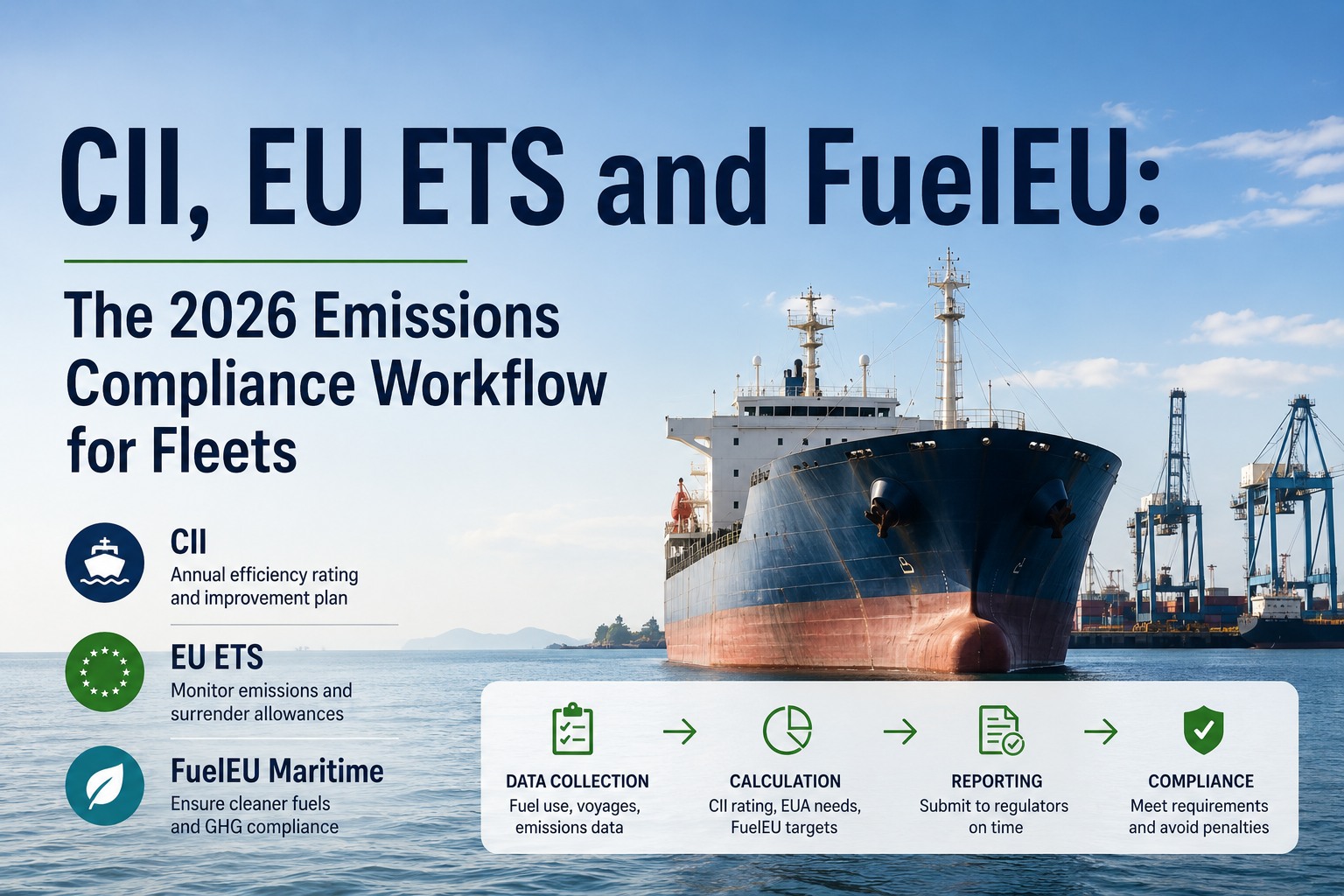
A single vessel calling at an EU port in 2026 is now subject to three separate emissions regimes at once, each measuring something different, each with its own deadlines and penalties, and each pulling on the same underlying voyage data. The Carbon Intensity Indicator rates the ship's operational efficiency on an A-to-E scale. The EU Emissions Trading System puts a hard price on its carbon, requiring allowances to be bought and surrendered for every covered tonne. And FuelEU Maritime caps the well-to-wake greenhouse-gas intensity of the energy it burns, with a penalty for exceeding the limit. They measure different things — intensity, absolute emissions, and fuel lifecycle intensity — and they can pull in different directions, yet they all draw on the same noon reports, bunker figures and voyage records. This is the defining compliance challenge of 2026: not any one of these rules, but managing all three simultaneously from one data foundation, turning what looks like three overlapping rulebooks into figures a technical manager, a charterer and a lender can all act on. The good news is that because the regimes share a data backbone, a well-organised emissions workflow can serve all three at once. This guide sets out how that workflow runs — the three regimes and how they differ, the shared MRV data foundation beneath them, the 2026 compliance calendar, and the path from a daily noon report to verified, surrendered compliance. To bring the voyage, fuel and emissions data that feeds all three regimes into one organised, verifiable system, start a free trial or book a demo.
COMPLIANCE GUIDE · MARITIME EMISSIONS 2026
CII, EU ETS and FuelEU: The 2026 Emissions Compliance Workflow for Fleets
Three emissions regimes now hit the same vessel from different angles, all drawing on the same voyage data. Here is how fleets manage CII ratings, EU ETS allowances and FuelEU intensity together in 2026 — the shared data backbone, the compliance calendar, and the workflow from noon report to verified reporting.
Three regimes, one vessel
CII
Rates operational intensity A to E
EU ETS
Prices absolute carbon via allowances
FuelEU
Caps well-to-wake fuel GHG intensity
Three Regimes, One Vessel
The starting point is understanding what each regime actually measures, because they are genuinely different instruments that happen to apply to the same ships — all vessels of 5,000 gross tons and above. Treating them as one rule is the first mistake; understanding how they differ is what makes a single workflow possible.
CII — Carbon Intensity Indicator
Measures: operational carbon intensity per capacity-mile
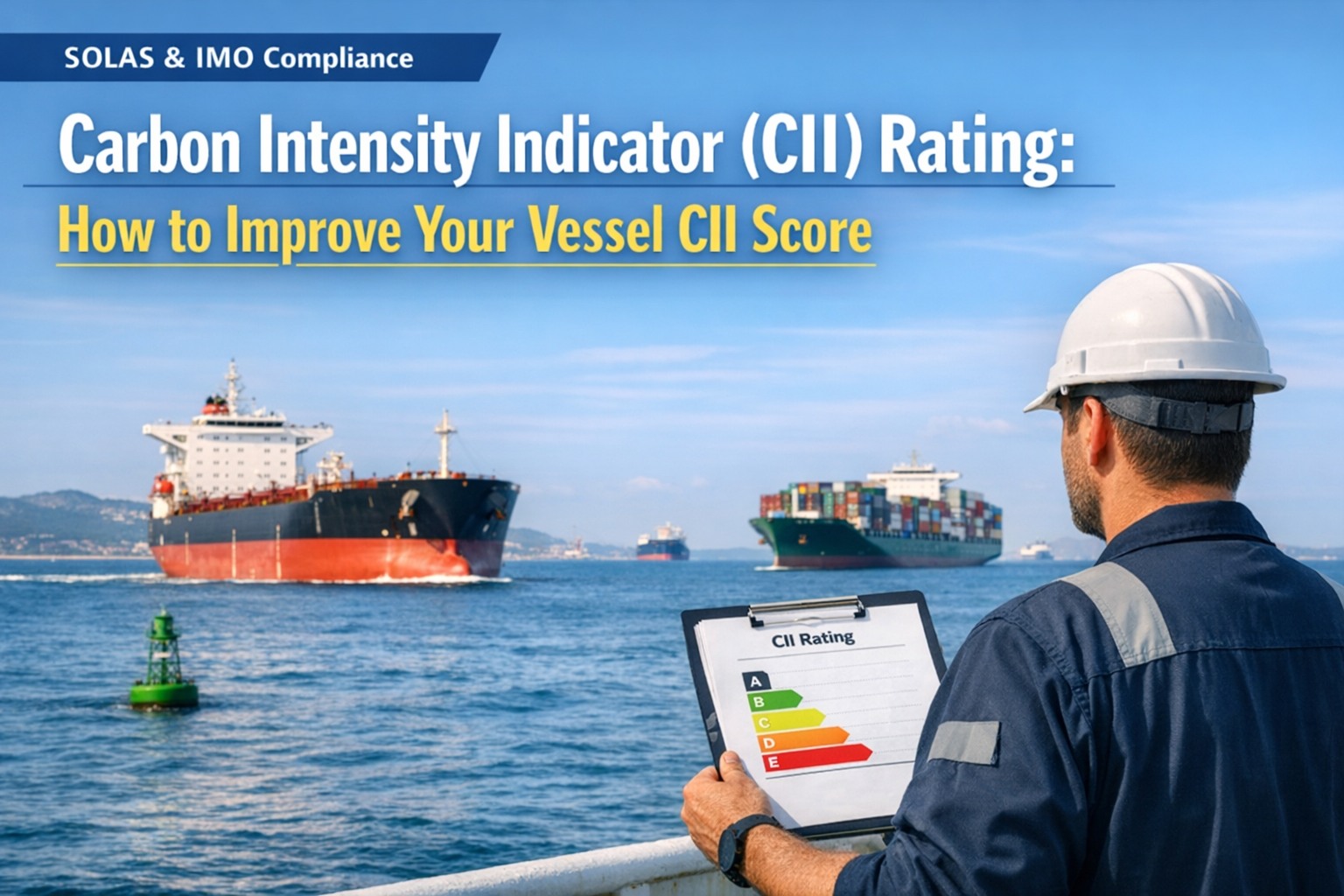
An IMO regime in force since 2023 with ratings issued from 2024, CII rates a ship's annual operational carbon intensity on an A-to-E scale across a full calendar year. It does not charge per tonne; it rates efficiency. The required intensity tightens every year — roughly eleven per cent below the 2019 baseline by 2026, heading toward about twenty-one per cent by 2030 — and a vessel rated D for three consecutive years, or E for a single year, must submit a corrective action plan.
EU ETS — Emissions Trading System
Measures: absolute covered emissions, priced via allowances
A cap-and-trade system extended to shipping from 2024, EU ETS requires companies to surrender EU Allowances for their covered emissions. In 2026 it reaches full phase-in: allowances must cover 100 per cent of covered emissions, up from 70 per cent for 2025, and methane and nitrous oxide join CO2 in scope. Geographically it covers 100 per cent of intra-EU voyages and at-berth emissions, and 50 per cent of voyages between an EU and a non-EU port, translating carbon into a direct cost of roughly two to three hundred euros per tonne of conventional fuel.
FuelEU Maritime
Measures: well-to-wake GHG intensity of energy used
In force since 1 January 2025, FuelEU caps the well-to-wake greenhouse-gas intensity of the energy used on board — the full lifecycle emissions per megajoule of energy, in grams of CO2-equivalent. The limit tightens over time, from a two per cent reduction in 2025 toward eighty per cent by 2050, and exceeding it incurs a penalty around 2,400 euros per tonne of VLSFO-equivalent above the limit. Crucially, its penalty is separate: a ship can be fully paid-up under the ETS and still owe a FuelEU penalty.
i
They can pull in different directions
Because the three regimes measure different things, an action that helps one may not help another proportionally, and can even work against it. Improving CII typically also reduces ETS exposure, since burning less fuel lowers both intensity and absolute emissions — but not always in proportion. FuelEU, by contrast, rewards the greenhouse-gas intensity of the fuel itself, so switching to a lower-intensity fuel can satisfy FuelEU while a slow-steaming strategy aimed at CII does little for it. Managing all three at once means seeing how a single operational or fuel decision ripples across all three scores, which is only possible when they are calculated from one shared, accurate dataset rather than in three separate spreadsheets.
The Shared Data Backbone
The reason a single workflow can serve three regimes is that they rest on the same foundation. Getting that foundation right is the whole game, because everything above it depends on it.
All three regimes draw on the EU Monitoring, Reporting and Verification framework and its THETIS-MRV platform as the data backbone, and the underlying inputs — voyage data, port-stay data and energy consumption — are largely the same for each. A ship-specific monitoring plan defines how emissions are tracked, and the same fuel-consumption, distance, cargo and time-in-port figures that feed the MRV report also feed the CII calculation, the ETS emissions total and the FuelEU intensity figure. This is why the discipline that matters most is the quality of that base data: without clean MRV data, everything above it fails. A single wrong bunker figure or a missing voyage leg does not corrupt one report — it corrupts all three, because they all draw from the same well. The corollary is the opportunity: capture voyage, fuel and port data once, accurately and completely, and it can be turned into all three compliance outputs without re-keying, reconciliation or the risk of three different numbers for the same voyage. The MRV framework has itself expanded to include methane and nitrous oxide, reflecting the widening scope, which makes disciplined, structured data capture more important, not less. To make clean, complete voyage and fuel data the reliable foundation your emissions reporting rests on, start a free trial or book a demo.
One accurate dataset, three compliance outputs
CII, EU ETS and FuelEU all draw from the same voyage, fuel and port data — so a single wrong figure corrupts all three. Marine Inspection helps capture that base data once, completely and verifiably, so it feeds every regime without re-keying or three conflicting numbers for one voyage.
The 2026 Compliance Calendar
The regimes run on an annual cycle with fixed deadlines, and missing them carries financial and administrative consequences. The sequence below is the rhythm every covered fleet works to.
By 31 Jan
Emissions reports submitted
The prior year's verified vessel emissions reports are prepared and submitted, drawing the full year of voyage and fuel data together into the MRV report that underpins all three regimes.
By 31 Mar
Third-party verification complete
An accredited independent verifier reviews the emissions data and confirms it via THETIS-MRV. Only verified emissions count, so the quality of the underlying data determines how smoothly verification passes.
By 30 Apr
Compliance data uploaded for tracking
Verified compliance data is uploaded so obligations can be tracked, and the CII rating for the year becomes clear — informing whether a corrective action plan will be required.
By 30 Sep
EU ETS allowances surrendered
Companies surrender EU Allowances covering their verified emissions — 100 per cent of covered emissions for the 2026 compliance year. Allowances must be bought at market rates, so the surrender obligation has a direct, budgetable cost.
Mid-year
FuelEU penalties and Documents of Compliance
FuelEU compliance is assessed, any penalties for exceeding the intensity limit are applied, and Documents of Compliance are distributed — a separate obligation running alongside the ETS surrender.
From Noon Report to Verified Compliance
Pulling it together, the practical workflow runs from the daily data captured on the vessel to the verified, surrendered compliance at year end. Each stage depends on the one before, which is why the discipline starts at the very first data point.
1
Capture at source — the noon report
Daily noon reports and bunker records capture fuel consumed by type, distance run, cargo carried and time in port. This is the raw material for every downstream calculation, and its accuracy sets the ceiling on everything above it — a lower-quality input cannot produce a higher-quality report.
2
Consolidate into the MRV dataset
The daily data is consolidated per voyage and per vessel into the monitoring framework, with the EU scope applied — 100 per cent for intra-EU and at-berth, 50 per cent for voyages to or from a non-EU port — so the covered portion is correctly identified rather than assumed.
3
Calculate all three outputs
From the one dataset, derive the CII rating, the EU ETS covered-emissions total and the FuelEU well-to-wake intensity. Calculating them together, from the same figures, is what prevents three conflicting numbers and reveals how each vessel stands against all three regimes at once.
4
Verify, report and surrender
Submit for third-party verification, report through THETIS-MRV, surrender the required ETS allowances, and address any FuelEU penalty and CII corrective action plan — closing the annual loop with an auditable trail back to the source data.
Run as one workflow rather than three, emissions compliance in 2026 becomes manageable: a single accurate stream of voyage and fuel data, captured cleanly at source, consolidated into the MRV framework, and turned into all three compliance outputs with a verifiable trail. The alternative — three separate processes drawing on three separately maintained datasets — multiplies the work, invites the inconsistencies that verification catches, and obscures the very interactions between the regimes that a fleet needs to see to make good fuel and operational decisions. There is also a commercial layer that sits on top of all this: the regulatory obligation rests with the shipping company, the entity holding the Document of Compliance under ISM, regardless of what a charter party says, so who ultimately bears the cost is a contractual matter to be defined in writing rather than assumed. But the foundation of handling that commercial question well, and of meeting every deadline without a year-end scramble, is the same: one clean, complete, verifiable dataset feeding all three regimes. To make that dataset the reliable core of your fleet's emissions compliance, start a free trial or book a demo.
Frequently Asked Questions
What is the difference between CII, EU ETS and FuelEU?
They measure three different things and all apply to ships of 5,000 gross tons and above. CII, the IMO's Carbon Intensity Indicator, rates a ship's operational carbon intensity per capacity-mile on an A-to-E scale once a year. EU ETS is a cap-and-trade system that puts a direct price on absolute covered emissions, requiring companies to surrender EU Allowances for each tonne. FuelEU Maritime caps the well-to-wake greenhouse-gas intensity of the energy used on board, in grams of CO2-equivalent per megajoule, with its own penalty. A single vessel calling at EU ports can be subject to all three at once, and because they measure different things, they can pull in different directions — which is why they must be managed together from one dataset.
How much does EU ETS cover in 2026?
From 1 January 2026, EU ETS covers 100 per cent of covered emissions for ships of 5,000 gross tons and above, up from 70 per cent for the 2025 compliance year, and methane and nitrous oxide are now included alongside CO2. Geographically, it applies to 100 per cent of emissions on intra-EU voyages and at berth in EU ports, and 50 per cent of emissions on voyages between an EU and a non-EU port. Companies must buy and surrender EU Allowances covering these emissions at market rates, which translates into a carbon cost of roughly two to three hundred euros per tonne of conventional fuel, making emissions a direct and budgetable operating expense.
What is the FuelEU Maritime penalty?
FuelEU Maritime, in force since 1 January 2025, caps the well-to-wake greenhouse-gas intensity of the energy used on board, and exceeding the limit incurs a penalty of around 2,400 euros per tonne of VLSFO-equivalent energy above the threshold. The intensity limit tightens over time, starting at a two per cent reduction in 2025 and escalating toward eighty per cent by 2050. Importantly, the FuelEU penalty is entirely separate from EU ETS: a ship can have surrendered all its required ETS allowances and still owe a FuelEU penalty, because the two regimes measure different things — absolute priced emissions versus fuel lifecycle intensity. This is why FuelEU cannot be folded into ETS compliance and must be tracked in its own right.
How is the CII rating calculated and what happens if it is poor?
The Carbon Intensity Indicator measures a ship's annual CO2 emissions per capacity-mile across a full calendar year and assigns an A-to-E rating reflecting operational efficiency, with the required intensity tightening each year — roughly eleven per cent below the 2019 baseline by 2026 and heading toward about twenty-one per cent by 2030. A vessel rated D for three consecutive years, or E for a single year, must submit a corrective action plan setting out how it will improve. Beyond the formal requirement, a poor rating raises exposure during vetting and charter-rate negotiation, because charterers increasingly factor CII into decisions, so the rating carries commercial weight well beyond the regulatory obligation itself.
Do the three regimes share data?
Yes, and this is what makes a single workflow possible. All three draw on the EU Monitoring, Reporting and Verification framework and the THETIS-MRV platform, and the underlying inputs — voyage data, port-stay data and energy consumption — are largely the same for each. The same fuel-consumption, distance, cargo and time-in-port figures feed the CII calculation, the ETS emissions total and the FuelEU intensity figure. This means the quality of the base data is decisive: a single wrong bunker figure or missing voyage leg corrupts all three outputs, not just one. Capturing voyage and fuel data once, accurately and completely, lets it serve all three regimes without re-keying or the risk of three different numbers for the same voyage.
Who is responsible for emissions compliance — the owner or the charterer?
The regulatory obligation rests with the shipping company, defined as the entity that has assumed ISM responsibility — the Document of Compliance holder — unless the registered owner has formally retained the obligation. This holds regardless of what a charter party says: the regulator looks to the shipping company. Who ultimately bears the cost, however, is a commercial matter to be negotiated and defined in writing in the management or charter agreement, and industry-standard clauses exist to allocate ETS costs between owners and charterers. If a charterer refuses to cover the cost, that is a commercial dispute, but the regulatory duty stays with the shipping company. Defining cost allocation clearly in the contract, before the obligation falls due, is essential to avoiding disputes.
Three Regimes, One Clean Dataset
CII, EU ETS and FuelEU all draw on the same voyage, fuel and port data — so the fleets that manage them well are the ones that capture that data once, cleanly and completely, and turn it into all three compliance outputs with a verifiable trail. Marine Inspection helps make that base data reliable and organised across your fleet, so emissions compliance becomes one disciplined workflow rather than three year-end scrambles. Build the foundation the whole regime rests on.