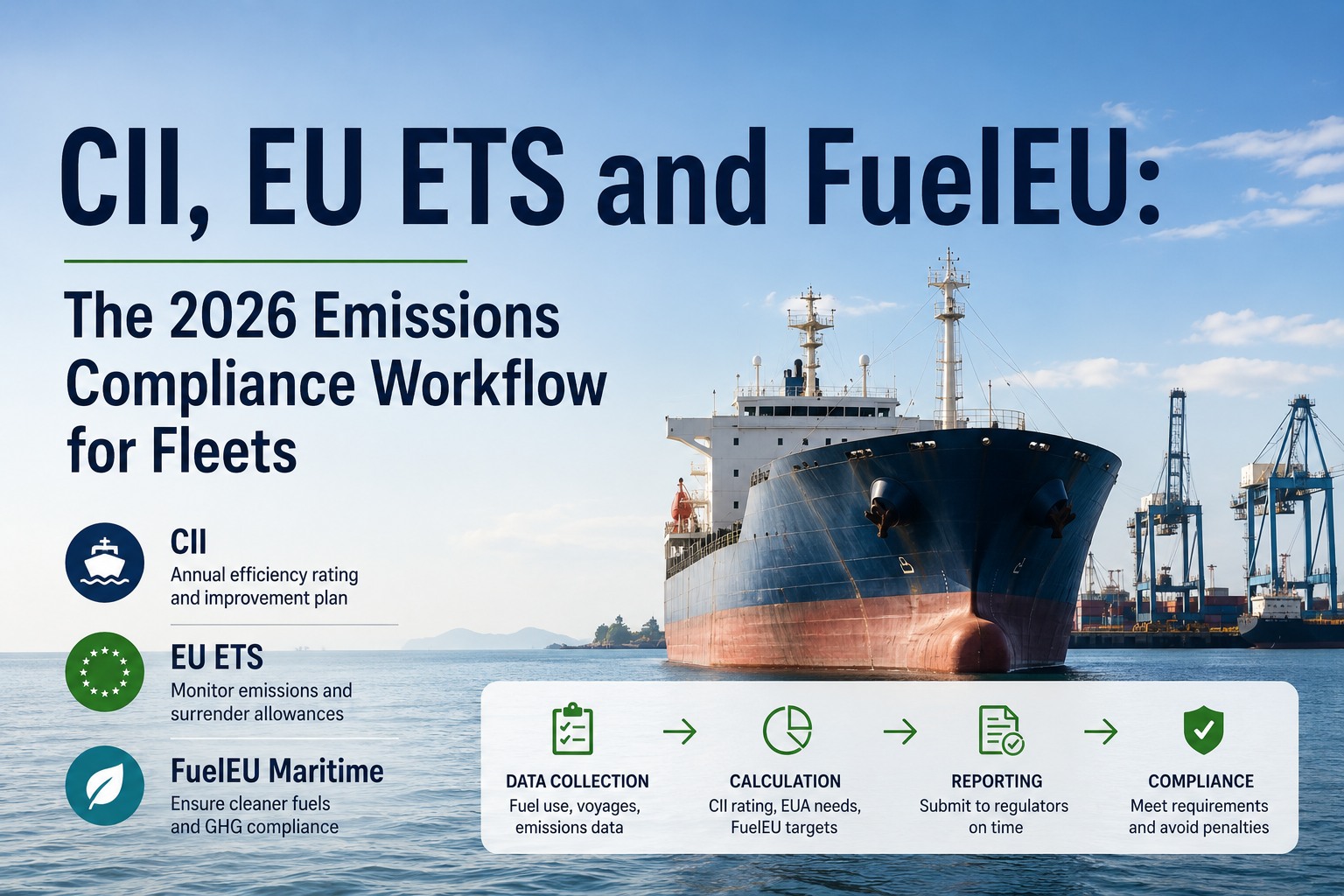
As of 1 January 2026, the European Union Emissions Trading System reaches full force for shipping, and the grace of the phase-in is over. Where companies surrendered allowances for 40% of their emissions in the first year and 70% in the second, they must now cover 100% — and for the first time that obligation extends beyond carbon dioxide to methane and nitrous oxide. For any company operating ships of 5,000 gross tonnes or more that call at EU or EEA ports, the EU ETS is no longer a future concern or a partial cost; it is a direct, per-voyage financial liability that has to be measured, reported, verified, and paid for in tradable allowances. The mechanics are unforgiving: every tonne of CO2-equivalent in scope requires an allowance, allowances must be bought and surrendered by a hard annual deadline, and the penalty for falling short is €100 per missing tonne plus public naming and the risk of being barred from EU ports. This guide explains what the EU ETS covers, how its scope and per-voyage percentages work, the compliance obligations and deadlines, the financial impact, and how 2026's expansion changes the calculation. For help tracking emissions per voyage and producing the verified data the system demands, book a Marine Inspection demo.
Green shipping · EU ETS compliance
EU ETS Maritime: Emissions Trading Compliance for Shipping
A practical guide to the EU Emissions Trading System for shipping — full 100% compliance from 2026, the scope and per-voyage coverage, MRV reporting, allowance surrender, financial impact, and the methane and N2O expansion.
100%of in-scope emissions covered from 2026
€100/tpenalty per tonne CO2e not surrendered
30 Septannual allowance surrender deadline
The Essentials at a Glance
Before the detail, the core facts a fleet manager or compliance officer needs to hold in mind. The EU ETS is a cap-and-trade system: the EU caps total emissions, issues a declining number of allowances, and requires each company to surrender one allowance for every tonne of CO2-equivalent it emits in scope.
Who is covered
Cargo and passenger ships of 5,000 GT and above calling at EU/EEA ports; offshore ships of 5,000 GT from 2027.
What is covered
CO2 from 2024; methane (CH4) and nitrous oxide (N2O) added from 2026, measured as CO2-equivalent.
The unit
One EU Allowance (EUA) equals the right to emit one tonne of CO2-equivalent; shipping receives no free allowances.
The basis
Allowances are surrendered against verified emissions reported under the EU MRV regulation, on a per-voyage basis.
The Phase-In Is Complete
The maritime EU ETS was introduced gradually to let the industry adjust. That ramp is now finished — 2026 is the first year of full coverage, and the expanded gas scope arrives at the same moment.
2024
40% — CO2 only
Companies surrendered allowances for 40% of verified 2024 CO2 emissions, with a 5% reduction permitted for ice-class ships.
2025
70% — CO2 only
Coverage rose to 70% of verified 2025 emissions. Compliance was strong — over 99% of required allowances were surrendered.
2026
100% — CO2, CH4 & N2O
Full surrender of all in-scope emissions, now including methane and nitrous oxide for the first time.
2027+
Offshore ships added
Offshore ships of 5,000 GT and above enter ETS scope; a review considers extending to 400–5,000 GT vessels.
The Scope: How Per-Voyage Coverage Works
The single most important thing to understand about the EU ETS is that it does not cover all of a ship's emissions — it covers a defined share based on where each voyage begins and ends. This per-voyage scope is what makes port selection and routing a genuine cost lever.
100%
Intra-EU voyages & at berth
Emissions on voyages between two EU/EEA ports, and emissions while at berth in an EU/EEA port, are fully covered.
50%
Voyages into the EU/EEA
Emissions on a voyage from a non-EU port to an EU/EEA port are covered at half, recognising the leg outside EU waters.
50%
Voyages out of the EU/EEA
Emissions on a voyage from an EU/EEA port to a non-EU port are likewise covered at half.
An anti-evasion rule closes the obvious loophole: container ships calling at a transshipment port outside the EU/EEA but within 300 nautical miles of an EU/EEA port must still count 50% of the emissions for the full voyage to that port, not just the short final leg. The Commission publishes the list of affected transshipment ports. The practical lesson is that even a single EU port call generates real ETS exposure, so routing and port choice now carry a carbon price.
Measure it per voyage
Track In-Scope Emissions Voyage by Voyage
Because the EU ETS applies per voyage at different percentages, accurate per-voyage fuel and emissions data is the foundation of compliance. Marine Inspection tracks consumption and emissions by voyage and vessel, applies the scope rules, and produces the verified data EU MRV requires. Book a 30-minute demo to see ETS-ready emissions tracking, or start a free trial today.
The 2026 Expansion: Methane and N2O
The arrival of methane and nitrous oxide in the ETS scope from 2026 is more than a technicality — for some operators it materially changes the cost equation, because these gases have far higher global warming potential than CO2.
Methane (CH4)
~28× CO2
Methane slip from LNG dual-fuel engines, long a sustainability talking point, now becomes a direct line item in operating cost, calculated using defined slip factors.
Nitrous oxide (N2O)
~273× CO2
Nitrous oxide, with a very high warming potential, is now counted in the surrender obligation alongside CO2 and methane as CO2-equivalent.
For LNG-fuelled operators this is significant. Where a certified actual methane slip factor is not available, default coefficients apply — proposed values include around 3.1% of fuel mass for Otto-cycle dual-fuel medium-speed engines and far lower figures, around 0.2%, for dual-fuel slow-speed engines. Engine selection and slip performance therefore translate directly into allowance cost, making accurate methane accounting a commercial concern, not just an environmental one.
Your Compliance Obligations
Meeting the EU ETS is a defined annual cycle of monitoring, reporting, verification, and surrender. Each step has a responsible party and a deadline, and missing any of them creates exposure. See compliance tracking in a demo.
1
Monitor per voyage
Track fuel consumption and emissions of CO2, CH4, and N2O on a per-voyage basis under an approved monitoring plan that reflects the expanded gas scope.
2
Report under EU MRV
Compile the annual emissions report under the EU Monitoring, Reporting and Verification regulation — the data foundation the ETS surrender is built on.
3
Verify independently
Have the emissions report verified by an accredited verifier, producing the verified figure against which allowances are surrendered.
4
Surrender allowances
Hold and surrender enough EUAs to cover the verified in-scope emissions by 30 September each year, for the previous calendar year.
The obligation rests with the shipping company responsible for the vessel, which deals with a designated administering authority. Because shipping receives no free allowances, every required EUA must be purchased on the market — making allowance procurement and price management a real part of the compliance task.
The Financial Impact
The EU ETS turns emissions into a direct, variable operating cost, and quantifying that cost is now a core planning exercise. The size of the bill depends on three things a fleet can partly control.
In-scope emissions
The tonnes of CO2-equivalent covered, driven by fuel burned and how much of each voyage falls in scope at 100% or 50%.
The allowance price
The market price of an EUA, which the fleet must buy with no free allocation, and which fluctuates with the carbon market.
Fuel & engine choice
Lower-carbon fuels cut in-scope emissions; methane slip from LNG engines now adds to them, shifting the calculation.
Routing & port calls
Because scope is per voyage, route structure and port selection change how much of the emissions are chargeable.
The cost is also passed through the market: many operators recover ETS costs via surcharges, and the per-voyage structure means even tramp operators must price exposure into each EU-linked fixture. With the cap declining each year under the Fit for 55 target of a 62% emissions cut by 2030, the supply of allowances tightens and the cost pressure is designed to rise over time.
Penalties and Enforcement
The EU ETS has real teeth, and the consequences of non-compliance go well beyond the cost of the missing allowances. Compliance officers should treat the obligations as hard requirements, not targets.
€100 per tonne
A penalty of €100 for every tonne of CO2-equivalent not surrendered — on top of still owing the allowances themselves.
Public disclosure
Non-compliant companies are named publicly, carrying reputational damage with charterers, financiers, and partners.
Port detention or expulsion
Persistent non-compliance can lead to a ship being detained or a company's vessels expelled from EU ports.
Dual-scheme exposure
From mid-2026 the UK ETS also extends to maritime, so a ship calling at both UK and EU ports faces two parallel obligations.
The thread running through all of it is data. Every obligation — monitoring, reporting, verification, surrender — depends on accurate, voyage-level emissions records, and every penalty flows from getting that data wrong or short. The fleets that handle the EU ETS most cheaply are those that measure precisely, because precise data avoids over-surrendering, survives verification cleanly, and turns compliance from a scramble into a routine. Book a demo to see EU ETS emissions tracking.
Frequently Asked Questions
What is the EU ETS for maritime?
It is the extension of the EU's cap-and-trade Emissions Trading System to shipping. Companies operating ships of 5,000 GT and above calling at EU/EEA ports must monitor and report their emissions and surrender tradable allowances — one EU Allowance per tonne of CO2-equivalent in scope — by an annual deadline, with no free allowances provided to shipping.
What percentage of emissions does the EU ETS cover in 2026?
From 1 January 2026 the phase-in is complete and companies must surrender allowances for 100% of their in-scope verified emissions, up from 40% on 2024 emissions and 70% on 2025 emissions. At the same time, the scope expands beyond CO2 to include methane and nitrous oxide for the first time.
How does the per-voyage scope work?
Coverage depends on the voyage. Emissions are 100% in scope for voyages between two EU/EEA ports and while at berth in an EU/EEA port, and 50% in scope for voyages into or out of the EU/EEA from or to a non-EU port. An anti-evasion rule also captures 50% of emissions to nearby non-EU transshipment ports within 300 nautical miles.
What does the 2026 methane and N2O inclusion mean?
From 2026 the ETS covers methane and nitrous oxide alongside CO2, measured as CO2-equivalent. Because methane has roughly 28 times and N2O roughly 273 times the warming potential of CO2, this matters especially for LNG dual-fuel ships, where methane slip — calculated with defined default factors when no certified figure exists — becomes a direct allowance cost.
What are the deadlines and who is responsible?
The responsible shipping company must monitor emissions per voyage, report them annually under EU MRV, have them independently verified, and surrender enough allowances to cover the verified in-scope emissions by 30 September each year for the previous calendar year, dealing with a designated administering authority.
What happens if a company fails to comply?
Non-compliance brings a penalty of €100 per tonne of CO2-equivalent not surrendered, on top of still owing the allowances, plus public naming and the risk of ship detention or expulsion from EU ports for persistent breaches. From mid-2026 the UK ETS adds a parallel obligation for ships calling at both UK and EU ports.
Built for EU ETS compliance
Turn Emissions Compliance Into Clean Data
Track CO2, methane, and N2O per voyage and vessel, apply the EU ETS scope percentages, manage bunker and consumption records, and produce verified MRV-ready reports — so surrender is accurate, verification is clean, and the carbon cost is one you can plan for. Marine Inspection makes EU ETS compliance a matter of good data. Book a tailored walkthrough or start a free trial today.