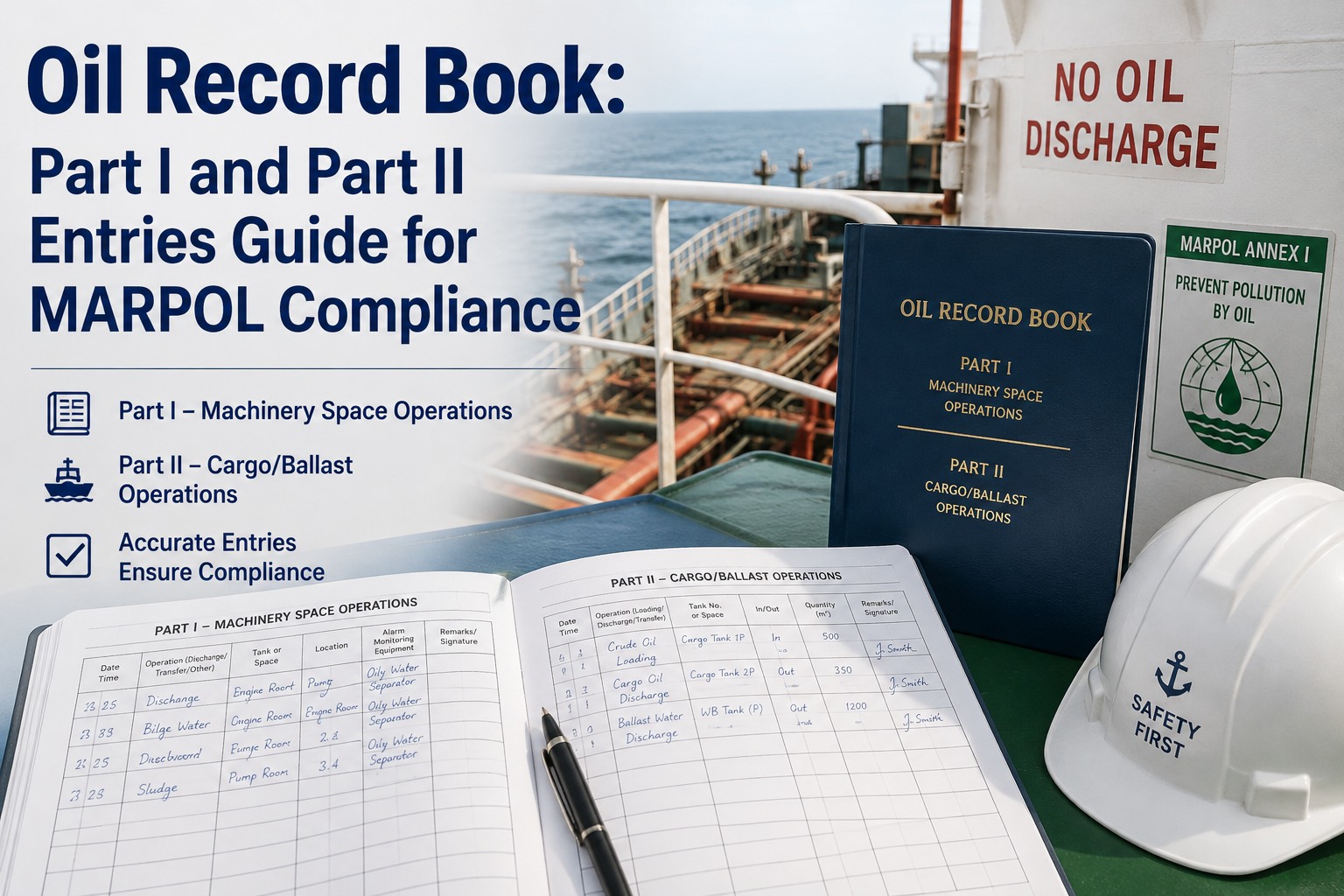
The Oil Record Book is one of the most scrutinised documents on any ship, and for a simple reason: it is the legal, signed account of everything a vessel does with oil, and it is among the very first things a Port State Control officer reaches for. A clean, consistent Oil Record Book signals a well-run ship; one with missing signatures, wrong codes, gaps or entries that do not reconcile with the ship's other records signals the opposite, and the consequences escalate quickly from a Code 17 deficiency requiring correction, through detention, to criminal prosecution in the most serious cases of falsification. The paradox is that the underlying operations — pumping bilges through the separator, disposing of sludge ashore, bunkering, cleaning cargo tanks — are routine, and the entries that record them follow a fixed, learnable structure. Most Oil Record Book problems are not the result of pollution but of poor record-keeping: the right operation done and the wrong entry made, or no entry made at all. This guide sets out how to make correct Oil Record Book entries for the deck officers and engineers responsible for them. It explains what the two parts cover and who must keep them, walks through the operational code structure for Part I machinery space operations and Part II cargo and ballast operations, sets out the golden rules that keep entries defensible, and shows where inspections most often go wrong so those errors can be avoided. To keep Oil Record Book entries, sludge and bilge records and the supporting evidence organised and inspection-ready across your fleet, start a free trial or book a demo.
INDUSTRY GUIDE · MARPOL ANNEX I
Oil Record Book: Part I and Part II Entries Guide for MARPOL Compliance
A working reference for deck officers and engineers to correct Oil Record Book entries — what Part I and Part II cover, the operational code structure for machinery space and cargo operations, the golden rules that keep entries defensible, and the errors that most often trigger Port State Control deficiencies.
Two Books, Two Scopes, One Standard
The Oil Record Book is mandated by MARPOL 73/78 Annex I, and it comes in two parts covering different operations. Getting the scope right is the first step, because keeping the wrong book — or failing to keep both where both are required — is itself a deficiency.
PART I
Machinery Space Operations
Required under Regulation 17 on all ships of 400 GT and above, and on oil tankers of 150 GT and above.
Records everything the machinery spaces do with oil: ballasting and cleaning of fuel oil tanks, discharge of dirty ballast, collection and disposal of oil residue (sludge), discharge of oily bilge water through the oily water separator, bunkering, and any accidental or exceptional discharge. Most cargo vessels keep Part I only.
PART II
Cargo and Ballast Operations
Required under Regulation 36 on oil tankers of 150 GT and above, in addition to Part I.
Records cargo and ballast handling: loading and unloading of oil cargo, internal transfers, crude oil washing, ballasting and cleaning of cargo tanks, discharge of dirty ballast and tank washings, and disposal of residues and slops. Tankers keep both parts, with required cross-references between them.
i
Cross-references between the two books
On tankers, some operations touch both books and must be entered in both. When sludge or bilge water from the engine room is transferred to slop tanks, or when non-oil-cargo oily residues move into cargo slop tanks, a corresponding entry is required in both Part I and Part II, and where sludge or bilge water is transferred from multiple engine-room tanks a separate entry is made for each transfer. Missing one side of a cross-reference is a classic inconsistency that inspectors look for, because the two books must tell the same story about the same oil.
The Part I Code Structure
Part I entries are organised by lettered operational codes, each covering a category of machinery space operation, with numbered item lines beneath. Every entry combines the date, the code letter and the item number with the required particulars recorded in the blank spaces. The codes below are the backbone of Part I.
A
Ballasting or cleaning of fuel oil tanks
Identity of the tanks, whether they were cleaned since last containing oil, and details of ballasting.
B
Discharge of dirty ballast or cleaning water from fuel tanks
Method, quantity, whether through the separator, position at start and finish, or delivery ashore.
C
Collection and disposal of oil residue (sludge)
Quantities collected, transfers between sludge tanks, and disposal ashore or by incinerator, with tank identity.
D
Non-automatic discharge of bilge water
Discharge overboard through the separator with the oil content monitor, quantity, and position, or delivery to shore.
E
Automatic discharge of bilge water
Discharge overboard through the separator, the time period, and position at start and finish.
F
Condition of the oil filtering / separator equipment
Maintenance, testing and any failure of the oily water separator and the 15 ppm oil content monitor.
G
Accidental or exceptional discharge of oil
Circumstances, quantity, and reasons for any accidental or other exceptional discharge, recorded fully.
H
Bunkering of fuel or bulk lubricating oil
Date, port, type and quantity of fuel or lube oil received, and the tanks it went into.
I
Additional operational procedures and general remarks
Separator seal logs, overboard valve locking and numbering, and any other relevant remarks.
Part II follows the same principle for cargo and ballast work — lettered codes covering loading, internal transfer, crude oil washing, ballasting and cleaning of cargo tanks, discharge of dirty ballast and tank washings, and disposal of residues — again combining date, code and item number with the particulars. The structure is identical; only the operations differ. To route each operation to the correct book and code with the required cross-references handled automatically, start a free trial or book a demo.
Make every entry right the first time
The operation is routine; the entry is what gets inspected. Marine Inspection routes each operation to the correct part and code, keeps cross-references consistent, prompts for the required particulars and signatures, and holds the record inspection-ready per vessel — so the book tells one clean, reconcilable story.
The Golden Rules of a Defensible Entry
Beyond knowing the codes, a handful of rules govern how entries must be made. These are what separate an Oil Record Book that survives inspection from one that generates deficiencies, and they are simple enough to be non-negotiable.
01
In ink, never pencil
All entries are made in ink. Pencil in any legal log invites suspicion of alteration and is avoided entirely. Errors are corrected by a single struck-through line, the correction initialled — never erased or overwritten.
02
Immediately, on completion
Each entry is made without delay, directly on completion of the operation, so nothing is reconstructed from memory later. Entries are recorded chronologically, in the order operations actually occurred.
03
Signed by the officer, page signed by the master
Each completed operation is signed and dated by the officer in charge, and each completed page is signed by the master. A missing signature is one of the most common deficiencies and one of the easiest to avoid.
04
Consistent with the ship's other records
Entries must reconcile with the engine log, bunker records, sounding books and tank soundings. Inspectors cross-check, and a figure in the Oil Record Book that contradicts another record is a serious finding.
05
Retained and available for three years
The completed book is kept aboard, readily available for inspection, and retained for at least three years. It must be producible on demand, which means knowing where it is and that it is complete.
Where Inspections Go Wrong
Port State Control treats the Oil Record Book as a primary document, and most findings fall into a few recurring categories. Knowing them turns inspection from a hazard into a routine.
Keeps the book clean
Every operation entered immediately, in ink, in chronological order
Officer signature on each operation and master signature on each page
Correct code and item number for the actual operation performed
Cross-references between Part I and Part II where operations touch both
Figures that reconcile with engine log, soundings and bunker records
Separator, monitor and overboard-valve seal status recorded and kept
Triggers a deficiency
Missing signatures on operations or pages — a leading Code 17 finding
Wrong operational code, or the wrong book part for the operation
Gaps, or entries reconstructed and written up long after the event
Figures that do not reconcile with the ship's other records
Erasures, overwriting or pencil entries suggesting alteration
A missing Part II cross-reference for an engine-room-to-slop transfer
The theme across every finding is the same: the pollution-prevention operations themselves are almost always done correctly, and it is the record of them that fails. An Oil Record Book that is entered immediately, signed properly, coded correctly and reconciled with the ship's other logs is a straightforward pass, and it protects the ship and its officers where a sloppy one exposes them — because in a serious case, an inaccurate or falsified Oil Record Book is treated as a crime in its own right, independent of whether any oil ever went into the sea. Discipline in the book is discipline that protects careers. To keep entries prompted, coded, cross-referenced and reconciled across your fleet, and hold the three-year record ready for any inspection, start a free trial or book a demo.
Frequently Asked Questions
What is the difference between Oil Record Book Part I and Part II?
Part I covers machinery space operations and is required under MARPOL Annex I Regulation 17 on all ships of 400 GT and above and oil tankers of 150 GT and above — recording bilge water discharge, sludge collection and disposal, fuel tank ballasting, bunkering and accidental discharges. Part II covers cargo and ballast operations and is required under Regulation 36 on oil tankers of 150 GT and above, recording cargo loading and unloading, crude oil washing, cargo tank cleaning and slop disposal. Most cargo vessels keep Part I only, while tankers keep both with required cross-references between them.
Who has to keep an Oil Record Book?
Oil Record Book Part I is required on every ship of 400 gross tons and above and on every oil tanker of 150 gross tons and above, covering machinery space operations. Oil Record Book Part II is additionally required on oil tankers of 150 gross tons and above for cargo and ballast operations. So a typical cargo ship keeps Part I only, while an oil tanker keeps both. The requirement flows from MARPOL 73/78 Annex I, Regulations 17 and 36, and the book must be kept current, signed, and available for inspection at all times.
How should entries be made in the Oil Record Book?
Each entry combines the date, the operational code letter and the item number, with the required particulars written in the blank spaces, recorded chronologically. Entries must be made in ink — never pencil — and directly on completion of each operation rather than reconstructed later. Every completed operation is signed and dated by the officer in charge, and every completed page is signed by the master. Corrections are made by a single struck-through line, initialled, never erased or overwritten. The entries must also reconcile with the ship's other records such as the engine log and bunker documents.
What are the operational codes in Part I?
Part I uses lettered codes for categories of machinery space operation: A for ballasting or cleaning of fuel oil tanks; B for discharge of dirty ballast or cleaning water from those tanks; C for collection and disposal of oil residue or sludge; D for non-automatic discharge of bilge water through the separator; E for automatic discharge of bilge water; F for the condition of the separator and 15 ppm oil content monitor; G for accidental or exceptional discharges; H for bunkering of fuel or lubricating oil; and I for additional operational procedures and general remarks. Each code has numbered item lines specifying the particulars to record.
How long must the Oil Record Book be kept?
The Oil Record Book must be retained on board and readily available for inspection for at least three years from the date of the last entry. It is one of the first documents a Port State Control officer asks to see, so it must be producible on demand and complete for that period. Keeping superseded volumes accessible for the full three years, and knowing where the current and recent books are, is part of being inspection-ready — a book that cannot be produced is as much a problem as one with faulty entries.
What are the most common Oil Record Book deficiencies?
The most frequent are missing signatures — either the officer's on an operation or the master's on a page — which are a leading cause of Code 17 deficiencies; incorrect operational codes or use of the wrong book part; gaps or entries written up long after the event rather than immediately; figures that do not reconcile with the engine log, soundings or bunker records; erasures, overwriting or pencil entries that suggest alteration; and missing cross-references on tankers where an engine-room transfer to slop tanks should appear in both parts. Simple procedural errors, they are correctable but taken seriously.
What happens if the Oil Record Book is inaccurate or falsified?
Consequences escalate with severity. Simple errors such as a missing signature or wrong code typically result in a deficiency requiring correction before departure. More serious inconsistencies can lead to detention. And a deliberately inaccurate or falsified Oil Record Book is treated as a criminal matter in its own right — prosecutions have centred on false entries independent of whether any illegal discharge occurred, because the integrity of the record is itself protected by law. This is why disciplined, honest, contemporaneous record-keeping matters so much: the book protects the ship and its officers only if it is accurate.
Keep the Book Inspection-Ready, Every Voyage
Marine Inspection routes each oil operation to the correct part and code, keeps Part I and Part II cross-references consistent, prompts for required particulars and signatures, reconciles figures against the ship's records, and holds the three-year Oil Record Book ready for Port State Control — turning a common source of deficiencies into a clean, defensible record across the fleet.