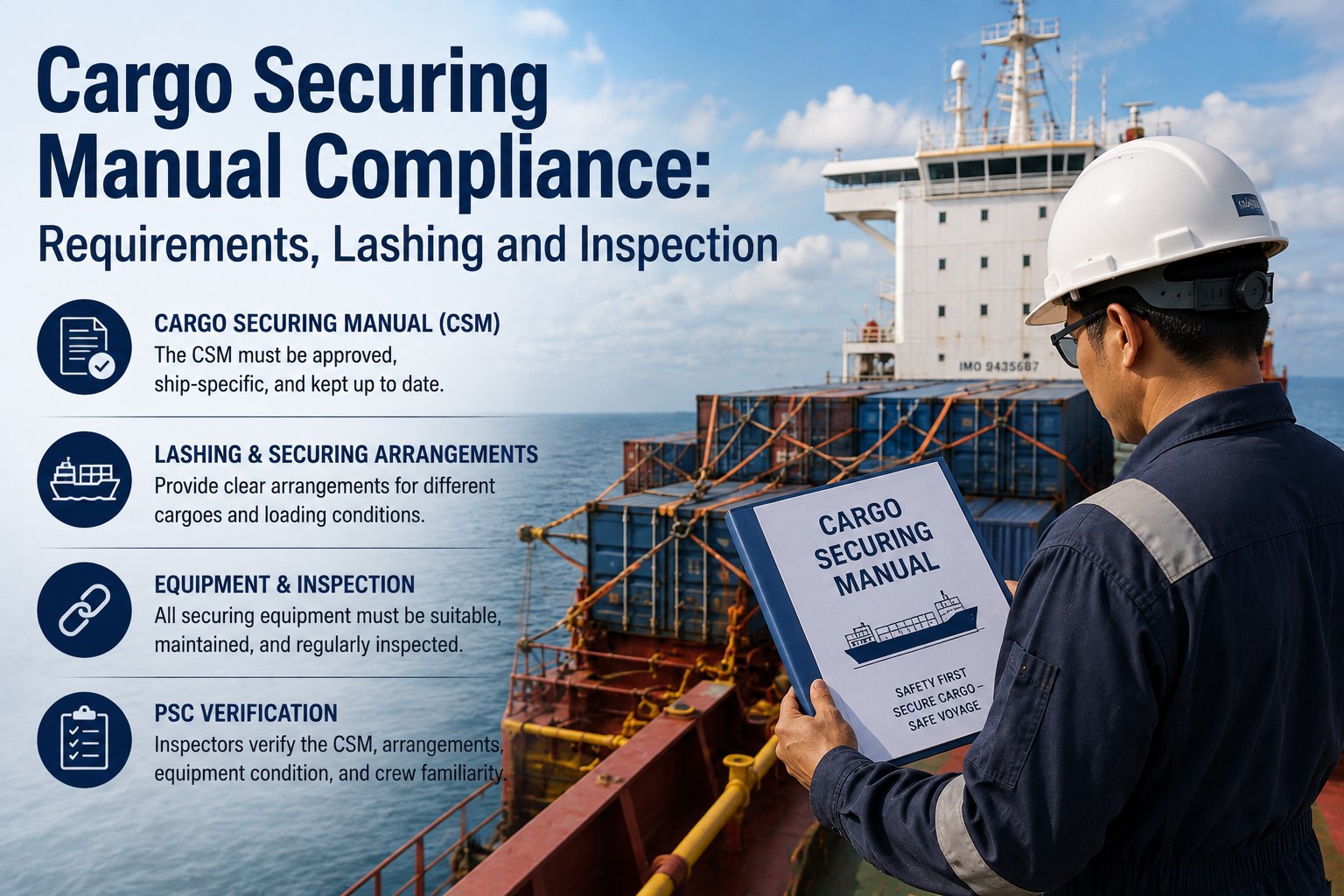
Cargo that shifts at sea can cost a ship its stability, its cargo and, in the worst cases, its crew — and the single document that stands between safe carriage and that outcome is the Cargo Securing Manual. Under the SOLAS Convention, every ship carrying cargo units or cargo transport units, which is to say all cargoes other than solid and liquid bulk, must load, stow and secure that cargo throughout the voyage in accordance with a Cargo Securing Manual approved by its flag Administration. The manual is not generic guidance; it is a vessel-specific, approved document that defines how cargo must be secured for that particular ship, drawn up to a standard at least equivalent to the IMO's revised guidelines and made consistent with the Code of Safe Practice for Cargo Stowage and Securing. Yet the recurring finding across inspections and casualties is not that ships lack a manual, but that the manual is not applied correctly — securing arrangements that do not match the approved plan, equipment that is not maintained, verification that is not carried out or recorded. With the manual under particular scrutiny during the 2026 Port State Control campaign on cargo securing, understanding exactly what the CSM requires has rarely mattered more. This guide sets out Cargo Securing Manual compliance from the document outward: its regulatory basis, what the manual must contain, the securing-equipment discipline it defines, the inspection cycle it demands, and the master's residual responsibility that no approval stamp removes. To keep cargo securing inspections, equipment records and verification evidence aligned with your approved manual across the fleet, start a free trial or book a demo.
COMPLIANCE GUIDE · CARGO SECURING
Cargo Securing Manual Compliance: Requirements, Lashing and Inspection
The Cargo Securing Manual is the vessel-specific, Administration-approved document that governs how cargo must be secured for the voyage. Here is what the CSM must contain, the securing-equipment discipline it defines, the inspection cycle it demands, and the responsibility that stays with the master.
The regulatory basis
SOLAS VI/5 & VII/6
Cargo secured per an approved manual
CSS Code
General principles for stowage and securing
MSC.1/Circ.1353
Guidelines for preparing the manual
What the CSM Is and Why It Is Mandatory
The Cargo Securing Manual exists because the safe securing of cargo cannot be left to improvisation. Regulations VI/5 and VII/6 of the SOLAS Convention require that cargo units, including containers, be loaded, stowed and secured throughout the voyage in accordance with a Cargo Securing Manual approved by the Administration, and drawn up to a standard at least equivalent to the guidelines developed by the IMO. This applies to all ships engaged in carrying cargoes other than solid and liquid bulk.
Two features make the manual what it is. First, it is approved by the flag Administration, or a recognised organisation on its behalf, which means its contents have been checked against the regulatory requirements before the ship relies on them. Second, it is vessel-specific: the manual describes the securing arrangements for that particular ship and the cargo types it is designed to carry, not a generic template. Its layout and content must follow the IMO's revised guidelines for the preparation of the Cargo Securing Manual, which structure the manual to align with SOLAS and the Code of Safe Practice for Cargo Stowage and Securing. That CSS Code, in turn, sets out the general principles the whole system rests on — proper planning, execution and supervision of securing operations; the suitability of the ship and its securing equipment; and the training and competence of the people doing the work. The manual is where those principles become concrete for a specific vessel, which is exactly why it must be both correct and followed. To keep your securing practice anchored to the approved manual rather than drifting from it, start a free trial or book a demo.
What the Manual Must Contain
An approved Cargo Securing Manual is a structured document with defined components, each serving the crew at a different point in the securing task. Knowing its anatomy is knowing what compliance requires, because an inspector checks the ship against these contents.
01
Catalogue of securing devices
A full catalogue of the fixed and portable securing equipment provided on the ship — lashing gear, twistlocks, turnbuckles, container fittings, bridge fittings and the like — with the strength of each device expressed as its Maximum Securing Load, and instructions for its use and maintenance.
02
Approved securing arrangements and lashing patterns
The approved securing arrangements and lashing patterns for the cargo types the ship is designed to carry, specifying how many lashings, at what angles, for each position — the plan against which actual securing is later verified.
03
Guidance for non-standard and heavy cargo
Guidance on securing non-standard or heavy cargo units that fall outside the standard arrangements, so the crew have a defined method rather than improvising for unusual loads.
04
Procedures for the full securing cycle
Procedures covering loading, stowing, lashing, verification and inspection — the operational steps that turn the securing plan into practice and define how compliance is confirmed and maintained through the voyage.
05
Documentation and checklists
The documentation and checklists that support compliance and record it — including the record book entries and inspection records that demonstrate the securing was carried out and verified as the manual requires.
The manual is the plan — the records prove you followed it
Every component of the CSM has a matching obligation on board. Marine Inspection ties securing checklists to your approved lashing arrangements, tracks the securing-device inventory and its condition, and captures verification with photo evidence — so the ship demonstrably matches its manual.
Securing Equipment and the MSL Discipline
At the technical core of the manual is the strength of the securing devices, governed by a concept every officer securing cargo must understand and respect.
Maximum Securing Load and Safe Working Load
The Maximum Securing Load, or MSL, defines the allowable load capacity of a device used to secure cargo to the ship, and it must be respected for every securing device in use. Safe Working Load, or SWL, may be substituted for MSL provided it is equal to or exceeds the strength defined by the MSL. Where the components of a lashing are connected in series — a wire to a shackle to a deck eye, for instance — the lowest MSL in that series governs the whole device, because a lashing is only as strong as its weakest link. The MSL values of the securing devices on each side of a cargo unit must be adequate for the forces the cargo will experience. Respecting these values is not optional fine print; it is the calculation that determines whether the securing will actually hold, and it is why the catalogue of devices and their strengths sits at the heart of the manual.
Beyond respecting the ratings, the securing devices themselves must be looked after. Cargo Securing Devices must be inspected and maintained, damaged devices removed from service and replaced, and records of that maintenance kept — because a twistlock or turnbuckle rated for a given load only delivers it if it is in sound condition. Turnbuckles must be tensioned and locked correctly against reverse turning, and lashings protected from chafing and aligned to prevent distortion. An inventory of serviceable equipment sufficient for the cargo carried, maintained and evidenced, is therefore as much a part of compliance as the manual itself. To keep the securing-device inventory and its maintenance history current and evidenced, start a free trial or book a demo.
The Inspection Cycle the Manual Demands
Securing is not finished when the last lashing is tightened. The manual demands a cycle of verification and re-inspection running from completion of securing through the whole voyage, and every stage must be recorded. This cadence is where good practice is proven.
On completion of securing
A verification inspection compares the lashings directly against the approved arrangement in the manual, confirming the tension, the number of lashings and their correct engagement, and identifying any deficiencies needing correction. Photographic evidence of the arrangements should be collected, valuable for audits, claims and any later investigation. If securing cannot be achieved exactly in accordance with the manual, the operation must stop until guidance is obtained.
Shortly after departure
Lashings are re-inspected soon after the vessel proceeds to sea, when initial working of the ship and cargo can reveal any slackening or movement that was not apparent alongside, allowing early correction before conditions worsen.
After heavy weather or unusual movement
Securing is re-inspected after heavy weather, and after any unusual vessel movement or vibration, since these are exactly the conditions that load and loosen lashings. Lashings should be regularly checked and re-tightened throughout the voyage as needed.
Recorded every time
All inspections must be recorded, with entries made in the record book. The record is what demonstrates the cycle was actually followed, and it is what an inspector, an auditor or a claims investigator will look for as evidence that the manual was applied and not merely carried.
Approval does not transfer the responsibility to the master
A crucial point often missed: the flag approval stamp on a Cargo Securing Manual frequently carries a caveat making clear that the completeness of securing devices on board has not been verified against the manual, and that the master remains responsible for the completeness and satisfactory condition of the equipment and for the adequacy of the manual for the type of cargo actually carried. In other words, approval confirms the manual meets the regulatory standard, but it does not confirm that this ship, today, has the right serviceable equipment for this cargo — that judgement stays with the master. Officers must monitor compliance continuously, and where the manual's securing requirements cannot be met exactly, the operation must stop until proper guidance is obtained rather than proceeding on a best-effort basis. This residual responsibility is why applying the manual, maintaining the equipment and recording the inspections are active, ongoing duties, not one-time confirmations.
Where Compliance Breaks Down
The consistent theme across cargo securing failures is not the absence of a manual but the gap between having it and applying it. Recognising the common breakdowns is how a vessel closes them, and it is precisely what the 2026 Port State Control campaign on cargo securing is designed to check.
Inspections and casualty investigations repeatedly find the same patterns: securing arrangements that do not match the approved plan, securing equipment that is damaged or not maintained, insufficient serviceable devices for the cargo actually carried, verification inspections that were not done or not recorded, and crew who are unfamiliar with the manual they are meant to apply. In several documented cases, container vessels have required extensive restows to bring stowage back into compliance, at significant cost, delay and dispute with charterers, and cargo securing shortfalls frequently reflect wider operational weaknesses that surface later as P&I claims. Every one of these failures is preventable through the disciplines the manual already defines: securing to the approved arrangement, respecting the load ratings, maintaining the equipment, carrying out and recording the inspection cycle, and ensuring the crew know and apply the manual. With the joint Paris and Tokyo Port State Control campaign on cargo securing running from September to November 2026 and applying a dedicated questionnaire to every inspected vessel, the manual and its application are under particular scrutiny, and the vessels that come through cleanly are those for which the CSM is a document genuinely lived rather than merely carried. To make your approved manual something the ship demonstrably follows, with equipment records and recorded inspections to prove it, start a free trial or book a demo.
Frequently Asked Questions
Which ships need a Cargo Securing Manual?
A Cargo Securing Manual is required on all ships engaged in the carriage of cargoes other than solid and liquid bulk cargoes. Under SOLAS Regulations VI/5 and VII/6, cargo units, including containers, must be loaded, stowed and secured throughout the voyage in accordance with a Cargo Securing Manual approved by the flag Administration. This covers the great majority of general cargo, container, ro-ro and similar vessels, since almost any ship carrying discrete cargo units rather than bulk falls within scope. If a bulk carrier carries cargo units falling within the relevant SOLAS chapters, that cargo too must be stowed and secured in accordance with an approved manual. The manual must be vessel-specific and drawn up to a standard at least equivalent to the IMO's revised guidelines, so a generic or non-approved document does not satisfy the requirement.
What must a Cargo Securing Manual contain?
An approved manual contains several defined components: a catalogue of the ship's fixed and portable securing devices with their Maximum Securing Load and instructions for use and maintenance; the approved securing arrangements and lashing patterns for the cargo types the ship is designed to carry, specifying the number of lashings and allowable angles; guidance on securing non-standard or heavy cargo; procedures for loading, stowing, lashing, verification and inspection; and the documentation and checklists that support and record compliance. Its layout and content must follow the IMO's revised guidelines for preparing the Cargo Securing Manual and be consistent with the Code of Safe Practice for Cargo Stowage and Securing. Together these components give the crew everything needed to secure cargo correctly and to verify that they have done so, which is why an inspector checks the ship against them.
What is MSL and how does it relate to SWL?
Maximum Securing Load, or MSL, is the term defining the allowable load capacity of a device used to secure cargo to a ship, and it must be respected for every securing device. Safe Working Load, or SWL, may be substituted for MSL for securing purposes provided it is equal to or exceeds the strength defined by the MSL. An important rule applies when lashing components are connected in series, such as a wire to a shackle to a deck eye: the lowest MSL in that series governs the strength of the whole device, because the arrangement is only as strong as its weakest component. The MSL values of the securing devices on each side of a cargo unit must be adequate for the forces expected. Respecting these ratings is fundamental, because they determine whether the securing will physically hold under the loads of the voyage.
How often must cargo securing be inspected during a voyage?
The manual demands a cycle of inspection rather than a single check. On completion of securing, a verification inspection compares the lashings against the approved arrangement, confirming tension, the number of lashings and correct engagement, and photographic evidence should be collected. Lashings are then re-inspected shortly after departure, when initial working of the ship may reveal slackening, and again after heavy weather or any unusual vessel movement or vibration, since these conditions load and loosen lashings. Throughout the voyage, lashings should be regularly checked and re-tightened as needed. Critically, all of these inspections must be recorded, with entries in the record book, because the record is the evidence that the cycle was actually carried out. It is this documented cycle, not just the initial securing, that demonstrates compliance to an inspector or investigator.
Does an approved CSM mean the ship is automatically compliant?
No, and this is a commonly misunderstood point. The flag approval confirms that the manual's contents meet the regulatory standard, but the approval stamp frequently carries a caveat stating that the completeness of securing devices on board has not been verified against the manual, and that the master remains responsible for the completeness and satisfactory condition of the equipment and for the adequacy of the manual for the cargo actually carried. So approval addresses the document, not the day-to-day state of the ship. The master and officers must ensure the right serviceable equipment is actually on board for the cargo, apply the approved arrangements, maintain the devices, carry out and record the inspection cycle, and stop the operation to seek guidance if the manual's requirements cannot be met exactly. Compliance is an active, ongoing responsibility that the approval of the manual does not discharge.
Why do cargo securing deficiencies keep occurring?
Because the failure is almost always in application rather than in the existence of the manual. Inspections and casualty investigations repeatedly find securing arrangements that do not match the approved plan, securing equipment that is damaged or unmaintained, insufficient serviceable devices for the cargo carried, verification inspections that were not done or recorded, and crew unfamiliar with the manual they are meant to follow. The consistent theme is that procedures were in place but not applied correctly. These failures carry real consequences, from extensive and costly restows on container vessels to delays, charterer disputes and P&I claims, and in serious cases to cargo shifting or being lost at sea. All are preventable through the disciplines the manual already defines, which is exactly why the 2026 Port State Control campaign on cargo securing focuses on whether ships genuinely apply their manuals.
A Manual Followed, Not Just Carried
The Cargo Securing Manual only protects the ship when the vessel demonstrably matches it — the right serviceable equipment, securing to the approved arrangement, the load ratings respected, and every inspection carried out and recorded. Marine Inspection ties securing checklists to your approved manual, tracks the securing-device inventory and condition, and captures verification with photo evidence across the fleet, so compliance is proven rather than assumed, in the campaign window and beyond.