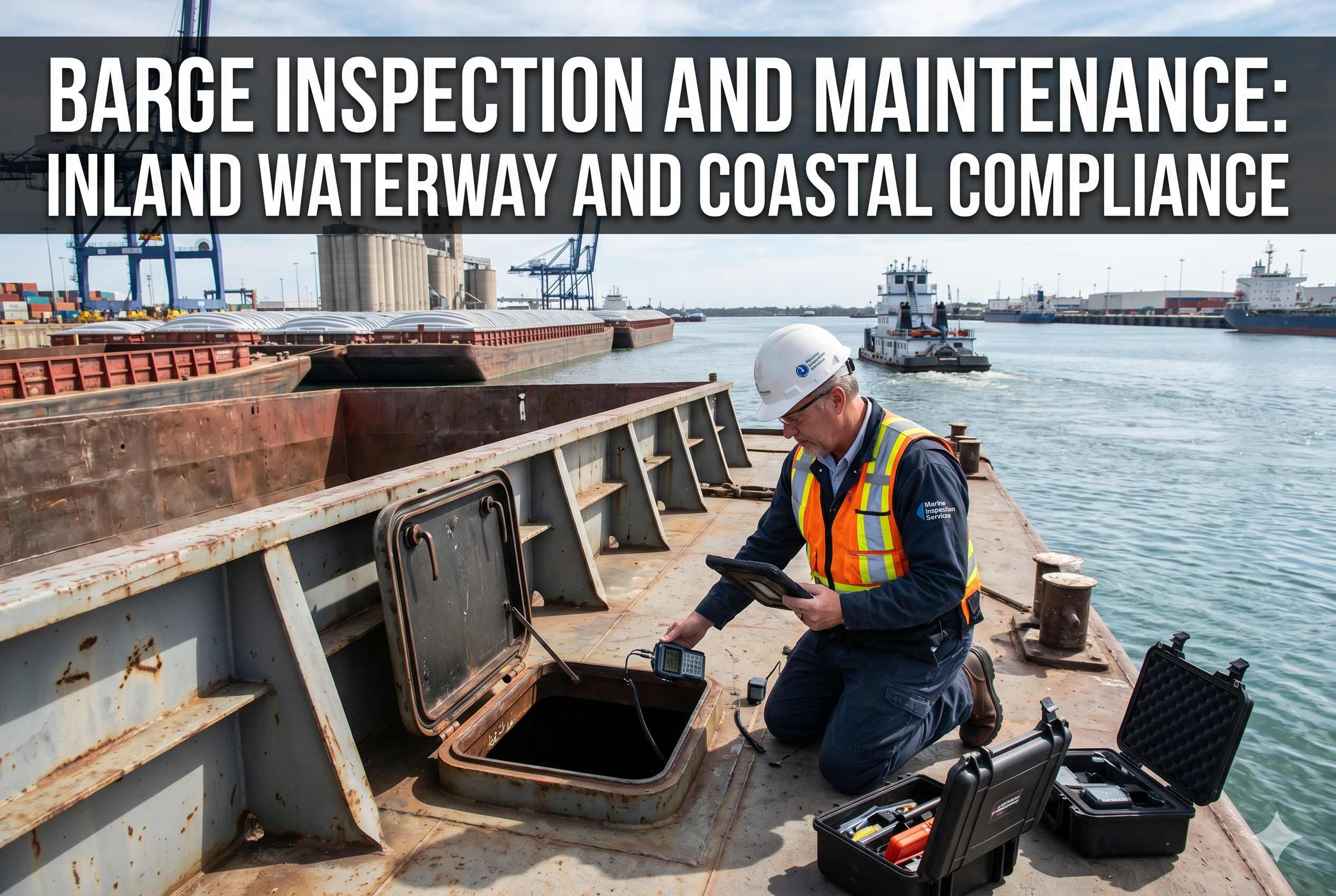
A 15-barge tow on the Lower Mississippi moves 22,500 tons of cargo as a single unit — the equivalent of 225 railroad cars or 870 tractor-trailer trucks. The US inland barge fleet — 22,385 working barges across the Mississippi River System and Gulf Intracoastal Waterway — quietly carries roughly 465 million tons of commodities valued at $158 billion every year, almost a third of US GDP by value. Yet 80% of the lock and dam infrastructure these barges depend on has exceeded its 50-year design life, the average barge is aging fast, and 2024's record-low Mississippi water cost the industry $1 billion in disrupted shipments. For barge operators, inspection isn't optional paperwork — it's the only thing standing between a Certificate of Inspection and a vessel out of service. This guide walks every regulatory layer from USCG Subchapter D, I and O through OPA 90, ABS rules, and Subchapter M push-boat compliance for the operators running America's most underrated freight fleet. Start a free trial of Marine Inspection to digitize barge fleet COI tracking and structural surveys.
The US Inland Barge Industry in 2026 — By the Numbers
22,385
Working Barges (2024)
Mississippi River System + Gulf Intracoastal Waterway
$158B
Annual Cargo Value Moved
~465 million tons of agriculture, energy, chemicals, materials
80%
Locks Past Design Life
237 lock chambers across 191 sites — most over 50 years old
5 Year
USCG Certificate of Inspection
With annual inspections, periodic checks & drydock exams
Why Barge Inspection Sits in a Regulatory Category All Its Own
Barges are the most diverse vessel category the US Coast Guard inspects. A 130 ft tank barge carrying gasoline, a 200 ft dry hopper barge moving corn, a 60 ft spud barge supporting bridge construction, and an unmanned chemical barge carrying anhydrous ammonia all fall under different inspection regimes — sometimes within the same fleet. Most are unmanned. Most are pushed, not towed. Many are over 30 years old. And after the 2024 record low water on the Mississippi cost the industry $1 billion in disrupted shipments, the regulatory and operational case for tighter inspection discipline has never been stronger. Book a Marine Inspection demo to see how barge fleet operators centralize structural surveys, COI documentation, and Subchapter M push-boat records.
The Three-Subchapter Decision: SubD vs SubI vs SubO
For unmanned tank barges carrying liquid bulk cargo, USCG inspection regulations give the owner a structural choice. Most operators don't realize how consequential it is — the subchapter under which a barge is certificated determines decades of inspection cycles, equipment requirements, and crew training obligations. Per 46 CFR 151.01-10, the owner notifies the OCMI of the option at COI application time; default is Subchapter D.
DEFAULT
Subchapter D
Tank Vessels
46 CFR Parts 30–39
The default regime for unmanned tank barges carrying flammable / combustible liquids in bulk. Detailed requirements for cargo tank arrangement, vapor control, overfill protection, fire safety, and electrical equipment.
5-year COI cycle with annual inspections
Stricter cargo handling and tankerman requirements
Required for bulk dangerous cargoes per Table 30.25-1
ALTERNATIVE
Subchapter I
Cargo & Miscellaneous Vessels
46 CFR Parts 90–99
Owner can opt into SubI for tank barges carrying cargoes from Table 151.05 that are not flammable or combustible enough to require SubD treatment. Requires written election at COI application time.
Lighter administrative load for low-flammability cargoes
Form CG-3752 with explicit SubI election required
Hull, machinery, lifesaving still inspected to SubI standard
DANGEROUS BULK
Subchapter O
Certain Bulk Dangerous Cargoes
46 CFR Part 151
Layered ON TOP OF SubD or SubI for bulk chemicals, liquefied gases, and other Table 151.05 cargoes. Adds segregation, materials, monitoring and emergency requirements unique to the cargo type.
Specialized cargo containment requirements
Cargo-specific tank materials and coatings
Tank monitoring, level alarms, gauging
The Six Barge Types Every Operator Needs to Inspect Differently
"Barge" describes a hull form, not a job. The inspection priorities, structural concerns and equipment scope vary dramatically across the six common barge categories. Knowing which category your equipment falls into tells you where most findings will appear.
TANK
Tank Barge
Liquid bulk: petroleum, chemicals, LPG, anhydrous ammonia
Market share: 37% of NA fleet, 49.8% globally — dominant segment
Inspection priorities: tank coating integrity, vapor control system, overfill protection, pressure relief valves, double-hull (post-OPA 90)
Cycle: 5-year COI under SubD/O with internal tank exams
COVERED
Dry Hopper Covered
Grain, fertilizer, sensitive dry bulk requiring weather protection
Cargoes: ~60% of grain/soybean exports through Mississippi elevators arrive by covered barge
Inspection priorities: hopper coaming integrity, cover seals, hatch operation, internal coating condition, sweat / condensation management
Risk: moisture infiltration ruining cargo, hopper corrosion accelerated by agricultural chemistry
OPEN
Dry Hopper Open
Coal, sand, rock, stone, scrap steel, ore
Cargo profile: primary tonnage carrier — coal alone 512M short tons US production 2024
Inspection priorities: hull plating thickness (continuous abrasion from cargo loading), cargo box integrity, freeing arrangements, fender system
Risk: heavy bulk loads accelerate hull and stringer fatigue, freeing port blockage
DECK
Deck / Flat-Top Barge
Heavy lift, oversized cargo, modular construction units, project cargo
Cargoes: wind turbine components, transformers, modular plant sections, construction equipment
Inspection priorities: deck plate condition, lashing point integrity, ballast tank surveys, sheave / pad eye certification, watertight integrity
Special: often requires load line endorsement and may operate beyond Boundary Line
SPUD
Spud / Construction Barge
Bridge construction, dredging, pile driving, marine construction work
Configuration: deck barge with vertical spuds for positioning, often equipped with crane or pile driver
Inspection priorities: spud well wear and structural reinforcement, crane base integrity, lifting gear certification, deck loading limits
Use: typically Subchapter I cargo & misc vessel certification
SPECIAL
Liquid Mud / Bulk Cement
Oilfield service, drilling support, specialty cement transport
Cargo profile: drilling muds, brines, fracturing fluids, bulk cement, barite, calcium chloride
Inspection priorities: cargo tank coating chemistry compatibility, agitator systems, transfer piping, pneumatic discharge systems on cement barges
Subchapter: SubD or SubO depending on cargo classification
The Anatomy of a Barge Hull Inspection
The single biggest difference between barge inspection and any other vessel survey is the structural focus. With no propulsion, no superstructure, and limited machinery, the inspection is overwhelmingly about steel — plating thickness, framing, weld integrity, internal compartments. The USCG Marine Safety Manual Vol II and Vol IV detail the structural exam requirements; a thorough survey works systematically through the barge's primary structural zones.
Primary Structural Zones — Barge Hull Inspection
A
Bottom Plating
Continuous-contact zone with ground in shallow draft and at lock walls. UTM thickness measurements at multiple locations, pitting depth surveys, weld seam integrity.
B
Side Shell & Knuckle
High-impact zone where barge contacts other barges in tow and lock walls. Inspect for buckling, fracture lines, deformation, paint loss revealing corrosion.
C
Deck Plating
On dry hopper barges: cargo loading and unloading wear. On tank barges: deck piping support, expansion dome attachments. Standing water corrosion under deck fittings.
D
Forward / Aft Rake
The angled fore and aft sections that allow the barge to part water. Inspect for impact damage from grounding, weld integrity at rake-bottom intersections, rake tank watertight integrity.
E
Forepeak / Aftpeak Tanks
Void or ballast compartments at the bow and stern raked sections. Internal exam for corrosion, debris, watertightness, manhole cover gaskets, sounding tube integrity.
F
Internal Framing & Stringers
Longitudinal stringers, transverse frames, deep beams. NDT on welded connections. Stringer-to-bottom plating welds carry the cargo loads.
G
Bulkheads & Penetrations
Watertight transverse bulkheads, cofferdam boundaries, piping and electrical penetrations, striker plates. Per MSM Vol IV Ch. 6.H — fastening, rivets, welding all examined.
H
Cargo Tank / Hopper Internals
Tank coating condition (epoxy, zinc, special-cargo materials), pitting maps, cathodic protection anodes, baffles, suction wells, cleaning evidence (Marine Chemist Certificate for tanks containing residue).
Tank Barge Specifics: Cargo Containment, Vapor Control, Overfill Protection
Tank barges face the strictest inspection regime in the fleet. Beyond hull structure, every system that touches the cargo — from the bottom of the tank to the vapor control valve — has individual inspection criteria. The Streamlined Inspection Program (SIP) for SubD/O Tank Barges drives an annual checklist that operators run between 5-year COI cycles. Sign up for Marine Inspection to digitize your tank barge SIP workflows.
Cargo Containment Systems
01
Cargo Tank Internal Examination
Coating condition mapping, pitting depth, weld integrity, baffle condition. Marine Chemist Certificate required for entry. Internal exam interval per class society and CFR.
02
Cargo Piping & Hoses
Pressure testing per ASME B31.1, hydrostatic test affidavit, hose certification (annual visual + periodic pressure test), cargo manifold valves, transfer drip pans.
03
Pressure Relief Valves & Vacuum Breakers
Tank PV valves set to design pressure, function tested, freeze protection. Cargo vent system clearance from sources of ignition. Flame screens and arresters in date.
Cargo Operations Safety
04
Vapor Control System (VCS)
Per 33 CFR 154.820 / 46 CFR 39: vapor collection piping, manifold isolation valve, oxygen content monitoring, inert gas system if required. COI endorsement specifies which cargoes are VCS-approved.
05
Overfill Protection (46 CFR 39.20-9)
Each tank fitted with overfill alarm, automatic shutdown, or independent gauging. Critical for vessel-shore vapor-collected operations. Function-tested per CFR.
06
Cargo Gauging & Monitoring
Tank level gauges, temperature monitoring (if applicable), pressure monitoring, remote shutdown function tests, indicator panel readability.
Required Markings & Documentation
07
Deck Markings (46 CFR 35.30-1)
Expansion domes and slop tank openings marked "Danger Keep Out", red flag/red light operable, white safety stripe on deck perimeter clearly marked, cargo information cards or MSDS posted.
08
Required Documents Onboard
Certificate of Inspection, OPA 90 approval letter, Certificate of Financial Responsibility, Stability Letter, Transfer Procedures, VCS procedures, benzene monitoring program, hydrostatic test affidavit, person-in-charge designation.
Stop Running Tank Barge Compliance Out of Filing Cabinets
SubD/O SIP checklists, vapor control endorsements, cargo piping pressure tests, overfill device function logs — fleet-wide visibility, instant audit-ready exports.
OPA 90 and the Tank Barge Double-Hull Era
The Oil Pollution Act of 1990 — passed after the Exxon Valdez — fundamentally reshaped tank barge construction in the US. The single-hull tank barge phase-out followed a multi-decade horizon, with the final cutoff hitting in 2015. Today, every US tank barge operating in domestic trade is double-hulled. Understanding the OPA 90 layer matters because every tank barge built before 2015 still carries forward inspection records, repair history, and class status that affects insurance, financing and resale.
1990
OPA 90 Enacted
Mandates double-hull for all new tank vessels carrying oil; phase-out of single-hull tankers and barges over an extended timeline.
1995
All New Builds Double-Hull
From this point onward, no single-hull tank barge could be ordered for delivery to US flag service.
2005–2010
Mid-Phase Retirements
Single-hull tank barges began aging out of service based on size and year-built thresholds — owners commit to scrap or rebuild.
2015
Final Single-Hull Cutoff
Final OPA 90 deadline: no single-hull tank barge may carry oil in US waters. Today every domestic tank barge is double-hull.
The MSM Vol II / IV Inspection Categories Surveyors Actually Use
The USCG Marine Safety Manual is the working document used by every Coast Guard marine inspector boarding a barge. It groups inspection items into functional categories. Here's how the inspection actually unfolds in practice, organized the way the inspector's checklist runs.
Cargo Containment
Cargo tanks, tank insulation, secondary barriers, marine portable tanks
Cargo Handling
Cargo piping, pump & compressor rooms, pressure relief valves, cargo hoses, vent systems, gauging systems, overfill protection
Vapor Collection
Vapor Control System (VCS), inert gas system, oxygen monitoring, vapor manifold isolation, vapor connection markings
Pollution Prevention
Oil/water/waste retention, oily bilge/ballast discharge, prohibited oil spaces, MARPOL compliance, fuel oil/cargo oil containment
Fire Protection
Fire control plan, structural fire protection, fire doors and controls, fire axes, paint/oil/lamp stowage
Lifesaving & Emergency
Emergency towing arrangement, discharge removal/spill kit, emergency lightering equipment, MARPOL placards
Structural & Decks
Bulkhead penetrations, striker plates, fastening/rivets/welding (MSM Vol IV Ch. 6.H), guards/ladders/rails, forward/aft peak/rake
Operations & Documentation
Person-in-charge designation, Marine Chemist Certificate, transfer procedures, COI/CFR/stability letter onboard, deck markings legible
Push-Boat Compliance: Where Subchapter M Meets the Barge Fleet
An unmanned barge is only useful when something pushes it. The towboat or pushboat moving your barges is itself a regulated towing vessel under USCG Subchapter M (46 CFR Parts 136–144) — fully phased in since 19 July 2022. Barge operators with their own pushboat fleets carry the additional weight of Subchapter M compliance for each towing vessel. Operators contracting tow services share responsibility for ensuring the contracted pushboat's COI status. Book a demo to see integrated barge + pushboat compliance workflows.
The Pushboat Side of the Tow
Subchapter M COI
Every covered US towing vessel has a USCG Certificate of Inspection — annual inspections, periodic checks, drydock examinations, valid 5 years. Operator chose TSMS option (third-party SMS) or USCG option (annual direct inspection) at first COI.
TSMS Documentation
For TSMS-option pushboats: written SMS, internal audit cycle, external Third-Party Organization audits, Responsible Carrier Program (RCP) records if applicable.
Crew Endorsements
Towing-vessel licensed officers, drug/alcohol test records, medical certificates, watchstanding records, training documentation per Part 140.
The Barge Side of the Tow
Barge COI
Each tank barge under SubD/O carries its own COI on a 5-year cycle. Dry barges under SubI similar. COI references vessel name, hull number, route authorized, cargoes approved.
Person-in-Charge
Tankerman PIC during cargo transfer operations on tank barges. Documented PIC designation, training records, transfer procedures followed.
Combined Tow Operations
Tow makeup, towline integrity, lashing arrangements, lighting requirements, navigation rules. Both pushboat operator and barge owner share liability.
The 2024 Crisis: What Aging Infrastructure Means for Operators
The barge industry's biggest 2026 risk isn't regulatory — it's physical. Aging fleet, aging infrastructure, and a climate of more extreme low-water and flood events are converging. In 2024 alone, low water on the Mississippi cost the industry $1 billion in disrupted shipments. And the data tells the story.
$1B
Mississippi Low-Water Losses (2024)
Record low water levels disrupted ag goods transport — barges loaded below capacity, slower transit, alternative mode shifts.
80%
Locks Past 50-Year Design Life
237 lock chambers across 191 sites — most over 50 years old, prompting unscheduled closures and capacity bottlenecks.
+13%
Steel Plate PPI Increase YoY
December 2024 fabricated steel plate PPI hit 254.5 — building new replacement barges remains expensive.
5.5%
Profit Margin (2026 vs 6.6% in 2021)
Industry profit compressed by weather delays, lock closures and rising maintenance — inspection failures hurt more than ever.
The Cost of a Failed Barge Inspection
For an unmanned barge, a COI deficiency isn't paperwork. It's lost charter days, regulatory scrutiny on every other vessel in the fleet, and in worst cases an environmental incident that ends the company. Knowing the actual cost of poor inspection discipline is what justifies the digital investment.
Days
COI Suspension
A barge out of service waiting for re-inspection misses every charter window — direct revenue loss plus charter penalty exposure.
Concurrent
Fleet-Wide Scrutiny
Findings on one barge often trigger increased inspection focus on the rest of the fleet — a single failure cascades.
$$$M
OPA 90 Spill Response
A tank barge spill triggers federal cost recovery, state environmental claims, NRD assessments — single events have ended companies.
Insurance
Premium Surge / Cover Loss
P&I and hull underwriters track inspection findings across the fleet — premium surcharges and renewal denials follow patterns.
How Digital Inspection Software Reshapes Barge Fleet Operations
Manual binders work for a 5-barge family operation. They break down at fleet scale. Digital inspection platforms transform the operational reality for fleet operators running 50, 200 or 1,000 barges across multiple river systems.
01
Fleet-Wide COI Status Dashboard
Every barge's Certificate of Inspection — issue date, expiry, conditions, route authorized, cargoes approved — visible in one fleet view. Alerts at 90/60/30 days before expiry.
02
Structural Survey History
UTM thickness measurements, internal exam records, NDT reports, repair histories — searchable by hull number, location, dock, drydock period. The data class society and OCMI request first.
03
Tank Barge SIP Compliance
Annual SIP checklist for SubD/O tank barges — required documents, deck markings, lifesaving, fire safety, vapor control, cargo handling — completed in field, signed digitally.
04
Pushboat + Barge Combined View
Subchapter M COI for pushboats, individual COIs for each barge in a tow, crew endorsements, transfer procedures — combined operational compliance picture for any planned tow.
05
Defect-to-Closure Tracking
Each finding becomes a corrective action with assigned owner, due date, evidence required, closure approval. Audit trail for OCMI, ABS surveyor, and P&I underwriter.
06
Mobile Field Capture
Crew capture inspection evidence on mobile or tablet — works at fleeting facilities, drydock, mid-tow. Photos auto-tagged to hull number, location, date — searchable forever.
Run Barge Compliance Like a Modern Fleet Operator
Tank barge SIP, hull surveys, OPA 90 records, Subchapter M push-boat docs, ABS class status — one platform built for fleet-scale barge operations.
Pre-COI Barge Inspection Readiness Checklist
Use this as a pressure-test before submitting Form CG-3752, before the OCMI boards for a periodic, or before drydock. Items below are the highest-rate findings on US inland barge inspections.
Barge Pre-Inspection Quick-Check
Documentation & Certification
Certificate of Inspection current; renewal application 30+ days before expiry (Form CG-3752)
OPA 90 approval letter and emergency notification procedures onboard
Certificate of Financial Responsibility (COFR) onboard and current
Certificate of Documentation, Stability Letter (if required) onboard
ABS or other class society survey status current
Hull & Structural
Bottom plating UTM measurements within acceptable wastage limits
Forepeak / aftpeak rake tank internal exam current; manhole gaskets sound
Cargo tank internals inspected; coating condition documented; Marine Chemist Certificate for entry
Bulkhead penetrations sealed; striker plates intact; fastening/rivets/welding examined
Drydock examination current per CFR / class cycle
Cargo Systems (Tank Barges)
Cargo piping pressure-tested; hydrostatic test affidavit onboard
Pressure relief valves tested and tagged; vapor manifold marked vapor/liquid
Overfill protection device installed and function-tested per 46 CFR 39.20-9
Vapor Control System (VCS) endorsement on COI matches cargoes carried
Cargo hoses certified, in date, stowed properly
Markings, Safety & Pollution
Expansion domes / slop tank openings marked "Danger Keep Out"
Red flag in place and painted, red light operable
White safety stripe on deck perimeter clearly marked
MSDS / Cargo Information Cards posted
Discharge removal/spill kit, emergency lightering equipment onboard
Person-in-charge designation documented and onboard during transfers
Frequently Asked Questions
Which subchapter applies to my tank barge — D, I or O?
Subchapter D is the default regime for unmanned tank barges carrying flammable or combustible liquids. Per 46 CFR 151.01-10, owners can elect Subchapter I for tank barges carrying Table 151.05 cargoes that aren't classed as flammable / combustible — but the election must be made in writing on Form CG-3752 at COI application time. Subchapter O layers on top of D or I for bulk dangerous cargoes (chemicals, liquefied gases). Most commercial tank barge operators run SubD as the practical default; SubI is the exception case.
How often must a barge be drydocked for inspection?
USCG inspection regulations and class society rules together drive drydock cycles. Tank vessels are inspected at least every 5 years per 46 CFR 31.10-15, with internal structural exams, drydock exams, and underwater surveys at intervals defined by the OCMI and class. Many barges operate on a 5-year COI cycle with a drydock survey at the renewal point and underwater surveys allowed in lieu under specific conditions. ABS or other recognized class society plans and certificates may be accepted as evidence of structural efficiency under 46 CFR 31.10-1(c).
Are unmanned barges actually inspected, or just the pushboat?
Both — separately. Unmanned tank barges and most cargo barges over 25 GT carry their own USCG Certificates of Inspection on a 5-year cycle with annual inspections. The pushboat (towing vessel) carries its own COI under Subchapter M. Per 46 CFR 31, tank barges "need not be manned unless, in the judgment of the OCMI, such manning is necessary." Inspection requirements still apply fully — the absence of crew doesn't reduce the structural, cargo, and safety equipment scope.
Are all US tank barges now double-hull?
Yes. The Oil Pollution Act of 1990 mandated phase-out of single-hull tank vessels in US waters carrying oil. The final cutoff was 2015 — every tank barge operating in domestic trade today is double-hull. The inter-hull void space adds a substantial inspection burden — internal exams must cover not just cargo tanks but also the void space between the inner cargo tank and outer hull plating.
What's the role of ABS in barge inspection?
The American Bureau of Shipping (ABS) and other recognized classification societies set rules for vessel construction and condition. Under 46 CFR 31.10-1(c), ABS-approved plans and certificates may be accepted by the Coast Guard as evidence of structural efficiency of the hull and reliability of machinery. Many barge operators run their fleet to ABS class — the Coast Guard accepts class survey records in lieu of duplicating its own structural exam in many circumstances.
Does Subchapter M apply to my barge fleet?
Subchapter M applies to the towing vessels (pushboats / towboats) — not the barges themselves. If you own pushboats, every covered towing vessel needs a COI under SubM (TSMS option or USCG option), fully phased in since July 2022. The unmanned barges in your tow are inspected under SubD/I/O on their own cycle. If you contract tow services, your operational responsibility includes confirming the contracted pushboat carries valid SubM COI.
How does digital inspection software help with fleet-scale barge operations?
Marine Inspection consolidates COI tracking, structural survey records, cargo system documentation, OPA 90 evidence, ABS class status, and Subchapter M pushboat compliance into a single platform. For fleet operators running 50+ barges across multiple river systems and dock facilities, the alternative is paper binders and spreadsheets that fail at audit time. Digital capture on mobile, fleet-wide dashboards, expiry alerts, and one-click evidence packs for OCMI or class surveyor visits transform fleet operational reality.
22,000+ Barges Carry America's Cargo — Run Yours Audit-Ready
USCG Subchapter D, I, O compliance, ABS class records, OPA 90 documentation, Subchapter M push-boat tracking — all on one platform built for inland and coastal barge operators.