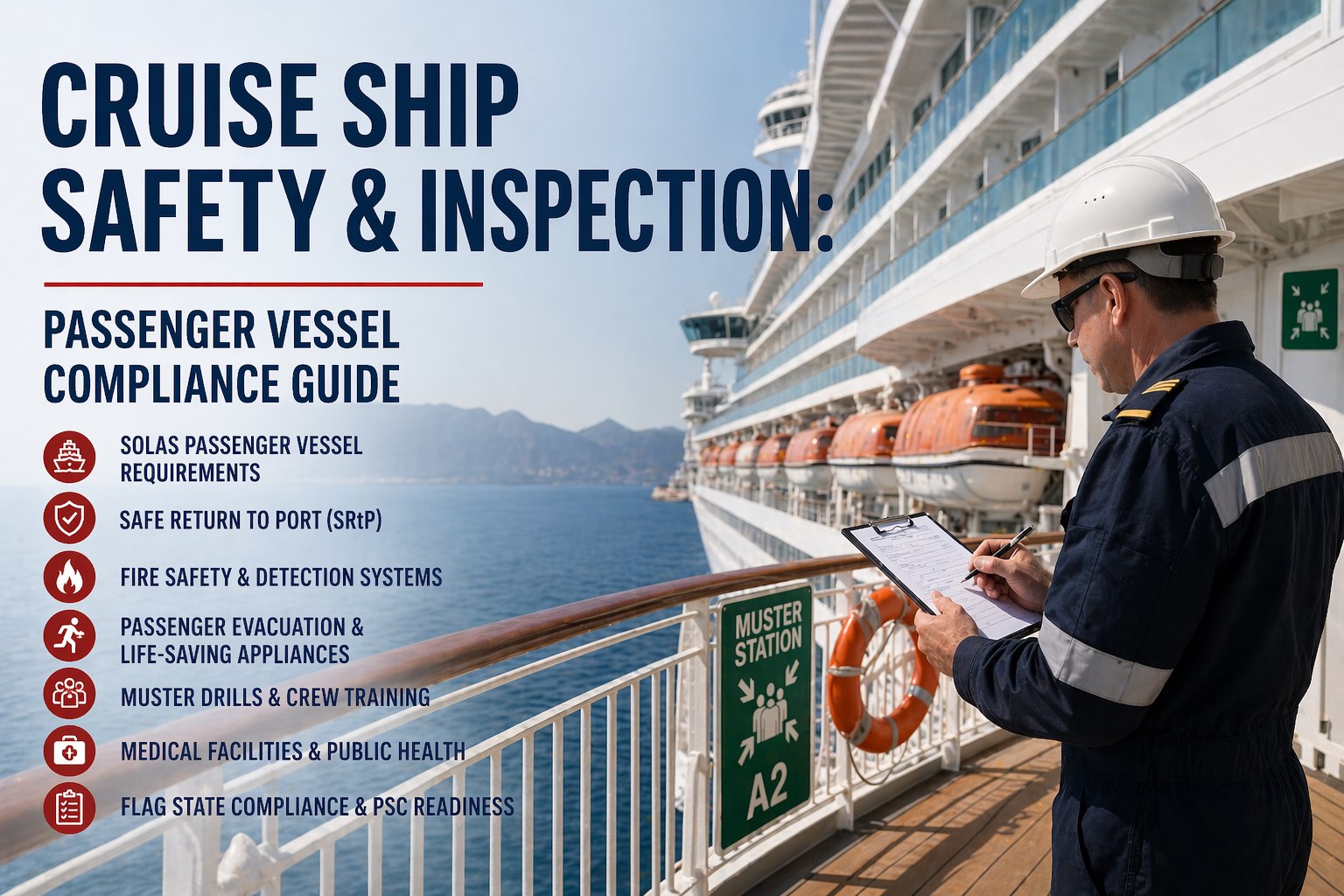
Cruise Ship Safety and Inspection: Passenger Vessel Compliance Guide
A modern cruise ship is not a vessel in the traditional sense — it's a floating city carrying up to 7,600 passengers plus crew across international waters, complete with hotels, restaurants, hospitals, theatres, waterparks and its own power grid. The regulatory load is proportionate. A cruise ship captain answers to SOLAS passenger ship requirements, Safe Return to Port (SRtP) rules born out of the Costa Concordia tragedy, CLIA-adopted ACEP medical standards, CDC Vessel Sanitation Program inspections, flag state scrutiny, and port state control at every port call. This guide explains every layer of cruise ship safety inspection, what changed after 2010 and 2015, what's coming by 2028–2032, and how digital inspection platforms keep mega-ships audit-ready across 14+ decks simultaneously. Start a free trial of Marine Inspection to digitize cruise ship safety documentation fleet-wide.
The Cruise Industry in 2026 — The Numbers
37.7M
Ocean Cruise Passengers (2025)
Up from 34.6M in 2024; projected 41.9M by 2028
370
Ocean-Going Cruise Ships
Total global fleet; CLIA member fleet >310
$168B
Global Economic Impact
Supporting 1.6M jobs across ports worldwide
2 / yr
Unannounced CDC Inspections
Every cruise ship calling U.S. ports + 3 internal audits
Why Cruise Ship Safety is a Category of its Own
Passenger ship rules are the strictest in commercial shipping. A cargo ship losing propulsion is a commercial setback; a cruise ship losing propulsion with 5,000 souls onboard is potentially the next Costa Concordia. The regulatory philosophy since 2010 has therefore shifted dramatically — the ship itself is now treated as "its own best lifeboat," with SOLAS mandating that passenger ships can remain operational and return to port under their own power after a major fire or flooding casualty, rather than depending on evacuation. That philosophy reshaped vessel design, system redundancy, and how every inspection is conducted. Book a Marine Inspection demo to see how cruise operators consolidate all inspection regimes onto one audit-ready platform.
A Single Cruise Ship is Essentially a Floating City
7,600
Max passengers on largest ships
2,350
Crew members onboard
20
Decks
2,805
Staterooms
7+
Restaurants & specialty venues
20+
Bars & lounges
40+
MW installed electrical load
1
Full medical centre with ICU
Figures typical of a modern Icon / Oasis-class vessel. Every one of these systems has its own inspection regime.
Costa Concordia to 2026: How Modern Cruise Ship Safety Was Built
Three disasters — Titanic (1912), Estonia (1994) and Costa Concordia (2012) — shaped every passenger ship rule in force today. The 2012 Concordia sinking killed 32 people and exposed that 600 passengers hadn't yet done the muster drill when the ship grounded; SOLAS was amended within a year. Modern cruise ship safety didn't happen in a straight line — it happened in waves, with each disaster triggering a regulatory response that remains in force today.
1912
Titanic Disaster
1,517 dead. Triggered the first SOLAS Convention in 1914 — originally mandating enough lifeboats for every soul onboard and continuous radio watch.
1994
MS Estonia Capsized
852 dead. Led to SOLAS subdivision and damage stability revisions for Ro-Ro passenger ships (Ro-Pax), plus mandatory bow-door indicators.
2010
Safe Return to Port Enters Force
SOLAS II-1/8-1 and II-2/21–22 — passenger ships with keels laid on/after 1 July 2010, ≥120 m or 3+ main vertical zones, must return to port under own power after a defined casualty.
2012
Costa Concordia Capsized
32 dead. ~600 passengers still awaiting muster drill at grounding. IMO agreed interim measures within 5 months; formal SOLAS III/19 amendment adopted 2013.
2015
Pre-Departure Muster Mandatory
SOLAS III/19 amended — muster of newly embarked passengers now must take place prior to or immediately upon departure, not within 24 hours as before.
2020
Damage Stability Overhaul
MSC 98 SOLAS Chapter II-1 amendments entered force 1 January 2020 — substantive subdivision/damage stability review informed directly by Concordia investigation findings.
2025
Type 4 Stability Computer / Shore Support
From January 2025 — ships ≥120 m or with 3+ fire compartments must carry a Type 4 loading computer onboard OR arrange shore-based emergency support for damaged-condition stability calculations.
2028–32
Revised SRtP Explanatory Notes
SDC 12 (Jan 2026) finalized revised Explanatory Notes covering the full life-cycle of passenger ships. Applies to building contracts from 1 Jan 2028, keels from 1 Jul 2028, or delivery from 1 Jan 2032.
Safe Return to Port (SRtP): The Core Concept Behind Every Modern Cruise Ship
Safe Return to Port is the single most important concept in modern passenger ship safety. Built into SOLAS Regulations II-1/8-1, II-2/21 and II-2/22, it fundamentally shifts the design philosophy away from evacuation and toward survivability. The idea is simple: a cruise ship that suffers a casualty should be able to keep passengers safely onboard and return to port under its own power, rather than forcing them into lifeboats in open sea. In practice, it demands near-complete duplication of essential systems. Sign up for Marine Inspection to digitize SRtP drill records and FMEA documentation.
SRtP Core Requirement
After a fire or flooding casualty within defined thresholds, the ship must return to the nearest port under its own power. If threshold exceeded, essential systems must remain operational for at least 3 hours to support orderly evacuation — even with one entire main fire zone lost.
SOLAS II-1/8-1 + II-2/21 + II-2/22
Propulsion & Steering
Duplicated propulsion lines, redundant steering, independent control systems surviving one fire zone loss
Electrical Power
Main + emergency + redundant generation; emergency generator (II-1/42) capable of supporting SRtP essential services
Internal / External Comms
PA system, crew radios, bridge-to-shore satellite, emergency broadcast — all redundant across fire zones
Fire Detection & Suppression
Detection within main vertical zones, fire pump redundancy, drencher duplication, structural A/B class boundaries
Bridge redundancy, backup ECDIS, independent position fixing, chart back-ups in separate fire zones
Safe Areas for Passengers
Pre-designated passenger shelter areas with ventilation, sanitation, medical support, food/water for 3-hour orderly evacuation
Decision Support System
Real-time scenario guidance for Master per SOLAS III/29; documents available in multiple locations covering foreseeable casualties
Operational reality: SRtP drills must be carried out by the crew at intervals not exceeding 3 months. Touch drills can be combined with other scheduled drills. Every SRtP ship must have company-authored SRtP procedures integrated into the SMS before delivery, with the Master able to initiate them within minutes of a casualty.
Muster Drills: The Single Biggest Change in Passenger Safety
Before the Costa Concordia, muster drills could be held any time within the first 24 hours of sailing. About 600 Concordia passengers hadn't yet mustered when the ship grounded off Giglio. IMO moved fast — interim measures in May 2012, formal SOLAS III/19 amendment adopted June 2013, entered into force 1 January 2015. Since then, every passenger must complete muster prior to or immediately upon departure. The regulation did not specify format, which allowed virtual ("e-muster") drills to emerge during the pandemic. Schedule a demo to digitize your muster attendance tracking.
BEFORE 2015 — Legacy Regime
Muster within 24 hours of embarkation
Ship allowed to depart before drill completion
Large crowds in a single assembly period
Low attendance tracking rigor
Limited crew accountability for missing passengers
Why it failed Concordia: the ship grounded while ~600 passengers had not yet attended their muster — increasing chaos and loss of life during evacuation.
FROM 2015 — Current SOLAS III/19
Muster prior to or immediately upon departure
In-person OR e-muster drill with station scan
Stateroom cards scanned at each muster station
Mandatory safety briefing in multiple languages
Non-participants tracked and offloaded at next port
Enforcement: USCG and Port State Control authorities verify compliance records. Non-participants can be denied boarding or disembarked at the next port of call without refund.
All Passenger Ship Drills at a Glance (SOLAS III/19 + II-2)
WeeklyRadio / GMDSS equipment testing, batteries, EPIRB surface test
WeeklyAbandon ship drill + fire drill on passenger ships (per III/19.3.2)
MonthlyRescue boat launched and manoeuvred in water
Every 2 monthsEnclosed space entry and rescue drill (added via III/19 amendment)
Every 3 monthsLifeboat launched with assigned crew and manoeuvred
Every 3 monthsSRtP drills (SRtP-equipped passenger ships)
Every departureMuster of newly embarked passengers with stateroom-card scan
Stop Tracking Cruise Safety in Spreadsheets
Muster records, lifeboat launch logs, fire drill attendance, SRtP drill evidence — all timestamped, photo-documented and port-state-ready in one unified platform.
Fire Safety: The #1 Cause of Cruise Ship Casualties
Fire is historically the single biggest threat to any passenger ship — the Carnival Triumph engine-room fire (2013), Carnival Freedom funnel fire (2023) and the Viking Sky power loss (2019) all demonstrate how quickly a technical issue can escalate when 5,000 people are onboard. SOLAS Chapter II-2 structures cruise ship fire safety in three concentric layers: prevention through structural fire protection, detection through mandatory systems, and containment-and-response through main vertical zones and fixed suppression.
LAYER 1
Structural Fire Protection
Main Vertical Zones (MVZ): maximum 48 m in length, bounded by A-60 class divisions. Any passenger ship >96 m LOA typically has 3+ MVZs, triggering SRtP applicability.
A/B class divisions: steel bulkheads and decks insulated to prevent temperature rise on the unexposed side during a 60-minute fire.
Restricted combustibles: all accommodation joinery, linings, ceilings and paint must meet non-combustible or low flame-spread standards per FTP Code.
FRP scope expanding: SDC 12 (January 2026) finalized revised interim guidelines for fibre-reinforced plastic elements in ship structures — to be submitted to MSC 111 May 2026.
LAYER 2
Detection & Alarm Systems
Individually addressable detectors (from 1 January 2026) mandatory on new-build Ro-Ro / vehicle spaces — driven by electric vehicle fire risks.
Continuous smoke detection in all accommodation, service spaces and control stations; heat detectors in galleys; flame detection in high-risk machinery spaces.
Central fire control station continuously manned, with direct displays of all detector zones, alarm positions, ventilation dampers and fire door status.
Bunker fuel flashpoint: from 1 January 2026 suppliers must certify minimum 60 °C flashpoint on every Bunker Delivery Note.
LAYER 3
Suppression & Response
Fixed fire-extinguishing systems: CO₂ for machinery spaces, water mist or sprinkler in accommodation and service spaces, dry chemical or foam in high-risk zones.
Duplicated drencher pumps — compliance with SRtP demands redundancy across main vertical zones, per MSC.1/Circ.1369 explanatory notes.
Firefighter outfits: minimum of 2 sets per main vertical zone plus centralized SCBA charging station; breathing apparatus serviced to manufacturer + SOLAS II-2/10 intervals.
Fire patrol: continuous patrol through accommodation and service spaces during sailing, logged in the fire rounds book — PSC officers check this on every inspection.
Cruise Ship Medical Facilities: ACEP Guidelines & CLIA Enforcement
Unlike most inspection topics where SOLAS sets the rule, cruise ship medical facilities operate under a voluntary-but-mandatory framework: the American College of Emergency Physicians (ACEP) publishes guidelines, the Cruise Lines International Association (CLIA) makes them contractually binding on all member oceangoing lines carrying 100+ persons, and flag states and port authorities verify compliance. The guidelines were first published in 1995, revised October 2023, and cover facilities, staffing, equipment, pharmacy, infection control and documentation. Sign up to track medical facility audits digitally.
ACEP 2023
Cruise Ship Medical Facility Requirements
Mandatory for all CLIA oceangoing cruise line members
Facility
1 inpatient bed per 1,000 persons onboard
1+ isolation room or isolation capability
Wheelchair/stretcher accessible
ADA-accessible toilet (new builds post-1997)
Secure storage for medical supplies and controlled drugs
Staffing (24/7)
≥1 physician + ≥1 clinical provider at sea
≥3 years post-graduate clinical experience
Emergency cardiovascular care competency
Procedural sedation skills
Rapid response team trained & drilled monthly
Core Equipment
2 defibrillators + cardiac monitors
EKG + lab testing capability
Oxygen delivery systems
Stretcher + spinal backboard
Wheelchairs + patient transport
Clinical Practice
Stabilize critically ill / injured patients
Appropriate diagnostic & therapeutic intervention
Medical evacuation coordination when required
Communicable disease screening / isolation
CDC Vessel Sanitation Program compliance
Passenger Vessel Classes: One Title, Five Regulatory Profiles
"Passenger vessel" covers wildly different operations. A 7,600-passenger Icon-class mega-ship, a 2,000-passenger North Sea Ro-Pax, a 200-berth expedition vessel and an intra-island ferry all carry passengers but face different SOLAS sub-regimes. Knowing which one applies to your fleet prevents compliance gaps — and surprises at PSC inspections.
01
Mega Cruise Ships
>5,000 pax, full SOLAS + SRtP
SOLAS II-1/8-1 SRtP mandatory
Type 4 loading computer or shore support (2025)
ACEP medical + CDC VSP
E-muster with individual scan
02
Mid-Size Cruise Ships
1,500–5,000 pax, full SOLAS + SRtP
All SOLAS passenger chapters apply
SRtP if ≥120 m or 3+ MVZs
ACEP medical standard
Full muster regime & SRtP drills
03
Ro-Pax & Car Ferries
Ro-Ro passenger, SOLAS + Stockholm Agreement
SOLAS II-1 damage stability (post-Estonia)
Bow / stern door indicators
Weather-tight deck integrity
Regional: Stockholm Agreement (NW Europe)
04
Expedition & Polar Cruise Ships
Small pax (100–500), SOLAS + Polar Code
SOLAS Chapter XIV Polar Code (since 2017)
Polar Ship Certificate + PWOM
Cold-weather life-saving appliances
Enhanced crew polar training
05
Mega Yachts & PYLC
<36 pax commercial, under Passenger Yacht Code
Passenger Yacht Code (Red Ensign Group)
Alternative compliance for some SOLAS items
MCA / Cayman / Isle of Man flag rules
Charter guest briefing protocols
06
Non-SOLAS Domestic Passenger
Domestic trading only, national rules
Flag state domestic passenger regulations
EU Directive 2009/45/EC (European domestic)
USCG Subchapter H / K / T (USA)
IMO model legislation guidance available
The Inspection Oversight Stack: Who Actually Checks a Cruise Ship
Cruise ships are among the most scrutinized vessels at sea. Between flag state statutory surveys, class society intermediate checks, port state controls at every call, CDC vessel sanitation inspections, internal company audits, and industry-body verification — most ships face inspection-like scrutiny more than 20 times per year. This is the oversight pyramid behind every voyage.
Tier 1 — Foundation
Flag State Statutory Surveys
Initial / annual / intermediate / renewal surveys by Flag Administration or Recognized Organization. Issue Passenger Ship Safety Certificate under SOLAS I/12.
Tier 2 — Class
Classification Society Surveys
DNV, Lloyd's Register, ABS, Bureau Veritas, RINA, ClassNK. Hull and machinery condition surveys, SRtP verification, class notations maintained throughout service life.
Tier 3 — Port State
Port State Control (PSC)
Paris MoU, Tokyo MoU, USCG, others. Inspect foreign-flagged vessels for SOLAS / MARPOL / MLC / ISM compliance. Detention power if serious deficiencies found.
Tier 4 — Public Health
CDC Vessel Sanitation Program
Every ship calling U.S. ports receives 2+ unannounced CDC inspections/year. Scores publicly posted. Legionella Team handles legionellosis reports.
Tier 5 — Industry
CLIA Policies & Internal Audits
CLIA mandatory policies (medical, health, security). 3+ internal audits per ship per year. Company-specific superintendent inspections and third-party vetting.
The Cost of a Cruise Ship Inspection Failure
A cruise ship deficiency isn't just a compliance issue — it's a front-page news event. Detentions generate days of negative headlines, refund obligations, and long-term brand damage. The financial and reputational stakes dwarf any other passenger vessel segment.
$2M+
Daily revenue at risk
Mega-ship daily revenue runs into millions; cancelled itineraries mean refunds, compensation and lost per-passenger on-board spend.
$168B
Industry contribution — under scrutiny
Cruise delivers $168B global economic impact. Every detention affects destination relationships, port agreements and regulatory goodwill.
30+ days
CDC publication visibility
CDC VSP inspection scores are public. A poor score stays visible for months, affecting travel agent recommendations and booking confidence.
5,000+
Passengers per ship
Every safety incident involves thousands of witnesses with smartphones, social media and lawyers — reputation risk dwarfs direct cost.
How Digital Inspection Software Changes Cruise Ship Safety
Managing safety documentation on a 20-deck, 5,000-passenger ship using paper binders or SharePoint folders is how audit findings appear. A modern digital platform centralizes every certificate, drill log, muster record, medical facility check, and corrective action across the fleet — accessible to port captains, DPAs, and flag surveyors in real time. Book a Marine Inspection demo to see cruise-ship-ready workflows live.
01
Passenger Muster Tracking
Stateroom card scan data aggregated in real time. Non-participants flagged to Chief Purser and Master. SOLAS III/19 compliance evidenced per voyage.
02
SRtP Drill Documentation
Three-monthly SRtP drills digitally logged with scenario, participating crew, systems tested and outcomes — fully searchable for flag state audit.
03
Fire Safety & Rounds Log
Continuous fire patrol logged on mobile, with zone covered, time, observations and any defects auto-generating a corrective action work order.
04
Lifeboat & LSA Maintenance
Every lifeboat launch, davit inspection, life jacket check, liferaft servicing and EPIRB test tracked — due dates alerted 90/60/30 days ahead.
05
Medical Facility Audits
ACEP guideline compliance tracked: drug expiry, equipment calibration, staff credential currency, monthly rapid-response team exercise records.
06
CDC VSP Readiness
Galley, potable water, pool, spa, child-care and medical facility check records kept in the format CDC inspectors expect — searchable in seconds.
Use this quick-check to pressure-test your ship before the next port call, flag survey or CLIA audit. It's not exhaustive — it covers the items PSC officers and CDC VSP inspectors open the inspection with.
Cruise Ship Safety Quick-Check (2026 Edition)
SRtP & Damage Control
SRtP Compliance Certificate valid with current survey endorsement
Type 4 loading computer operational OR shore-based support agreement active
SRtP drills completed at ≤3-month intervals with participants logged
Damage control plans and Decision Support System current
Passenger Muster & Drills
Every passenger mustered prior to / immediately upon departure
Stateroom card scan data retained per voyage
Weekly fire and abandon ship drills (passenger ship cadence)
Quarterly lifeboat launch with full assigned crew
Fire Safety
Main vertical zone A/B class divisions verified intact
Addressable detection systems serviced (Ro-Ro: individually addressable from 2026)
Fuel flashpoint declared on Bunker Delivery Notes (≥60 °C)
Fixed fire-fighting systems within servicing intervals; drencher pumps duplicated
Medical Facility (ACEP / CLIA)
1 inpatient bed per 1,000 persons onboard; isolation capability
Galley HACCP records current with temperature logs
Potable water disinfection + Legionella control programme active
Pool, spa and child-activity area sanitation logs
Pre-boarding passenger health screening protocol
Get Your Cruise Fleet Inspection-Ready
Muster tracking, SRtP drills, fire safety rounds, medical facility audits, CDC VSP prep — consolidated into one cloud platform accessible from bridge, engine control room or head office.
What is Safe Return to Port (SRtP) and which ships does it apply to?
SRtP is the SOLAS requirement (Regulations II-1/8-1, II-2/21, II-2/22) that a passenger ship must be able to return to port under its own power after a fire or flooding casualty within defined thresholds. It applies to passenger ships with keels laid on or after 1 July 2010 that are 120 m or longer OR have three or more main vertical zones. Revised Explanatory Notes agreed at SDC 12 (January 2026) will apply to new contracts from 2028 and deliveries from 2032.
Why did the muster drill rules change in 2015?
The Costa Concordia sank in January 2012 with about 600 passengers who had not yet completed their muster drill. IMO responded within months — formal SOLAS III/19 amendments adopted in 2013 and entered into force 1 January 2015. The muster of newly embarked passengers must now take place prior to or immediately upon departure, rather than the previous "within 24 hours."
Are virtual (e-muster) drills SOLAS compliant?
Yes, provided they deliver the safety information required under SOLAS III/19 and each passenger physically visits their muster station for a stateroom-card scan confirming attendance. Most major cruise lines (Royal Caribbean, Carnival, Norwegian, Princess, Holland America, Virgin Voyages) use e-muster. Disney Cruise Line and MSC Cruises typically use fully in-person drills.
Who regulates medical facilities on cruise ships?
There is no single international regulator, which makes the CLIA + ACEP framework functionally mandatory. The American College of Emergency Physicians publishes the Health Care Guidelines for Cruise Ship Medical Facilities (updated October 2023), and CLIA makes those guidelines contractually binding on its oceangoing member lines carrying 100+ persons. Flag states and port authorities verify compliance during inspections.
How many inspections does a cruise ship actually face each year?
More than 20 inspection-like events in a typical year: flag state annual and intermediate surveys, classification society surveys, two or more unannounced CDC VSP inspections (for U.S.-calling ships), Port State Control inspections at every port region, three or more internal company audits, plus CLIA policy audits and flag/class drill witness visits. Digital platforms reduce the administrative burden of managing all of them by consolidating evidence into a single source of truth.
What's coming next for cruise ship safety?
The revised SRtP Explanatory Notes agreed at SDC 12 in January 2026 expand guidance to cover the full life cycle of passenger ships — design, verification, testing and operational aspects — and will apply to building contracts from 1 January 2028 and deliveries from 1 January 2032. SOLAS Chapter II-1 is also being revised to address modern propulsion and steering systems such as azimuth thrusters and waterjets, targeting entry into force 1 January 2032.