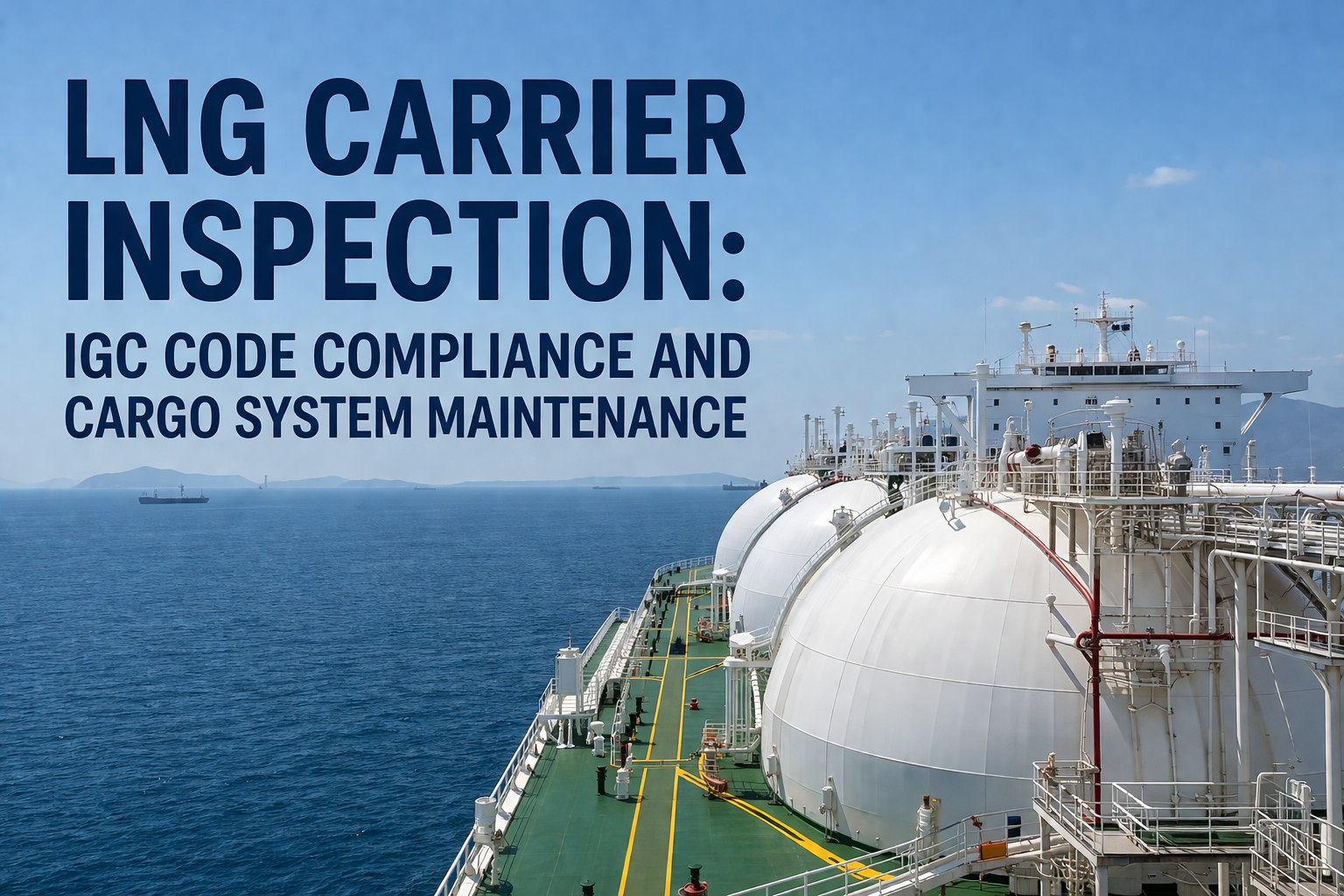
An LNG carrier sits at the apex of merchant ship complexity. A modern 174,000 m³ membrane carrier transports 80 million litres of cargo at minus 163°C, generates and consumes its own boil-off gas, runs dual-fuel propulsion at 17–20 knots, and operates under the strictest mandatory safety code in shipping — the IMO IGC Code, mandatory under SOLAS Chapter VII since 1986. The fleet is also at a once-in-a-generation inflection. The 1,000th LNG carrier is forecast to deliver in Q2 2027, with over 200 newbuilds set to enter service in 2026–27 alone — the busiest delivery years in industry history. And on 1 July 2026, IGC Code amendments enter force adding high-manganese austenitic steel as an approved containment material and refining the rules for using cargo as ship fuel. This guide walks through every inspection regime — IGC Code chapters, classification society surveys, USCG Letter of Compliance, containment system specifics, and BOG management — that LNG carrier operators must master in 2026 and beyond. Start a free trial of Marine Inspection to digitize IGC Code compliance and cargo system surveys across your gas carrier fleet.
The Global LNG Carrier Fleet in 2026
1 Jul 2026
IGC Code Amendments Force
High-Mn austenitic steel + cargo-as-fuel rule changes
700+
Active LNG Carrier Fleet
1,000th delivery expected Q2 2027
~400
Vessels on Order
45–50% of fleet — largest orderbook ever
−163°C
LNG Cryogenic Temperature
~600× volume reduction from gaseous state
Why LNG Carrier Inspection Sits Apart From Any Other Tanker Survey
An oil tanker carries cargo at ambient temperature and atmospheric pressure. An LNG carrier carries cargo at the temperature of liquid nitrogen and depends on its insulation system to keep it there for 30+ days at sea. Every inspection priority that flows from that physics is unique: cargo containment is a layered membrane-and-insulation system rather than just a steel tank; nitrogen and inert gas systems are core safety equipment, not optional; emergency shutdown logic protects the vessel from the cargo it carries; and boil-off gas — the cargo evaporating during the voyage — is itself an operational, fuel and safety system that must be managed every hour. The IGC Code has been amended 13 times since adoption to keep up with this fast-moving technology, most recently in 2022 and 2025, with the 1 July 2026 amendments now imminent. Book a Marine Inspection demo to see how gas carrier operators digitize containment system surveys, IGC Code compliance, and cargo operations records.
The IGC Code 2026 Amendments: What Operators Must Prepare For
The IGC Code is not static — and 2026 brings two distinct sets of amendments that operators across the gas carrier fleet need to understand. The first set entered force on 1 January 2026; the second on 1 July 2026. Together they reshape both materials engineering and the rules for using cargo as ship fuel.
IN FORCE
1 January 2026
High-Manganese Austenitic Steel
MSC.523(106) replaces Table 6.3 in IGC Code Section 6.4 to permit high-manganese austenitic steel as an approved material for cargo tanks, secondary barriers and process pressure vessels for design temperatures down to −165°C.
Impact: a new material class joins 9% nickel steel, Invar, and stainless steels in the approved list — broadening shipyard supply options and supporting cost reduction in newbuilds.
FORCE 1 JUL 2026
MSC.566(109)
Cargo as Fuel — Toxic Cargo Rules Refined
Paragraph 16.9.2 of the IGC Code amended: the prohibition on using cargoes as fuel now applies only to toxic cargoes that require carriage in Type 1G ships. Toxic cargoes carried in Type 2G/2PG ships — including ammonia — may now be used as ship's fuel with flag administration approval.
Impact: retroactive — applies to gas carriers built on or after 1 July 2016, including existing ships. Voluntary early implementation possible per MSC.1/Circ.1681. Ammonia-as-fuel pathway opens for the gas carrier sector.
Three Containment Systems, Three Inspection Profiles
The cargo containment system on an LNG carrier dictates almost everything about the inspection regime. Five systems are defined under the IGC Code, but three dominate the active and order book fleet: GTT membrane (Mark III and NO96 family), Moss spherical, and Type C cylindrical (in smaller vessels and bunker tankers). Each presents a distinctly different inspection challenge.
DOMINANT
GTT Membrane
Mark III & NO96 family
~80–85% of orderbook
TypeMembrane (non-self-supporting)
Mark III primary1.2 mm corrugated 304L stainless
NO96 primary0.7 mm Invar (36% Ni alloy)
Secondary barrierComposite Triplex (MkIII) or Invar (NO96)
Inspection focusMembrane integrity, insulation space N₂, sloshing damage
CLASSIC
Moss Spherical
Type B Independent
Legacy fleet + niche newbuilds
TypeSelf-supporting spherical
Material9% Ni steel or aluminium alloy
Secondary barrierDrip tray (partial)
SloshingHigher resistance — robust at any fill
Inspection focusSkirt connection, equator weld, fatigue analysis
SMALL SCALE
Type C Pressurised
Cylindrical / Bilobe
Bunker tankers, small-scale carriers
TypePressure vessel (P > 2 bar)
MaterialHigh-tensile steel, double-wall
Secondary barrierNot required (full pressure design)
StrengthNo refrigeration needed for some cargoes
Inspection focusPressure vessel surveys, relief valves
The Membrane Evolution: Why BOG Rate Drives Containment Choice
For membrane carriers — the dominant fleet segment — the headline performance metric is boil-off gas (BOG) rate per day. Each successive GTT generation has reduced it. For a conventional 174,000 m³ carrier, every 0.05% per day reduction equals roughly 36 tonnes of LNG conserved per day — directly translating into voyage economics, charter rates, and emission profiles.
GTT Membrane Generations & Boil-Off Rate Progression
Mark III Flex+ / GTT NEXT1
2020s
The Eight IGC Code Chapters That Drive Every Inspection
The IGC Code is structured around 19 chapters, but eight drive the bulk of survey activity. Understanding which chapter applies to which finding helps both operators and surveyors run more efficient inspections. Sign up for Marine Inspection to deploy IGC-aligned templates across your fleet.
Ch 4
Cargo Containment
Tank type definitions (Type A, B, C, membrane, integral, semi-membrane), secondary barrier requirements, partial filling restrictions, sloshing analysis, design conditions including thermal cycling and ship motions.
Ch 5
Process Pressure Vessels & Liquid, Vapour and Pressure Piping
Cargo piping system, expansion arrangements, valves, hoses, pump tower equipment, emergency shutdown valves, pressure relief, manifold and crossover arrangements.
Ch 6
Materials of Construction
Approved materials for cargo tanks, secondary barriers, piping. Table 6.3 — replaced January 2026 to add high-manganese austenitic steel — defines plates, sections and forgings for cryogenic service.
Ch 7
Cargo Pressure / Temperature Control
BOG management strategies, reliquefaction systems, gas combustion units, pressure relief valve settings (MARV), thermal oxidizers, free-flow systems. US waters require lower MARV settings than international.
Ch 8
Vent Systems for Cargo Containment
Pressure relief valve sizing, vent mast arrangement, vent location and height, flame arresters. US ports prohibit cargo vapor venting under 2016+ IGC Code rules — pressure must be maintained for 21+ days for LNG.
Ch 11
Fire Protection & Extinction
Cargo area fire main, water spray system, dry chemical powder system for cargo deck, structural fire protection, emergency fire pumps. Specific to gas carrier operating profile.
Ch 13
Instrumentation, Automation & Safety Systems
Tank level gauging (radar/floating types, redundant), temperature, pressure, gas detection (fixed and portable), Emergency Shutdown System (ESD), high-level alarms, auto-stop on cargo pumps.
Ch 16
Use of Cargo as Fuel
Detailed requirements for natural gas as fuel in main and auxiliary machinery. Para 16.9.2 amended 1 July 2026 to permit ammonia and certain other Type 2G/2PG cargoes as fuel with flag administration approval.
Stop Tracking IGC Code Compliance Across Five Different Systems
Containment integrity, vent pressure logs, ESD function tests, gas detection calibration, IGC chapter-mapped surveys — fleet-wide, audit-ready, exportable for class society and flag state on demand.
BOG Management: The Three Pathways
Boil-off gas is unavoidable on any LNG carrier — heat ingress through insulation evaporates roughly 0.07–0.15% of cargo per day depending on containment generation. What you do with that gas defines your vessel's operational profile and emissions footprint. Modern carriers have three pathways, often combined.
PATH 1
Burn as Fuel
Most common
BOG sent to dual-fuel main engines (typically WinGD, MAN ES, Wärtsilä) and gas-burning auxiliary boilers. Modern dual-fuel two-stroke engines power 376+ vessels. Surplus BOG can be redirected to a Gas Combustion Unit (GCU).
Inspection focus: dual-fuel engine cargo gas supply system, gas valve unit (GVU), engine gas detection, emergency gas shutdown logic
PATH 2
Reliquefy
Newest builds
Onboard reliquefaction plant condenses BOG back to liquid and returns it to cargo tanks — preserves cargo integrity and maximises delivered volume. Increasingly common on modern carriers using slow-steam dual-fuel propulsion.
Inspection focus: reliquefaction compressors, heat exchanger leak detection, control system function, BOG composition (nitrogen rejection)
PATH 3
Combust (GCU)
Backup / surplus
Gas Combustion Unit burns excess BOG when fuel demand is low (e.g., port stay, slow steaming). Mandatory equipment on most carriers — atmospheric venting of LNG vapour is prohibited in US waters and increasingly elsewhere.
Inspection focus: GCU burner integrity, combustion air supply, flame failure protection, emergency vent isolation
Cargo System Inspection: Pump Tower to Manifold
The cargo system on an LNG carrier is a coordinated machine — not a tank with a pump. Surveying it means working through every component the LNG touches between cargo tank bottom and the shore manifold. Each component has specific inspection requirements per IGC Code and class society rules.
A
Cargo Tank & Insulation Spaces
Membrane integrity (tightness test post-build, periodic verification), primary insulation space N₂ gas detection, secondary insulation space inerting, sloshing damage assessment in partially-filled conditions.
B
Pump Tower Assembly
Submerged main cargo pumps (typically 2 per tank), spray pump for tank cooldown and forcing vaporiser, emergency cargo pump well, level gauging system, fill line — all suspended from tank top.
C
Cargo Piping System
Cryogenic-rated piping (304L SS or Invar), expansion bellows or expansion loops, cargo crossover, isolation valves, ESD-actuated valves at manifold, drip trays, double-block-and-bleed arrangements.
D
Cargo Manifold
Cargo connection points (typically 3 ports each side: vapour return + 2 liquid), insulated drip trays, manifold reduction sections per terminal compatibility, ESD button at manifold, pre-cooling water curtain.
E
Vapour Return System
Vapour line back to cargo tank during loading, vent mast riser, pressure relief valves with double springs (per chapter 8), vacuum protection. Critical to maintain tank pressure during loading and unloading operations.
F
ESD & Gas Detection
Emergency Shutdown System with ESD-1 (vessel) and ESD-2 (terminal-link) levels, fixed gas detectors throughout cargo area, fire detection in cargo handling spaces, automatic spool-piece release at manifold.
G
Inert Gas / Nitrogen System
N₂ generators (usually two for redundancy), inert gas system for cargo tank purging during cool-down/warm-up, nitrogen for insulation space maintenance, emergency dry powder system on cargo deck.
H
Cargo Compressors & Heaters
Two-stage cargo compressors for vapour return management, BOG forcing vaporiser for engine fuel supply, LNG forcing vaporiser, cargo heater for tank warm-up, glycol or steam heating circuits.
The 10/70 Sloshing Rule: Why Tank Levels Matter
Membrane LNG tanks face a unique structural concern that doesn't apply to oil tankers or chemical carriers: sloshing. Partially-filled membrane tanks experience violent liquid motion in seaway conditions, generating impact pressures on tank walls and corrugated membranes that can cause damage. The IGC Code, GTT and classification societies all enforce strict fill-level restrictions to prevent sloshing damage on membrane tanks.
Membrane LNG Tank Filling Limits — The 10/70 Rule
0–10%
Heel Range
Cargo level low enough that liquid surface is short and sloshing energy is dissipated by tank bottom. Allowed for ballast voyages and tank cool-down operations.
10–70%
Restricted (Sloshing Risk)
Filling levels in this range generate maximum sloshing impact loads. NORMALLY PROHIBITED on membrane tanks. Special analysis required if voyage planning forces operation in this range.
70–98%
Loaded Voyage Range
Cargo level high enough that liquid is constrained by tank top, sloshing motion is suppressed. Standard operating range for laden voyages.
The LNG Cargo Operations Cycle
An LNG carrier moves through five distinct cargo operation phases between charters. Each phase has unique inspection touchpoints, gas detection requirements, and risk profiles. The crew documentation generated in each phase forms the audit trail for class, flag and port state inspections.
1
Inerting / Gas-Up
After dry-dock or post-warm-up, cargo tanks are inerted with N₂ to displace air, then gassed-up with vapour to displace inert. Oxygen content monitored to safe threshold before LNG introduction.
2
Cool-Down
Gradual reduction of tank temperature using LNG spray pumps before bulk loading. Thermal stress on membrane / Moss tank materials must be controlled — typical cool-down rate 10°C/hour.
3
Loading
Bulk loading at terminal — cargo manifold connected to shore arm, ESD links established, vapour return line aligned to terminal. Tank pressure managed to avoid overpressure or vacuum.
4
Loaded Voyage
BOG generated continuously — managed via fuel use, reliquefaction, or GCU. Tank pressure maintained within MARV. US-bound voyages must hold pressure ≥21 days without venting; lower MARV setting required in US waters.
5
Discharge & Stripping
Main cargo pumps discharge to shore. Spray pump strips remaining cargo. Heel retained in each tank for cool-down maintenance during ballast voyage. Inspection: pumping records, manifold ESD, post-discharge tank residual
The Cost of an LNG Carrier Inspection Failure
For LNG carriers, the cost of a failed inspection isn't just downtime — it's missed loading windows at multi-billion-dollar terminals, daily charter rates over $100K, and exposure to the severest port state actions in the maritime sector.
$$$K/day
Charter Rate Exposure
Modern LNG carriers earn $90K–$150K daily on long-term charter; spot rates have peaked above $400K/day. A vessel out of service exposes the operator to charter penalty terms and replacement tonnage cost.
Detention
USCG Letter of Compliance Issues
Foreign LNG carriers calling US ports require valid LOC. US-specific MARV settings, vent prohibition, and 21-day pressure-hold requirements drive rejection if not pre-set correctly.
Asset Risk
Containment System Failure
A membrane breach is rare but catastrophic — repair requires return to specialised yard, extended downtime, full re-cooldown, and potentially OEM (GTT) recertification.
Resale
Asset Value Erosion
Inspection findings, deficient PSC records, or missed class survey items show up immediately in vessel valuation. With 5-year-old carriers at $165–180M and scrap pressure on older steam-turbine vessels, compliance protects asset value.
How Digital Inspection Software Closes the IGC Code Gap
Manual paper logs collapse under the weight of LNG carrier complexity. A modern gas carrier generates thousands of inspection data points per voyage — gas detector calibrations, ESD function tests, BOG composition logs, tank pressure records, manifold ESD pre-arrivals. A digital platform turns that into an organised, queryable asset that supports every class survey, port state inspection, and flag state audit. Book a demo to see gas carrier-specific workflows.
01
IGC Code Chapter Mapping
Every inspection item linked to its source IGC Code chapter and paragraph, including the 1 January 2026 high-Mn steel changes and 1 July 2026 cargo-as-fuel amendments. Compliance pre-mapped, not interpreted ad-hoc.
02
Containment System Surveys
Membrane tightness test records, insulation space N₂ levels, sloshing-related damage logs, secondary barrier integrity verifications — searchable by tank number, voyage date, surveyor.
03
Cargo Operations Logs
Inerting, gas-up, cool-down, loading, voyage, discharge — each phase captured with timestamps, evidence and signatures. Export-ready for class society annual or charterer pre-arrival audit.
04
ESD & Gas Detection Records
Function test schedule, calibration history, alarm log, test results — every gas detector and ESD valve documented to a maintenance plan visible to chief officer, fleet manager, and port state inspector.
05
USCG Letter of Compliance Pack
US-specific MARV settings, 21-day pressure hold demonstration, vent system isolation evidence, prior US port compliance history — assembled in seconds for arrival at any US LNG terminal.
06
Class Society Survey Coordination
Annual / intermediate / renewal surveys mapped to class society code (ABS, DNV, LR, BV, NK, KR), Certificate of Fitness expiry tracking, drydock survey items, alternate compliance program records.
Run Gas Carrier Inspection at the Standard the Cargo Demands
IGC Code, USCG LOC, class society certificates, containment surveys, BOG management, cargo operations logs — all on one cloud platform built for the most complex sector in shipping.
2026 LNG Carrier Inspection Readiness Checklist
Use this to pressure-test your vessel's compliance position before the next class society annual, USCG LOC examination, or terminal pre-arrival inspection. Items below reflect both pre-existing IGC Code requirements and the 2026 amendment additions.
LNG Carrier Pre-Inspection Quick-Check
Certificates & Documentation
Certificate of Fitness (IGC Code) current and onboard
USCG Letter of Compliance for vessels calling US ports
Class society annual / intermediate / renewal survey status current
Cargo operations manual reflecting any 2026 IGC amendments adopted
Crew gas carrier endorsements (STCW Tanker — Liquefied Gas) all valid
Containment & Insulation
Membrane / Moss tank integrity records current; tightness test on file
Primary insulation space N₂ levels logged daily; secondary space inert
Sloshing-related fill records; voyage compliance with 10/70 rule
Insulation space gas detection calibrated and operational
Cargo System & Safety
Cargo pumps, spray pump, emergency pump function tests current
Cargo piping pressure tests, expansion arrangements inspected
ESD-1 and ESD-2 systems function tested; manifold ESD button operational
Pressure relief valves set to design MARV (US-set MARV if calling US)
Fixed and portable gas detection calibrated; alarms function tested
Inert gas / N₂ generators operational; capacity confirmed
BOG, Fuel & Emergency
BOG management plan current; fuel/reliquefy/GCU pathways verified
Dual-fuel engine gas valve unit (GVU) function tests logged
Gas Combustion Unit burner integrity checked; flame failure protection tested
Reliquefaction plant operational records (if fitted)
Cargo deck dry chemical / water spray system pressure-tested
Emergency drills (fire, gas release, ESD activation) per schedule
Frequently Asked Questions
When do the 2026 IGC Code amendments enter force, and which vessels do they apply to?
Two distinct sets entered/are entering force. MSC.523(106) — adding high-manganese austenitic steel to the approved materials list — entered force internationally on 1 January 2026 and applies to gas carriers from that date. MSC.566(109) — refining the rules for using cargoes as fuel — enters force on 1 July 2026 and applies retroactively to gas carriers constructed on or after 1 July 2016, including existing vessels. Voluntary early implementation is permitted per MSC.1/Circ.1681.
What's the difference between membrane and Moss containment systems?
Membrane tanks (GTT Mark III, NO96 family) are non-self-supporting — the cargo load transfers through insulation to the inner hull, which forms the structural envelope. Moss tanks are self-supporting Type B independent spheres made of 9% Ni steel or aluminium that sit in the hold. Membrane tanks utilise hull volume more efficiently (lower Suez Canal tonnage costs, higher cargo capacity per length). Moss tanks have superior sloshing resistance and don't require partial-fill restrictions. Membrane dominates ~80–85% of new orders; Moss continues for specific applications including offshore storage and ice-class operations where sloshing robustness matters.
Why does the IGC Code require partial filling restrictions on membrane tanks?
Sloshing impact loads. With LNG at intermediate fill levels (roughly 10–70% of tank height) the liquid surface is large enough and the freeboard sufficient that cargo motion in seaways generates very high local impact pressures on tank corrugations and corners. Class society and GTT testing established the standard limits: keep below 10% (heel) or above 70% (laden voyage). Modern Mark III Flex+ and NO96 Super+ designs allow somewhat wider operating ranges based on revised analysis, but the principle remains.
What's BOG and how is it managed?
Boil-off gas — LNG vapor generated by heat ingress through tank insulation. Standard membrane carriers generate roughly 0.10–0.15% of cargo per day. Modern Mark III Flex+ designs reduce BOG to 0.07%. Carriers manage BOG via three pathways: (1) burn it as fuel in dual-fuel main engines and auxiliary boilers, (2) reliquefy it back to LNG and return to cargo tanks, (3) combust surplus in the Gas Combustion Unit (GCU). US ports prohibit atmospheric venting under 2016+ IGC rules — pressure must be maintained ≥21 days without venting on US-bound voyages.
What is a USCG Letter of Compliance (LOC) and who needs one?
Foreign-flag gas carriers calling US ports require a USCG-issued Letter of Compliance demonstrating compliance with US-specific gas carrier safety requirements. Key US-specific items: prohibition of cargo vapor venting in port (since 2016 IGC), 21-day cargo pressure-hold capability for LNG, and lower Maximum Allowable Relief Valve (MARV) settings compared to international waters. Most foreign-flag gas carriers carry two MARV settings — international and US — and crew must reset to US values before entering US waters.
How fast is the LNG carrier fleet growing, and what does it mean for inspection capacity?
Faster than at any point in the industry's history. Approximately 100 LNG carriers are scheduled to deliver in 2026 and another 100 in 2027 — projecting the 1,000th LNG carrier by Q2 2027. The orderbook represents 45–50% of the existing fleet — a record. With record deliveries comes record demand for newbuild commissioning surveys, sea trials, gas trials, and Certificate of Fitness issuance. Class societies (especially ABS, DNV, LR, BV, NK, KR) are stretched to support the volume — operators planning newbuilds should engage class early on inspection scheduling.
How does Marine Inspection support LNG carrier-specific workflows?
Pre-loaded IGC Code chapter-mapped templates covering containment, piping, vent systems, BOG management, ESD, gas detection, fire protection and instrumentation. Mobile capture for ship's officers, fleet-wide visibility for shore management, exportable evidence packs for class society / USCG / port state inspections. Built-in tracking for the 1 January 2026 and 1 July 2026 amendments, plus gas-carrier-specific certificate management (Certificate of Fitness, USCG LOC, class status, crew Tanker — Liquefied Gas endorsements).
700+ LNG Carriers, $250M+ Each — Run Inspection Like the Asset Demands
IGC Code 2026 amendments, containment system surveys, BOG management records, USCG LOC compliance — Marine Inspection is the single platform for every gas carrier inspection workflow.