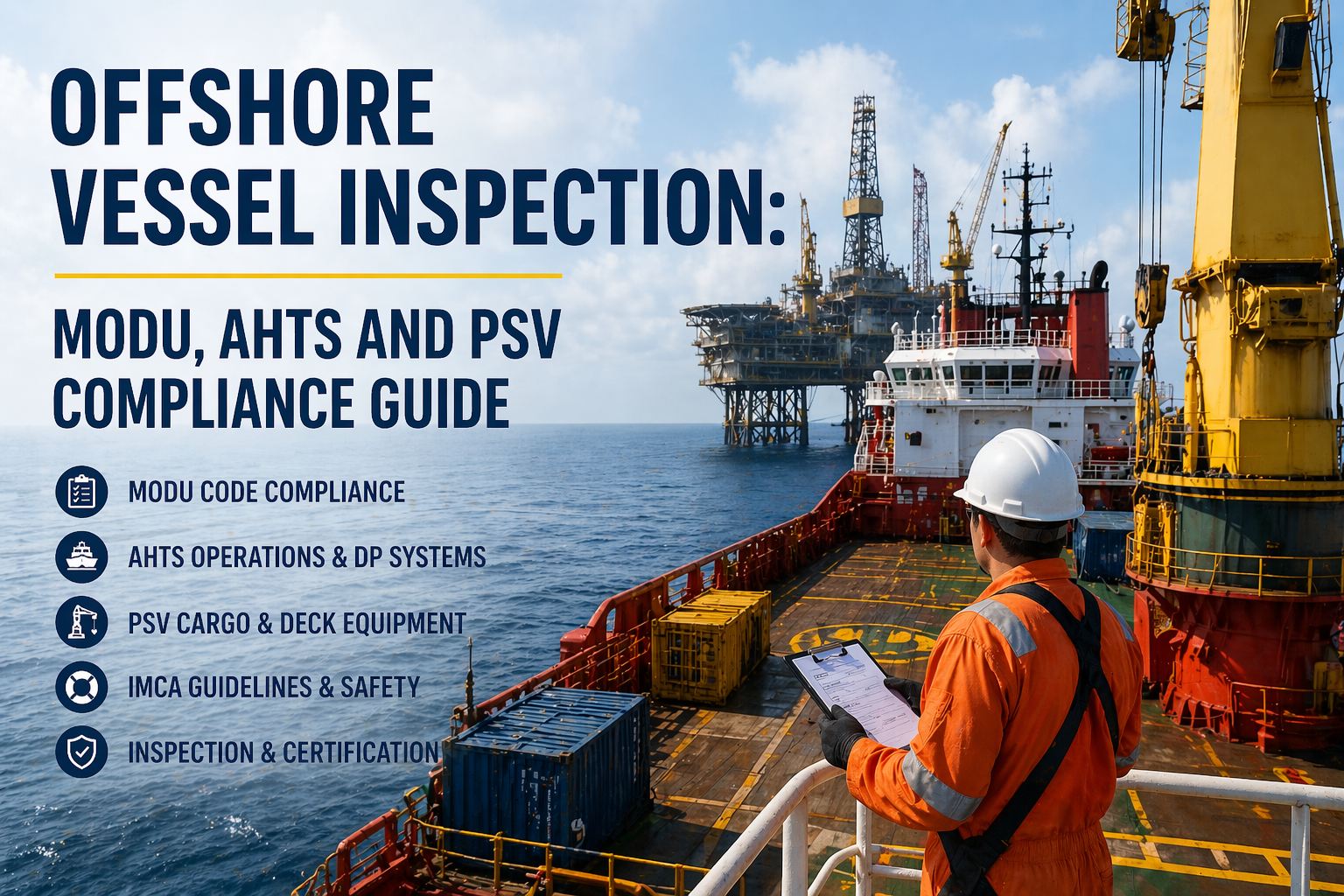
Offshore Vessel Inspection: MODU, AHTS and PSV Compliance Guide In 2026
Offshore vessels operate in the most punishing, highest-stakes environment in shipping — from Mobile Offshore Drilling Units (MODUs) anchored over deepwater wells to Anchor Handling Tug Supply (AHTS) vessels towing rigs through North Sea gales and Platform Supply Vessels (PSVs) holding station meters from a live platform on dynamic positioning. Inspection failures here don't just mean PSC detentions; they mean denied charters from BP, Shell, Equinor, or Petrobras, because offshore vetting is far stricter than flag-state compliance. This guide covers MODU Code surveys, DP class trials, AHTS/PSV OVID and eCMID inspections, offshore crane certification, and IMCA guidelines you need to pass every inspection on the first attempt. Start a free trial of Marine Inspection to digitize every offshore inspection from eCMID prep to DP annual trials.
The Offshore Inspection Stakes in 2026
$30.4B
OSV Market 2026
Projected USD 55.1B by 2035 at 7.7% CAGR
4,900+
OSVs Operating Globally
~2,000 PSVs and 42.4% AHT/AHTS share of fleet
18
eCMID Sections
Issue 14 (Feb 2025) — risk-rated questions
$25K+
DP2 North Sea Day Rate
Rig utilization hit 88% by mid-2024
Why Offshore Vessel Inspection is a Different Game
A tanker calling a European port worries about Paris MoU PSC. An offshore vessel working for Equinor on Johan Sverdrup worries about PSC plus OVID plus eCMID plus annual DP trials plus lifting appliance LOLER equivalents plus the charterer's own audit team flying in for a week. Offshore inspection is layered — every layer independent, every layer detainable, every layer with a separate database where failed findings follow your vessel from charter to charter. Getting any of it wrong means your vessel is cold-stacked while your competitor sails. Book a Marine Inspection demo to see how operators consolidate all five inspection regimes onto one audit-ready platform.
IMO Resolution A.1023(26) — MODU Safety Certificate with initial, annual, intermediate and renewal surveys every 5 years. Applies to keels laid after 1 Jan 2012.
03
OCIMF OVID Inspection (Oil Major Charter)
Used by Chevron, Shell, BP, Total, ExxonMobil, Equinor, Petronas and others. Annual inspection, report valid 12 months, stored in a shared database visible to all OCIMF members.
04
IMCA eCMID / MISW Inspection
Free-to-use IMCA M 149 (≥500 GT) or MISW (<500 GT) SMS health check conducted by an Accredited Vessel Inspector. Issue 14 introduced risk-rated findings in February 2025.
05
DP Annual Trials & FMEA Proving
IMO MSC.1/Circ.645 and 1580 plus IMCA M 190 annual trials and M 191 for MODUs. Missing a single test makes the vessel uncharterable for DP2/DP3 operations.
MODU, AHTS & PSV: The Three Workhorses, The Three Inspection Profiles
Each offshore vessel class faces a distinct inspection profile. A PSV cares about cargo rail arrangements and chemical back-loading; an AHTS lives and dies by its winch certification and shark-jaw load tests; a MODU gets inspected against an entirely separate IMO code because it's essentially a floating industrial site. Lumping them together is how fleet teams miss findings. Here's what's actually different. Sign up for Marine Inspection to get vessel-type-specific inspection templates pre-loaded for every offshore class you operate.
MODU
Mobile Offshore Drilling Unit
Drilling exploration & appraisal wells in offshore basins; semi-submersible, jack-up, or drillship configurations.
Regulation2009 MODU Code (A.1023(26))
Survey cycleAnnual + 5-year renewal
Key certificateMODU Safety Certificate (2009)
AdditionalWell control, BOP tests, heli-deck cert
Watch items: BOP stack function tests, well control drills, accommodation module fire integrity, derrick structural surveys, helideck CAP 437 compliance, lifeboat launching under trim.
AHTS
Anchor Handling Tug Supply
Towing rigs, setting and recovering anchors, deepwater mooring, emergency response standby, fire-fighting and oil recovery.
RegulationSOLAS + MODU Code (if it handles anchors for rigs)
InspectionsOVID / eCMID / annual DP trials
Typical DP classDP2 (DP1 for older tonnage)
AdditionalWinch, shark jaws, stern roller certs
Watch items: anchor winch brake holding tests, tow pin and shark jaw SWL certification, stern roller inspection, deck edge rails, FiFi-1/FiFi-2 class pump testing, emergency release systems.
PSV
Platform Supply Vessel
Ferrying fuel, water, drill fluids, cement, bulk chemicals, tubulars and deck cargo from shore base to rigs and platforms.
Watch items: back-load cargo segregation, bulk mud and cement line pressure testing, deck cargo securing, hose coupling certification, chemical tank cleanliness, MARPOL Annex I/II for cargo residues.
Pre-Load Every Offshore Vessel Template in One Platform
MODU surveys, AHTS winch tests, PSV cargo checks, DP annual trials — configured by class, tonnage, and trading area. No more paper checklists, no more scattered drives.
The MODU Code is the offshore equivalent of SOLAS — a standalone IMO instrument because drilling units mix ship-like operations with industrial drilling activity that SOLAS simply wasn't written for. The current 2009 edition (A.1023(26)) applies to units with keels laid on or after 1 January 2012 and sits alongside earlier 1979 and 1989 versions still in force for older rigs. It provides safety standards "equivalent to that required by SOLAS" for conventional ships. Request a Marine Inspection demo to see the full MODU Code digital checklist library.
Ch
Chapter Scope
What PSC / Flag Surveyors Check
1
General provisions & surveys
MODU Safety Certificate validity, survey dates, endorsements, exemptions noted on cert
2
Construction, watertight integrity, stability
Hull scantlings, watertight doors, damage stability booklet, column-stabilized ballast control
3
Subdivision, freeboard & load line
Load line marks, free surface effects, operating limits, transit vs. operating draft
4
Machinery installations
Essential machinery redundancy, classification society approval, emergency generator function
5
Electrical installations
Main and emergency distribution, switchboard insulation, earth fault protection
6
Machinery & electrical in hazardous areas
Ex-rated equipment certification, zone classification drawings, gas detection, ventilation rates
Operating manual, station bill, drills, emergency procedures, offloading operations
Dynamic Positioning: The DP1, DP2, DP3 Classification That Makes or Breaks Your Charter
No offshore inspection topic trips up crews faster than DP classification. It's not optional tech — it's what makes an AHTS or PSV charterable at all for oil-major work. The IMO framework (MSC.1/Circ.645 as amended by 1580 and 738 Rev.2) defines three classes based on how much redundancy the vessel carries and what happens after a single fault. Classification societies (DNV, ABS, Lloyd's Register, Bureau Veritas) issue the matching DP notation, and the Flag State Verification and Acceptance Document (FSVAD, now DPVAD) is the paper that proves it. Start a free trial to digitize your annual DP trials programme.
DP1
Equipment Class 1 — No Redundancy
Single DP computer, single thruster group, single power generation system. A single fault can lead to loss of position. Suitable for low-consequence operations: open-water survey, buoy tending, non-critical cable lay.
Annual trial focus: basic function test, position reference systems, single-failure demonstration not required by class but often by operators
DP2
Equipment Class 2 — Redundancy in Active Systems
Loss of position shall NOT occur after a single fault in any active component (thruster, generator, switchboard, PRS, sensor). Duplicated computers, separated power plant, multiple position references. Static failures (cables, valves) may still cause position loss.
Typical vessels: most modern AHTS, PSVs in oil-major service, dive support standby, subsea light-intervention
Annual trial focus: full FMEA proving, blackout recovery, worst-case failure design intent, consequence analysis, each PRS tested independently
DP3
Equipment Class 3 — Redundancy Plus Compartmentalization
Everything in DP2, plus physical and fire separation — loss of position shall not occur from a single fire or flooding of any one watertight compartment (A-60 separated). Multiple gyros, extra PRS, back-up DP control centre in a separate fire zone.
Typical vessels: drillships, heavy construction vessels, saturation diving vessels, high-spec IMR and pipe-lay craft
Annual trial focus: full FMEA plus compartment loss simulation, back-up DP control changeover, fire-isolated redundancy validation
Key fact many crews miss: a DP2 vessel is only "DP2" while every piece of redundant equipment is operational. An unserviceable thruster, a tripped generator that isn't repaired, or a failed PRS downgrades the vessel's operating class in real time — and most oil-major charters include contractual clauses voiding the day rate the moment this happens. Your annual DP trials programme must prove the as-built redundancy is still intact, not just that the DP desk drives.
OVID vs eCMID: Two Inspections, Two Databases, One Truth
OVID and eCMID are the two industry-led inspection regimes an offshore vessel will face every year on top of PSC and flag state. They look similar on paper, but they're aimed at different stakeholders, enforced differently, and live in completely separate databases. Mixing them up — or preparing for one when the charterer asked for the other — is a classic way to lose a contract window. Book a demo to pre-run both inspections digitally before the external inspector arrives.
Offshore Crane & Lifting Appliance Certification: Where Inspections Quietly Fail
Lifting is the single most overlooked inspection category on offshore vessels — and it just got sharper teeth. SOLAS Chapter II-1 Regulation 3-13 entered force 1 January 2026 and pulls all onboard lifting appliances (cargo cranes, engine-room cranes, hose-handling gear, anchor-handling winches) under direct statutory SOLAS control for the first time. For MODUs, Chapter 12 of the MODU Code already required this; for AHTS/PSV it was previously flag-state or class-discretionary. Missing documentation is now a detainable PSC deficiency. Sign up for Marine Inspection to auto-track every lifting appliance SWL test, NDT, and thorough examination across your fleet.
Offshore Pedestal Cranes
Annual thorough examination + 4-yearly load test at 1.25x SWL. Wire rope discard criteria per ISO 4309. Slewing bearing play measurement mandatory each thorough examination.
FROG, Billy Pugh, POB capsules: annual load testing, shock absorber inspection, buoyancy verification, certification register. Each lift operation with personnel requires daily pre-use inspection.
Hose Handling Gear & Tuggers
Smaller-capacity but high-frequency lifts. Annual load test, pennant wire discard inspection, snatch block certification, overload protection testing — now explicitly in SOLAS scope from 2026.
Davits & Launching Appliances
SOLAS III and LSA Code: five-yearly overload test, annual thorough exam, weekly winch brake test when lifeboat at stowed position, on-load release function test, fall replacement or end-for-ending interval tracking.
Lifting Appliance Register
MSC.1/Circ.1663 Register of Ship's Lifting Appliances and Cargo Handling Gear must be maintained onboard. Every appliance listed with SWL, test date, next due date, inspector signature — PSC first thing checked from 2026.
IMCA Guidelines: The Offshore Marine Operating Manual You Can't Ignore
IMCA isn't a regulator, but its guidelines have become de-facto industry standard. Charterers write them into contracts, auditors score you against them, and insurance underwriters price premiums with them in mind. If you run AHTS, PSV, construction or dive support, these are the IMCA publications your inspection prep must align with. Schedule a Marine Inspection demo to see how we map IMCA guidance directly into digital checklists.
M 149
CMID — Common Marine Inspection Document (≥500 GT)
The foundational offshore SMS inspection format. Issue 14 (Feb 2025) introduced risk-rated questions and categorized findings — expect more weight on high-risk items.
MISW
Marine Inspection for Small Workboats (<500 GT)
The CMID counterpart for crew boats, fast supply, small workboats, and survey craft below 500 GT. Issue 7 (Feb 2025) updated — guidance-driven format.
M 190
Guidelines for Annual DP Trials
The definitive programme for annual DP trials on DP-class vessels (excluding MODUs). Blackout recovery, PRS tests, consequence analysis, worst-case failure design intent.
M 191
Annual DP Trials for MODUs
MODU-specific DP trials guidance covering drillship and semi-submersible layouts — different redundancy philosophies, different failure modes than supply vessels.
M 117
Training & Experience of Key DP Personnel
DPO / SDPO competence framework. 180 days sea time plus coursework for DP Unlimited. Charterer auditors verify DP logbooks against this.
M 166
Guidance on Failure Modes & Effects Analysis
The structured approach to proving DP2 and DP3 worst-case failure design intent. FMEA + proving trials are the twin foundations of DP assurance.
The Real Cost of an Offshore Inspection Failure
Unlike a tanker in a PSC port, an offshore vessel that fails inspection rarely loses just a day. It loses the charter. And in offshore, charters are multi-million-dollar multi-year commitments.
$25K+
DP2 day rate lost per day off-hire
North Sea rates crossed USD 25,000/day mid-2024. Jones Act wind work pushes above USD 50,000/day. Every inspection day lost compounds.
12 mo
Shadow on your OVID record
OVID inspection reports persist 12 months and are visible to every oil-major member. A failing report means you're on the wrong side of tender pre-qualification.
$500M+
Contract award scale
Installation awards like Hornsea 3 reach half a billion. A single DP trial gap or missed lifting appliance cert pulls you out of contention completely.
89,510
Projected officer shortfall by 2026
IMO-reported shortage. Vessels are already being idled for want of DPOs and chief engineers. Documentation failure compounds an already thin talent pipeline.
How Digital Inspection Software Fixes the Offshore Inspection Stack
Most offshore operators still run their inspection stack as five disconnected regimes: flag certificates in Excel, MODU Code surveys with a class society PDF, OVID prep in SharePoint, eCMID via consultants, annual DP trials in a shipyard report. When the inspector lands, it all has to come together — and that's when findings appear. One platform collapses the stack. Book a demo to see this work across a multi-vessel fleet in real time.
01 Unified Certificate & Survey Tracking
Every MODU, SOLAS, OSV Code, DPVAD, lifting appliance, crane test and crew STCW certificate in one view. Alerts at 90 / 60 / 30 days — automatically.
02 Offline-Capable Mobile Inspections
Crew fill eCMID-aligned and OVID-aligned checklists on phones or tablets. Photos, timestamps, GPS — syncs when connectivity returns. Evidence inspectors can't dispute.
03 DP Trials & FMEA Documentation
Annual DP trials per IMCA M 190 / M 191 with digital sign-off, photo evidence at each test, PRS performance logs, consequence analysis output attached to the vessel file.
04 Findings & Corrective Action Tracking
Every OVID / eCMID observation becomes a dated, owner-assigned CAR with evidence-on-close. The audit trail charterers verify — ready in seconds, not days.
05 Lifting Register Automation
Your MSC.1/Circ.1663 lifting register built automatically from test data. Next thorough exam, SWL, last NDT — all live. 2026-amendment ready on day one.
06 Charterer Tender Package in One Click
When the next tender lands, assemble specs, inspection reports, DPVAD, lifting register, incident history and safety stats into a single download — hours instead of days.
Pass Every Offshore Inspection on the First Attempt
From MODU Code annual surveys to DP2 trials, from OVID to eCMID — Marine Inspection puts your full offshore compliance stack on one platform, accessible on any device, online or offline.
Use this quick-check to pressure-test your vessel before the inspector boards. It's not exhaustive — it's the items OVID, eCMID and PSC officers open the inspection with, where most first findings appear.
Offshore Pre-Inspection Quick-Check
Certificates & Documentation
MODU Safety Certificate (2009) valid with annual endorsement (drilling units)
DPVAD / FSVAD current with DP equipment class clearly endorsed
OSV Code of Safety for chemical-carrying PSVs, where applicable
Previous OVID report open findings closed with documentary evidence
eCMID inspection within validity (typically 12 months)
Dynamic Positioning Readiness
Annual DP trials completed per IMCA M 190 / M 191 within 12 months
FMEA up to date and reflects any modifications to power plant, thrusters or DP controls
DPO and SDPO logbooks current; IMCA M 117 experience evidenced
Position reference systems independently tested and working
Lifting Appliances (2026 New Rules)
Register of Ship's Lifting Appliances maintained per MSC.1/Circ.1663
All cranes, winches, tuggers with current Test & Thorough Examination certificates
SWL permanently marked and visible on every appliance
Totally enclosed lifeboat launching exercised quarterly with full crew
Rescue boat launched monthly and manoeuvred in water
Helideck inspections current — friction tests, foam system, NVG compatibility if night ops
FiFi-1 / FiFi-2 pumps tested per class interval (AHTS / standby vessels)
EPIRB and SART serviced at ≤5-yearly intervals; batteries in date
Frequently Asked Questions
What's the difference between OVID and CMID?
OVID is run by OCIMF (oil majors) and is an operational suitability assessment for oil-major charters; a positive OVID opens you to Chevron, Shell, BP, Equinor and similar members. eCMID is run by IMCA (offshore contractors) and is a safety management system health check conducted by an accredited AVI. Most offshore vessels need both — they're not interchangeable.
Does the 2009 MODU Code apply to my jack-up built in 2008?
No. The 2009 MODU Code applies to units with keels laid on or after 1 January 2012. Units built earlier fall under the 1989 or 1979 MODU Code depending on their construction date. All three are still in force simultaneously for different generations of MODUs.
How often do DP annual trials need to be done?
Within three months either side of each anniversary of the initial DP survey, per IMO MSC.1/Circ.645. Major classification societies build this into class survey cycles. IMCA M 190 (for DP ships) and M 191 (for MODUs) provide the detailed trial programme content.
What changed for lifting appliances on offshore vessels in 2026?
From 1 January 2026, SOLAS Chapter II-1 Regulation 3-13 brings all onboard lifting appliances (cranes, winches, tuggers, hose handling gear, anchor winches) under direct SOLAS statutory control. Valid Certificates of Test and Thorough Examination, visible SWL markings, and the MSC.1/Circ.1663 register are now mandatory and PSC-detainable. Existing ships must comply by first renewal survey.
Can one digital platform really handle MODU, AHTS and PSV together?
Yes — that's exactly the value. Marine Inspection pre-loads vessel-type-specific templates (MODU Code chapters, AHTS winch and shark-jaw tests, PSV cargo and chemical checks, DP annual trials, OVID and eCMID pre-runs) and lets fleet superintendents see compliance status across all classes in a single dashboard. Crew capture evidence on mobile, shore teams prepare for inspectors centrally.
Ready to Digitize Every Offshore Inspection?
MODU surveys, DP trials, OVID, eCMID, lifting appliance tracking, and charterer tender packages — unified in one audit-ready platform built for offshore operators.