Before a seafarer can do anything else on a ship, they must be able to survive one. That is the logic behind mandatory onboard safety training: every person who signs on — from a first-trip cadet to a master with thirty years at sea — first completes the same foundation of survival, firefighting, first aid, and social responsibility, because in an emergency the ocean does not check rank. This foundation is Basic Safety Training under Chapter VI of the STCW Code, and it sits beneath a layered structure of advanced qualifications, onboard familiarisation, and recurring drills that together turn a written safety management system into a crew that can actually respond. For a training or safety officer, the challenge is not knowing that this training exists — it is managing it: which certificates each seafarer holds, when each expires, who needs a refresher before their next contract, who has completed onboard familiarisation, and whether the drill record proves it all to a port state inspector. A single lapsed firefighting certificate can stop a seafarer joining; a thin drill record can draw a detention. This guide covers the four elements of Basic Safety Training, the advanced safety certificates, the five-year refresher cycle that catches crews out, onboard familiarisation, the training-versus-drills distinction, and building a safety training programme that holds up. Because all of it comes down to tracking certificates, familiarisation, and drills across a crew, book a Marine Inspection demo to see safety training records managed in one place.
Crew & training · onboard safety training
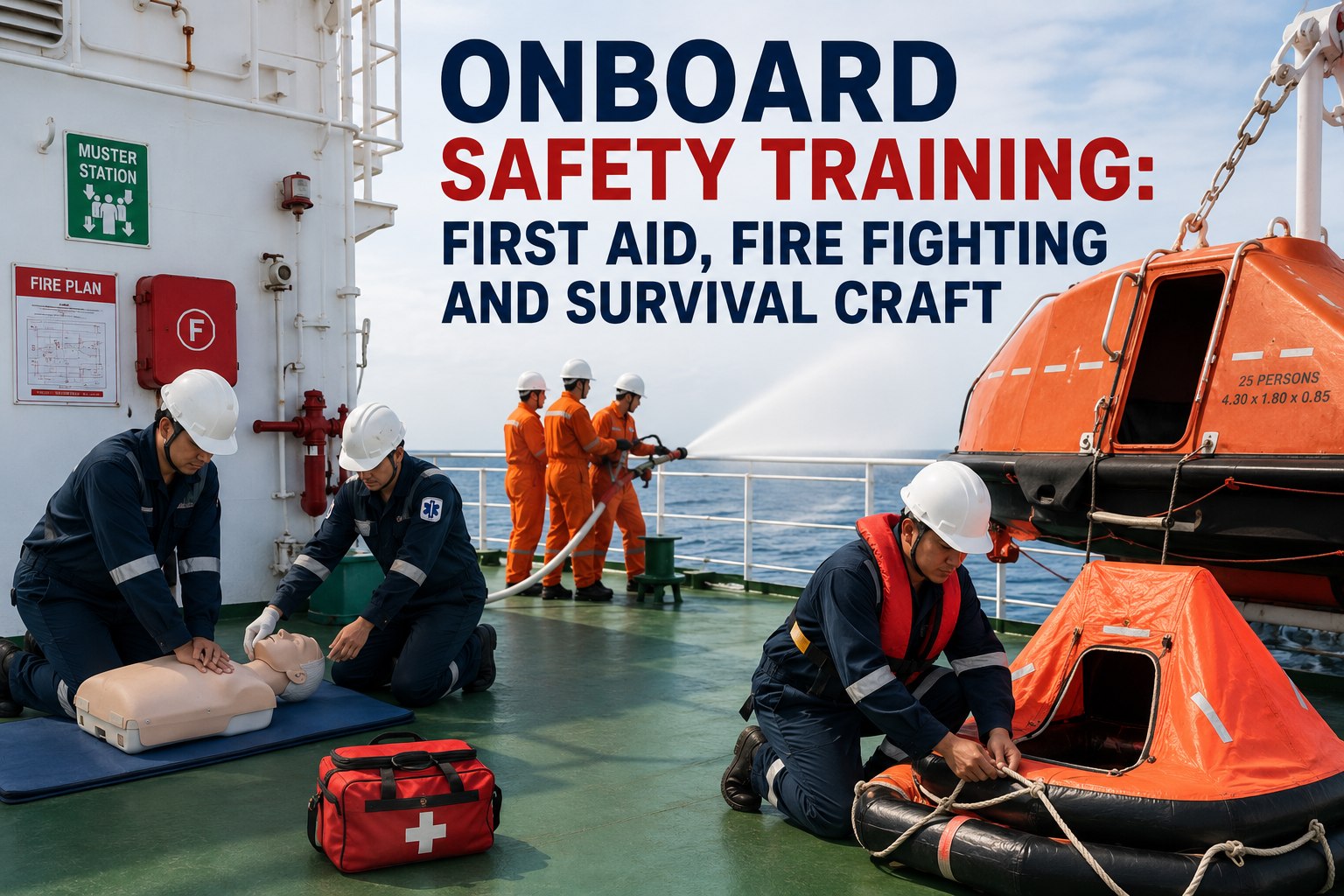
Onboard Safety Training: First Aid, Fire Fighting & Survival Craft
A guide for training and safety officers — the four elements of STCW Basic Safety Training, the advanced safety certificates, the five-year refresher cycle, onboard familiarisation, and building a training programme that survives inspection.
Basic (A-VI/1)
The foundation every seafarer holds — survival, firefighting, first aid, PSSR
Advanced (A-VI/2-4)
Survival craft, advanced firefighting, medical first aid and care
Onboard
Familiarisation, recurring drills, and the muster-list duties that make it real
The Four Elements of Basic Safety Training
Basic Safety Training, sometimes called Basic Training, is set out in STCW Table A-VI/1 and comprises four distinct elements. Every seafarer with designated safety or pollution-prevention duties must hold all four before joining a vessel. See certification tracking in a demo.
A-VI/1-1
Personal Survival Techniques (PST)
Sea survival skills for abandoning ship: donning immersion suits and lifejackets, boarding survival craft and rescue boats, surviving in the water, and the procedures for abandoning ship. Taught with practical water-survival exercises.
A-VI/1-2
Fire Prevention and Fire Fighting (FPFF)
Fire classes and chemistry, extinguishers and fixed systems, breathing apparatus, and shipboard firefighting including search and rescue in dark, smoke-filled spaces. Combines classroom theory with live fire training.
A-VI/1-3
Elementary First Aid (EFA)
The primary survey, CPR, control of bleeding, and immediate casualty management for maritime situations, where professional medical help may be days away and the first responder is a shipmate.
A-VI/1-4
Personal Safety and Social Responsibilities (PSSR)
Shipboard organisation, emergency procedures, pollution prevention, and effective communication and human relationships on board. From 1 January 2026, PSSR also includes the new mandatory competence on preventing and responding to harassment and bullying.
A crucial limitation applies to online-only versions of this training: a certificate obtained without the practical, hands-on elements typically restricts the holder from being assigned firefighting or abandon-ship duties, and cannot be converted to a Certificate of Proficiency. The practical water-survival and live-fire components are the point — Basic Safety Training is a competence to be demonstrated, not a syllabus to be read.
The Advanced Safety Certificates
Basic Training is the shared foundation. Seafarers with specific emergency responsibilities layer advanced certificates on top, each corresponding to a defined competence in the STCW Code. These are the qualifications a muster list actually depends on. See muster-list mapping in a demo.
A-VI/2
Proficiency in Survival Craft and Rescue Boats (PSCRB)
For those who launch and take charge of survival craft and rescue boats during an abandon-ship or rescue. Covers launching systems, boat handling, and command of survivors. Fast rescue boats carry a separate proficiency.
A-VI/3
Advanced Fire Fighting (AFF)
For those who control firefighting operations. Builds on basic firefighting with strategy and tactics, command of fire parties, breathing-apparatus control, and post-fire investigation. Required for officers and designated fire-team leaders.
A-VI/4-1
Medical First Aid
For those providing medical first aid on board, a level above elementary first aid, covering the immediate treatment of illness and injury for muster-list medical responders.
A-VI/4-2
Medical Care
For those in charge of medical care on board, typically the master or a senior officer. The highest onboard medical qualification, covering diagnosis, treatment, and radio-medical consultation in the absence of a doctor.
These layer onto rank and role: an officer designated to lead a fire team needs Advanced Fire Fighting; a seafarer assigned to a lifeboat as coxswain needs Proficiency in Survival Craft; the officer responsible for the ship's hospital needs Medical Care. The muster list assigns emergency duties, and each assigned duty implies a certificate — which is precisely where gaps hide. A seafarer can be fully certified in the abstract yet wrong for the specific duty the muster list gives them.
Every muster-list duty implies a certificate
Map Certificates to the Muster List, Not Just the Crew
A seafarer can hold valid certificates and still be wrong for the emergency duty assigned to them. Marine Inspection tracks each seafarer's safety certificates and expiry dates, maps them against muster-list roles, and flags the gaps before a crew change — so the fire-team leader holds Advanced Fire Fighting and the lifeboat coxswain holds Survival Craft proficiency. Book a 30-minute demo to see certification tracking, or start a free trial today.
The Five-Year Refresher Cycle
This is the single most common source of certification failure, and it exists because of a deliberate change. Before the 2010 Manila Amendments, Basic Safety Training was effectively a lifetime qualification. The Manila Amendments, which took full effect at the end of 2016, made it renewable — and skills-fade is the reason.
Five-year validity
Basic Safety Training certificates are valid for five years. Every certificate must be refreshed within that period, and safety-critical proficiencies such as advanced firefighting and survival craft carry their own five-yearly refresher obligation.
The sea-service route
A seafarer with sufficient recent sea service — commonly around 360 days in the previous five years on vessels holding regular fire, emergency, and abandon-ship drills — may revalidate through evidence of continued competence.
The refresher route
A seafarer without that qualifying sea service must complete an approved refresher course — for firefighting and survival techniques in particular — to re-establish competence before the certificate can be renewed.
Each proficiency separately
Refresher obligations attach to each certificate independently. A seafarer holding basic training, advanced firefighting, and survival craft must satisfy the refresher requirement for each — they do not renew as a single bundle.
The expiry cliff
Let a certificate lapse too far and neither route may remain open, forcing a full retake of the original course. Planning the refresher before expiry is always cheaper than recovering from it.
The reasoning behind mandatory refreshers is well established: proficiency in emergency response decays when it is not practised. A seafarer who completed firefighting training years ago and has never fought a fire has a certificate, but not necessarily the skill. The refresher requirement re-establishes the skill on a fixed cycle — which is exactly why a training officer must track expiry dates across the whole crew pool, not just confirm a certificate exists.
Onboard Familiarisation and Safety Training
Shore-based certificates are only half the picture. The moment a seafarer joins a specific ship, a second layer of training begins — the ship-specific knowledge no generic course can provide. See familiarisation tracking in a demo.
Safety familiarisation on joining
Every crew member receives safety familiarisation, and every seafarer assigned emergency duties must be familiar with those duties, before the ship sails. This is a legal requirement echoed across SOLAS, STCW, and the ISM Code.
This ship's equipment
Where this vessel's lifejackets, immersion suits, breathing apparatus, extinguishers, and muster stations are — and how this ship's specific systems work. Generic training does not tell a seafarer where the nearest EEBD is on this deck.
The muster list and duties
Each seafarer's assigned station and duty for fire, abandon ship, and other emergencies, understood before sailing rather than discovered during a drill.
Escape routes and alarms
The layout of escape routes, the meaning of alarm signals, and the actions each signal demands — the orientation that lets a new joiner act correctly in the first hour of an emergency.
Enclosed-space awareness
The dangers of enclosed spaces and the correct entry and rescue procedures, an area of heightened regulatory attention and dedicated recurring drills.
The onboard training manual
SOLAS requires a training manual and onboard instruction in the use of life-saving appliances, giving structure to the ship-specific safety education that continues throughout service.
The distinction matters for a training officer: shore certificates prove generic competence, while familiarisation proves this-ship competence, and an inspector checks both. A seafarer with a perfect certificate portfolio who cannot find the muster station is a familiarisation failure, and it is the ship's failure, not the seafarer's.
Training Versus Drills
Certificates and familiarisation establish knowledge. Drills convert it into the reflex that works under fear. The two are complementary, and confusing them is a common weakness. See drill scheduling in a demo.
The core frequency
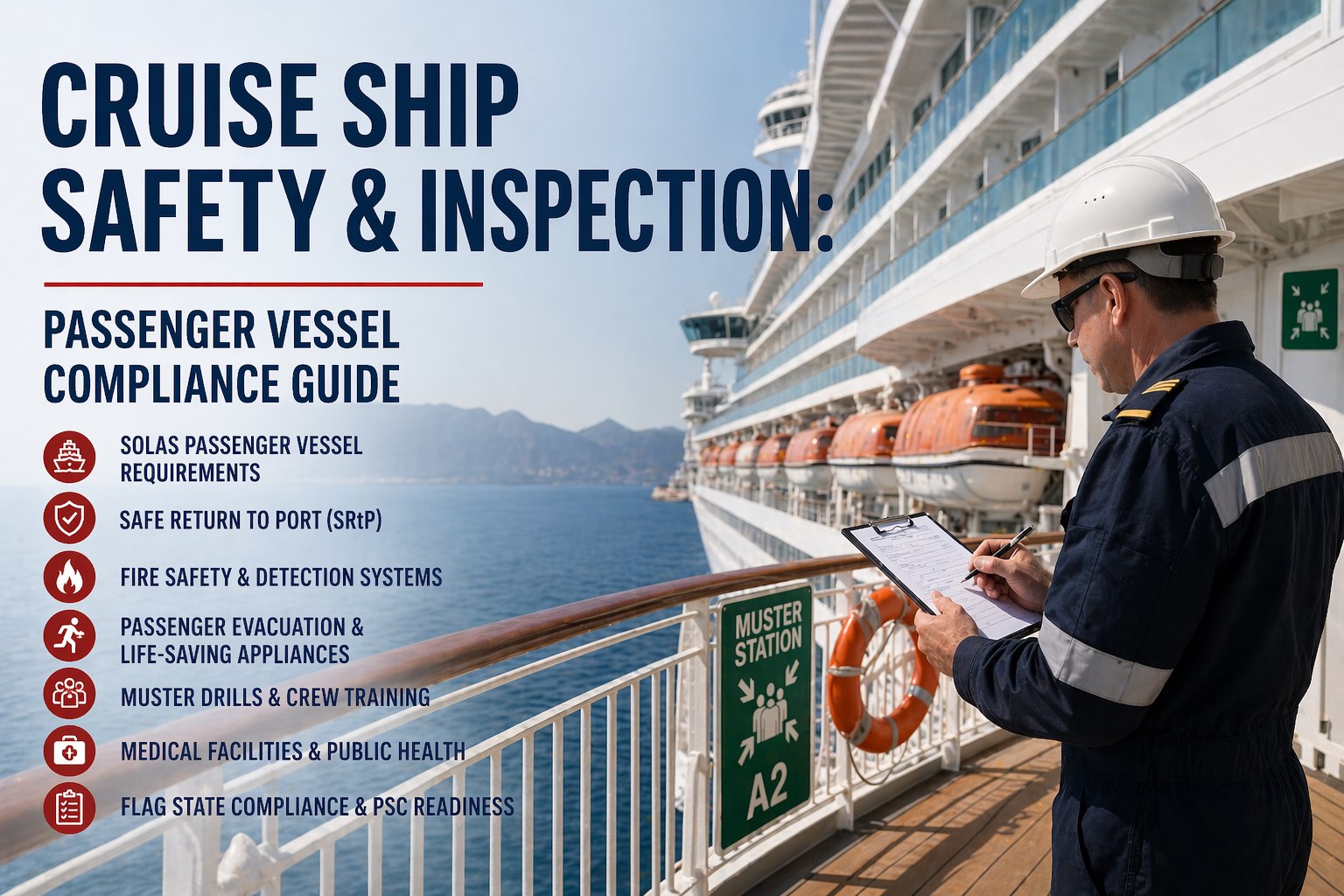
Under SOLAS, every crew member participates in at least one abandon-ship drill and one fire drill each month; passenger-ship drills are held weekly. New joiners must drill within 24 hours if they missed the previous month's exercises, and a new crew drills before sailing.
As if real
Drills must be conducted as if there were an actual emergency, not walked through as paperwork. The difference between a compliance drill and a training drill is the difference between a crew that can recite procedures and one that can execute them.
Vary the scenario
Different fire locations, night drills, and combined scenarios such as a fire leading to abandon ship test real capability, where repeating the same easy drill each month does not.
Verify the equipment
A drill is also an equipment check — fire pumps, breathing apparatus, lifeboat engines, alarms, and radios. Drills expose degradation early, before the emergency does.
Debrief and record
A structured debrief after each drill captures what went wrong and what to fix, and the record — date, scenario, named participation, response times, and findings — is the compliance evidence an inspector demands.
There is a survival dividend here that a training officer should hold onto: seafarers who have participated in multiple realistic drills survive real emergencies at measurably higher rates than those with minimal drill experience. Muscle memory, knowing where the equipment is, and confidence under stress all matter when it counts. Drills are not a box to tick; they are the mechanism that turns a certificate into a life saved.
Building the Safety Training Programme
Everything above must be managed as one continuous programme, and for a training or safety officer that is fundamentally an exercise in tracking and evidence across a whole crew.
Track certificates and expiry
Hold every seafarer's basic and advanced safety certificates with their expiry dates, and flag refreshers well before they lapse so nobody is grounded by an expired firefighting ticket.
Map to the muster list
Check that each seafarer holds the certificate their assigned emergency duty requires, closing the gap between generic certification and the specific role on the muster list.
Record familiarisation
Log safety familiarisation on joining for every crew member, with evidence that emergency-duty familiarisation was completed before sailing.
Schedule and log drills
Plan the monthly and periodic drill calendar, and record each drill by name, scenario, and finding — the participation evidence an inspector checks person by person.
Close out deficiencies
Track the equipment defects and procedural gaps that drills reveal through to correction, so a drill finding becomes a fix rather than a repeated observation.
Produce evidence on demand
Assemble the certificate, familiarisation, and drill record instantly for port state control, flag, and vetting inspections, rather than reconstructing it under pressure.
Onboard safety training is the part of crew management where the stakes are literal: it is the difference between a crew that survives a fire or a capsize and one that does not. But for the officer managing it, the daily reality is administrative — certificates expiring on rolling dates, refreshers to book, familiarisation to log for every new joiner, drills to schedule and record by name, and deficiencies to close out. Do all of that by hand across dozens of seafarers on multiple vessels and something slips; the slip surfaces as a grounded crew member or a detention. A system that holds certificates, familiarisation, and drills together, and warns before anything lapses, turns that fragile manual process into a reliable one. Book a demo to see safety training and drill management on your fleet.
Frequently Asked Questions
What are the four elements of STCW Basic Safety Training?
Under STCW Table A-VI/1: Personal Survival Techniques (A-VI/1-1), Fire Prevention and Fire Fighting (A-VI/1-2), Elementary First Aid (A-VI/1-3), and Personal Safety and Social Responsibilities (A-VI/1-4). Every seafarer with designated safety or pollution-prevention duties must hold all four before joining a vessel, and the course is typically completed over about five days with practical elements.
How long is Basic Safety Training valid?
STCW Basic Safety Training certificates are valid for five years. Since the 2010 Manila Amendments took full effect at the end of 2016, every certificate must be refreshed within that period. Safety-critical proficiencies such as advanced firefighting and survival craft carry their own five-yearly refresher obligation, tracked separately for each certificate.
What advanced safety certificates exist beyond Basic Training?
Proficiency in Survival Craft and Rescue Boats (A-VI/2), Advanced Fire Fighting (A-VI/3), Medical First Aid (A-VI/4-1), and Medical Care (A-VI/4-2). These layer onto rank and muster-list role — a fire-team leader needs Advanced Fire Fighting, a lifeboat coxswain needs Survival Craft proficiency, and the officer in charge of the ship's medical care needs Medical Care.
How is Basic Safety Training renewed?
A seafarer with sufficient recent sea service — commonly around 360 days in the previous five years on vessels holding regular drills — may revalidate through evidence of continued competence. A seafarer without that sea service must complete an approved refresher course, particularly for firefighting and survival techniques, before the certificate can be renewed.
What is the difference between safety training and onboard familiarisation?
Shore-based certificates prove generic competence in survival, firefighting and first aid. Onboard familiarisation is ship-specific: where this vessel's equipment and muster stations are, the layout of escape routes, alarm signals, and each seafarer's assigned emergency duty. Both are required, and familiarisation must be completed before a seafarer with emergency duties sails.
How often must onboard drills be held?
Under SOLAS, every crew member participates in at least one abandon-ship drill and one fire drill each month, with weekly drills on passenger ships. New joiners must drill within 24 hours if they missed the previous month's exercises, and a newly engaged crew drills before sailing. Drills must be conducted as if there were a real emergency and recorded with named participation.
Why do drills matter beyond compliance?
Seafarers who participate in multiple realistic drills survive real emergencies at measurably higher rates than those with little drill experience, through muscle memory, familiarity with equipment locations, and confidence under stress. Drills also verify that safety equipment works, exposing degradation before an emergency does. They are the mechanism that turns a certificate into a real capability.
Certificates, familiarisation, and drills as one record
Make Safety Training Impossible to Let Slip
Track basic and advanced safety certificates with expiry alerts, map them to muster-list duties, log familiarisation for every new joiner, schedule and record drills by name and scenario, close out the deficiencies drills reveal, and produce the whole evidence trail on demand for PSC, flag, and vetting. Marine Inspection turns onboard safety training from a fragile paper chase into a programme that holds. Book a tailored demo, or start a free trial today.