The question facing every technical director and fleet manager in 2026 is no longer whether to move away from heavy fuel oil, but which alternative fuel to move toward — and when. The IMO's Net-Zero Framework, approved in April 2025, sets mandatory greenhouse-gas limits and carbon pricing that make conventional fuel a shrinking option, while FuelEU Maritime and the EU ETS add cost and compliance pressure on European trades. Yet there is no single winner. LNG, methanol, ammonia, hydrogen, biofuels, and synthetic e-fuels each solve part of the problem and create new challenges of their own, and the right choice is highly route-dependent — the practical answer is usually the fuel you can bunker on your lanes, operate safely, and document cleanly, at a cost your contracts can recover. This guide compares all six pathways on the dimensions that actually decide a fleet's strategy: emissions, energy density, safety, cost, and availability. It is written for the people making twenty-to-thirty-year investment decisions on assets that will outlive several regulatory cycles. For help tracking fuel consumption, emissions, and compliance across whatever fuels your fleet adopts, book a Marine Inspection demo.
The Six Fuels at a Glance
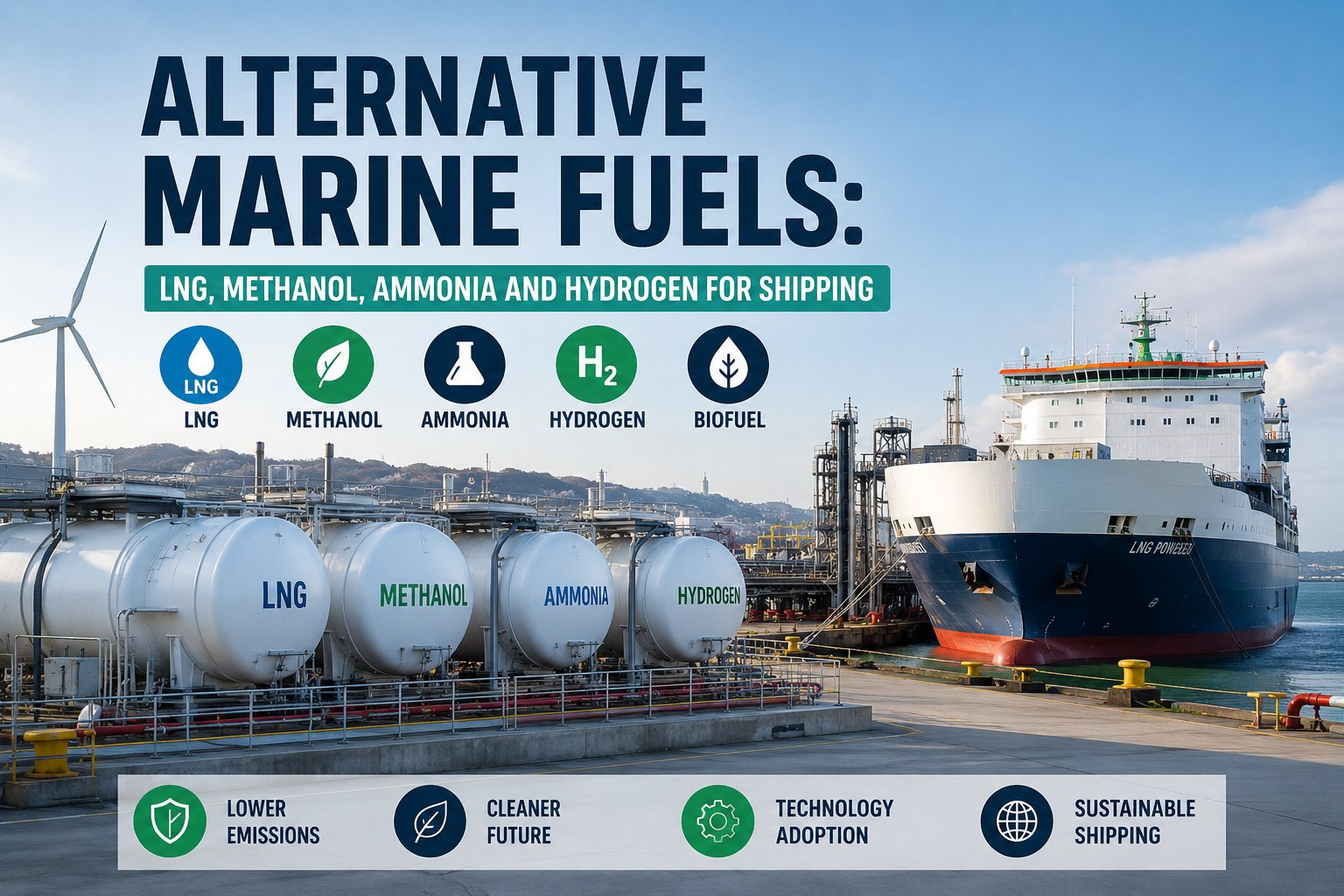
Before the detail, the landscape in one view. Each fuel sits at a different point on the trade-off between how clean it is, how ready it is, and how hard it is to handle. Scroll the table on mobile to compare across all five dimensions.
| Fuel | Emissions vs HFO | Maturity | Key challenge | Best fit |
|---|---|---|---|---|
| LNG | ~20–25% less CO2; methane slip | Mature | Fossil-origin; lifecycle gap to 2050 | Near-term transition fuel |
| Methanol | Near-zero SOx/PM; low if green | Commercial | Green supply scaling slowly | Short-sea, fast deployment |
| Ammonia | Zero-carbon burn; up to 90% WtW cut | Emerging | Toxicity; NOx aftertreatment | Deep-sea, long-term |
| Hydrogen | Near-zero at point of use | Early | Storage, density, cost | Short-sea, smaller vessels |
| Biofuels | Lower lifecycle; blend-dependent | Drop-in now | Feedstock availability & cost | Immediate compliance lever |
| Synthetic e-fuels | Near-zero if renewable-powered | Pre-commercial | Production cost; value chains | Long-term deep decarbonisation |
Emissions comparisons here use a well-to-wake boundary — the full lifecycle from energy extraction through onboard combustion — because a fuel that burns clean but is produced from fossil feedstock, like grey hydrogen or fossil methanol, delivers far less benefit than its tailpipe suggests. The colour of the fuel matters as much as the molecule.
LNG — the Mature Transition Fuel
Liquefied natural gas is methane cooled to minus 162 degrees Celsius, and it is the most established alternative by a wide margin. With over 200 bunkering ports, a fleet of more than 700 LNG-fuelled vessels, and proven dual-fuel engines, it offers the lowest-friction route to immediate emission-control-area compliance.
LNG's role is transitional and time-limited. Modelling suggests it will be among the most cost-competitive options through the early-to-mid 2030s — potentially extended with onboard carbon capture — but as the IMO's carbon pricing tightens, its fossil origin becomes a liability. Cost runs roughly 1.8 to 2.2 times HFO once vessel modifications are counted. It is a sensible bridge, not a destination.
Methanol — the Practical Near-Term Choice
Methanol has surged in adoption because it is liquid at ambient temperature and pressure, making it far easier to store and bunker than cryogenic or gaseous fuels. It works in available dual-fuel engines, uses adapted petroleum bunkering infrastructure, and comes in bio- and e-methanol variants that support a path to deep decarbonisation.
Methanol is the first new fuel many deep-sea operators can run at scale, and dual-fuel fleets are growing fast. The catch in 2026 is the gap between methanol-capable ships and low-emission methanol supply: the carbon benefit depends entirely on whether you can source bio- or e-methanol consistently on your lanes, rather than fossil-derived methanol. It is best treated as two fuels — the molecule and its provenance.
Ammonia — the Deep-Sea Long-Term Bet
Ammonia carries no carbon atom, so it produces zero CO2 when combusted, and it can achieve up to a 90% well-to-wake GHG reduction when made from renewable hydrogen. With better volumetric energy density than hydrogen and an existing global production and distribution industry, it is widely seen as the primary pathway for long-term deep-sea decarbonisation.
Ammonia's momentum is real: the first ammonia-fuelled vessels are expected to deliver in 2026, the IMO is evolving rules to permit its use, and cost modelling points to blue ammonia becoming the most cost-competitive option from around 2037. Given twenty-to-thirty-year vessel lifespans, that makes dual-fuel ammonia orders a credible choice today — provided the safety challenge of a toxic fuel is met with rigorous training and design.
Hydrogen — the Promising but Constrained Option
Hydrogen offers near-zero emissions at the point of use, whether burned or run through a fuel cell, and feeds directly into the production of ammonia and methanol. But as a marine fuel in its own right it faces the hardest physical constraints of the group.
Maritime leaders have grown more cautious on hydrogen as a deep-sea fuel, with confidence falling across recent industry surveys. Its most likely near-term role is in short-sea shipping and smaller vessels, and indirectly as the building block for green ammonia and e-methanol, rather than powering large ocean-going fleets directly this side of 2040.
Biofuels — the Immediate Compliance Lever
Biofuels such as FAME and HVO are the closest thing shipping has to an immediate switch. As drop-in fuels compatible with existing engines, they require no major vessel modification, and recent standards have widened the door: ISO 8217:2024 permits blends up to 100% FAME, and ports like Singapore allow B30 deliveries without separate approval, with B100 pilots underway.
For a fleet needing emissions cuts now, biofuels are the fastest lever — but the result depends on blend choice, storage discipline, changeover process, and documentation quality, which must be treated as part of the fuel spec. Feedstock availability means large-scale commercial supply may not arrive until the 2030s, so biofuels are best seen as a bridge that buys time while permanent solutions mature.
Synthetic E-Fuels — the Long-Term Endgame
Synthetic or electro-fuels — e-methanol and e-ammonia made from green hydrogen and captured or renewable carbon — carry the highest potential to deliver shipping's 2040 and 2050 targets, because when produced with renewable power they are near-zero on a lifecycle basis. They use the same engines and handling as their conventional-pathway counterparts, so the vessel side is solved; the challenge is entirely upstream.
The Readiness Timeline
Fuel choice is a timing decision as much as a technical one. These pathways mature on different clocks, and a fleet's strategy depends on matching fuel adoption to vessel renewal cycles and tightening regulation.
Safety and Crew Training
Every alternative fuel introduces hazards the industry has limited experience managing at scale, and safety is now as central to fuel selection as cost. The handling profile differs sharply across the group, and crew competency frameworks are being developed to keep pace.
The IMO is developing harmonised training standards for zero and near-zero-emission fuels precisely because crew competence is a gating factor. A fuel a fleet cannot crew safely is not a viable fuel, however clean — which is why ammonia's toxicity, despite its strong decarbonisation case, remains its central adoption hurdle.
The Infrastructure Reality
The quiet constraint on all of this is bunkering. A fuel is only usable where it can be supplied, and the global network is far from ready for a transition. Only a handful of ports — Rotterdam and Amsterdam prominent among them — have made serious investments in multi-fuel infrastructure.
This is why fuel selection is route-dependent. Bunkering infrastructure must be built alongside fuel production, and both need coordinated investment the industry has not yet fully mobilised — so the fuel that is theoretically best for a vessel may be impractical on its actual trading lanes. The winning strategy reads the map of where you trade, not just the chemistry.
Choosing a Pathway for Your Fleet
There is no universal answer, but the decision resolves into a few clear questions tied to how and where your vessels operate. The pattern emerging across the industry maps fuels to use cases rather than crowning one winner.
Whatever pathway a fleet chooses, the constant is measurement. Every alternative fuel carries compliance obligations under the IMO Net-Zero Framework, FuelEU Maritime, and the EU ETS, and the carbon pricing that now applies makes accurate consumption and emissions data a direct financial concern. The fleets that navigate the transition best will be those that can track what they burn, prove their emissions, and adapt as the fuel mix shifts. Book a demo to see fuel and emissions tracking in action.