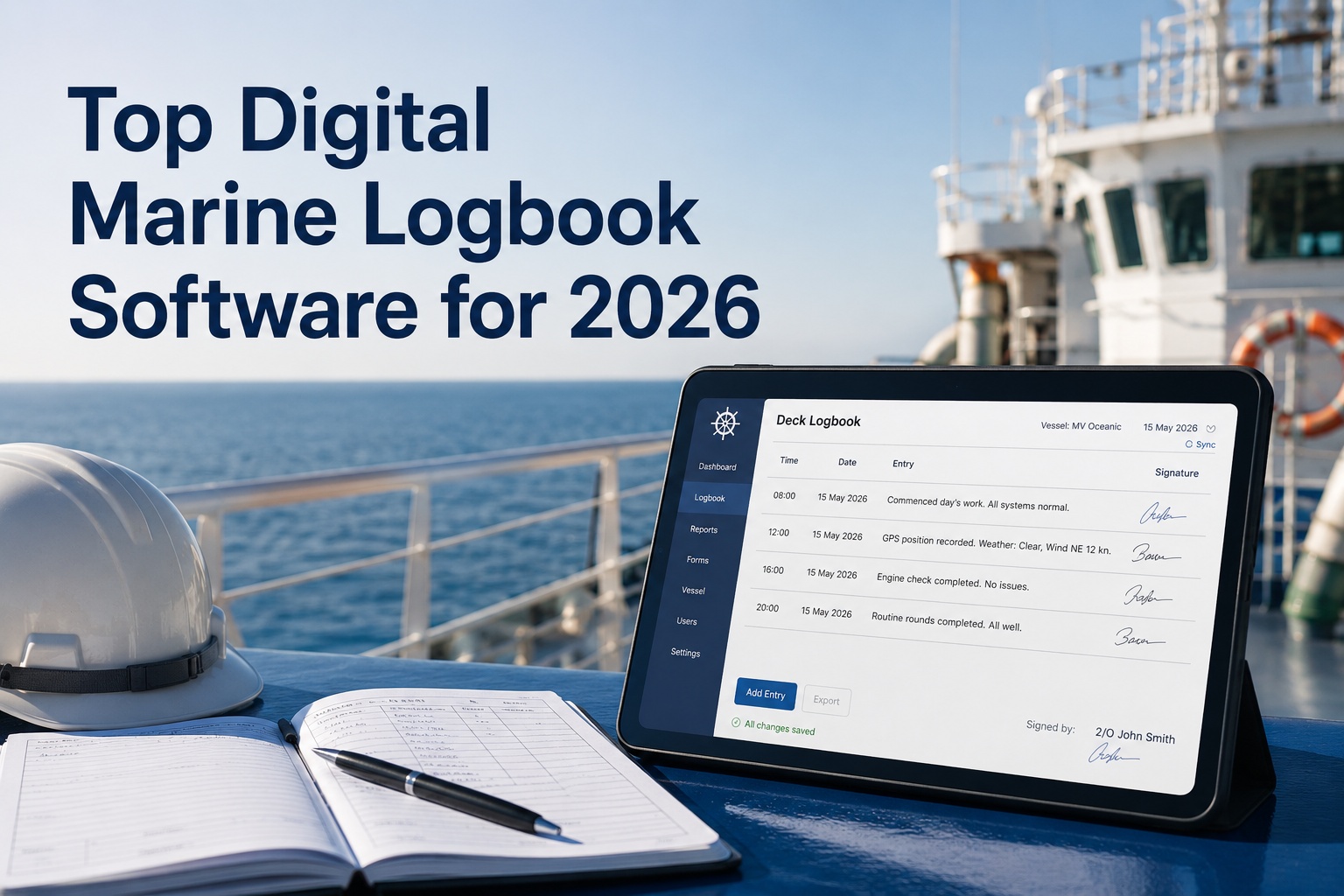
Digital Logbook Implementation in China: Maritime Compliance & IMO Guide 2026
A Port State Control officer boards your vessel in Shanghai. She requests the Oil Record Book Part II, the ballast water record, and 90 days of engine logbook entries. Your chief engineer disappears below deck, returning 20 minutes later with three paper volumes — one with a coffee stain obscuring a critical entry, another missing a signature from a watchkeeper who signed off two ports ago. The inspector notes two deficiencies before she's finished reviewing documentation. This scenario plays out across Chinese ports every single day. In 2024, China's PSC detention rates exceeded the Tokyo MOU average across nearly all fleet segments, with ISM documentation failures and poor maintenance records ranking among the top detainable deficiency categories. The vessels that pass inspections efficiently aren't carrying better crews — they're running marine inspection and maintenance software that digitizes vessel records and inspection workflows. For shipowners and fleet operators trading in Chinese waters, replacing paper logbooks with digital vessel inspection tools isn't a future consideration — it's a present-day competitive and regulatory necessity.
Digital Logbook Compliance: China Maritime Landscape 2026
PSC Inspections in China
8,500+
Annual inspections across major Chinese ports under Tokyo MOU
Detention Rate
Above Avg
China detention rates exceed Tokyo MOU average across most fleet segments
Inspection Prep Time Saved
60-70%
Reduction in crew documentation workload with digital inspection software
Flag States Accepting E-Logbooks
50+
Major flags including Marshall Islands, Panama, Liberia, and Singapore
Why China Demands Digital Logbook Readiness in 2026
China's Maritime Safety Administration runs one of the most rigorous port state control regimes in the Asia-Pacific region. The regulatory environment has tightened considerably with the MSA's energy consumption data reporting requirements — mandating that every vessel of 400GT and above (both Chinese-flagged and foreign-flagged) record energy consumption data in logbooks per their Ship Energy Efficiency Management Plan, with records kept for at least two years. Before departing any Chinese port, vessels must submit energy consumption reports to the MSA. Monthly reporting is required for vessels on fixed routes with short voyage durations. This level of documentation scrutiny makes paper-based systems increasingly unworkable. Manual entries introduce transcription errors, delayed submissions, and inconsistent data that trigger closer PSC examination. Fleet operators managing vessels calling at Chinese ports need marine inspection software that automates compliance documentation — and that's exactly what Marine Inspection's digital vessel inspection and maintenance platform delivers, aligning your record-keeping workflows directly with China MSA reporting formats.
China MSA Compliance Requirements for Vessel Logbooks
01
Energy Data Recording
All vessels 400GT+ must record energy consumption data per Ship Energy Efficiency Management Plan in logbooks or specified record books
Applies to both Chinese-flagged and foreign-flagged vessels
02
Pre-Departure Reporting
Before leaving any Chinese port, submit energy consumption report for the last voyage using MSA-specified data report format
Monthly reporting option for fixed-route vessels with short voyages
03
Record Retention
Ship records must be maintained for a minimum of 2 years. Incorrect data must be corrected within 3 working days of notice
Shanghai MSA responsible for national data verification
04
PSC Documentation Checks
Inspectors verify logbook accuracy, completeness, and consistency. ISM documentation and maintenance record deficiencies are top detention triggers
Vessels with 2+ failures in 12 months face special follow-up inspections
IMO and SOLAS Framework for Electronic Record Books
The International Maritime Organization formally recognizes electronic record books as valid alternatives to paper logbooks. IMO Resolution A.916(22) establishes that navigation event recording under SOLAS Chapter V, Regulation 28 can be accomplished through handwritten, electronic, or mechanical means. The MEPC has adopted Guidelines for the Use of Electronic Record Books under MARPOL (Resolution MEPC.312(74)), and ISO 21745:2019 defines the technical specifications and operational requirements for shipboard electronic record books. These frameworks establish the legal foundation that enables vessels to replace their paper Oil Record Books, Ballast Water Record Books, Garbage Record Books, and deck/engine logbooks with approved digital systems. However, compliance requires more than simply installing software — vessels must integrate electronic logbook procedures into their Safety Management System, maintain hardware backup protocols, ensure crew familiarization, and retain paper backup capability for system failures. Marine Inspection's marine inspection and maintenance software addresses each of these requirements through structured digital vessel inspection workflows, built-in audit trails, and automated compliance checks that keep your fleet aligned with IMO, SOLAS, and MARPOL standards simultaneously.
Key International Standards Governing Electronic Logbooks
Standard / Regulation
Scope
Key Requirement
SOLAS Chapter V, Reg. 28
Navigation event recording
Accepts electronic, handwritten, or mechanical recording methods
IMO Resolution A.916(22)
Navigation activity guidelines
Defines required records for electronic logbooks on navigational activities
MEPC.312(74)
MARPOL record books
Guidelines for electronic Oil Record Books, Garbage Record Books, and cargo records
ISO 21745:2019
Technical specifications
Minimum technical and operational requirements for shipboard electronic record books
BWM.2/Circ.80
Ballast water records
Guidance on electronic ballast water record-keeping and reporting
China MSA Energy Regulation
Carbon intensity data
Mandatory energy consumption recording for all vessels 400GT+ in Chinese waters
Paper vs. Digital: What PSC Inspectors Actually See
Understanding what port state control officers encounter during inspections reveals why digital vessel inspection software provides a measurable compliance advantage. In Chinese ports during May 2025, fire protection defects, ISM failures, and documentation gaps collectively drove the majority of detentions. While digital logbooks don't directly address fire equipment hardware, they eliminate the documentation and maintenance record deficiencies that invite deeper inspection scrutiny and escalation. Marine inspection and maintenance software connects your logbook entries to underlying inspection checklists, maintenance schedules, and equipment condition records — giving inspectors a unified view of vessel compliance rather than scattered paper trails.
Inspection Experience: Paper Logbooks vs. Digital Vessel Inspection Software
Paper Logbooks
20-30 minutes to locate and present requested records across multiple books
Illegible handwriting triggers inspector doubt and extended follow-up questioning
Missing signatures from off-signed crew members impossible to recover
No link between logbook entries and underlying maintenance or inspection records
Damaged or stained records raise tampering suspicion during PSC review
Digital Vessel Inspection Software
Instant search and retrieval of any record by date, equipment, or inspection type
Standardized entries with validation prevent formatting and compliance errors
Electronic signatures with timestamps create tamper-proof audit trails
Logbook entries linked directly to inspection checklists and maintenance work orders
Encrypted cloud backup with complete data integrity and shore-side access
Make Your Fleet China-PSC Ready with Digital Vessel Inspections
Marine Inspection's marine inspection and maintenance software unifies digital logbooks, vessel inspection checklists, and equipment maintenance tracking into one platform. Reduce inspection preparation time by 70% and eliminate documentation-related deficiencies before your next port call in China.
Implementation Roadmap: From Paper to Digital Vessel Inspections in 90 Days
Transitioning from paper logbooks to a digital vessel inspection system requires a structured approach that maintains compliance throughout the changeover period. The roadmap below reflects best practices from fleet operators who have successfully digitized record-keeping, inspection workflows, and maintenance tracking while navigating active trading schedules in Chinese waters. Marine Inspection's platform supports each phase — from initial configuration of inspection checklists and logbook modules to crew training and go-live verification. Operators beginning their digital vessel inspection transition receive guided implementation support that adapts to your vessel trading patterns, crew rotation schedules, and specific flag state requirements.
90-Day Digital Vessel Inspection Implementation Roadmap
Phase 1
Days 1-30
Assessment & Software Configuration
Audit current logbook types and inspection checklists carried onboard (deck, engine, ORB Part I/II, cargo, ballast water, garbage, GMDSS)
Verify flag state acceptance of electronic record books for your vessel's registry
Configure Marine Inspection's digital logbook modules, inspection templates, and maintenance tracking to match vessel type and operational profile
Update Safety Management System to include electronic logbook procedures, digital inspection workflows, and backup protocols
Phase 2
Days 31-60
Crew Training & Parallel Operation
Conduct crew familiarization on all activated logbook modules, inspection checklists, and maintenance reporting features
Run parallel paper and digital entries for 30 days to validate data consistency across all record types
Establish role-based access controls with electronic signature protocols for inspections and log entries
Test backup procedures including data retention, offline vessel inspection capability, and shore-side synchronization
Phase 3
Days 61-90
Go-Live & Verification
Transition to full digital operation for logbooks, inspections, and maintenance records with paper backups for contingency
Conduct internal audit of digital records against SMS requirements using Marine Inspection's built-in audit reporting
Verify China MSA energy consumption reporting workflow produces compliant submissions directly from the platform
Document implementation in vessel's ISM internal audit records for PSC transparency and inspection readiness
"The shift from paper logbooks to integrated marine inspection and maintenance software represents one of the most impactful operational improvements available to fleet operators today. In high-scrutiny port state control regimes like China, where inspectors routinely cross-reference logbook entries against maintenance records, inspection checklists, and equipment condition reports, having everything connected in a single digital platform is a genuine advantage. The ability to instantly present validated, time-stamped records — with direct links to the underlying inspection findings and maintenance actions — not only accelerates the inspection process but fundamentally changes the inspector's perception of vessel management quality. Vessels operating with digital inspection and maintenance software consistently experience shorter inspection durations and fewer documentation-related deficiencies. The administrative time savings alone — typically a 60-70% reduction in record-keeping workload — free officers to focus on operational safety, preventive maintenance, and the hands-on vessel inspections that actually keep equipment compliant."
— Marine Compliance Advisory, based on fleet operator feedback and digital vessel inspection industry analysis
Building a China-Ready Digital Compliance Strategy
Successfully operating in Chinese waters in 2026 requires understanding that China MSA's enforcement approach combines traditional PSC inspection rigor with an increasing emphasis on data-driven compliance verification. Vessels that have experienced two or more mechanical or electrical equipment failures within 12 months face mandatory joint inspections by shipping companies and classification societies, along with requirements to submit failure analysis reports. This escalation framework means that incomplete or inconsistent logbook and maintenance records can cascade into significantly more invasive oversight. A proactive digital compliance strategy addresses this by ensuring every maintenance action, vessel inspection finding, operational event, and regulatory submission is captured in a single, auditable system. Marine Inspection's marine inspection and maintenance software is purpose-built for this — connecting digital logbook entries to inspection checklists, deficiency tracking, corrective action workflows, and equipment maintenance histories. Fleet operators who centralize their vessel inspections and documentation digitally create a defensible compliance posture that satisfies not only routine PSC checks but also the more demanding special follow-up protocols that China MSA applies to flagged vessels.
China-Ready Digital Vessel Inspection Compliance Checklist
Marine inspection software configured with electronic logbook modules approved by vessel's flag state
SMS updated with digital inspection procedures, electronic record book protocols, and backup plans
Energy consumption data recording configured per China MSA report format within the platform
Crew familiarization on digital vessel inspection tools documented in onboarding records
Paper logbook backups available onboard for system failure contingency per SOLAS requirements
Data retention policy covers minimum 2-year storage with encrypted backup and shore-side access
Inspection checklists and maintenance work orders linked to logbook entries for unified audit trail
Offline digital inspection capability tested for ports and sea passages with limited connectivity
Digitize Your Fleet's Inspections, Logbooks & Maintenance
Marine Inspection's marine inspection and maintenance software integrates digital logbooks, vessel inspection checklists, deficiency tracking, and equipment maintenance workflows into a single PSC-ready platform. Join fleet operators who have eliminated documentation deficiencies and reduced inspection preparation time across Chinese and international ports.
Are electronic logbooks from marine inspection software legally accepted for PSC inspections in China?
Yes. China MSA operates under the Tokyo MOU framework, which recognizes electronic record books that comply with IMO guidelines. The key requirements are that your electronic logbook system meets ISO 21745:2019 technical standards, is approved or accepted by your vessel's flag state, and that paper backup capability exists onboard for system failures. Over 50 flag states — including major registries like the Marshall Islands, Panama, Liberia, Singapore, and the Bahamas — now formally approve electronic logbooks. Marine Inspection's marine inspection and maintenance software produces records in formats that satisfy these standards, and your SMS must document the electronic logbook and digital inspection procedures with crew familiarization records available for inspector review.
What specific logbook records does China MSA require for energy consumption reporting?
China MSA requires all vessels of 400GT and above — both Chinese-flagged and foreign-flagged — to record energy consumption data in accordance with their Ship Energy Efficiency Management Plan. Before leaving any Chinese port, vessels must submit a voyage-level energy consumption report using the MSA's specified data format. Vessels on fixed routes with voyage durations of 4 hours or less, or fixed routes with 12-hour voyages, may submit monthly aggregated reports instead. Monthly reports require daily or per-voyage recording, with aggregated data submitted to the local MSA branch before the 10th of each month. All records must be retained for a minimum of two years. Incorrect data must be corrected within three working days of receiving notice. Marine Inspection's platform includes configurable reporting templates that align with these MSA submission formats.
How does marine inspection and maintenance software reduce the risk of PSC detention in Chinese ports?
Digital vessel inspection software addresses detention risk through several mechanisms. First, it eliminates documentation deficiencies — missing entries, illegible records, and unsigned entries — that flag vessels for expanded inspection. Second, built-in validation ensures entries conform to MARPOL, SOLAS, and flag state formatting requirements, preventing the inconsistencies that inspectors cross-reference across multiple record types. Third, because the software links logbook entries directly to inspection checklists and maintenance work orders, inspectors see a complete picture of vessel compliance rather than disconnected paper records. Fourth, instant retrieval capability reduces time spent with inspectors, lowering the probability of discovering unrelated issues during extended reviews. In Chinese ports specifically, where ISM documentation and maintenance record failures rank among the most common detention triggers, having an integrated digital inspection and maintenance platform demonstrates proactive compliance management.
What types of vessel logbooks and inspection records can be digitized with Marine Inspection?
Most vessel logbooks, record books, and inspection checklists can now be maintained digitally, depending on flag state approval. Common digital replacements include the Deck Logbook, Engine Logbook, Oil Record Book Part I (machinery spaces) and Part II (cargo), Ballast Water Record Book, Garbage Record Book Parts I and II, Cargo Record Book, GMDSS Radio Logbook, Compass Observation Log, Emissions Logbook, and EGCS Record Book. Beyond statutory logbooks, Marine Inspection's software also digitizes vessel inspection checklists, safety equipment inspection records, maintenance work orders, deficiency reports, and corrective action tracking — creating a unified digital system where every inspection finding connects to the relevant logbook entry and maintenance action. Some specialized records may still require paper format depending on your flag state, and our platform identifies which records your registry permits in digital format.
What happens if the digital vessel inspection system fails during a voyage or in port?
All compliant electronic logbook and digital inspection implementations require a contingency plan documented in the vessel's SMS. Paper logbook backups must be available onboard and ready for immediate use during any period when electronic systems are inoperable. Marine Inspection's software operates offline with data stored locally on the vessel, syncing to shore-side servers when connectivity is available — meaning internet outages don't disrupt logbook or inspection recording. For hardware failures, the SMS should specify procedures for reverting to paper, the maximum acceptable duration before repair, and the process for transferring paper entries into the digital system once restored. PSC inspectors are familiar with these contingency arrangements and will accept paper records from documented system outage periods without penalizing the vessel for the temporary switch.