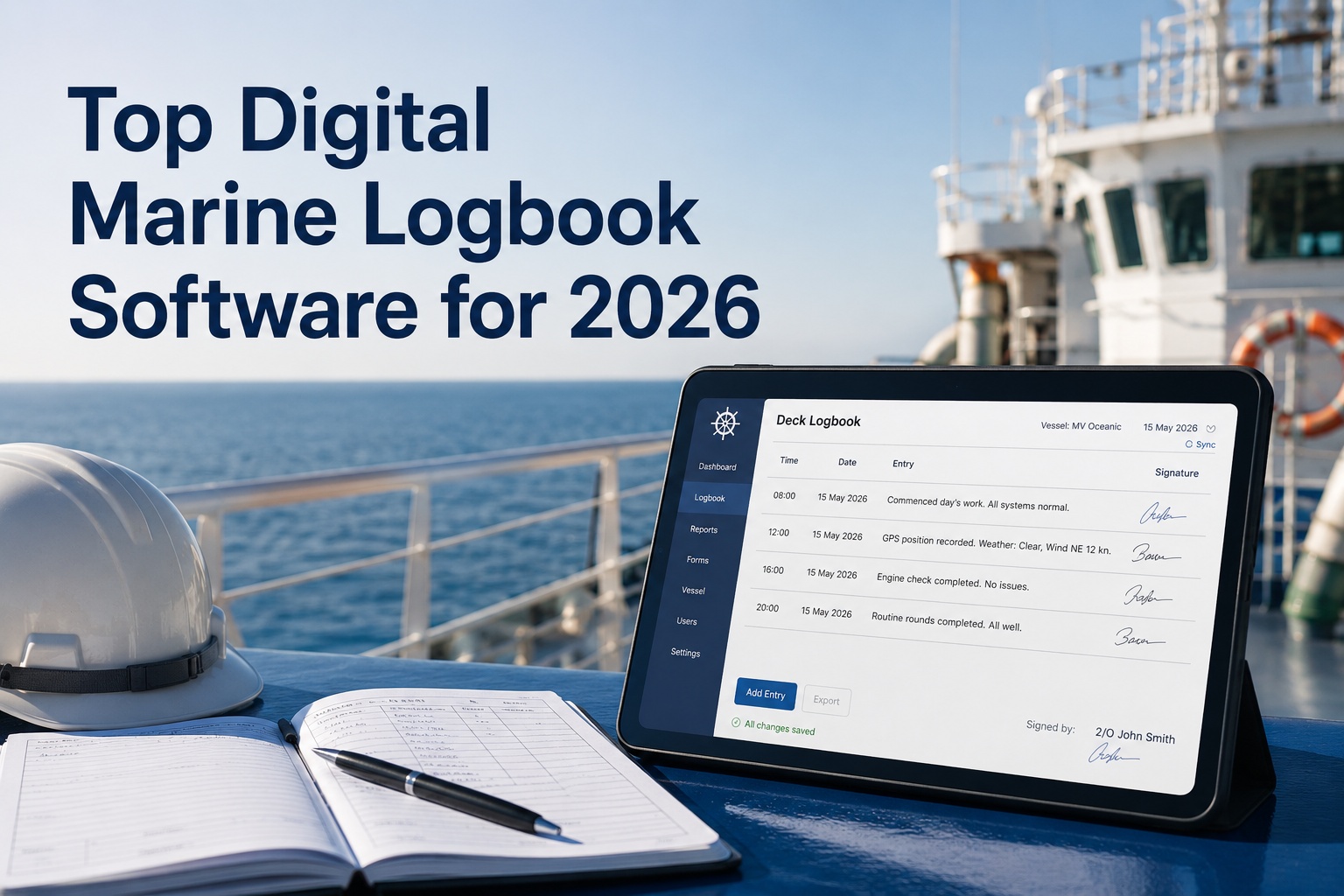
The paper logbook is finally on its way out, and 2026 is the year the shift becomes hard to resist. Flag-state acceptance of electronic logbooks has expanded to the US Coast Guard, Liberia, the Marshall Islands, Cayman, and more than twenty other flags, while IMO guidelines under MEPC.312(74) and the ISO 21745 standard give operators a clear, internationally recognised framework. The operational case is just as strong: during a Port State Control inspection, a vessel with electronic logs retrieves its complete documentation history in seconds, where paper takes the better part of an hour and invites extra scrutiny. But not all digital logbook software is equal, and choosing wrong means a system a flag state will not accept or an inspector does not trust. The criteria that separate the serious platforms are specific — genuine e-signatures, tamper-proof audit trails, demonstrated IMO and flag acceptance, and true offline operation for a ship at sea. This guide compares the top digital marine logbook software for 2026 against exactly those criteria, explains the record books a system must cover, and maps which kind of platform fits which operation. To see a compliant electronic logbook with audit trail and offline sync live, book a Marine Inspection demo.
2026 buyer's guide
Top Digital Marine Logbook Software for 2026
Compare the leading electronic logbooks on what actually matters — e-signatures, tamper-proof audit trails, IMO and flag-state acceptance, and offline support at sea — so you choose a system inspectors trust and flags accept.
20+ flagsnow accept electronic logbooks
MEPC.312(74)the IMO e-record-book standard
5–10 secto retrieve records at PSC vs ~an hour
Book a Demo
The Four Criteria That Separate the Serious Platforms
Every vendor claims to be compliant, so the real comparison happens on four specific capabilities. A gap in any one of them is the difference between a logbook a flag state accepts and one it rejects. Score every candidate against these before anything else. See all four in a demo.
01
E-signatures
Genuine digital signatures — ideally eIDAS-enabled — that attribute each entry to a named officer, with automatic timestamps and GPS coordinates that prevent backdating.
02
Tamper-proof audit trail
An immutable record of every entry, edit, and access. Corrected errors are marked but withdrawn entries remain visible to authorized users — the trail inspectors trust.
03
IMO & flag acceptance
Demonstrated alignment with MEPC.312(74) and ISO 21745, and acceptance by your specific flag state — not a generic compliance claim.
04
Offline support at sea
Full entry capability without connectivity, syncing to the cloud when the link returns — because a logbook that needs internet is useless mid-ocean.
Deep Dive — What Makes an Audit Trail Inspector-Grade
The audit trail is the single feature that earns an inspector's trust, because it is what makes an electronic record more reliable than paper rather than less. A serious platform builds the trail into every entry. See the audit trail in a demo.
Immutable entries
Once saved, an entry cannot be silently altered or deleted — modifications are tracked and backdating is prevented.
Visible corrections
Crew errors can be marked as such, but the original and withdrawn entries remain viewable to authorized users.
Timestamps & GPS
Automatic time and position stamps on each entry create an objective record no manual log can match.
Role-based access
Entries and approvals are tied to roles, so accountability is clear and unauthorized changes are blocked.
Encryption & backup
Strong encryption such as AES-256 and automatic backups protect against loss and tampering alike.
Printable signed copy
The ability to print a signed, tamper-proof copy for inspection or legal proceedings, as the IMO guidelines require.
The Record Books a System Must Cover
A digital logbook is only useful if it covers the full set of books a ship is legally required to maintain. The strongest platforms replace both the MARPOL environmental record books and the operational navigation and engineering logs, replicating each one's exact structure and fields.
MARPOL record books
Oil Record Book, Parts I & II
Garbage Record Book, Parts 1 & 2
Ballast Water Record Book
Cargo Record Book
Emissions / Annex VI records
Operational logbooks
Deck Logbook
Engine Logbook
GMDSS Radio Logbook
Compass & Radar logs
Official flag-state logbook
The Oil Record Book deserves special attention: it is the document Port State Control scrutinises most closely, so a platform's handling of it — structured entries, validation, and a clean audit trail — is a strong proxy for the quality of the whole system.
See it on your fleet
A Logbook Inspectors Trust and Flags Accept
Marine Inspection delivers IMO-aligned electronic logbooks with named e-signatures, an immutable audit trail, full offline operation that syncs ship-to-shore, and coverage of the MARPOL and operational books — with records retrievable in seconds at inspection. Book a 30-minute demo to see it on a vessel like yours, or start a free trial and digitise your logbooks today.
Why Offline Support Is Non-Negotiable
Of the four criteria, offline operation is the one most often underestimated and most likely to fail in practice. A ship spends much of its life beyond reliable connectivity, and a logbook that cannot record an entry without internet is not a logbook at all.
Entries never blocked
Crews record navigation, engine, and environmental events offline, so compliance does not pause when the satellite link drops.
Automatic sync
Data syncs to the cloud the moment connectivity returns, giving the shore office a near real-time view without crew effort.
No data loss
Local capture with encrypted backup means an entry is safe from the instant it is made, regardless of connection state.
Inspection-ready anywhere
The full record is available on board for a PSC inspection even with no signal, retrievable in seconds rather than searched by hand.
The 2026 Digital Logbook Landscape
The market splits into recognisable types. Rather than crown one platform best in the abstract, match the type to your fleet, your flag, and whether you want logbooks standalone or inside a wider management system. Scroll the table on mobile to compare.
Digital Marine Logbook Platform Types
A recurring 2026 theme is integration. A standalone logbook satisfies compliance, but a logbook connected to the wider platform turns regulatory data into operational value — oil-record-book fuel entries feeding IMO DCS and EU MRV reporting, and engine-log readings triggering maintenance alerts when parameters exceed thresholds.
The Buyer's Scorecard
Bring these questions to every demo. The answers separate a flag-accepted, inspector-trusted system from a digital form that merely looks the part.
Is it accepted by my specific flag state?
Generic compliance is not enough — confirm acceptance by your flag, not just the IMO framework.
Does it align with MEPC.312(74) and ISO 21745?
These define the technical and security requirements for electronic record books.
Are entries truly tamper-proof?
Immutable records with visible corrections and tracked access are what inspectors trust.
Does it work fully offline?
Entry must never depend on connectivity, with automatic sync when the link returns.
Does it cover all my required books?
Both MARPOL record books and operational deck, engine, and radio logs, with correct fields.
Can it print a signed copy for inspection?
The IMO guidelines require the ability to produce a signed, tamper-proof printout.
Does it integrate with the wider platform?
Links to DCS, MRV, and maintenance turn compliance data into operational value.
Where Marine Inspection Fits
Marine Inspection sits in the fleet-platform tier, providing electronic logbooks inside the same system that runs maintenance, inventory, and fuel — so logbook data is not stranded in a standalone tool. Its logbooks align with the IMO electronic record-book framework, capture named e-signatures with automatic timestamps, maintain a tamper-proof audit trail with visible corrections and role-based access, and work fully offline with ship-to-shore sync. Records are retrievable in seconds for Port State Control, and logbook data connects to compliance reporting and maintenance triggers rather than sitting in isolation. Sign up free to digitise your logbooks, or book a demo to see the audit trail and offline sync end to end.
Frequently Asked Questions
Are electronic logbooks legally accepted?
Yes. Electronic logbooks meeting IMO guidelines under MEPC.312(74) and the ISO 21745 standard are accepted by Paris MOU, Tokyo MOU, the US Coast Guard, and more than twenty flag states including Liberia, the Marshall Islands, and Cayman. Acceptance continues to expand, but operators should confirm their specific flag state accepts the chosen system.
What makes a digital logbook compliant?
It must meet the technical and security requirements in the IMO's Guidelines for the Use of Electronic Record Books — proper data security, tamper-proof audit trails, role-based access, backup procedures, and the ability to print a signed, tamper-proof copy for inspection or legal proceedings — and be accepted by the vessel's flag state.
Which logbooks can be kept electronically?
Both MARPOL environmental record books — Oil Record Book Parts I and II, Garbage, Ballast Water, Cargo, and Annex VI emissions records — and operational logs such as the deck logbook, engine logbook, GMDSS radio log, and compass and radar logs. A strong platform replicates each book's exact structure and required fields.
How do electronic logbooks help at PSC inspections?
They make records instantly retrievable — a complete documentation history in five to ten seconds, versus the better part of an hour searching paper. Search functionality finds specific entries quickly, mandatory-field validation prevents incomplete records, and the audit trail with timestamps and signatures gives inspectors confidence that entries are genuine and unaltered.
Do electronic logbooks work without internet?
The good ones do. Because ships spend much of their time beyond reliable connectivity, a compliant electronic logbook must allow crews to make entries fully offline, then sync automatically to the cloud when connectivity returns. Offline operation is one of the most important criteria and the one most likely to fail in weaker systems.
Should logbooks be standalone or part of a wider platform?
Either can be compliant, but integration adds value. When logbooks connect to a wider management system, oil-record-book fuel entries can feed IMO DCS and EU MRV reporting, and engine-log readings can trigger maintenance alerts — turning regulatory record-keeping from a compliance burden into operational data that improves fleet efficiency.
Built for marine compliance
Go Paperless Without Losing the Inspector's Trust
Named e-signatures, an immutable audit trail, IMO-aligned record books, full offline operation with ship-to-shore sync, and records retrievable in seconds at inspection — inside one platform that links logbooks to maintenance and compliance reporting. Marine Inspection makes the paperless transition one inspectors trust. Book a tailored walkthrough or start a free trial today.