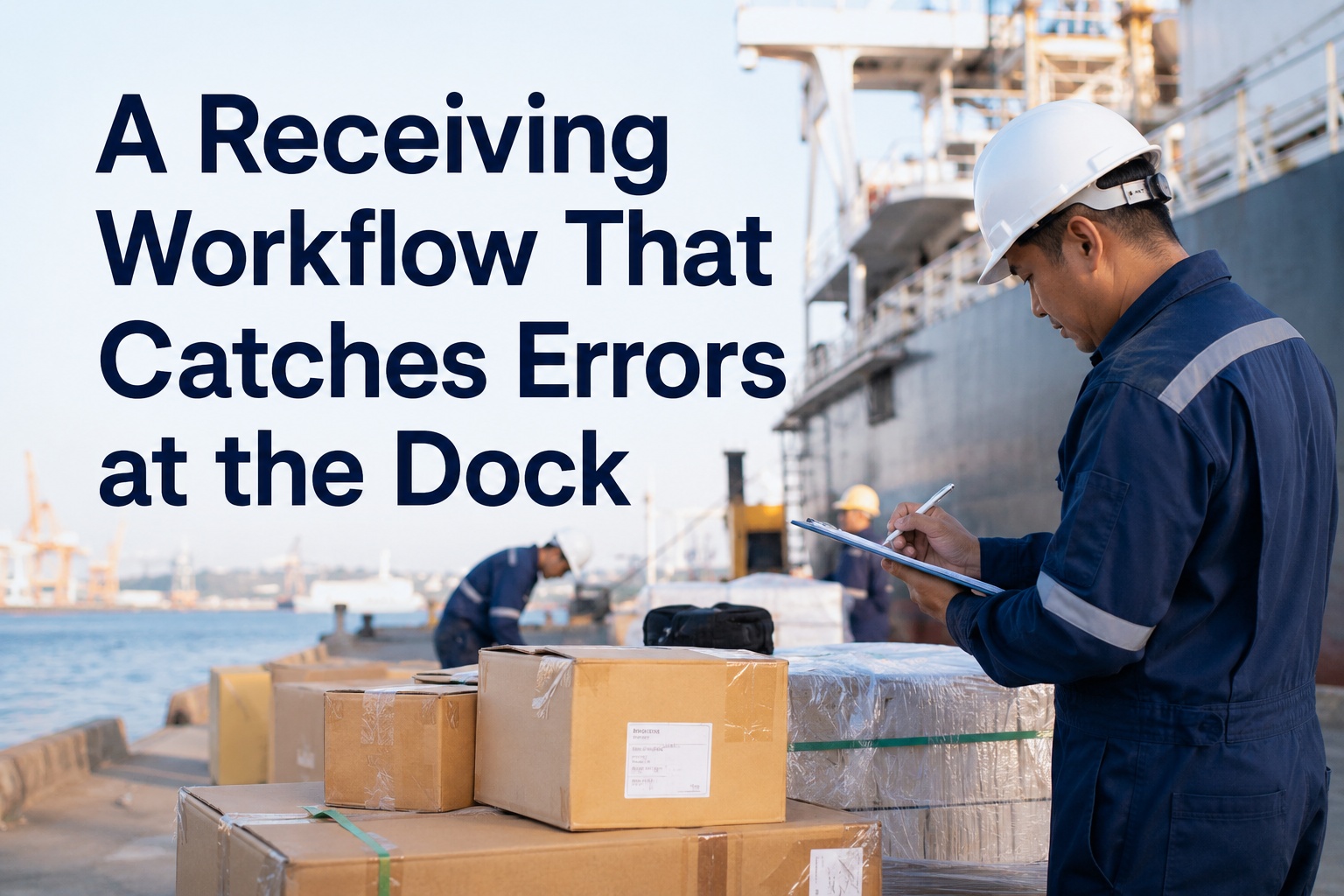
The most expensive moment in the parts supply chain is the one everyone treats as a formality: the few minutes when a delivery lands at the dock and someone signs for it. Sign without checking, and a shortage, a damaged part, or the wrong item slips silently into inventory — to be discovered weeks later by an engineer mid-repair, long after the supplier's invoice has been paid and the claim window has closed. A structured receiving workflow turns those few minutes into a control point: inspect against the purchase order, count what actually arrived, check condition and specification, record any discrepancy on the spot, and only then accept the goods into stock. The principle that makes it work is simple — a note written on the loading dock carries far more weight than a complaint raised after the invoice has been processed. Catching the error at the dock means rejecting it, claiming it, or reordering it immediately, while the evidence is in your hands and the supplier is still on the hook. This guide walks through the receiving workflow step by step, the discrepancies it catches, the goods-receipt record that protects every payment, and why structured receiving is the cheapest insurance in marine inventory. To see a receiving workflow run on a live vessel, book a Marine Inspection demo.
Catch it at the dock
A Receiving Workflow That Catches Errors Early
Inspect, verify, and accept incoming parts with a structured workflow that flags shortages, damage, and wrong items at the point of delivery — before they reach your shelves or your payments.
3errors caught: shortage, damage, wrong item
GRNthe record that protects every payment
3-waymatch starts at the dock, not the invoice
Book a Demo
Why Receiving Is a Control Point, Not a Formality
Receiving exists to confirm one thing: that the supplier delivered exactly what was ordered, in good condition, before any payment is approved. Skip it and the consequences are direct — you can pay for goods never delivered, accept damage you later own, or shelve the wrong part that derails a repair when it is finally opened. The goods-receipt step is the safeguard that sits between delivery and payment in the procure-to-pay flow, and it is where problems are cheapest to fix.
Verifies delivery
Confirms the supplier fulfilled the contract, so a fleet never pays for goods that did not actually arrive.
Controls quality & quantity
Damage, defects, and shortages are flagged immediately, while the goods and the evidence are still in hand.
Keeps inventory accurate
Stock updates reflect what truly arrived, so counts stay trustworthy and reorder points fire on real data.
Protects payment
The receipt record feeds the three-way match, so finance releases payment only for what was received.
The Receiving Workflow, Step by Step
Every delivery should move through the same defined sequence, whether it lands at a shore warehouse or is craned aboard at a port call. Each step has a job, and the order matters — inspection comes before acceptance, not after. See the workflow in a demo.
1
Receive & match the note
Accept the shipment and compare the supplier's delivery note against the purchase order before anything is unpacked.
2
Visual check & count
Examine packaging for visible damage and count the items — a quick first pass that surfaces obvious problems early.
3
Inspect against the PO
Verify quantity, condition, and specification item by item; for critical parts, test functionality before acceptance.
4
Record variances
Document any shortage, overage, damage, or wrong item — with photos — as a contemporaneous record at the dock.
5
QC hold if needed
Place questionable items on a quality-control hold status rather than accepting them into usable stock.
6
Generate GRN & put away
Create the goods-receipt note, update the inventory ledger, and stock accepted items in their shelf locations.
The Three Errors a Good Workflow Catches
Almost every receiving problem falls into one of three categories. A structured workflow is designed to catch each one at the dock, where it can still be acted on, rather than weeks later when it has become an invoice dispute or a failed repair.
Catching Errors at the Point of Receipt
The common thread is timing. Recording both the quantity ordered and the quantity received makes shortages and overages immediately visible at the point of receipt rather than weeks later when the invoice arrives — and a discrepancy documented on the dock, with a named receiver and photos, carries the weight a late complaint never can.
See it on your fleet
Stop Errors Before They Reach Your Shelves
Marine Inspection runs a structured receiving workflow — match against the PO, barcode-scan items, record discrepancies with photos, QC-hold questionable goods, and generate the GRN that feeds three-way matching. Book a 30-minute demo to see receiving on a vessel like yours, or start a free trial and set up your workflow today.
The Goods Receipt Note: The Document That Protects You
The output of the workflow is the goods-receipt note (GRN) — the contemporaneous record of what was delivered, in what condition, and accepted by whom. It is far more than paperwork; it is a foundational source document in the procure-to-pay chain and the receiving evidence that protects every payment. See the GRN in a demo.
Quantity ordered vs received
The received figure is what gets compared against the PO and the invoice in three-way matching, making shortages visible at once.
Condition & quality notes
Damage and defects documented at the time of receipt — a contemporaneous record made before any invoice dispute arises.
Receiver name & signature
Identifies who accepted the delivery, providing accountability and a named person who can speak to the goods' condition.
Photos & timestamps
Photographic evidence and dated entries that support claims and create an audit trail surveyors and finance can rely on.
How Receiving Feeds the Three-Way Match
The GRN is not the end of the story — it is the middle document in the three-way match that safeguards payment. Even a perfect invoice against a valid PO should not be paid unless the goods were actually received, and the GRN is what proves it.
Purchase Order
What was ordered
+
Goods Receipt
What actually arrived and was accepted
+
Invoice
What the supplier is billing
=
Verified Payment
Released only when all three agree
This is why receiving discipline is a financial control, not just a warehouse task. The GRN is the proof of delivery that stops a fleet paying for goods it never got, paying for damaged items it should have rejected, or paying an invoice for the wrong part — turning the dock into the first line of defence for the budget.
How Marine Software Runs Receiving — and Why It's Needed
Carbon-copy GRN pads and paper notes are error-prone and hard to track, which is why structured receiving so often breaks down. Purpose-built marine software makes the workflow consistent and the record durable, and copes with the realities of receiving at a quayside or aboard a vessel.
Guided receiving against the PO
The PO appears on the device so the receiver checks each line against what was ordered, instead of accepting blind and reconciling later.
Barcode scanning
Scanning items and shelf locations on receipt captures quantities and conditions in real time with near-perfect accuracy.
Discrepancy routing
A recorded shortage, damage, or wrong item routes automatically to the buyer, so resolution starts immediately, not after the invoice.
Photos and QC hold
Photographic evidence attaches to the GRN and questionable goods sit on QC hold, kept out of usable stock until cleared.
Works offline at the dock
Receiving is captured offline at a remote quayside or aboard ship and syncs to shore, so no delivery goes unrecorded for lack of signal.
Feeds match and inventory
The GRN updates stock and flows straight into three-way matching, closing the loop from order to shelf to payment in one system.
The deeper reason it is needed is that marine receiving happens in the hardest possible conditions — at remote ports, on a tight port-call clock, often with no connectivity and a crew that rotates. A paper process fragments under that pressure and the contemporaneous evidence is lost. Software that guides the receiver, captures photos offline, and routes discrepancies automatically preserves the dock-side record that protects the fleet's money and inventory. Book a demo to see it on your fleet.
Frequently Asked Questions
What is a receiving workflow in marine inventory?
It is the structured sequence for handling incoming parts — matching the delivery against the purchase order, inspecting for quantity, condition, and specification, recording any discrepancies, and generating a goods-receipt note before accepting items into stock. It turns the moment of delivery into a control point that catches shortages, damage, and wrong items at the dock.
What is a goods received note (GRN)?
A GRN is the document recording what was delivered, in what condition, and accepted by whom. It captures quantity ordered versus received, condition and quality notes, the receiver's name, and supporting photos. As a foundational source document in procure-to-pay, it feeds the three-way match and provides the audit trail that protects payment.
Why inspect goods at the dock instead of later?
Because a discrepancy documented at the point of receipt, with a named receiver and photos, carries far more weight than a complaint raised after the supplier's invoice has been processed. Catching a shortage, damage, or wrong item at the dock lets you reject, claim, or reorder immediately, while the evidence is in hand and the supplier is still accountable.
What discrepancies should receiving catch?
The main ones are shortages and overages, physical damage, wrong items, quality defects, and late or partial deliveries. Each is caught by comparing what arrived against the PO and inspecting condition — quantities flag shortages, visual checks catch damage, part numbers catch wrong items, and functionality checks on critical parts catch defects before they enter stock.
How does receiving connect to paying the supplier?
Through three-way matching. The goods-receipt note is matched against the purchase order and the supplier's invoice, and payment is released only when all three agree. Even a correct invoice against a valid PO should not be paid unless the goods were actually received — the GRN is the proof of delivery that confirms it.
Can receiving be done without internet at a remote port?
With purpose-built marine software, yes. The receiving workflow, including barcode scans, discrepancy notes, and photos, is captured offline at the quayside or aboard the vessel and syncs to shore when connectivity returns. This offline, source-level capture is exactly why marine receiving stays accurate where a connectivity-dependent or paper process would lose the record.
Built for marine receiving
Make the Dock Your First Line of Defence
Guided PO matching, barcode scanning, photo-backed discrepancy capture, QC holds, automatic buyer routing, and GRNs that feed three-way matching — all offline-capable and linked to your inventory and procurement. Marine Inspection turns receiving from a rubber stamp into real control. Book a tailored walkthrough or start a free trial today.