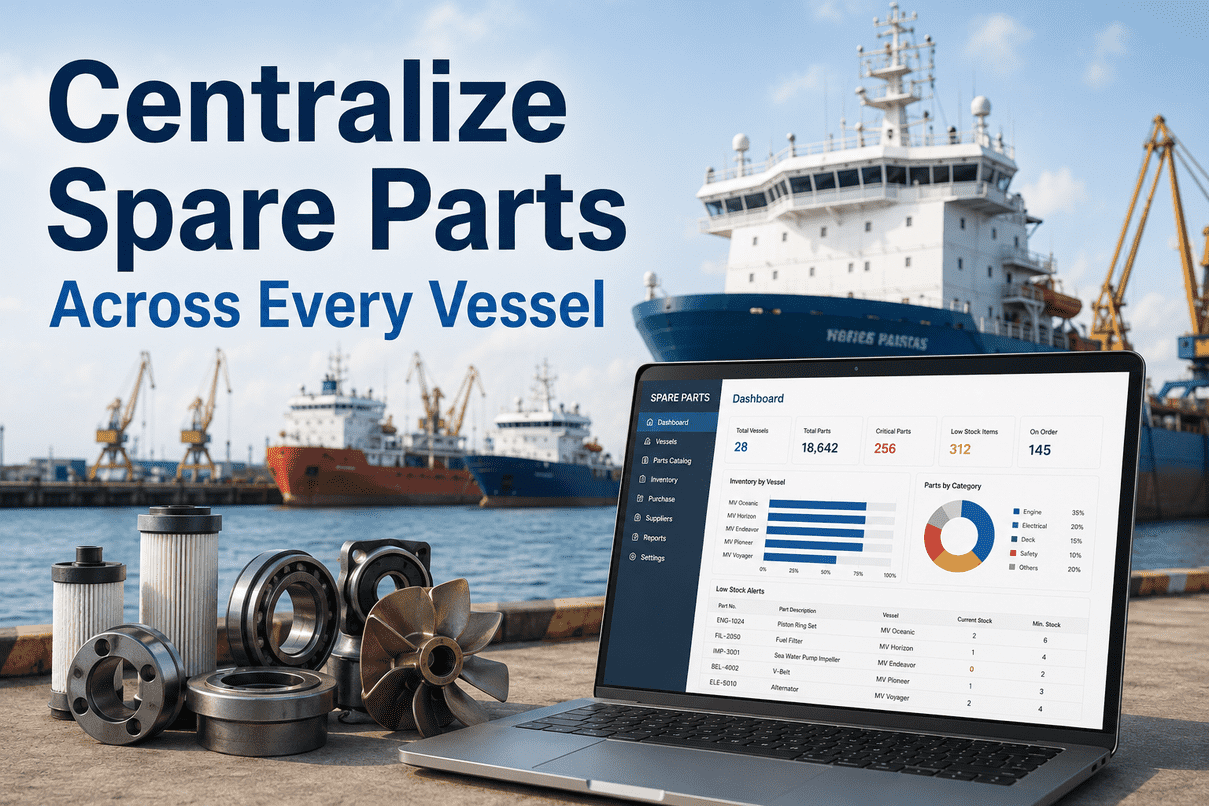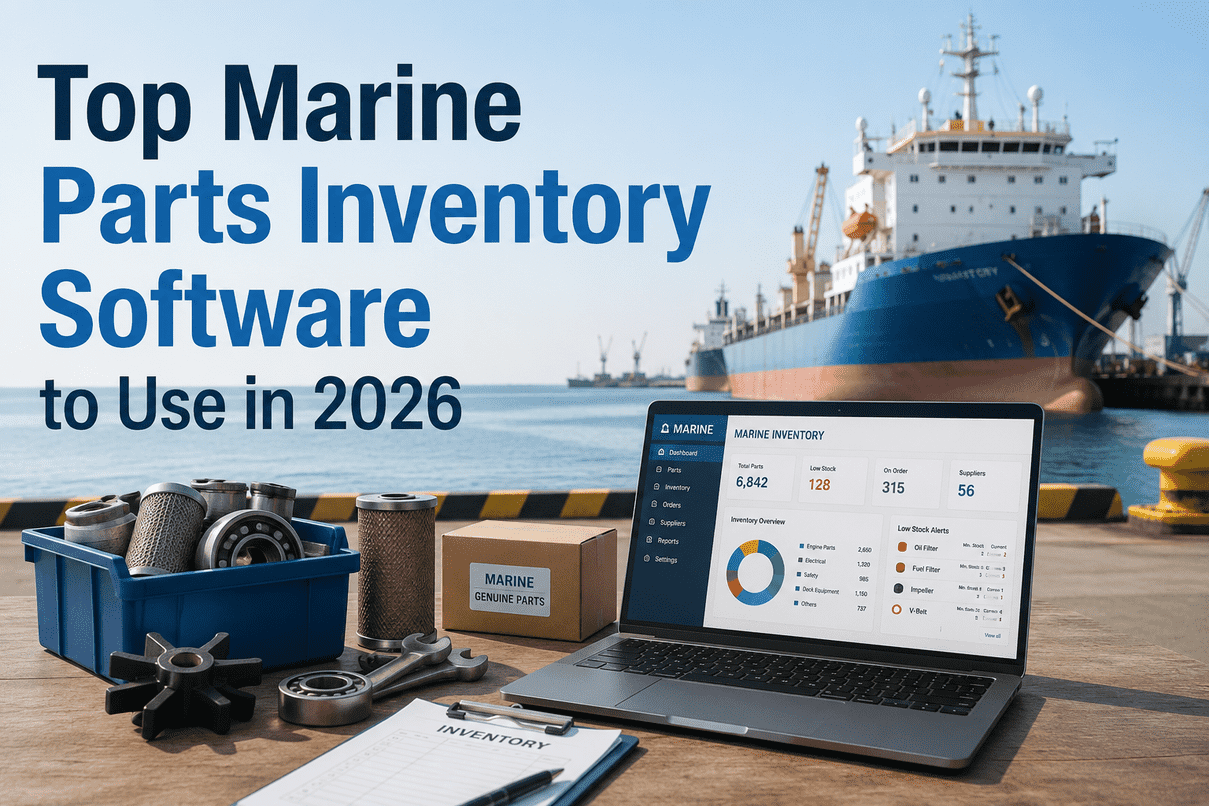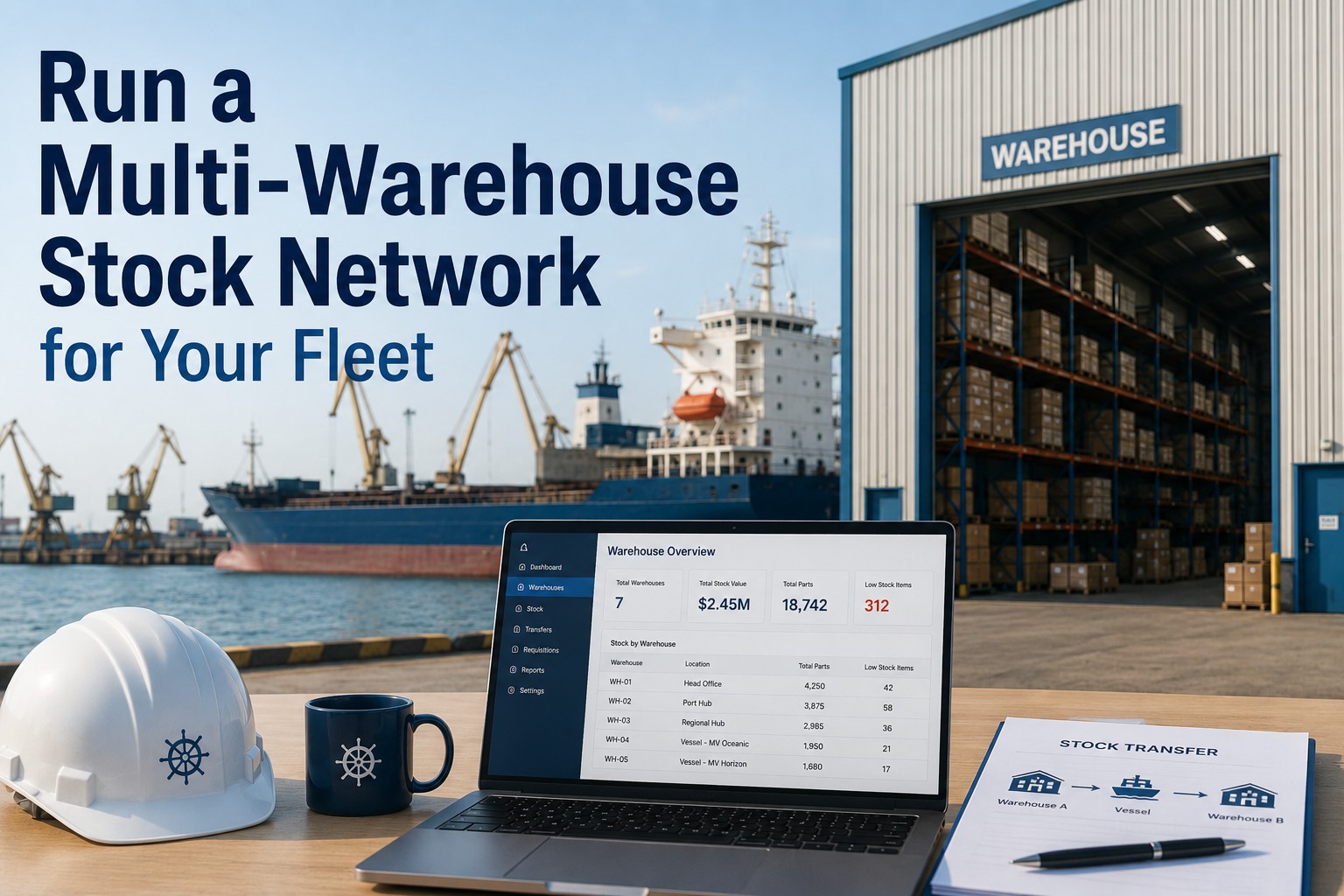
A part exists somewhere in your network — the question is where, and whether you can find it before you buy another one. For a fleet, spare parts are never in one place: they are spread across vessels scattered around the world, shore warehouses, port depots, and shipments in transit between them. When that distributed stock is tracked on clipboards, spreadsheets, and disconnected systems, visibility breaks down completely — and the cost is brutal. Inaccurate inventory data disrupts an estimated seventy percent of maritime operations, driving duplicate orders, emergency air-freight at five times normal price, vessels idle at port waiting on a critical spare, and capital tied up in parts that will never be used. Multi-warehouse stock management solves this by putting every location — every vessel, hub, and shore warehouse — into one platform with live counts, inter-location transfers, and unified requisitions, so you see what you hold and where, fleet-wide, in real time. This guide explains how a multi-location stock network works, the transfer and consolidation workflows that make it efficient, the in-transit visibility that closes the loop, and why a single platform is the only way to run distributed marine inventory without flying blind. To see your fleet's network in one view, book a Marine Inspection demo.
The Marine Stock Network: Four Location Types
Distributed marine inventory is not one warehouse with a nautical theme — it is a living network where materials constantly move, and ships move with them. A multi-warehouse platform models every node so a part is visible the moment it enters the network and stays visible until it is consumed. See the network view in a demo.
Why Distributed Stock Breaks Without One System
The failure mode is always the same: stock data fragments across locations until nobody can trust it. Every assumption that works in shore-side supply chain management breaks the moment materials cross a gangway — ships move, ports change, connectivity drops, and crew rotates. These are the costs that follow.
Inter-Location Transfers: Move Stock, Don't Rebuy It
The single biggest advantage of a multi-warehouse network is the ability to transfer a part between locations instead of buying a new one. When the same catalogue underpins every location, a transfer is a status change — not a fresh data-entry exercise — and the fleet's total stock value stays accurate wherever a part is sitting.
Set against an emergency purchase at five times the price, a transfer between locations is almost always the cheaper and faster answer — but only a fleet that can see all its stock at once can make that call. Watch a transfer run live in a demo.
The Consolidation Workflow: Three Suppliers, One Shipment
A hub warehouse does more than store — it consolidates. Instead of three suppliers shipping three parcels to a vessel at three different costs and arrival times, the network routes everything through a hub that combines them into a single, tracked dispatch.
| Stage | What Happens | System Action |
|---|---|---|
| Order | A pump, a box of filters, and navigation lamps ordered from three suppliers | POs raised; warehouse alerted to expect goods |
| Receive | Items arrive at the hub, are inspected and scanned | Stock received; POs updated; counts adjusted |
| Consolidate | Warehouse team picks all three and combines into one shipment | Items reserved against the requesting vessel |
| Dispatch | Single shipment sent via freight forwarder to the next port call | Items shown in transit to the vessel |
| Deliver | Vessel receives at port, scans items in | In-transit cleared; vessel ROB updated |
This is the workflow that turns a warehouse from passive storage into an active control layer — one consolidated shipment to a planned port call instead of three uncoordinated parcels chasing a moving ship.
In-Transit Visibility Closes the Loop
The piece that ties the network together is knowing what is on the way. When a purchase order is raised the warehouse is alerted; when goods are received the PO updates; when a shipment is dispatched the items show as in transit to the vessel — giving the whole organisation end-to-end supply-chain visibility from order to onboard.
Live Counts and Accuracy at Every Location
A network is only as good as the accuracy of its counts. Multi-warehouse platforms keep every location current with the same disciplines, so the fleet-wide view can actually be trusted.
| Mechanism | What It Does | Why It Matters |
|---|---|---|
| Barcode / QR scanning | Scans every item and shelf location on receipt, issue, and count | Near-perfect accuracy without slow manual entry |
| Digital cycle counts | Routine partial counts by location | Errors caught early, not at year-end stocktake |
| Movement logging | Every issue, receipt, transfer, and adjustment recorded | A complete, reconstructable stock history |
| Offline capture | Transactions logged at sea without connectivity | Vessel counts stay current and sync to shore |
| Min / max per location | Thresholds set independently for each node | Each location holds the right cover for its role |
How Marine Software Runs the Network — and Why It's Needed
Running this on spreadsheets is exactly why fragmented fleets stay fragmented. Purpose-built software holds one catalogue across every node and copes with the realities a generic warehouse system never faces.
The deeper reason it is needed is that a fleet's stock network spans ships that move, ports that change, connectivity that drops, and crews that rotate — the exact conditions under which spreadsheets fragment and trust collapses. A unified platform keeps one live picture alive across every location and every handover, which is the whole point of running a network rather than a scatter of disconnected storerooms. Book a demo to see it on your network.