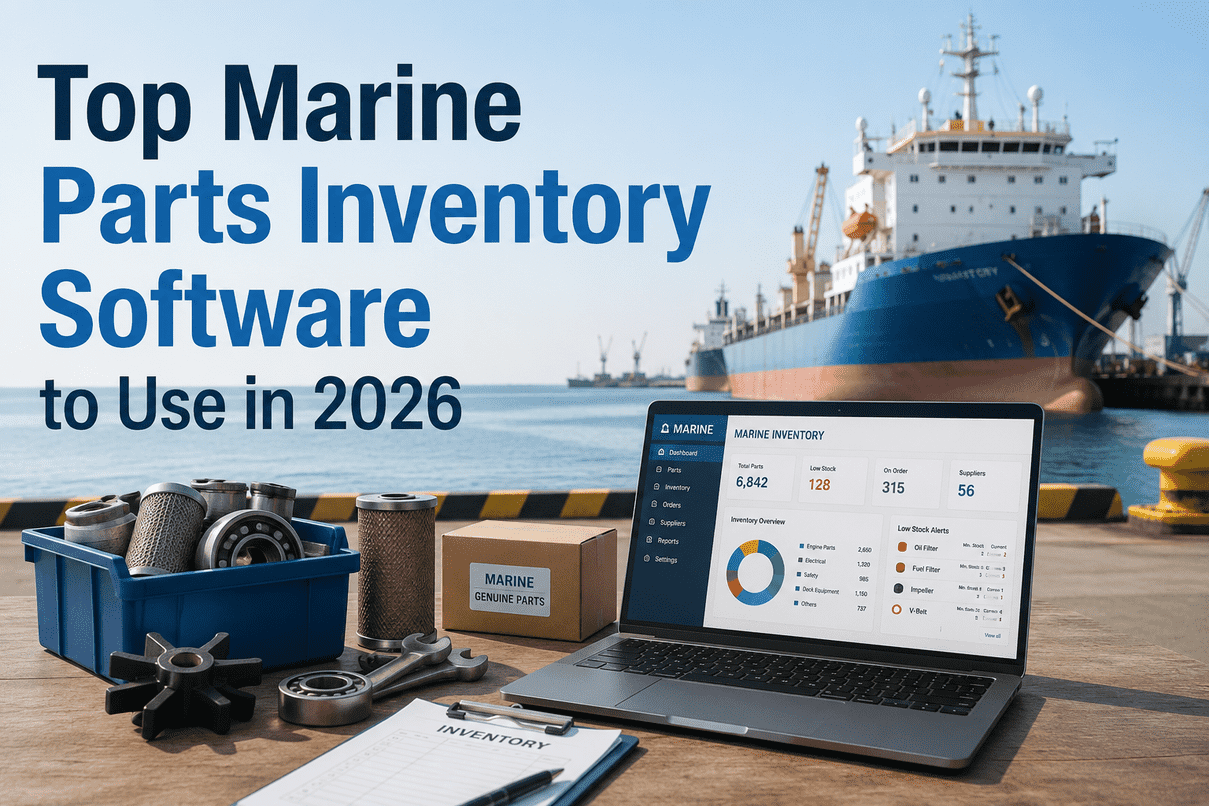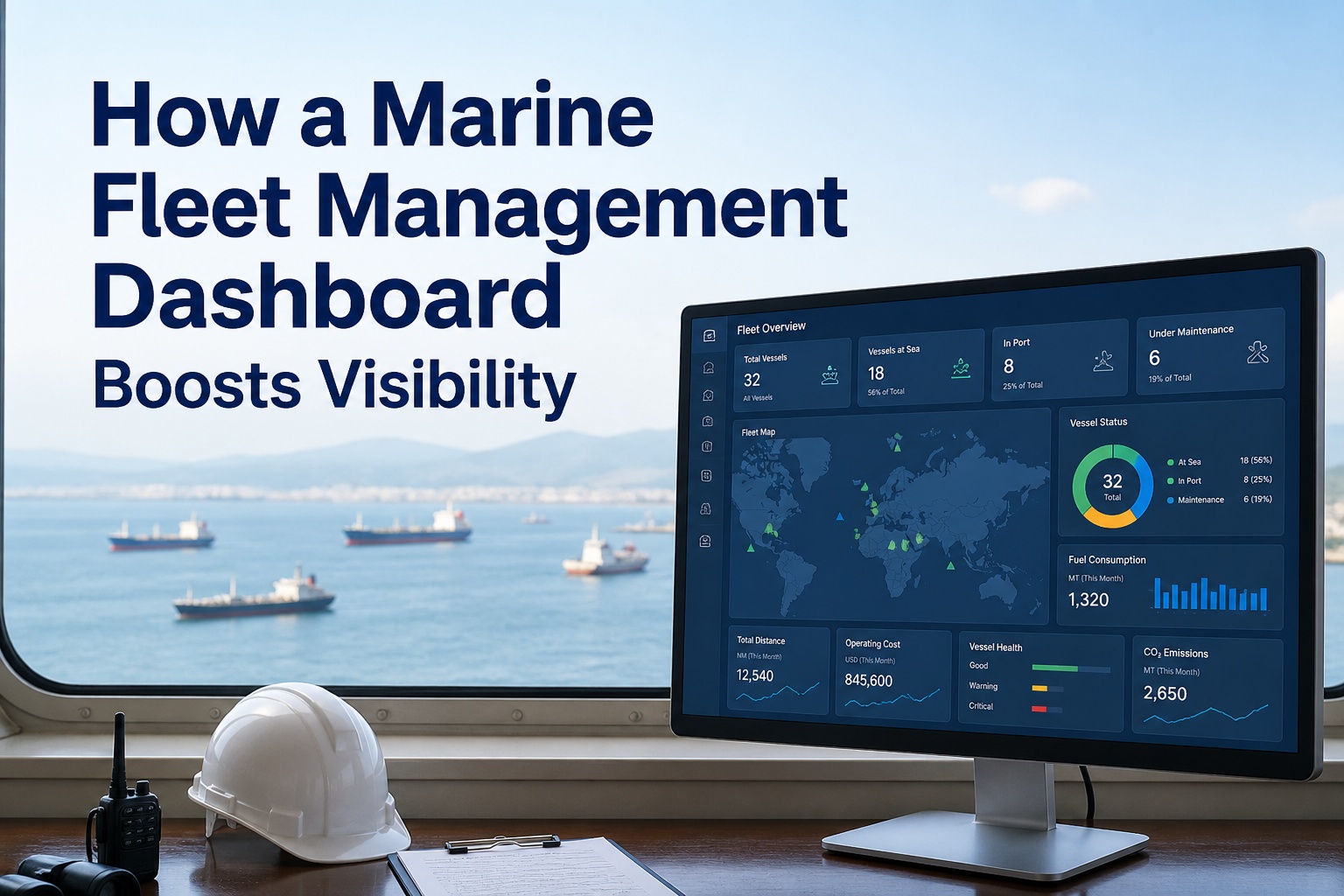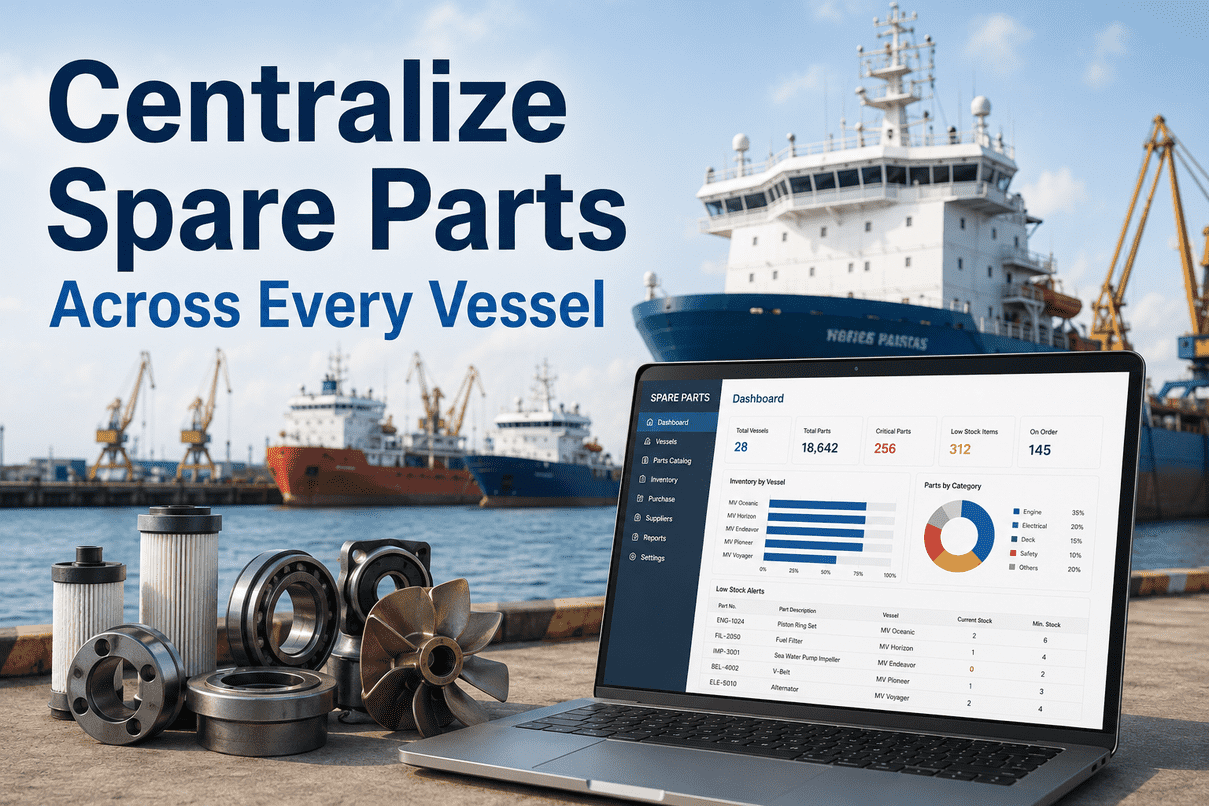
Spare parts are the largest controllable cost on a vessel and the most common cause of a delayed repair, yet on most fleets they live in a different reality on every ship — a different naming convention, a different spreadsheet, a different idea of what "minimum stock" means. One vessel calls it a fuel injection valve, another a fuel injector, a third just logs a part number nobody else recognises. When a chief engineer ashore tries to see what the fleet holds, the answer is a patchwork that cannot be searched, compared, or trusted. Centralized vessel spare parts management fixes this at the root: one master catalogue with standardized naming and coding, supplier prices held against each item, and minimum stock levels set per vessel and per warehouse, so the whole fleet's inventory becomes one searchable, controllable system. The payoff is direct — fewer stockouts that ground a vessel earning tens of thousands a day, less capital tied up in dead stock, faster procurement, and a compliance trail that satisfies SOLAS and class. This guide covers how a centralized catalogue is built, how coverage targets are set, how supplier pricing and critical-spares classification work, and why a single source of truth is the foundation of total parts control. Start a free trial of Marine Inspection to centralize your fleet's spares in one catalogue.
The Master Catalogue: The Single Most Impactful Investment
A centralized material catalogue with standardized naming, categorization, and unit-of-measure definitions is the single most impactful investment a fleet can make in inventory management. Each material should carry a consistent tracking configuration — defined once at the master level and enforced across every vessel — so a part means the same thing whether it is logged on a Baltic bulk carrier or an LNG carrier on a Middle East route. Without that master layer, every ship's data drifts into its own dialect, and fleet-wide visibility becomes impossible. The catalogue is the foundation everything else in this guide stands on.
Coding Standards: IMPA and ISSA
The reason centralized catalogues work is that the maritime industry already has shared coding languages. Building your catalogue on them means your parts speak the same language as your suppliers, eliminating the ambiguity that causes wrong deliveries and duplicate purchasing.
| Standard | What It Is | Scope | Why It Matters |
|---|---|---|---|
| IMPA code | Six-digit code in the Marine Stores Guide | 50,000+ items: stores, safety, spares | Guarantees correct delivery without ambiguity |
| ISSA code | Unique numbering in the ISSA catalogue | Deck, engine, provisions, bonded stores | Speeds international ordering with indexed items |
| OEM part number | Manufacturer's own reference | Equipment-specific spares | Ensures exact-fit replacement for machinery |
| IMO part number | Unique ID for emission-critical spares | Engines above 130 kW under MARPOL VI | Required, stamped, recorded in NOx technical file |
Carrying multiple codes against one catalogue item — the standardized name, the IMPA or ISSA number, the OEM reference, and where relevant the IMO number — is what lets a buyer ashore and an engineer aboard reference the same part with zero confusion, and lets the system flag exactly which spares carry regulatory obligations.
Coverage Targets: Min, Optimal, and Max per Vessel
A bulk carrier trading the Baltic does not need the same spare parts coverage as an LNG carrier on a Middle East-to-Asia route. Centralization does not mean one identical stock list for every ship — it means one catalogue with coverage targets set independently for each material at each location, driven by the vessel's trade pattern, operational profile, and supply chain access.
A coverage analysis view makes gaps visible at a glance, and fleet-wide coverage reports let the shore supply team prioritise replenishment across the entire fleet — directing limited budget to the most critical shortages first, rather than processing requisitions in the order they happen to arrive. That prioritisation is only possible when every vessel's stock sits in one comparable system.
Classify by Criticality Before You Set Levels
Coverage targets only make sense once parts are sorted by how badly their absence hurts. The standard ABC or criticality method directs attention and capital to the spares that can actually stop a vessel, and lets the cheap, easily replaced items be handled with a light touch.
Supplier Prices and True Landed Cost
Centralizing the catalogue is only half the picture; centralizing supplier pricing against each item is what turns it into a procurement tool. When every part carries its vendor options, pricing history, and lead times, buyers compare quotes from one place instead of chasing emails — and the fleet stops paying different prices for the same part on different ships.
| Data Held | What It Captures | What It Enables |
|---|---|---|
| Approved vendors | Preferred and alternative suppliers per item | Fast, compliant sourcing with fallback options |
| Pricing history | Past purchase prices over time | Quote comparison and price-trend visibility |
| Lead times | Expected delivery duration per vendor | Lead-time-aware reorder points that trigger early |
| Landed cost | Purchase price plus freight and charges | True total cost, not just the line price |
| Vendor performance | Delivery reliability and quality ratings | Evidence-based preferred-supplier decisions |
Tracking the full landed cost — purchase price plus freight and total charges — rather than the sticker price is what reveals which supplier is genuinely cheapest once delivery to a remote port is counted. Over time, pricing history and vendor performance ratings turn procurement from a series of one-off scrambles into a managed, data-driven function.
The Obsolescence Problem and Why a Live Catalogue Matters
Vessels, especially in the offshore sector, often outlive their equipment manufacturers. Original suppliers go out of business, manufacturers merge, and parts are quietly removed from catalogs — so the "original" spare can become impossible to source, and a replacement from another brand may demand very specific engineering knowledge. A static parts list cannot cope with this; a living, centralized catalogue can, by holding alternative parts, cross-references, and substitution notes against each item so the knowledge survives even when an OEM does not.
Tracking Stock Across Vessel, Fleet, and Warehouse
Centralization means a part is visible wherever it physically sits — on a ship, in a shore warehouse, or away being reconditioned. This multi-location view is what lets a fleet move a spare from one vessel to another instead of buying a second one, and never lose sight of a high-value component.
Because the same catalogue underpins all three, a transfer between locations is a status change rather than a fresh data-entry exercise, and the fleet's total spares value stays accurate no matter where a part is sitting.
Compliance: Spares Are a Regulatory Obligation
Centralized spares management is not only about cost and availability — several categories of spare carry hard regulatory requirements, and an auditor finding them missing or untracked is identifying a non-conformity. A catalogue that holds the compliance dimensions turns audit preparation from a scramble into a report.
How Marine Software Centralizes It — and Why It's Needed
Doing all of this on spreadsheets is exactly why most fleets do not manage to. Purpose-built marine software holds the master catalogue, enforces it across vessels, and copes with the realities of a ship that a generic ERP cannot.
The deeper reason it is needed is that spares management spans ship and shore, crew rotations, and patchy connectivity all at once — a context where a personal spreadsheet inevitably fragments. A centralized platform keeps one source of truth alive across every vessel and every handover, which is the entire point of managing spares as a fleet rather than as a collection of ships.