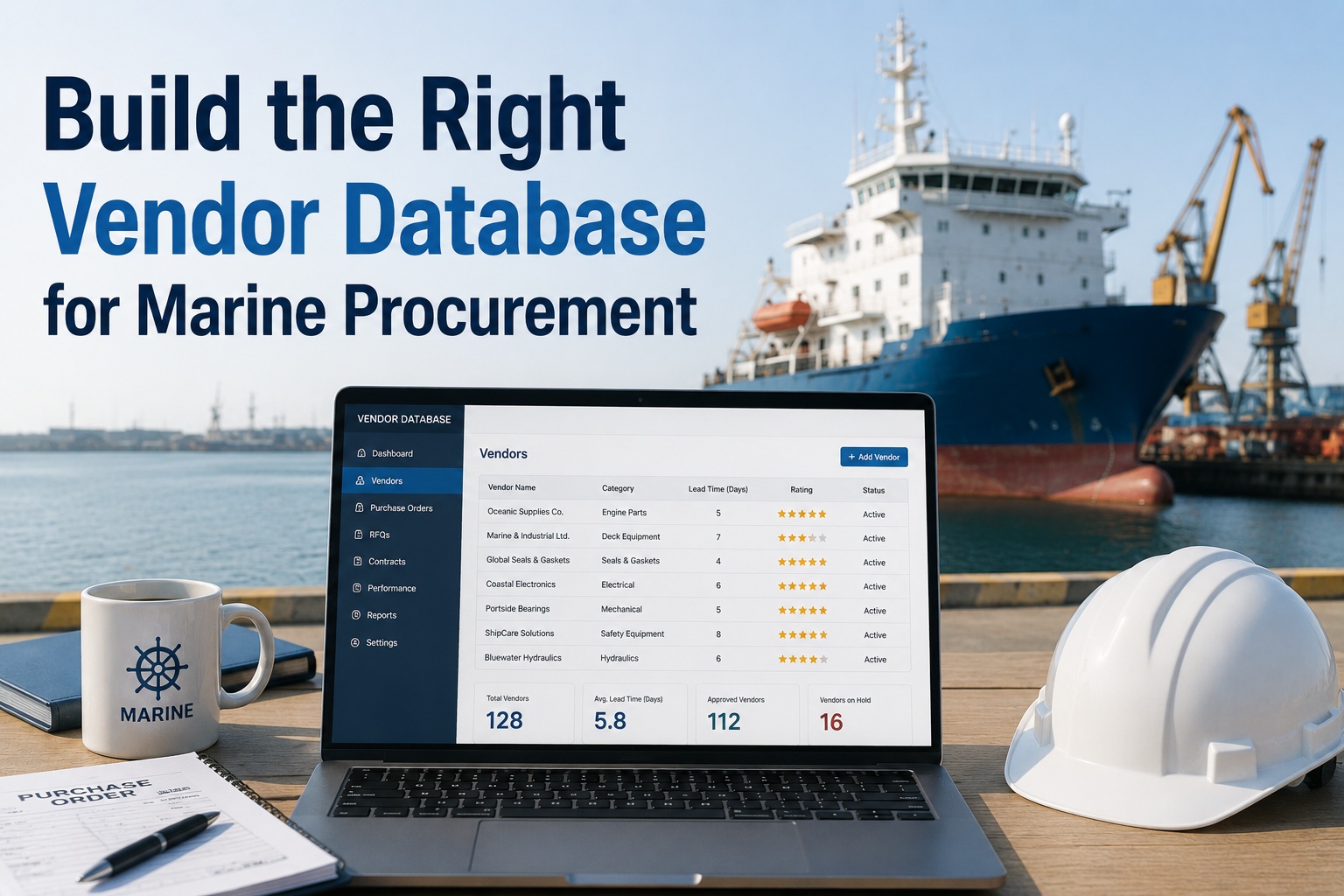
A fleet of vessels buys millions of dollars in spares, stores, services, and lubricants every year — and every one of those purchase orders is a bet on a supplier. Place it with the right vendor and the part arrives on time, at the agreed price, to the right port. Place it with the wrong one, with vendor data scattered across personal mailboxes and a buyer's memory, and you get the late delivery that strands a vessel, the price that quietly crept up, or the seal that failed and was reordered from the same supplier that supplied the bad one. A marine vendor database fixes this by holding every supplier's prices, lead times, approval status, and performance history in one structured, searchable system — so the buyer evaluating a quote sees exactly who delivers and who does not before the PO goes out. This guide covers what data a vendor database must hold, how performance scorecards work, where it sits in the procurement lifecycle, and why moving supplier intelligence out of inboxes and into a single source of truth is the difference between procurement that saves money and procurement that leaks it. To see a live vendor database and scorecard, book a Marine Inspection demo.
Right supplier, first time
Stop Gambling on Unreliable Suppliers
A structured vendor database puts every supplier's price, lead time, approval status, and performance score in front of the buyer at the moment of decision — so every purchase order goes to a vendor you can trust.
Prices & pricing history per item
Lead times by vendor and region
Performance scorecards on every supplier
Book a Demo
What a Marine Vendor Database Must Hold
A vendor list with names and phone numbers is a contact book, not a database. A procurement-grade vendor database holds the data that actually drives a sourcing decision — and holds it against every supplier so the choice is evidence-based, not habit. See the vendor profile in a demo.
Profile & approval status
Contact details, qualification documents, and an approval flag, so buyers source only from vetted, compliant suppliers.
Pricing & history
Current quotes and past purchase prices over time, so a buyer compares value and spots creeping costs.
Lead times
Expected delivery duration per vendor, feeding lead-time-aware reorder points and realistic planning.
Region & coverage
Where each supplier can deliver, so sourcing matches the vessel's next port and avoids congestion delays.
Performance scorecard
On-time delivery, price accuracy, and quality ratings built from the supplier's actual track record.
Item codes & catalogue links
Multiple supplier item codes mapped to your internal part catalogue for consistent, error-free purchasing.
The Performance Scorecard: Data, Not Gut Feel
The heart of a vendor database is the performance scorecard — a running, objective record of how each supplier actually performs, so the next sourcing decision is made on evidence rather than the buyer's most recent good or bad experience. These are the metrics that matter.
Table 1: Core Vendor Performance Metrics
The power of the scorecard shows up in a single moment: the next time a buyer raises a PO for that seal, the system surfaces the supplier's poor rating and the linked non-conformity, prompting them to choose a more reliable, approved alternative. That is procurement learning from its own history instead of repeating it.
Where the Vendor Database Sits in Procurement
Marine procurement is a hybrid process spanning ship, shore, and port — requisitions raised onboard, evaluation and ordering done ashore, delivery handled at global ports. The vendor database is the intelligence layer that the evaluation and selection steps draw on. See the full flow in a demo.
1
Need identified. A part is required — for example lube-oil filters for the main engine.
2
Requisition raised. Created via the PMS or by the crew, then verified by the superintendent.
3
Quotes collected. Sourced from the pre-approved vendor list in the database.
4
Vendors evaluated. Compared on price, lead time, past performance, and location.
5
PO generated. Approved through the chain and sent to the selected vendor.
6
Delivered & matched. Goods delivered to port, invoice matched, performance logged back.
The loop is what makes the database smarter over time: every completed order feeds delivery accuracy, price accuracy, and quality back into the vendor's scorecard, so the data the next buyer relies on is always current.
See it on your suppliers
Put Supplier Intelligence Behind Every PO
Marine Inspection holds vendor profiles with pricing history, lead times, performance ratings, and preferred-supplier lists, surfacing the right supplier at the moment a buyer chooses. Book a 30-minute demo to see the vendor database and scorecard on suppliers like yours, or start a free trial and import your vendor list today.
The Quote Comparison That Goes Beyond Price
The cheapest quote is rarely the best purchase. A vendor database powers a side-by-side comparison that weighs the full picture — because a slightly cheaper part from an unreliable supplier that delivers late to the wrong port costs far more than its price tag once a vessel is waiting.
Price & landed cost
Quote plus freight and charges, so the genuinely cheapest option is clear once delivery to a remote port is counted.
Lead time vs need
Whether the vendor can deliver before the vessel's port call, not just whether the price is attractive.
Performance history
The supplier's on-time and quality record, weighing reliability alongside the number on the quote.
Approval & risk
Approved status and any linked non-conformities, so a risky vendor is flagged before selection.
The Cost-Savings Levers a Vendor Database Unlocks
A structured vendor database is not just risk control — it is a direct lever on procurement cost. With supplier data centralized and comparable, fleets can pursue savings that fragmented inboxes make impossible.
Table 2: How a Vendor Database Cuts Procurement Cost
How Marine Software Builds the Database — and Why It's Needed
The reason most fleets do not have a real vendor database is that supplier intelligence lives in individual buyers' mailboxes and spreadsheets, where it cannot be compared, audited, or inherited when someone leaves. Purpose-built software fixes that by making the database a shared, living asset.
Out of inboxes, into one system
All supplier communication, contracts, conditions, spend, and quality incidents are captured from a single source instead of personal mailboxes — so the knowledge survives staff changes.
Scorecards built automatically
Every completed PO feeds delivery, price, and quality data back into the vendor's rating, so the scorecard is always current without manual upkeep.
Risk surfaced at selection
A poor rating or linked non-conformity appears the moment a buyer reaches for that vendor, steering the choice to a reliable alternative before the PO goes out.
Linked to catalogue and PMS
Supplier item codes map to the internal part catalogue and requisitions flow from the PMS, so sourcing is consistent and maintenance is never delayed by a stockout.
Tamper-proof audit trail
Every requisition, RFQ, approval, and PO is logged automatically, producing the defensible record internal and external audits require.
Shared across ship and shore
Buyers ashore, superintendents, and crew work from the same vendor data in real time, so geography never fragments the supplier picture.
The deeper reason it is needed is that procurement knowledge is institutional, not personal. A fleet spends millions across hundreds of suppliers, and when that intelligence lives in one buyer's head or inbox it walks out the door when they do. A shared vendor database keeps every hard-won lesson about who delivers and who does not alive for the whole organisation. Book a demo to see it on your fleet.
Frequently Asked Questions
What is a marine vendor database?
It is a structured, searchable record of every supplier a fleet uses, holding profiles, approval status, pricing and history, lead times, delivery region, performance scorecards, and item-code links to the part catalogue. It lets buyers evaluate and select the right supplier on evidence, rather than habit or whoever they happened to use last time.
What data should a vendor database hold?
At minimum: contact and qualification details with approval status, current and historical pricing, lead times per vendor, delivery region, a performance scorecard covering on-time delivery, price accuracy and quality, any linked non-conformities, and multiple supplier item codes mapped to your internal catalogue. Together these turn a contact list into a sourcing decision tool.
How do vendor performance scorecards work?
Each completed purchase order feeds data back into the supplier's record — whether it arrived on time, whether the invoice matched the quote, and whether the goods were correct and defect-free. Over time this builds an objective rating, so the next buyer sees a vendor's true track record, including any non-conformities, before placing an order.
How does a vendor database reduce procurement cost?
It enables vendor consolidation for bulk pricing, side-by-side quote comparison on value rather than sticker price, price-trend visibility for renegotiation, approved alternatives for resilience, and reliable-vendor selection that avoids the costly delays of late delivery. Centralized, comparable supplier data is what makes each of these possible.
Why move vendor data out of email and spreadsheets?
Because supplier intelligence held in personal mailboxes cannot be compared, audited, or inherited when a buyer leaves. Centralizing communications, contracts, spend, and quality incidents in one system makes the knowledge a shared, durable asset and produces the tamper-proof audit trail that compliance requires.
Does a vendor database support procurement compliance?
Yes. By logging every requisition, RFQ, approval, and purchase order automatically and tying them to approved-vendor status, it creates a clear, defensible record for internal and external audits. Buyers source only from vetted suppliers, and the full history of any supplier — qualification, orders, scorecard, and non-conformities — can be retrieved instantly.
Built for marine procurement
Send Every PO to the Right Supplier
Vendor profiles, pricing history, lead times, performance scorecards, approved-supplier lists, and a tamper-proof audit trail — all in one platform that links to your catalogue and PMS. Marine Inspection turns scattered supplier intelligence into procurement you control. Book a tailored walkthrough or start a free trial today.