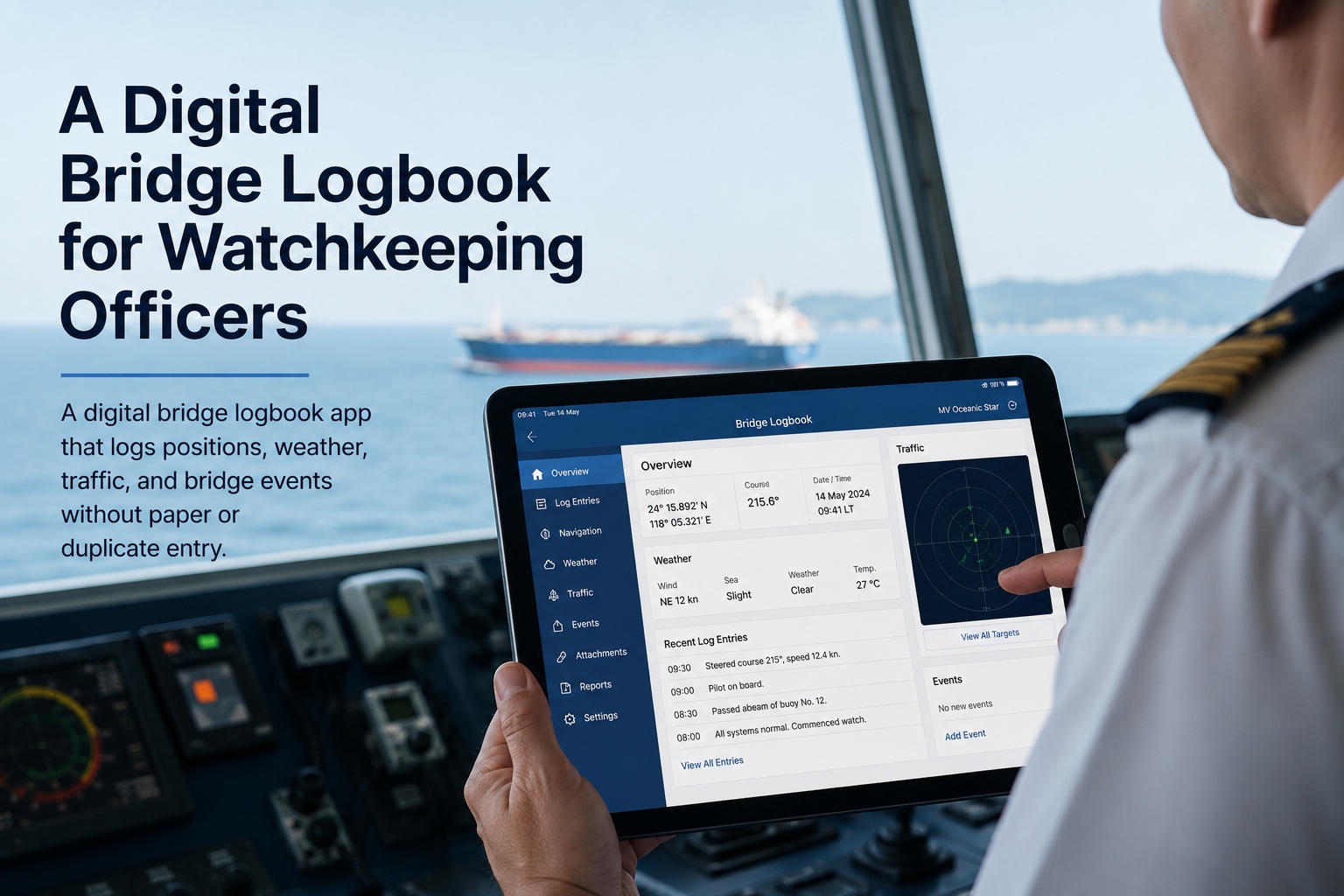
For the officer of the watch, the bridge logbook is both a duty and a liability. Every hour, alongside maintaining a proper lookout and fixing the ship's position, the OOW must record where the vessel is, what the weather is doing, what traffic is around, and every significant event of the watch — and that record carries their signature, which means it carries their responsibility. On paper, this is a chore performed in snatched moments: scribbled positions, a weather line copied from one instrument, events noted from memory at the end of the hour, and the same data written again into the movement book or the noon report. The duplication wastes the watchkeeper's attention at exactly the moments it should be on the window. A digital bridge logbook app changes that. It logs positions, weather, traffic, and bridge events with a few taps or automatic feeds, timestamps and signs each entry to the named officer, and writes the data once so it never has to be re-entered downstream. The result is a more accurate legal record, a faster watch, and an OOW whose attention stays where it belongs. This page walks through the watch you already know, shows it before and after, lays out who benefits and what they get, and explains why the electronic record protects you better than paper. To see a digital bridge logbook on a live watch, book a Marine Inspection demo.
Built for the officer of the watch
Spend Your Watch on the Lookout, Not the Logbook
Log positions, weather, traffic, and bridge events in a few taps — every entry timestamped, signed to you, and written once so it never needs re-typing. Less time on paperwork, more on the window.
hourlyposition, course, speed, weather logged
signedeach entry to the named OOW
onceenter data once, never duplicate it
Book a Demo
The Problem You Know Too Well
It is the middle of a busy watch. Traffic is building, the visibility is closing in, and the hourly log entry is due. You glance down to scribble the position, copy a weather reading, and try to remember the time of that last course alteration — all while your eyes should be on the window. Later you copy the same figures into the movement book and the noon report. None of it is hard; all of it pulls your attention from the one job that matters most, and every entry is signed in your name. If that watch sounds familiar, the rest of this page is about removing that friction. See the alternative in a demo.
Eyes off the window
Writing the log by hand at the busiest moments takes your attention off the lookout — exactly when the risk is highest.
Entered again and again
The same position and events get re-typed into the movement book, noon report, and official log — wasted time and a chance to make a transcription error.
Memory-filled gaps
Events noted from memory at the end of the hour are less accurate — a weak point if the log is ever scrutinised in an investigation.
Your signature, your risk
Every entry carries your name and your responsibility, so a rushed or incomplete log is a personal liability, not just a chore.
Your Watch, Before and After
The clearest way to see the difference is to compare the same watch on paper and in the app. The work is the same; the friction is gone.
On Paper Today
Look down, write time, date, position by hand
Copy a weather reading from each instrument
Recall and note events from memory later
Re-enter it all in the noon report and movement book
Hand over verbally, little of it on record
With the App
Position, time, and date filled automatically
Weather pulled from instruments, confirmed in a tap
Events logged the moment they happen, timestamped
Data written once, flowing to every downstream report
Handover documented against a checklist and signed
Who It's For, and What You Get
A bridge logbook touches more than the officer holding the pen. Each person who depends on the log gets something specific from going digital. See your role's view in a demo.
Officer of the Watch
A faster log that keeps your attention on the lookout, with entries signed and timestamped automatically so your record is always complete and defensible.
Master
Confidence that every watch is logged consistently and handovers are documented, with night and standing orders acknowledged on record.
Shore & DPA
A near real-time view of every vessel's bridge log without requesting it, and an audit-ready record for any inspection or investigation.
PSC / Inspector
An immutable, searchable record retrieved in seconds, with timestamps and signatures that make entries demonstrably genuine.
What You Log — in Seconds, Not Minutes
The app captures every element the paper deck log requires, but each one is a tap or an automatic feed rather than a handwritten line. Here is what a watch records, made effortless.
Position
Latitude and longitude at hourly intervals, by GPS in open water or radar and visual bearings in coastal areas, with cross-track error.
Course & speed
Standard and gyro compass courses with deviation and error values, the steering mode, and speed through the water and over ground.
Weather
Wind direction and force on the Beaufort scale, barometric pressure, air and sea temperature, visibility, and sea and swell state.
Traffic & COLREG actions
Vessels encountered, close-quarters situations, and any action taken to comply with the collision regulations, with the time recorded.
Bridge events
Course alterations, waypoints, equipment tests, drills, restricted visibility, and any significant occurrence during the watch.
Status references
Chart numbers in use, engine room manned or unmanned with the responsible engineer, and main engine RPM and status.
See it on your fleet
Give Your OOWs Their Attention Back
Marine Inspection logs position, course, weather, traffic, and bridge events in a few taps or automatic feeds, timestamps and signs each entry to the named officer, documents the handover, and writes the data once so it never needs re-entering. Book a 30-minute demo to see the bridge logbook on a vessel like yours, or start a free trial and digitise your deck log today.
The Handover That Leaves Nothing to Chance
The takeover is the riskiest moment of any watch — where a missed hazard or an unshared instruction causes a navigational mistake. With the app it becomes a documented, checklist-driven event instead of a verbal exchange that leaves no trace. See the handover in a demo.
Position cross-checked
The incoming officer confirms the plotted position and cross-track error before assuming responsibility, logged as part of takeover.
Compasses compared
Gyro and magnetic compass comparison recorded at handover and after major course changes, as standing orders require.
Orders acknowledged
Master's night and standing orders reviewed and acknowledged in the system, so the incoming OOW's awareness is on record.
Named accountability
Each officer's watch is clearly bounded and signed, so responsibility for every entry is unambiguous and traceable.
Enter Once — It Fills the Rest for You
On many vessels the same data is written several times: into the bridge log, the movement book, the noon report, and the official logbook. Each re-entry costs time and risks a transcription error. The app captures the data once and flows it everywhere it is needed.
You log it once
A position, course, or event is entered a single time during the watch — at the moment it happens, with full accuracy.
It builds the noon report
Distance, average speed, and consumption roll up from logged data, so the daily report is generated rather than re-typed.
It feeds compliance records
Relevant entries flow into the official logbook and other record books without you copying them across by hand.
It reaches the office
Synced data gives the shore office a near real-time view, ending the request-and-resend cycle for vessel information.
A Record That Protects You
The bridge log is official evidence in any investigation, so its integrity protects the officer who signed it. A well-built digital log is not just faster than paper — it is more defensible, because the qualities that make paper trustworthy are enforced automatically.
No page ever removed
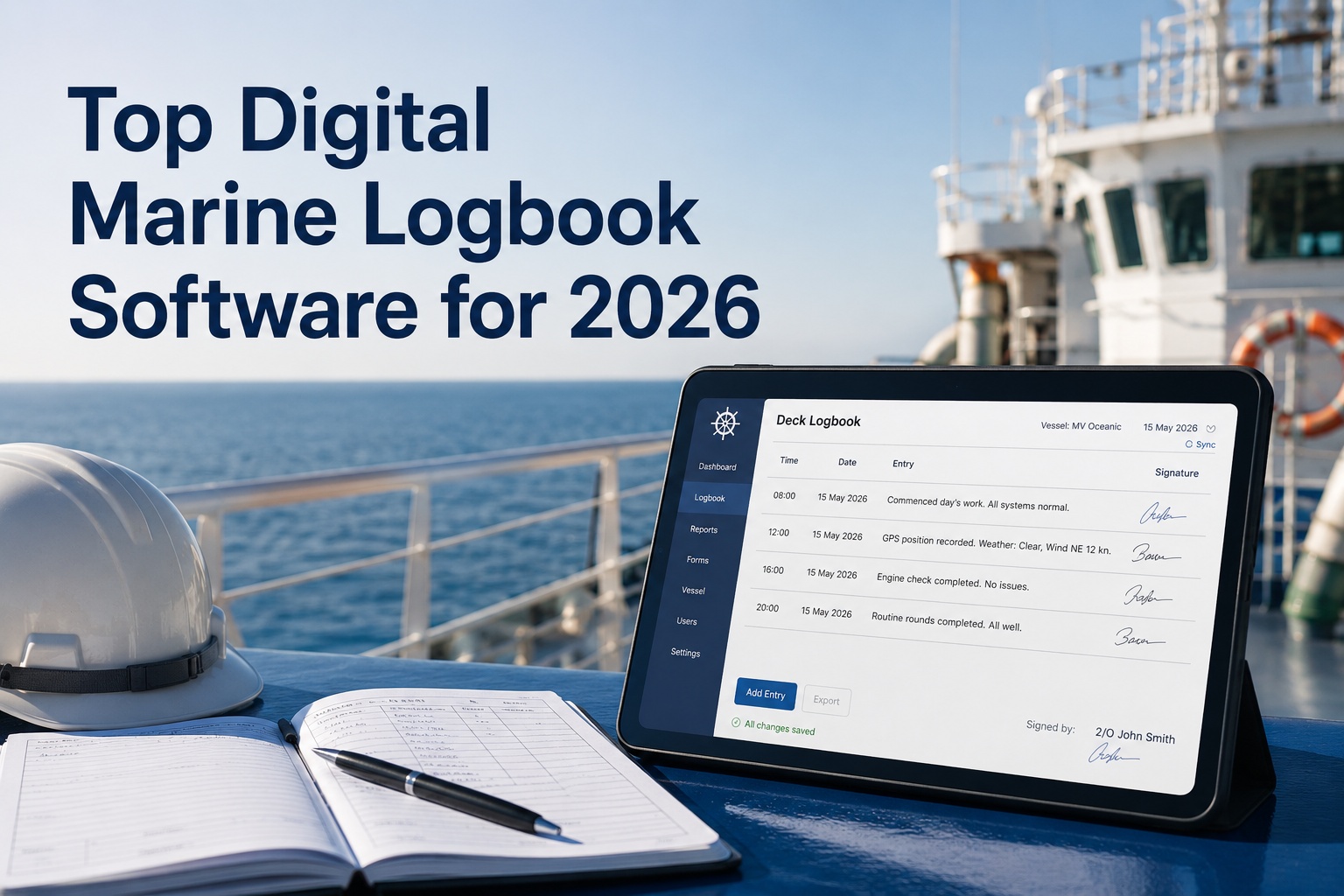
Paper rules forbid removing an original page; a digital log makes entries immutable, so the record cannot be quietly altered or lost.
Corrections stay visible
Where paper requires a single line through an error initialed by the officer, the app marks corrections while keeping the original viewable.
Objective timestamps
Automatic time and position stamps remove the ambiguity of a hand-written time, strengthening the record as evidence.
Signed and attributed
Each entry carries the named officer's electronic signature, preserving the personal accountability the OOW's signature represents.
Why It Holds Up at Sea
A bridge logbook app only earns its place if it works in the real conditions of a watch — offline, fast, and reliable. Purpose-built marine software is designed for exactly that, where a generic notes app or a paper book falls short.
Works fully offline
Entries are made without connectivity and sync to shore when the link returns, so the log never depends on a signal at sea.
Fast, structured entry
Pre-set fields and a few taps replace handwriting, with automated validation ensuring required data is never left blank.
Automatic data feeds
Position and instrument data can populate the entry directly, cutting transcription error and freeing your attention.
Tamper-proof audit trail
Every entry, edit, and access is tracked and signed, producing the immutable record an investigation or inspection relies on.
Written once, used everywhere
Logged data feeds noon reports, the official logbook, and shore-side visibility, ending duplicate entry across the vessel.
Part of the wider platform
The bridge log sits alongside the other logbooks and ship records, so navigation data connects to compliance and operations.
The deeper reason it matters is that the bridge log competes for your most limited resource — attention — at the moments safety depends on it most. Every minute spent writing, copying, and re-copying by hand is a minute not spent on the lookout. An app that captures the entry in seconds, signs it automatically, and never asks for the same data twice gives that attention back to the window, where your real duty lies. Book a demo to see it on your fleet.
Frequently Asked Questions
What is a digital bridge logbook app?
It is an electronic replacement for the paper deck or bridge log book, used by the officer of the watch to record position, course, speed, weather, traffic, and bridge events. It timestamps and signs each entry to the named officer, works offline, and writes data once so it never needs re-entering into the noon report or official logbook.
What does the officer of the watch log?
Hourly position in latitude and longitude, standard and gyro courses with deviation and error, speed, and weather — wind force on the Beaufort scale, pressure, temperatures, visibility, and sea state. Plus significant events: course changes, traffic and COLREG actions, drills, equipment tests, chart references, and engine room status. Each entry carries the OOW's signature.
How does it help during the watch?
By collapsing each entry to a few taps or automatic feeds from GPS and instruments, so record-keeping does not compete with the lookout. Timestamps, dates, and signatures are applied automatically, removing the clerical friction that, on a paper log, repeatedly pulls the watchkeeper's eyes off the window.
How does a digital log handle corrections?
Paper rules require an error to be struck through with a single line and initialed, never erased or covered with white-out. A digital log enforces the same principle automatically: corrections are marked and attributed, but the original entry remains visible to authorized users, preserving the integrity the bridge log needs as legal evidence.
Does it eliminate duplicate entry?
Yes. The same position, course, or event is often written into the bridge log, movement book, noon report, and official logbook. A digital app captures it once and flows it to each destination — the noon report is generated from logged data and relevant entries feed the official records, ending the re-typing that wastes time and introduces transcription errors.
Does the bridge log app work without internet?
Yes. Because a ship is often beyond reliable connectivity, the app allows the OOW to make all entries fully offline, then syncs to shore when the link returns. Offline operation is essential — a bridge logbook that needed a signal to record a position would be unusable for its core purpose.
Built for the bridge
A Bridge Log That Keeps Up With the Watch
Tap-fast position, course, weather, traffic, and event logging; automatic timestamps and named e-signatures; documented handovers; an immutable audit trail; and write-once data that feeds noon reports and official records — all offline-capable at sea. Marine Inspection gives the watchkeeper a logbook that keeps up. Book a tailored walkthrough or start a free trial today.