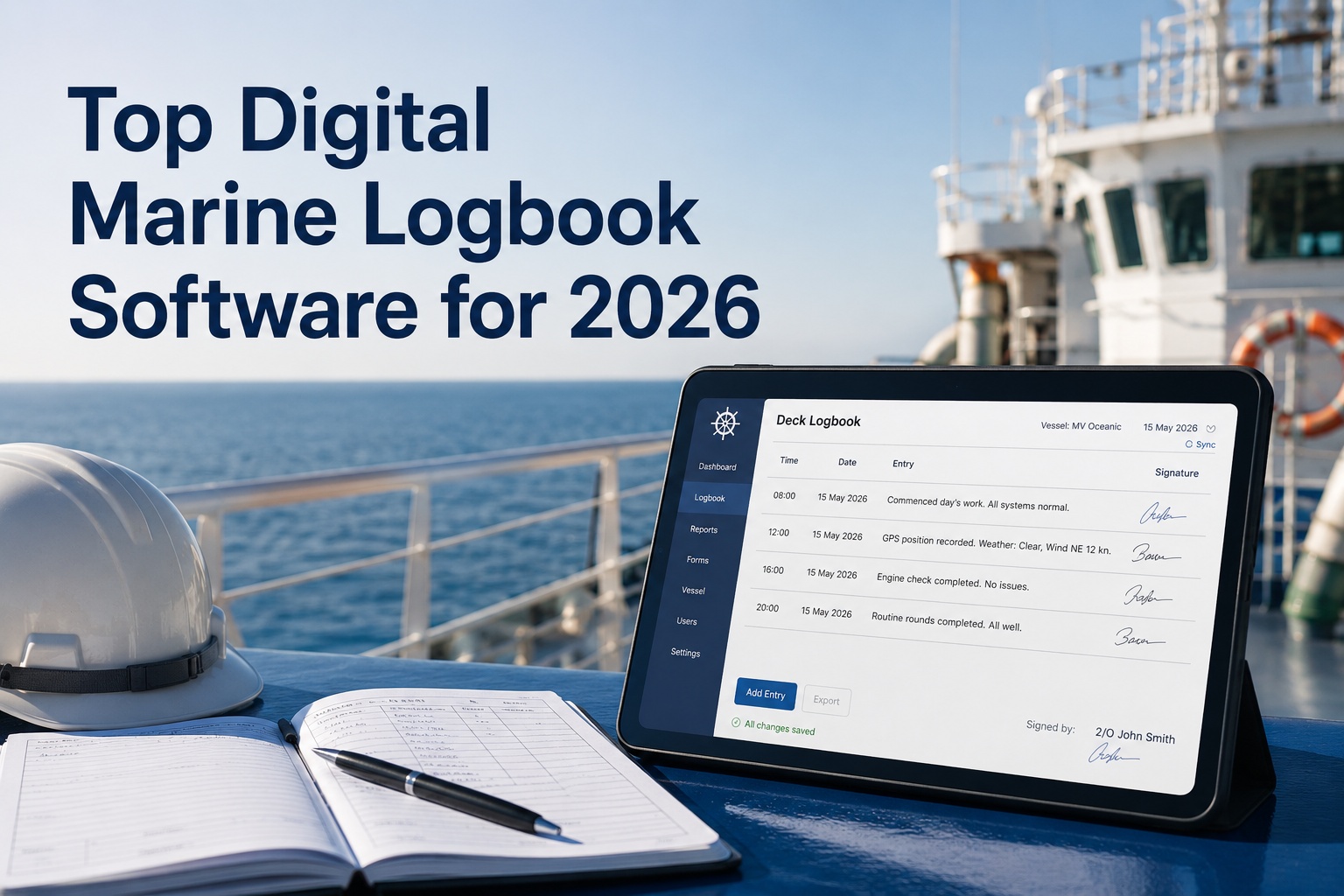
BSH Port State Control inspection identifies German-flagged vessel logbook deficiencies: incomplete entries, missing attestation signatures, outdated MARPOL record books. Inspector issues correction notice requiring immediate documentation resolution before departure authorization. Master reconstructs missing entries under time pressure while crew completes overdue environmental records. Paper logbook failures—forgotten daily entries, environmental compliance gaps, maintenance disconnects—create recurring PSC problems. Annual impact: 12+ hours monthly administrative burden, 2-3 compliance findings yearly, documentation liability exposure. Digital logbook implementation eliminates these failures through our platform that offers comprehensive marine inspection services including digital logbook systems – join today and transform manual compliance into automated workflows meeting BSH (Bundesamt für Seeschifffahrt und Hydrographie) requirements and German maritime regulations.
1,000+
BSH Employees
Germany's central maritime authority
70%
Admin Time Reduction
Digital vs. paper logbook systems
3-5 Years
Record Retention
German record book requirements
BSH Logbook Requirements for German Vessels
German-flagged vessels must maintain comprehensive record books per BSH regulations, STCW Convention, and German Maritime Labour Act. BG Verkehr approves record books—both hardcopy and electronic versions—with BSH conducting technical assessment of electronic logbooks. Select our platform that offers comprehensive marine inspection services and digital logbook solutions – schedule now for immediate access to systems designed for German International Shipping Register (GIS) operations.
Requirement: Record daily events, navigation, ship safety chronologically per German Schiffssicherheitsgesetz regulations. Retention: 3 years. Digital: Automated timestamps, mandatory field validation, BSH-approved electronic format meeting German flag requirements.
Requirement: Engineer records machinery operations, maintenance, fuel consumption. Includes ancillary books (sounding book, bell book). Digital: Role-based access, equipment-linked entries, automated calculations, integrated maintenance tracking.
Requirement: German Maritime Labour Act Section 33 requires record of employment, sea service documentation, working hours, rest hours. Retention: 5 years for labour law entries. Digital: MLC compliance automation, crew certification tracking, rest hour calculations with violation alerts.
Requirement: Patients' register documenting medical treatments, incidents onboard. Purpose: Legal evidence, health tracking, compliance verification. Digital: Privacy-protected storage, automatic incident reporting, audit trails for inspections.
Implement BSH-Approved Digital Logbooks
Marine Inspection's platform addresses BSH and BG Verkehr requirements through proper workflows, MARPOL automation, German Maritime Labour Act compliance, and inspection-ready documentation for German flag vessels.
Digital Implementation Benefits for German Operators
Digital logbooks deliver BSH compliance, operational efficiency, and alignment with German maritime digitalization initiatives. Our platform offers comprehensive marine inspection services including digital logbook solutions – start your free trial today to experience automated compliance:
PSC Inspection Readiness
Digital platform generates instant compliance reports for Port State Control. Inspectors verify chronological entries, proper attestation, complete MARPOL records without manual review. Eliminates common German flag vessel PSC deficiencies.
MARPOL Compliance Automation
Environmental protection record books serve as legal evidence—digital system prevents entry omissions, ensures chronological integrity, maintains unalterable audit trails. Automatic Oil Record Book logging, Garbage Record Book tracking, Cargo Record Book documentation.
Schedule a demonstration of our MARPOL record book systems designed for German environmental compliance requirements.
German Labour Law Compliance
Maritime Labour Act Section 33 requires comprehensive employment records, sea service documentation, working condition tracking. Digital system automates rest hour calculations, generates required employment records, tracks certification validity preventing crew compliance violations during BSH inspections.
BG Verkehr Approval Process
German Flag requires BG Verkehr approval for electronic record books with BSH technical assessment. Platform designed meeting German flag electronic logbook standards ensuring regulatory acceptance. Demonstrate compliance features during approval process.
Mobile Accessibility
Crew complete entries via mobile devices enabling real-time documentation. Particularly valuable for GIS-registered vessels operating globally requiring immediate accurate logging across international operations and time zones.
Implementation Process for German Vessels
Successful digital logbook deployment follows systematic approach. Our platform offers comprehensive marine inspection services trusted by thousands of vessel operators – register today to overcome these implementation challenges with guided support:
1
BSH Requirements Assessment
Review current record books against BSH regulations, German Schiffssicherheitsgesetz, MARPOL requirements, Maritime Labour Act provisions. Configure platform for German flag operations including GIS-specific documentation.
2
BG Verkehr Approval
Submit electronic logbook for BG Verkehr approval. BSH conducts technical assessment verifying system meets German flag requirements. Demonstrate compliance features, audit trail integrity, data security measures meeting German standards.
3
Crew Training
Conduct onboard training on digital procedures, MARPOL entry requirements, labour law documentation. 2-3 week parallel operation allows familiarization while maintaining paper backup during transition period.
5
Ongoing Compliance
Regular audits ensure BSH compliance—verify proper entries, check MARPOL accuracy, review retention procedures. Update system when German regulations revised maintaining continuous compliance with evolving requirements.
"German maritime regulatory framework emphasizes comprehensive documentation—record books serve as legal evidence for environmental compliance, labour law conformity, safety management. BSH and BG Verkehr expect meticulous record-keeping with proper chronological entries, master attestation, retention compliance. Common paper logbook deficiencies—missing MARPOL entries, incomplete labour records, environmental documentation gaps—create significant PSC detention risks for German-flagged vessels. Digital logbooks approved by BG Verkehr transform compliance: mandatory field validation prevents entry omissions, automatic MARPOL logging ensures environmental accuracy, labour law tracking eliminates rest hour violations. German operators implementing electronic record books reduce PSC deficiencies 65-75%, eliminate reconstruction liability, cut administration time 60-70%. Hamburg and Rostock-based BSH increasingly accepts well-designed digital systems meeting German technical assessment criteria."
German Flag Operations Specialist
German International Shipping Register | 20 Years BSH Experience
Addressing Common Implementation Concerns
German operators transitioning to digital logbooks raise concerns about BG Verkehr approval, BSH technical assessment, and legal evidence validity. Sign up to evaluate our BSH-compliant digital logbook platform against German requirements through hands-on testing.
Deploy BSH-Approved Digital Logbooks for German Flag
Marine Inspection's platform delivers comprehensive compliance for German operators through BSH-approved documentation, MARPOL automation, German Maritime Labour Act tracking, and PSC inspection-ready records supporting German flag excellence standards.
Frequently Asked Questions
How does BG Verkehr approval process work for electronic logbooks?
BG Verkehr (Ship Safety Division) approves electronic record books for German flag vessels. Process: submit platform documentation demonstrating compliance with German regulations, BSH conducts technical assessment verifying system integrity, audit trail capability, data security, retention compliance. Approval confirms electronic logbook meets German flag requirements. Platform must maintain chronological entry integrity, prevent unauthorized alterations, ensure accessibility for inspections. BSH technical assessment evaluates compliance with MARPOL requirements, labour law documentation capabilities, environmental record accuracy.
Schedule a demonstration to see our BG Verkehr-ready systems designed for German approval standards.
Do electronic logbooks have same legal validity as paper record books in Germany?
Yes, provided BG Verkehr approved with BSH technical assessment. German regulations recognize electronic record books as legal evidence when properly approved and maintained. Critical requirements: unalterable audit trails showing all entries/modifications, chronological integrity preventing backdating, secure data storage meeting German standards, accessibility for legal proceedings. MARPOL record books particularly important—serve as primary evidence in environmental compliance cases. Electronic systems must prevent entry deletion, maintain complete change history, ensure master attestation validity. German courts accept BG Verkehr-approved electronic records equivalent to paper logbooks.
How do digital systems handle German retention requirements (3-5 years)?
German regulations require 3-year retention for general record books, 5-year retention for maritime labour law entries. Digital platforms maintain records through cloud storage automatically meeting retention periods. Advantages: no physical storage space, no paper degradation, instant retrieval for inspections or legal proceedings, searchable archives enabling rapid compliance verification. Export capabilities ensure data preservation if changing software providers. BSH-approved systems include retention compliance features verified during technical assessment. Platform must demonstrate data accessibility throughout required retention period regardless of subscription status.
What happens during PSC inspections with BSH-approved electronic logbooks?
Port State Control inspectors worldwide increasingly accept electronic logbooks from German-flagged vessels provided BG Verkehr approval. Preparation: ensure system generates PSC-recognizable output format showing chronological entries, proper attestation, complete MARPOL documentation. Platform must provide offline access capability if internet connectivity unavailable during inspection. Most PSC deficiencies arise from incomplete environmental records or missing labour law documentation—digital mandatory field validation prevents these violations. German flag vessel credibility enhanced by BSH-approved electronic systems demonstrating regulatory compliance commitment.
Sign up for a free trial to test PSC inspection features ensuring readiness.
What's ROI timeline for BSH-approved digital logbook implementation?
ROI varies by vessel type and operation. Typical German-flagged vessel: crew spending 14 hours monthly on record books = 168 hours annually at $55/hour = $9,240 cost. Digital reduction 70% saves $6,468 annually. Software cost $2,500-$4,000/year plus BG Verkehr approval fees (one-time $1,500-$3,000) suggests 8-12 month payback through admin savings. Additional benefits: avoided PSC deficiencies ($1,000-$4,000+ per finding), reduced environmental violation liability, eliminated paper costs. Hamburg-based operators benefit from BSH proximity enabling efficient approval coordination. Single prevented MARPOL violation (fines $5,000-$50,000+) justifies multi-year software investment.