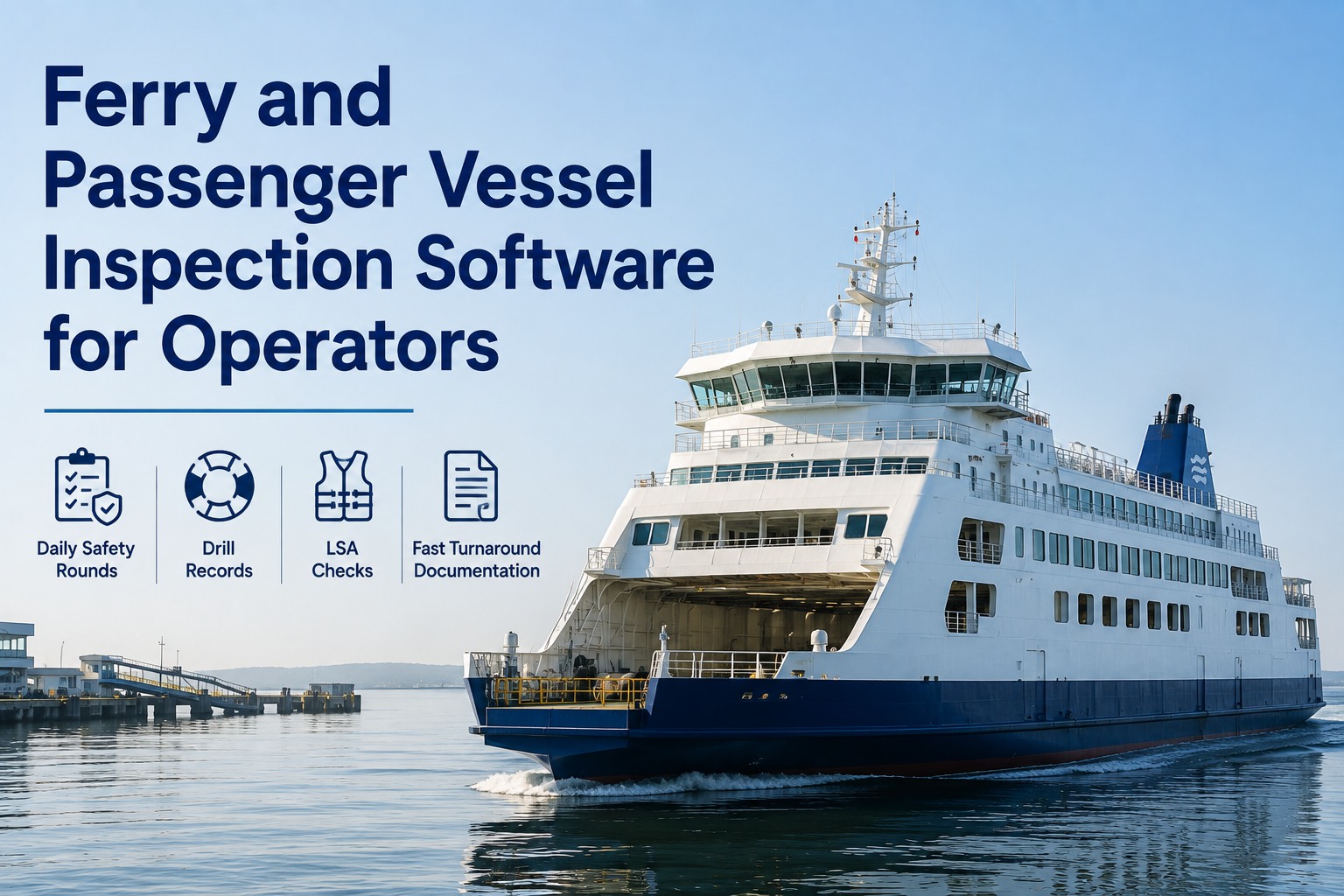
Ferry operators run the only compliance regime in shipping that repeats on a timetable rather than on a voyage. The global ferry industry moves roughly 4.27 billion passengers and 373 million vehicles a year, a scale comparable to commercial aviation, and it does so in crossings measured in hours. That changes what the regulations actually cost to satisfy. When the IMO amended SOLAS Regulation III/19 following the Costa Concordia loss — thirty-two dead, and around six hundred passengers still awaiting their muster drill at the moment of grounding — the requirement moved from mustering newly embarked passengers within twenty-four hours to doing so prior to or immediately upon departure. On a seven-day cruise that is one event per voyage. On a ninety-minute crossing with six departures a day it is six events, every day, with a record behind each one. Add watertight doors that must be operated daily and drilled weekly, a fifteen-strong drill matrix with named participation, damage control drills now mandated for all passenger ships, and a crew that rotates on a shift pattern rather than a contract, and the documentation load is unlike anything else afloat. Start a free trial of Marine Inspection and see it carried on the same clock the timetable runs on.
Same Regulation, Different Arithmetic
Deep-sea passenger vessel
1
muster event per voyage
A single embarkation, a single muster, one record. The regulation is satisfied once and the crew has days before the next one.
Short-sea ferry
6+
muster events per day
Every departure carries newly embarked passengers, so the obligation recurs at every sailing, with the evidence trail multiplied by the timetable rather than by the calendar.
The Concordia Amendment and Why It Lands Hardest on Ferries
The change was adopted by the Maritime Safety Committee at its 92nd session in June 2013 and entered into force on 1 January 2015, after the IMO had agreed interim recommended operational measures within five months of the casualty. Book a Marine Inspection demo and see per-departure muster records held without adding minutes to a turnaround.
What the amendment requires
Musters of newly embarked passengers must take place prior to or immediately upon departure, replacing the previous allowance of within twenty-four hours. Passengers must be instructed in donning life jackets, identifying their muster stations, understanding emergency broadcasts, and the first actions to take when an emergency announcement is made.
The ferry consequence
Frequency. A vessel completing several round trips a day generates the obligation at every departure, and each one needs to be evidenced. The practical question is not whether the muster happens — it does — but whether anybody records that it happened, in a form a Port State Control officer can review months later against a specific sailing.
Where it fails in practice
The announcement is made, the demonstration is given, and nothing is written down because the crew is already turning the vessel around for the return leg. The compliance act occurred; the compliance evidence did not. That distinction is invisible until somebody asks for the record of a particular crossing.
The Drill Matrix
SOLAS mandates a substantial set of distinct drill types across five frequency bands, and drill records are the single most inspected element of any safety management system — Port State Control officers verify them at every boarding and ISM auditors review schedules and participation at every audit. On a passenger vessel the matrix is at its densest. Sign up for Marine Inspection and hold the whole matrix against named crew rather than against a vessel.
Drill Frequencies and What Each One Demands
Weekly
Watertight doors and passenger muster
Watertight door drills run weekly, alongside the passenger muster obligation which for a ferry is effectively a per-departure event. These are the highest-frequency items in the matrix and the ones most likely to be performed correctly and recorded poorly.
Monthly
Fire, abandon ship, rescue boat
Every crew member must participate in fire and abandon ship drills monthly with no exceptions, subject to a twenty-four hour rule for new joiners and a before-sailing rule for new crews. On a shift-pattern roster this is the requirement that generates the most tracking work, because the crew present changes constantly.
Quarterly
Lifeboat launch, man overboard, oil spill, steering gear, damage control
Damage control drills are now mandated through amendments to SOLAS Chapter II-1 Regulation 19 and Chapter III Regulations 30 and 37, required at regular intervals for all passenger ships. The requirements are operational in nature rather than structural, which means they are satisfied by activity and evidenced by records.
Half-yearly
Free-fall lifeboat, emergency towing
Lower frequency and correspondingly higher risk of being missed, particularly where a vessel has been on a stable route with a settled crew and nobody has looked at the schedule as a whole.
Annual
Security drills
Annual items sit far enough apart that the crew who performed the last one may have entirely turned over before the next falls due, which places the institutional memory in the system rather than in the people.
Documentation standard
Every drill record should carry the date, the scenario, the equipment used, named participation, response times, and debrief findings with corrective actions attached. Named participation is the element that breaks on a ferry, because the roster changes between sailings and a record showing that a drill occurred is not the same as a record showing which individuals took part.
Most inspected element
Drill Records Are Checked at Every Boarding
Date, scenario, equipment, named participation, response times and debrief findings with corrective actions — captured at the muster station on the device the officer already carries, attributed to the individuals actually present on that shift, and retrievable against a specific sailing months later.
Watertight Doors: A Daily Obligation Nobody Systematises
This is the requirement most ferry operators satisfy physically and evidence poorly, and the regulatory direction of travel has been steadily tightening around it since 1992. Schedule a walkthrough and see daily door operation recorded as data rather than as a logbook line.
Daily operation
All watertight doors in main transverse bulkheads that are in use at sea, both hinged and power operated, are to be operated daily. That is a recurring record obligation with a defined frequency, and on a ferry it falls due every operating day without exception.
Weekly drills
Watertight door drills run weekly, separately from daily operation. The two are distinct obligations and are frequently conflated in a single logbook entry, which does not satisfy either cleanly when an auditor separates them.
The sixty-second standard
Since 1 February 1992, new passenger ships have been required to be equipped with power-operated sliding doors, except in specified cases, capable of being closed from a console on the bridge in not more than sixty seconds. That is a measurable performance standard, which means it can be tested and should be recorded as a measured value rather than as a pass.
Closed except in exceptional circumstances
All watertight doors are to be kept closed except in exceptional circumstances, and the regulatory trajectory has been to narrow that exception further. Revised guidance covers doors which may be opened during navigation, and later amendments to Chapter II-1 Regulation 22 have moved toward removing the possibility of leaving them open, applying to ships by contract, keel-laying and delivery dates rather than uniformly across the fleet.
The record problem
Daily operation of every door, weekly drills, a sixty-second closure standard that is measurable, and an exception regime that varies by build date. Four distinct obligations attaching to the same physical equipment, each with its own frequency, all of them typically evidenced by a single handwritten line in a deck log. When an inspector asks which doors were operated on a specific date three months ago and by whom, the log rarely answers.
What the Daily Round Actually Has to Cover
Beyond the drill matrix, a passenger vessel carries a continuous inspection burden that runs on the operating day rather than on a maintenance calendar. The table below is what a structured round has to reach and where each item usually falls through. Start a free trial and build the round against your own vessel layout.
Table 1: Recurring Inspection Obligations on a Passenger Vessel
Structured rounds captured at the point of inspection, attributed to the officer on that shift, evidenced against a specific sailing.
Damage Control and Safe Return to Port
Two of the most consequential post-Concordia developments sit in this area, and both are structural obligations with operational and documentary consequences. Book a walkthrough and see damage control drills and stability support arrangements held in the same record as everything else.
Damage control drills
The IMO agreed that damage control drills would improve passenger ship safety and adopted amendments to SOLAS Chapter II-1 Regulation 19 and Chapter III Regulations 30 and 37 to mandate them. The requirements are operational in nature, with drills required at regular intervals for all passenger ships. Because they are operational rather than structural, they apply across the fleet rather than only to new builds, and they are satisfied through demonstrated activity with a record behind it.
Subdivision and damage stability
The Maritime Safety Committee adopted a substantive set of Chapter II-1 amendments in 2017, entering force on 1 January 2020, following a review focused on new passenger ships and informed directly by the Costa Concordia investigation. Revised Explanatory Notes were adopted alongside them, together with revised guidance for watertight doors which may be opened during navigation.
Safe Return to Port
SOLAS Regulations II-1/8-1, II-2/21 and II-2/22 require a passenger ship to be able to return to port under its own power after a fire or flooding casualty within defined thresholds. The requirement applies to passenger ships with keels laid on or after 1 July 2010 that are 120 metres or longer, or that have three or more main vertical zones. Revised Explanatory Notes were agreed at SDC 12 in January 2026 with future application dates — confirm the applicable position for your own tonnage with your society.
Stability calculation support
Ships of 120 metres or more, or with three or more fire compartments, are required either to carry a loading computer capable of damaged-condition stability calculation or to arrange shore-based emergency support for those calculations. Where shore support is the chosen route, the arrangement itself is a compliance artefact that needs to be current and demonstrable, not a contact number in a folder.
Ro-Ro Spaces and the Detection Change
Ro-ro and vehicle spaces are the defining hazard of the passenger ferry, and 2026 brought a fire detection change specific to them. Sign up for Marine Inspection and hold vehicle deck inspections against the space rather than the vessel.
The definition
A roll-on roll-off ship is defined in the November 1995 amendments to SOLAS Chapter II-1 as a passenger ship with ro-ro cargo spaces or special category spaces. The car and passenger ferry on short-sea routes is the most common expression of it, and the combination of large undivided spaces, vehicles carrying fuel, and passengers in accommodation above is what has driven most of the regulatory attention this vessel type receives.
The 2026 detection requirement
New ships with ro-ro or vehicle spaces must install individually addressable smoke and heat detectors. Addressability is the operative word: it changes a detection alarm from a zone indication into a specific location, which materially changes the response and also creates a maintenance obligation per detector rather than per loop.
What it means for the maintenance record
Individually addressable devices should be individually maintainable. Function test, cleaning and fault history belong against each detector, so that a recurring fault on a specific unit surfaces as a pattern rather than as a series of unrelated alarm entries in a log.
The operational reality
Vehicle deck inspection competes directly with loading and discharge, which on a ferry is the busiest period of the entire turnaround. Any inspection process that assumes a quiet deck and unhurried access will be completed on paper rather than in fact, which is precisely the failure mode a structured mobile round is designed to remove.
Where the Work Has to Fit
Ferry maintenance planning is a scheduling problem before it is a technical one. Understanding which windows genuinely exist is what separates a plan that gets executed from a backlog that grows. Schedule a demo and filter your own backlog by the window it actually fits.
Turnaround
Minutes
Discharge, load, muster, sail. Nothing that can be interrupted by a schedule belongs here, and anything attempted will be abandoned mid-task. This window belongs to rounds and checks, not to maintenance.
Crossing
Hours
The genuine daily working window for engineering, provided the task can be completed or safely suspended before arrival. Drills that require passenger involvement also fall here on longer routes.
Overnight layover
Hours to a shift
Where the route allows it, this is the most productive window in the week and the one most worth planning against explicitly rather than filling opportunistically.
Off-service and dock
Days
Seasonal or scheduled withdrawal. On a route with year-round demand this window is scarce and expensive, so work reaching it that could have been done overnight represents a direct commercial loss.
Evaluating a Platform for a Ferry Operation
Run these with a master, a chief engineer and a safety officer present. Generic maintenance capability will not distinguish shortlisted platforms; frequency handling and attribution will. Start a free trial and test against your own timetable rather than a demo dataset.
Table 2: Buyer Questions Specific to Ferry and Passenger Operators
2026 PASSENGER VESSEL COMPLIANCE REALITY
Domestic voyages sit outside SOLAS but rarely outside regulation. SOLAS passenger ship requirements do not generally apply to passenger ships on domestic voyages, yet many countries base their national regulations on IMO standards, and the IMO adopted recommendatory Model Regulations on Domestic Ferry Safety in April 2022 providing framework provisions on certification, manning and safety for incorporation into national law. Establish your own applicable regime rather than assuming either that SOLAS applies or that nothing does. Application dates vary by build. Several passenger ship amendments apply by contract date, keel-laying date or delivery date rather than uniformly, including the tightening around watertight doors under Chapter II-1 Regulation 22. Confirm which apply to each hull in your fleet individually. Explanatory notes continue to evolve. Revised Explanatory Notes relevant to Safe Return to Port were agreed at SDC 12 in January 2026 with future application dates; confirm the current position with your classification society. The statutory floor still applies. ISM Code Element 10 requires a documented maintenance system and SOLAS Chapter IX makes ISM mandatory for SOLAS-certified ships.
Frequently Asked Questions
When must newly embarked passengers be mustered?
Prior to or immediately upon departure. The Maritime Safety Committee adopted amendments to SOLAS Regulation III/19 at its 92nd session in June 2013, replacing the previous requirement to muster within twenty-four hours, and they entered into force on 1 January 2015. The change followed the Costa Concordia loss in January 2012, in which around six hundred passengers had not yet completed their muster drill at the time of grounding, and the IMO agreed interim recommended operational measures within five months of the casualty. Passengers must be instructed in life jacket donning, muster station identification, emergency broadcasts and first actions on an emergency announcement.
How often must watertight doors be operated and drilled?
These are two separate obligations. All watertight doors in main transverse bulkheads that are in use at sea, both hinged and power operated, are to be operated daily. Watertight door drills are held weekly. In addition, since 1 February 1992 new passenger ships have been required to carry power-operated sliding doors, except in specified cases, capable of closure from a bridge console in not more than sixty seconds, and all watertight doors are to be kept closed except in exceptional circumstances. Later amendments have moved toward removing the possibility of leaving them open, applying by contract, keel-laying and delivery dates rather than across the whole fleet at once.
Are damage control drills mandatory on passenger ships?
Yes. The IMO agreed that damage control drills would improve passenger ship safety and adopted amendments to SOLAS Chapter II-1 Regulation 19 and Chapter III Regulations 30 and 37 to mandate them, with drills required at regular intervals for all passenger ships. The requirements are operational in nature rather than structural, which means they apply to existing tonnage rather than only to new builds, and compliance is demonstrated through performed drills with proper records rather than through equipment fit. Record them to the same standard as every other drill: date, scenario, equipment, named participation, response times and debrief findings with corrective actions.
Which vessels does Safe Return to Port apply to?
Safe Return to Port is required under SOLAS Regulations II-1/8-1, II-2/21 and II-2/22, requiring a passenger ship to return to port under its own power after a fire or flooding casualty within defined thresholds. It applies to passenger ships with keels laid on or after 1 July 2010 that are 120 metres or longer, or that have three or more main vertical zones. Separately, ships of 120 metres or more or with three or more fire compartments must either carry a loading computer capable of damaged-condition stability calculations or arrange shore-based emergency support for them. Where shore support is chosen, that arrangement is itself a compliance artefact requiring currency and demonstrability.
Do SOLAS requirements apply to domestic ferries?
Not generally, but the practical answer is more nuanced. SOLAS passenger ship requirements do not usually extend to passenger ships on domestic voyages, and yet domestic ferry operations are critical infrastructure in many regions and frequently the only affordable transport available. Many countries base national regulations directly on IMO standards, and in April 2022 the IMO adopted recommendatory Model Regulations on Domestic Ferry Safety providing framework provisions on certification, manning and safety for incorporation into national law. The operational implication is that a system serving domestic operators must carry configurable national requirements rather than a fixed SOLAS template.
How do you record compliance when the turnaround is minutes long?
By capturing at the point of the act rather than afterwards, and by keeping the capture short enough to survive the pressure. A muster record that takes three taps at the muster station gets made; a form that takes four minutes at a desk gets made later from memory, or not at all. The same applies to watertight door rounds, vehicle deck checks and bow door verification. The design test is simple and worth running during any evaluation: hand the device to an officer, time a full round during an actual turnaround, and see whether the process finishes before the vessel sails.
Ferry and passenger operations
Compliance on the Timetable, Not the Voyage
Six departures a day means six muster records a day
Per-sailing muster evidence, daily watertight door operation recorded by door and by person, weekly drills with named participation across a shift roster, individually addressable detectors held as individual assets, vehicle deck rounds captured during loading rather than after it, and damage control drills evidenced to the same standard as everything else — offline on the device your officers already carry, fast enough to finish before the vessel sails.