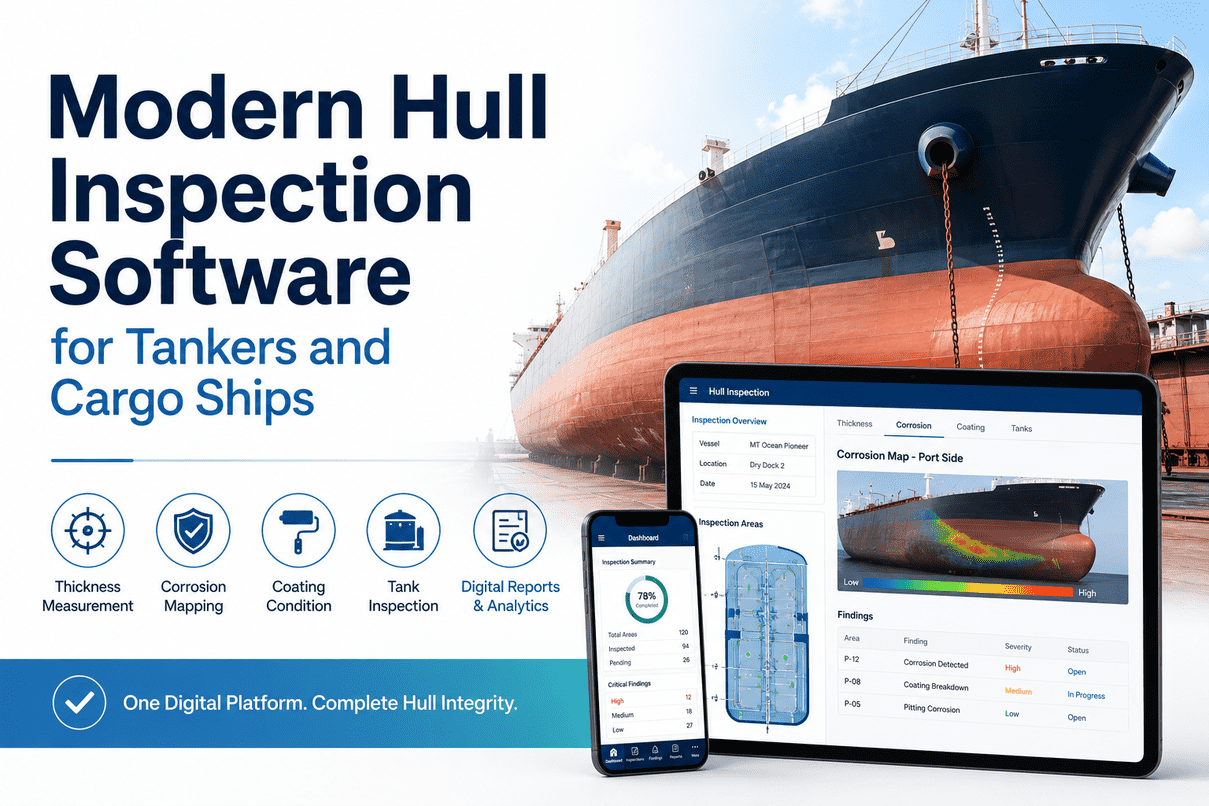
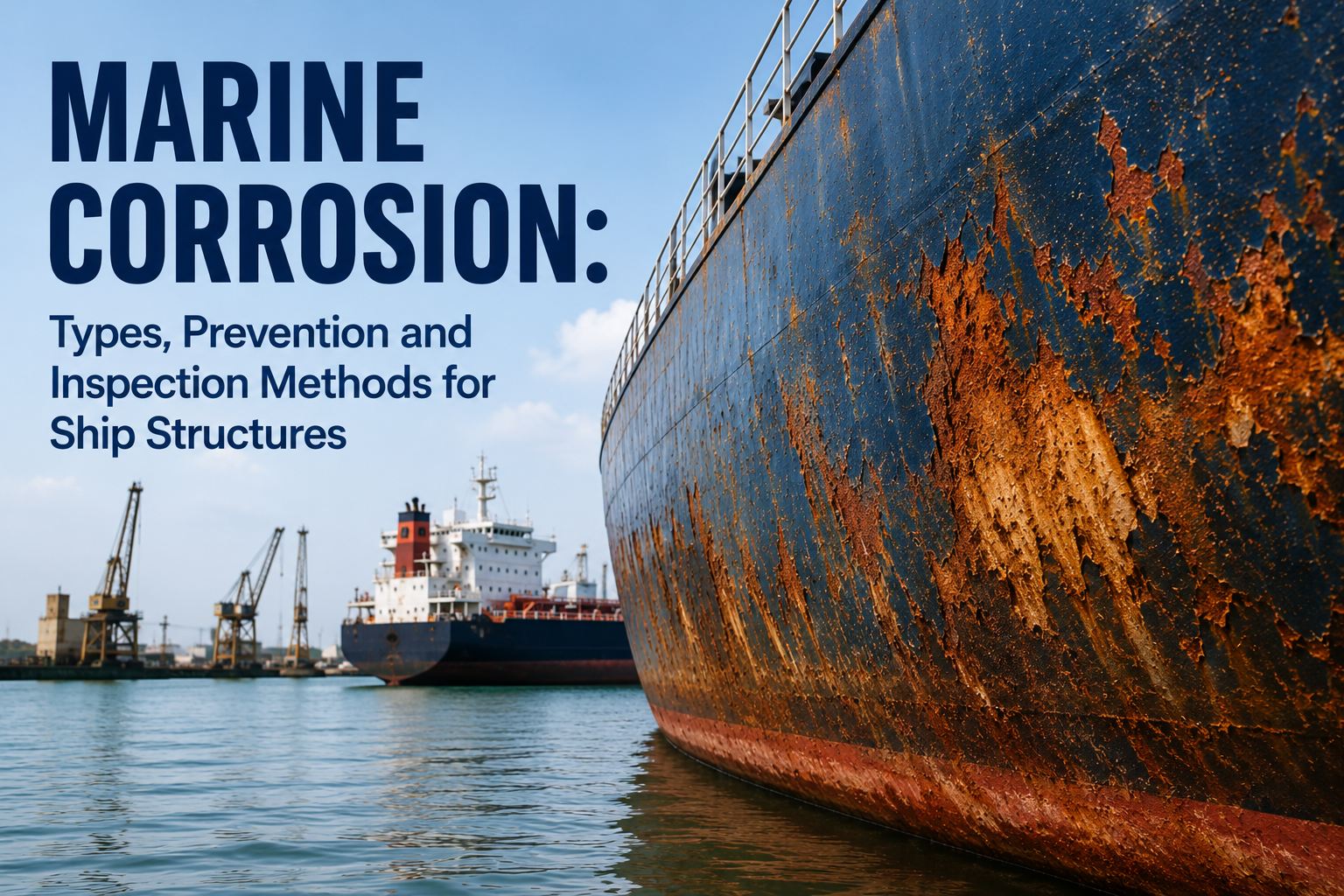
Hull integrity is the single largest steel asset on a vessel — and the single most expensive failure mode. The Enhanced Survey Programme (ESP), mandatory for bulk carriers and oil tankers under IACS Unified Requirements Z10.1 and Z10.2, structures the inspection regime: Annual Survey, Intermediate Survey at 2 to 3 years, and Special or Renewal Survey every 5 years — each with progressively deeper scope. Class rules generally require immediate steel replacement when a plate shows 20 percent or more reduction from as-built thickness. Substantial corrosion is flagged at 75 to 100 percent of the allowable wastage limit. The 2026 environment adds new dimensions. UWILD (Underwater Inspection in Lieu of Drydocking) is increasingly accepted by class societies, enabled by ROV-deployed Acoustic Resonance Technology validated by Lloyd's Register. CSR Common Structural Rules updates are layered on the ESP foundation. Pitting corrosion in tank bottoms, coating breakdown, anode wastage, and engine room structure below floor plates all receive heightened survey attention. Hull inspection software brings every dimension into one digital platform — thickness measurement reports, corrosion mapping with CAD overlays, coating condition tracking, tank inspection records, and the ESP file ready for any class surveyor. Start a free trial of Marine Inspection to conduct hull integrity surveys with the rigor 2026 ESP requirements expect.
Hull Inspection Software · 2026
Thickness. Corrosion. Coatings. Anodes. Every Hull Reading Mapped, Tracked, Class-Ready.
UTM, ART, PAUT, ACFM integrated capture with CAD-overlay corrosion mapping, substantial-corrosion thresholds enforced, ESP file maintained, UWILD-compatible workflow.
M/V Pacific Star · Tank 4P Bottom Plating
UTM Survey · 28 May
New >90%
Fair 75-90%
Substantial <75%
The Six Hull Integrity Areas Every Inspection Must Cover
The Enhanced Survey Programme, OCIMF recommendations, and CSR Common Structural Rules converge on six hull integrity areas that every credible hull inspection must verify. Each area has its own measurement methods, regulatory thresholds, and reporting requirements.
01
Hull Plating
Deck plating, bottom plating, side shell, sheer strake, garboard strake — UTM grid readings against as-built thickness. Material loss percentage calculated. Substantial corrosion threshold at 75 to 100 percent of allowable wastage triggers detailed survey expansion.
02
Tank Structure & Internals
Cargo tanks, ballast tanks, fuel oil tanks, double bottom, pump rooms — pitting corrosion in tank bottoms is a leading ESP finding. Stringers, web frames, transverse frames, longitudinals all surveyed close-up at intermediate and special surveys.
03
Welds & Structural Joints
Girth welds, longitudinal welds, fillet welds, tee joints — visual close-up examination, ACFM for crack detection through coatings, magnetic particle testing for surface cracks, dye penetrant testing on critical joints during dry docking.
04
Coatings & Protective Systems
Epoxy tank coatings, anti-fouling hull coatings, deck coatings — Good, Fair, Poor rating per IMO PSPC. Breakdown patterns mapped, coating thickness measurements taken, lifecycle replacement schedule maintained in the ESP file.
05
Anodes & Cathodic Protection
Sacrificial anode wastage, impressed current cathodic protection system function, hull-to-water potential readings, anode replacement schedule, bonding straps verified. ESP requires anode condition recording at each survey level.
06
Engine Room Structure
Below bottom floor plates where corrosion continues unnoticed, tank tops, shell plating in engine room, foundation structures — OCIMF specifically recommends E/R structure examination at Special and Intermediate Surveys despite not being in original ESP scope.
The Hull Survey Schedule & Scope Matrix
The matrix below maps each hull survey type to its inspection scope, frequency, and required evidence per IACS Unified Requirements Z10.1 and Z10.2. Class surveyors verify the ESP file against this matrix at every attendance. Scroll horizontally on mobile for the full view. Book a survey-schedule walkthrough to map your fleet's current ESP file against the regulatory baseline.
| Survey Type |
Scope |
Frequency |
Evidence Required |
| Annual Survey |
Visual exam, weathertight integrity, vent pipes |
±3 months around anniversary |
Survey report + photo evidence |
| Intermediate Survey |
Selected tanks close-up, UTM on suspect areas |
Between 2nd and 3rd anniversary |
TMR extract + CER update + photos |
| Renewal / Special Survey |
All tanks close-up, full UTM, internal exam |
Every 5 years |
Full TMR + CER + ESP file |
| Dry Dock Survey |
External shell, rudder, propeller, sea chests |
Twice per 5 years |
Drydock report + UTM external |
| UWILD Survey |
In-water hull thickness via ROV-ART scan |
Class-approved alternative |
ART scan data + class approval letter |
| Bottom Survey |
Bottom plating, sea chests, rudder bearings |
Every 36 months max |
UTM grid + visual + photo |
| Tank Top Examination |
Pitting corrosion check in cargo tanks |
Intermediate + Renewal |
Pitting map + UTM + coating rating |
| Coating Condition Survey |
Good/Fair/Poor rating per IMO PSPC |
Every survey level |
Coating rating + breakdown map |
| Anode Condition Recording |
Wastage percentage + replacement schedule |
Every survey level |
Anode chart + photo + ESP entry |
| Substantial Corrosion Follow-Up |
Expanded UTM where 75%+ wastage found |
Triggered by initial finding |
Expanded TMR + steel renewal record |
The Five NDT Technologies Modern Hull Inspection Uses
Hull inspection is no longer single-technology. Five non-destructive testing methods cover the substantial majority of hull integrity scenarios, with technology selection driven by location, coating state, and survey type. A credible platform structures captures from all five into one unified record.
UTM
Ultrasonic Thickness Measurement
Primary tool for hull thickness measurement. High-frequency sound waves identify internal corrosion and material loss behind paint or marine growth. Calibrated probe readings recorded against as-built thickness charts.
ART
Acoustic Resonance Technology
Lower frequency wider bandwidth than PAUT. Penetrates coatings without removal. Lloyd's Register validated for quantitative UTM through coatings. Up to 1 million thickness readings per square metre. Enables UWILD via ROV deployment.
PAUT
Phased Array Ultrasonic
Multi-element probe with electronically-steered beams. Higher resolution than conventional UTM for weld inspection. Used for critical girth welds, longitudinal welds, and structural connections during drydock surveys.
ACFM
Alternating Current Field Measurement
Crack detection and sizing through coatings. DNV and ABS approved. Surface-breaking cracks located and sized without coating removal. Particularly valuable for weld crack inspection in service.
CUI
Close-Up Visual Inspection
ESP-mandated close-up examination of selected tanks and structures. Surveyor within arm's reach of structure. Pitting corrosion, coating breakdown, weld irregularities documented with photo evidence and location coordinates.
Substantial Corrosion & Steel Replacement Thresholds
The class rules on substantial corrosion and steel replacement are unambiguous — but their application across different hull locations and structural members varies. The table below maps allowable wastage limits and replacement triggers across the structural locations most commonly surveyed. Scroll horizontally on mobile for the full view.
| Hull Location |
Substantial Corrosion |
Steel Replacement Trigger |
Inspection Method |
| Deck plating |
75% of allowable wastage |
20% reduction from as-built |
UTM grid + visual |
| Bottom plating |
75% of allowable wastage |
20% reduction from as-built |
UTM grid + ART (UWILD) |
| Side shell plating |
75% of allowable wastage |
20% reduction from as-built |
UTM + ACFM for cracks |
| Tank top plating |
75% of allowable wastage |
20% reduction + pitting depth |
UTM + pitting map + visual |
| Longitudinal frames |
75% of allowable wastage |
Web 17%, flange 20% |
UTM + close-up visual |
| Transverse web frames |
75% of allowable wastage |
Web 17%, flange 20% |
UTM + close-up visual |
| Stringers |
75% of allowable wastage |
Web 17%, flange 20% |
UTM + close-up visual |
| Bulkhead plating |
75% of allowable wastage |
20% reduction from as-built |
UTM grid + visual |
| Pitting in tank bottoms |
Pitting density > 20% area |
Pit depth > 50% of plate |
Pitting map + UTM |
| Critical welds |
Any visible crack |
Crack confirmed by ACFM/MT |
ACFM + visual + MT/PT |
Hull Survey Demo · 30 Minutes
See Thickness Mapping And ESP File Assembly On Your Vessel
A 30-minute session with a Marine Inspection product expert. Bring a recent UTM report from your fleet. Walk through the 6-area hull integrity framework, 10-row substantial corrosion thresholds, CAD-overlay corrosion mapping, and class-surveyor-ready ESP file generation on real survey data.
The Six Workflows Hull Inspection Software Should Cover
Beyond the basic survey checklist, six workflows separate a credible hull inspection platform from a generic document repository. Each addresses a recurring operational pattern across the ESP cycle, drydock planning, and class-surveyor liaison.
A
Thickness Measurement Report Generation
UTM readings captured from probe and reconciled against as-built drawings. Material loss percentages calculated automatically. CAD-overlay corrosion maps generated. Class-society-format TMR exported in minutes rather than days.
B
Condition Evaluation Report Compilation
CER summarizes TMR with substantial corrosion areas highlighted, coating condition recorded, anode wastage logged, recommended repairs noted. Pack format aligned to flag state submission requirements.
C
UWILD Pre-Pack Assembly
Underwater Inspection in Lieu of Drydocking application pack assembled — vessel history, hull condition trend, last-drydock findings, ART scan plan, class-approval correspondence. UWILD viability case made on data rather than hope.
D
Class Pre-Survey Briefing Pack
Class surveyor attendance triggers pre-survey pack — last 5 years of TMRs, coating breakdown trends, anode replacement history, defects closed since last survey. Surveyor briefed with data before stepping aboard.
E
Drydock Specification & Plan
Anticipated drydock scope built from current TMR data, substantial corrosion zones, coating breakdown patterns, anode replacement needs. Steel renewal estimate calculated. Yard tender pack assembled with documented basis.
F
Fleet-Wide Hull Trend Detection
Same corrosion pattern across sister vessels, recurring coating failure in same tank, accelerated anode wastage across the fleet — patterns surface across vessels rather than dying in individual ESP files. Capex decisions informed by clean data.
Why Marine Inspection For Hull Inspection Software
Marine Inspection delivers a technical-superintendent-first hull inspection platform on the six-integrity-area framework, IACS Z10.1/Z10.2 ESP alignment, ten-row substantial corrosion threshold matrix, five-NDT technology integration, and six workflow capabilities. Start a free trial or book a 30-minute demo to see hull inspection on your fleet's tankers, bulkers, or cargo ships.
ESP Z10.1/Z10.2 Aligned
IACS Unified Requirements baked in. Annual, Intermediate, Renewal, Drydock, UWILD survey types pre-loaded with current scope and frequency requirements. CSR Common Structural Rules updates layered on top.
Five-NDT Technology Capture
UTM, ART, PAUT, ACFM, and Close-Up Visual Inspection all captured into one unified record. Lloyd's Register-validated ART through coatings supported. Probe data reconciled against as-built drawings automatically.
CAD-Overlay Corrosion Mapping
Thickness readings plotted onto vessel CAD drawings showing thinning areas visually. Material loss percentages color-coded. Substantial corrosion zones automatically flagged with expanded UTM trigger.
ESP File On Demand
Complete ESP file maintained continuously rather than reconstructed before class survey. Master sign-off captured. Class surveyor receives clean digital pack rather than paper folder reconstruction.
UWILD Workflow Built In
Underwater Inspection in Lieu of Drydocking application pack assembled with vessel history, condition trend, ART scan plan, class-approval correspondence. UWILD viability documented on data rather than hope.
Drydock Specification & Tender
Anticipated drydock scope built from current TMR data. Steel renewal estimate calculated. Yard tender pack assembled with documented basis. Drydock cost surprises reduced through data-driven specification.
Frequently Asked Questions
What does hull inspection software do?
Hull inspection software brings every dimension of hull integrity into one digital platform — thickness measurement reports, corrosion mapping with CAD overlays, coating condition tracking, anode wastage recording, tank inspection records, weld and joint examination, and the ESP file ready for any class surveyor. Six hull integrity areas covered are Hull Plating (deck, bottom, side shell, sheer strake, garboard strake), Tank Structure and Internals (cargo, ballast, fuel, pump rooms, web frames, longitudinals), Welds and Structural Joints (girth, longitudinal, fillet, tee joints), Coatings and Protective Systems (epoxy tank coatings, anti-fouling per IMO PSPC), Anodes and Cathodic Protection (sacrificial anode wastage, impressed current systems), and Engine Room Structure (below floor plates per OCIMF recommendations). The Enhanced Survey Programme (ESP) mandatory for bulk carriers and oil tankers under IACS UR Z10.1 and Z10.2 structures the inspection regime with Annual, Intermediate, and Renewal Surveys plus Drydock and UWILD options.
What is the Enhanced Survey Programme?
The Enhanced Survey Programme (ESP) is a rigorous inspection regime specifically designed for bulk carriers and oil tankers under IACS Unified Requirements Z10.1 and Z10.2. It is not a suggestion — it is a mandatory requirement for class renewal. ESP structures three progressive survey types. Annual Survey within plus or minus 3 months around the certificate anniversary covers visual examination of weathertight integrity, vent pipes, weather-deck closures, and external structure. Intermediate Survey between the second and third anniversary adds selected tanks close-up examination and UTM on suspect areas. Renewal or Special Survey every 5 years requires all tanks close-up inspection, full UTM coverage, internal examination, and complete ESP file submission. The ESP file maintained on board contains Thickness Measurement Reports, Condition Evaluation Reports, coating condition ratings (Good, Fair, Poor per IMO PSPC), anode wastage records, repair history, and substantial corrosion follow-up evidence. Master ensures these records are available at every class surveyor attendance.
When does class require steel replacement?
Class rules generally require immediate steel replacement when a plate shows 20 percent or more reduction from as-built thickness — the headline number. Specific thresholds vary by structural member. Deck plating, bottom plating, side shell plating, tank top plating, and bulkhead plating all trigger replacement at 20 percent reduction from as-built. Longitudinal frames, transverse web frames, and stringers trigger replacement at 17 percent reduction in the web and 20 percent in the flange. Pitting in tank bottoms triggers replacement when pit depth exceeds 50 percent of plate thickness or when pitting density exceeds 20 percent of the surface area. Critical welds trigger replacement on any confirmed crack via ACFM, magnetic particle testing, or visual examination. Below the replacement threshold, substantial corrosion is flagged at 75 to 100 percent of the allowable wastage limit — a finding that triggers expanded UTM coverage to map the extent of corrosion before drydock specification.
What NDT technologies does hull inspection use?
Five non-destructive testing methods cover the substantial majority of hull integrity scenarios. Ultrasonic Thickness Measurement (UTM) is the primary tool — high-frequency sound waves identify internal corrosion and material loss behind paint or marine growth, with calibrated probe readings recorded against as-built thickness charts. Acoustic Resonance Technology (ART) operates at lower frequencies with wider bandwidth than PAUT, penetrates coatings without removal, is Lloyd's Register validated for quantitative UTM through coatings, captures up to 1 million thickness readings per square metre, and enables UWILD via ROV deployment. Phased Array Ultrasonic Testing (PAUT) uses multi-element probes with electronically-steered beams for higher resolution weld inspection — critical girth welds, longitudinal welds, structural connections. Alternating Current Field Measurement (ACFM) provides crack detection and sizing through coatings (DNV and ABS approved). Close-Up Visual Inspection (CUI) is ESP-mandated examination of selected tanks and structures with surveyor within arm's reach.
What is UWILD and when is it accepted?
UWILD stands for Underwater Inspection in Lieu of Drydocking — a class-approved alternative to drydocking for selected hull inspections, enabled by ROV-deployed inspection technology that has matured significantly through 2025 and 2026. Acoustic Resonance Technology validated by Lloyd's Register enables quantitative UTM through coatings, ACFM provides crack detection through coatings (DNV and ABS approved), and HullScanner / ORCA / MagCrawler systems are deployed via work or inspection class ROVs to scan hull structure with the vessel in service. UWILD acceptance depends on vessel age, hull condition history, last drydock findings, class society agreement, and flag state acceptance. A credible UWILD case requires complete vessel history, hull condition trend showing absence of accelerated deterioration, last-drydock findings with no outstanding repair items, an ART scan plan defining coverage and accuracy, and class-approval correspondence confirming the alternative is accepted for the specific survey window. The data discipline required for UWILD acceptance is the same data discipline that improves drydock specification accuracy when full drydocking is required.
What goes into the Thickness Measurement Report?
The Thickness Measurement Report (TMR) is the complete document of all measured readings on hull structure and tanks during a survey. The report contains UTM readings captured from calibrated probes at every required measurement point, as-built thickness from vessel drawings, material loss percentage calculated against original, location coordinates for every reading mapped to the structural drawing, surveyor or technician identity, calibration certificate for the probe, ambient conditions at measurement, and the cross-reference between readings and the CAD-overlay corrosion map. Modern reporting uses CAD drawings to map thinning areas, giving owners a visual representation of where corrosion is most aggressive. The Condition Evaluation Report (CER) is generated from the TMR and summarizes substantial corrosion areas, coating condition ratings, anode wastage, recommended repairs, and surveyor remarks. Both reports must be sent to the flag state. The platform produces both in class-society-aligned format within minutes of survey completion rather than the weeks of manual compilation traditionally required.
How does Marine Inspection handle hull inspection?
Marine Inspection delivers a technical-superintendent-first hull inspection platform on the six-integrity-area framework (Hull Plating, Tank Structure, Welds, Coatings, Anodes, Engine Room Structure), IACS Z10.1/Z10.2 ESP alignment, ten-row substantial corrosion threshold matrix, five-NDT technology integration (UTM, ART, PAUT, ACFM, Close-Up Visual), and six workflow capabilities. ESP file maintained continuously rather than reconstructed before class survey. CAD-overlay corrosion mapping with thickness readings plotted on vessel drawings and material loss percentages color-coded. UWILD workflow with application pack assembled including vessel history, hull condition trend, ART scan plan, and class-approval correspondence. Drydock specification with steel renewal estimate calculated from current TMR data and yard tender pack assembled. Fleet-wide hull trend detection surfaces patterns across sister vessels. 6-12 week deployment for typical mid-size fleets with free trial available before any commitment.
Ready When You Are
Every Reading Mapped. Every Survey Class-Ready. Every Hull Decision Data-Driven.
Six hull integrity areas, IACS Z10.1/Z10.2 ESP alignment, ten-row substantial corrosion thresholds, five-NDT technology integration, CAD-overlay corrosion mapping, UWILD workflow, drydock specification automation — all in one platform built for the 2026 hull inspection reality.